Latin America's Payments Landscape Is Not What You Think It Is

链捕手Dipublikasikan tanggal 2026-06-21Terakhir diperbarui pada 2026-06-21

Abstrak

This report challenges common misconceptions about Latin America's payment landscape, based on over 500 hours of firsthand research. Key findings include: 1) Crypto card transaction volume primarily comes from high-net-worth individuals receiving USDT salaries, not retail spending. 2) QR code payments (e.g., Brazil's Pix, Argentina's Mercado Pago) are the dominant payment method across most emerging markets, not cards. 3) A major untapped opportunity lies in enabling cross-border interoperability between domestic instant payment systems. 4) Payment competition is shifting from customer acquisition to owning the settlement layer (e.g., acquiring banks). 5) Latin America is not a single market; Brazil, Mexico, Argentina, and smaller "forgotten five" countries (e.g., Guatemala, Honduras) have vastly different dynamics. 6) Stablecoin-to-fiat conversion margins are collapsing toward zero, pushing companies to build value-added services on top. 7) Future payment winners will be multi-country brands, not single-corridor specialists. 8) Marketing must target specific user segments (e.g., digital nomads, unbanked immigrants) with tailored messaging, not a generic "Brazilian" audience. 9) Contrary to perception, Latin American regulators are often ahead of the US in creating frameworks for digital assets and instant payments, with clear licensing deadlines. The core takeaway is that the region's payment rules are being rewritten, moving beyond cards and stablecoin arbitrage towards int...

Author: Claudia

Compiled by: Jiahuan, ChainCatcher

The rules of payments in Latin America are being rewritten. 500 hours of on-the-ground investigation. Things most fintech companies haven't seen.

I spent almost a month in Latin America with broken Portuguese and worse Spanish. Over 500 hours on the ground, over 100 hours in the air, speaking with over 100 local users, developers, and more than 10 regulators.

The notes I brought back are different from what most payment professionals on this platform say. Some things even contradict my understanding before the trip.

In Brazil, the airline lost my luggage. In Mexico, a wheel broke off when the bag came down the conveyor belt. Friends kept saying that as an Asian woman traveling alone, this was brave.

But what I really want to say is: Latin Americans are the warmest people I've ever met. Strangers helped me with directions, translation, and fixing my broken luggage. In Peru, a taxi driver waited 20 minutes for me to figure out which hotel I had booked. In São Paulo, a bartender drew me a map on a napkin to direct me to a meeting I was late for.

For every story about Latin America being "dangerous," there should be a story about a stranger walking me to the right taxi. Even when the language didn't connect, the hearts did.

Here's what I learned, some of which I got wrong before this trip.

1. Do Crypto Cards Win on Cashback?

The real transaction volume of crypto cards doesn't come from retail users' high-frequency, small-amount spending, but from high-net-worth clients.

The typical pattern I saw repeatedly in Brazil is: A professional receives salary in USD or USDT (usually from a multinational employer or crypto company), loads it into a crypto card, and then withdraws to a local bank account via Pix when they need Brazilian Reais (BRL).

Whether it's Kast, RedotPay, or any other crypto card, the majority of volume comes from this group, not the person buying a $4 coffee with stablecoins.
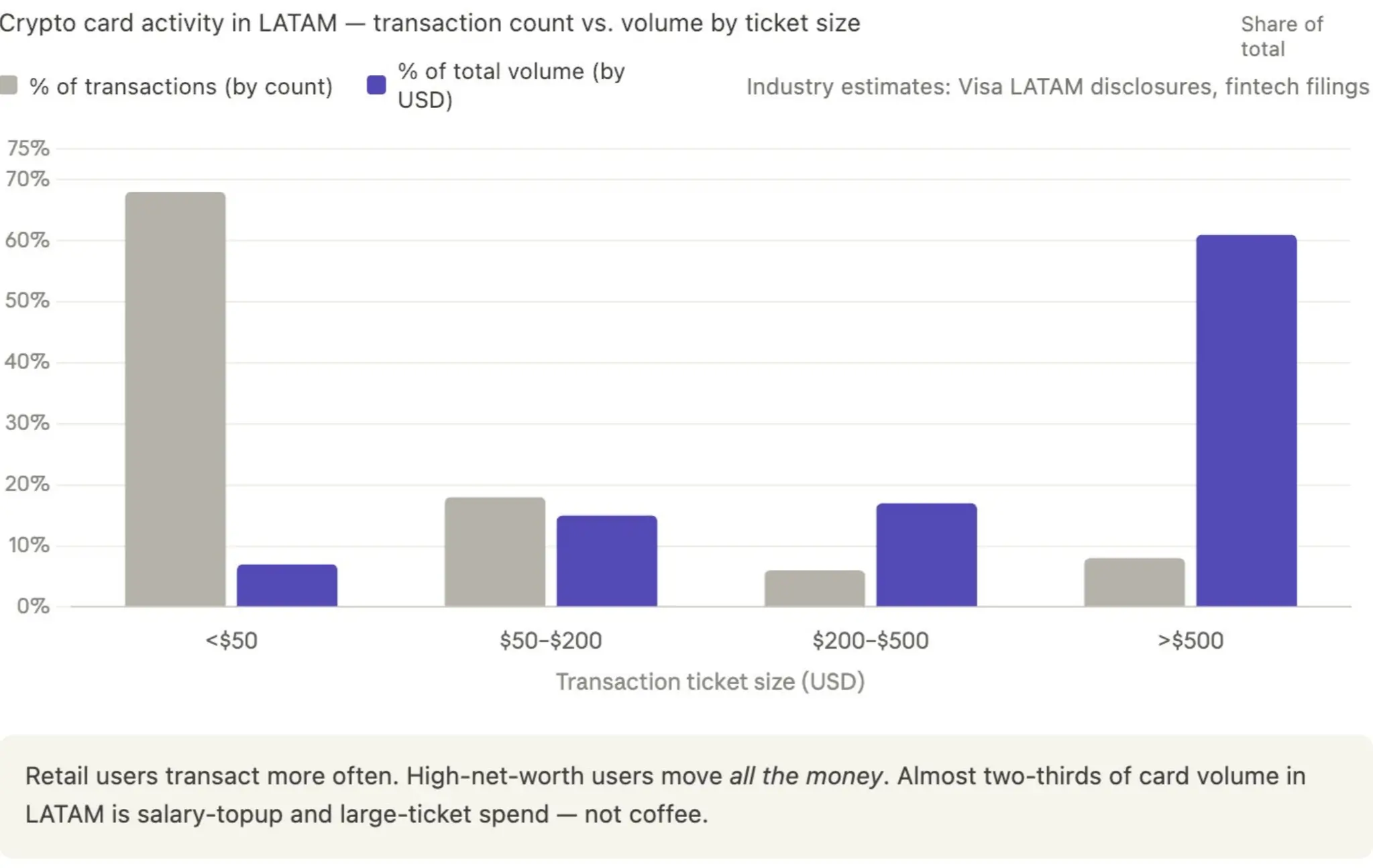
Brazil received about $5 billion in personal inbound remittances in 2024 (Central Bank of Brazil data), with the proportion arriving in stablecoin form rising rapidly, as employers pay in USDC or USDT to avoid FX friction. Latin American crypto card transaction volume is highly concentrated in amounts over $500, which is typical for professional salary top-ups, not retail spending.

2. QR Codes Are Eating the Next Decade

Everyone is competing on issuing cards, on user acquisition. They're missing the structural shift happening underneath.

In emerging markets, QR code payments are quietly taking over the entire payment market. Brazil's Pix now processes over 6 billion transactions monthly. Argentina is covered with Mercado Pago QR codes. Peru has Yape and Plin. Mexico has CoDi. Merchants don't need POS terminals, customers don't need cards.

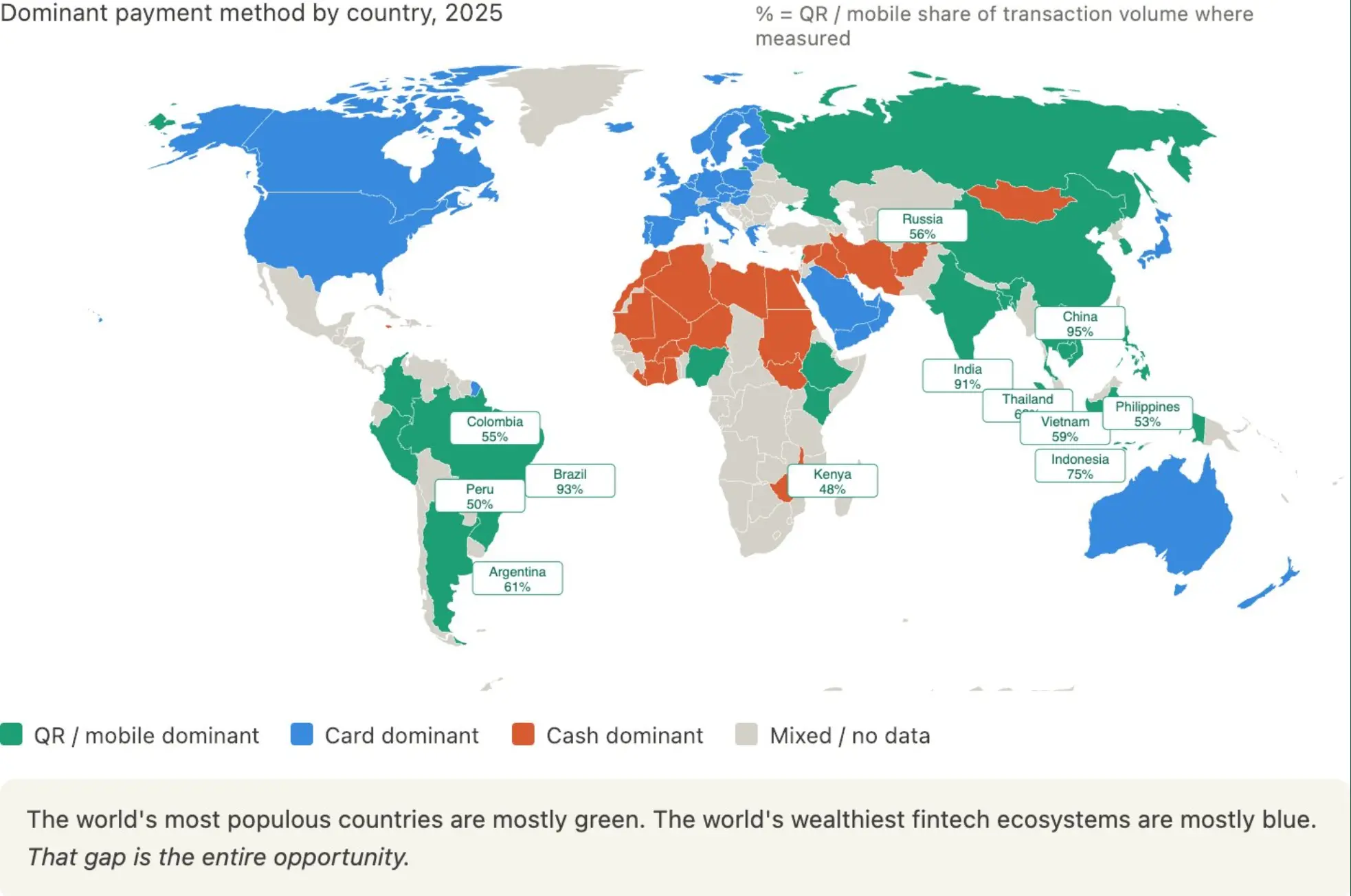
This isn't just a Latin American story. Look at the map of global payment dominance:

→ Brazil: 93% QR code. Pix dominates.
→ China: 95% QR code. Alipay and WeChat Pay have essentially flattened cards.
→ India: 91% QR code. UPI processes more transactions than all US card networks combined.
→ Indonesia: 75%. Thailand: 62%. Argentina: 61%. Vietnam: 59%. Colombia: 55%. Philippines: 53%. Peru: 50%.

Meanwhile, the US, Canada, Western Europe, and Australia remain card-dominated. Most of Africa and the Middle East remain cash-dominated.

One thing most Western fintech practitioners overlook: QR code payments are already the dominant payment method for the majority of the world's population. Card-dominated markets are becoming a shrinking minority, and these are precisely where venture capital, payment company HQs, and most fintech Twitter users are located.

The world's most populous countries are mostly green (QR code), the world's richest fintech ecosystems are mostly blue (cards). This gap is where all the opportunity lies.
Bringing the focus back to Brazil. Pix processed over $3 trillion in transaction volume in 2024, used by about 80% of Brazilian adults. Pix transaction volume already surpassed the sum of credit and debit cards in 2023, and the gap is widening. Mexico's CoDi grew 67% year-over-year in 2024. Argentina's Transferencias 3.0 transaction volume doubled in the same year.
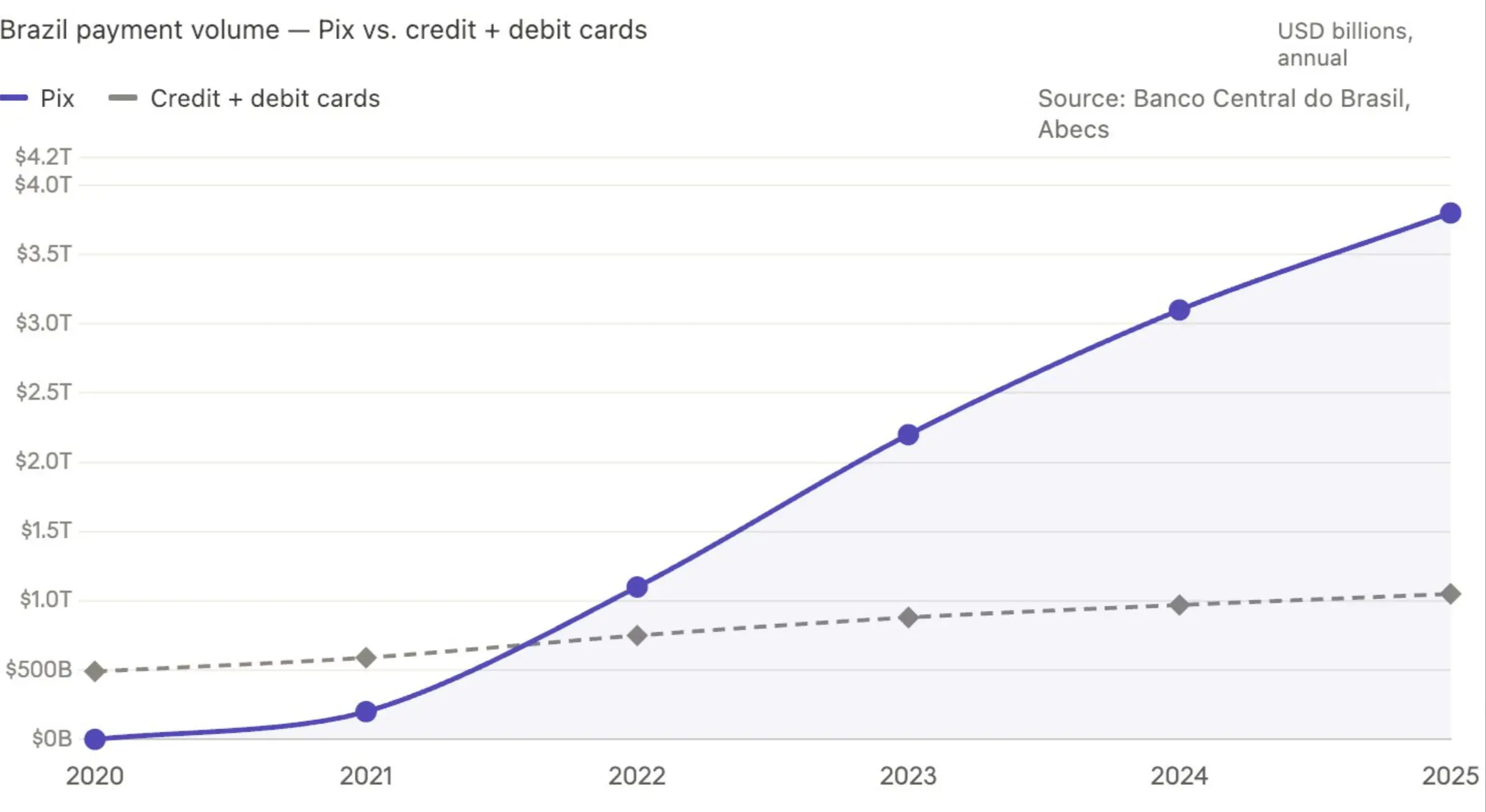
The logic of crypto cards assumes that the Visa and Mastercard card network rails will always be the main settlement layer in emerging markets. But the data says that's no longer the case. And this gap is widening faster than card networks can reinvent themselves.

If you're building a crypto card for emerging market users in 2026, your competitor isn't other crypto cards, but those payment rails that don't require a card at all.

3. The Biggest Unbuilt Opportunity in Payments

Visa and Mastercard unified the fragmentation of card networks, but didn't solve the fragmentation for merchants. Not every small merchant can afford a POS terminal. The cost of acquiring just doesn't make sense for a fruit stand.

QR codes and scan-to-pay solved the "last mile" within each country. Brazil's Pix, Mexico's SPEI, Peru's Yape, each dominates domestically.

But internationally, it's still fragmented. As a foreigner, you effectively have only two choices:

Choice A: Use a Visa or Mastercard to withdraw cash from an ATM. Cost: FX markup, fees, and you can only pay with cash.

Choice B: Download a local app. Link a card, do KYC verification. Cost: 3% to 5% FX loss, takes days, and only works in that one country.

Both paths end the same: you can only pay within that country. Change countries, it all resets, start over.
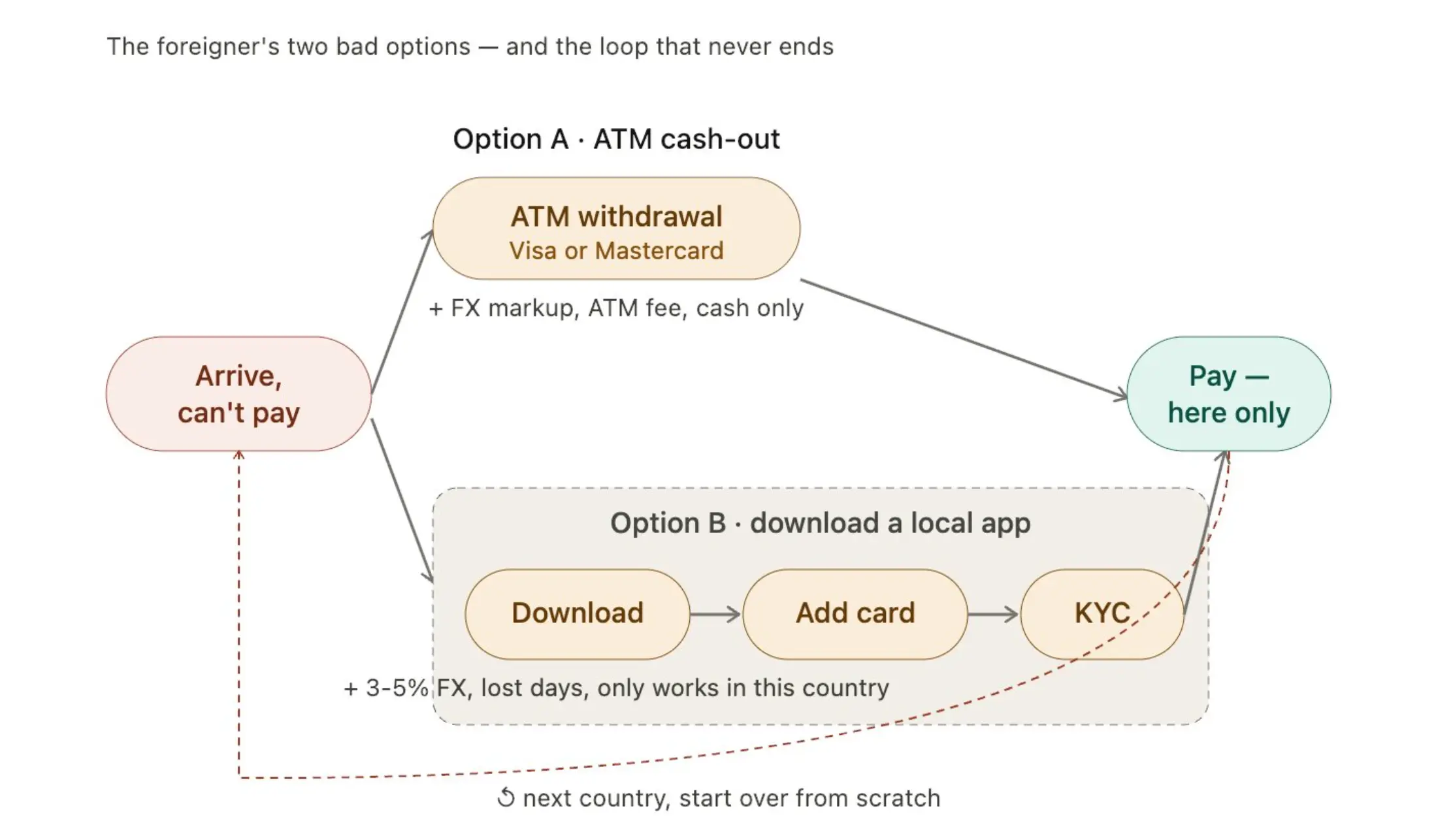
One rainy night, sitting in a bar in Brazil as a foreigner wanting to order an espresso martini, my Pix didn't work. My non-Brazilian wallet couldn't talk to the bar's POS (they only accept local payments). The layer of "international interoperability" between countries' instant payment systems doesn't exist yet.
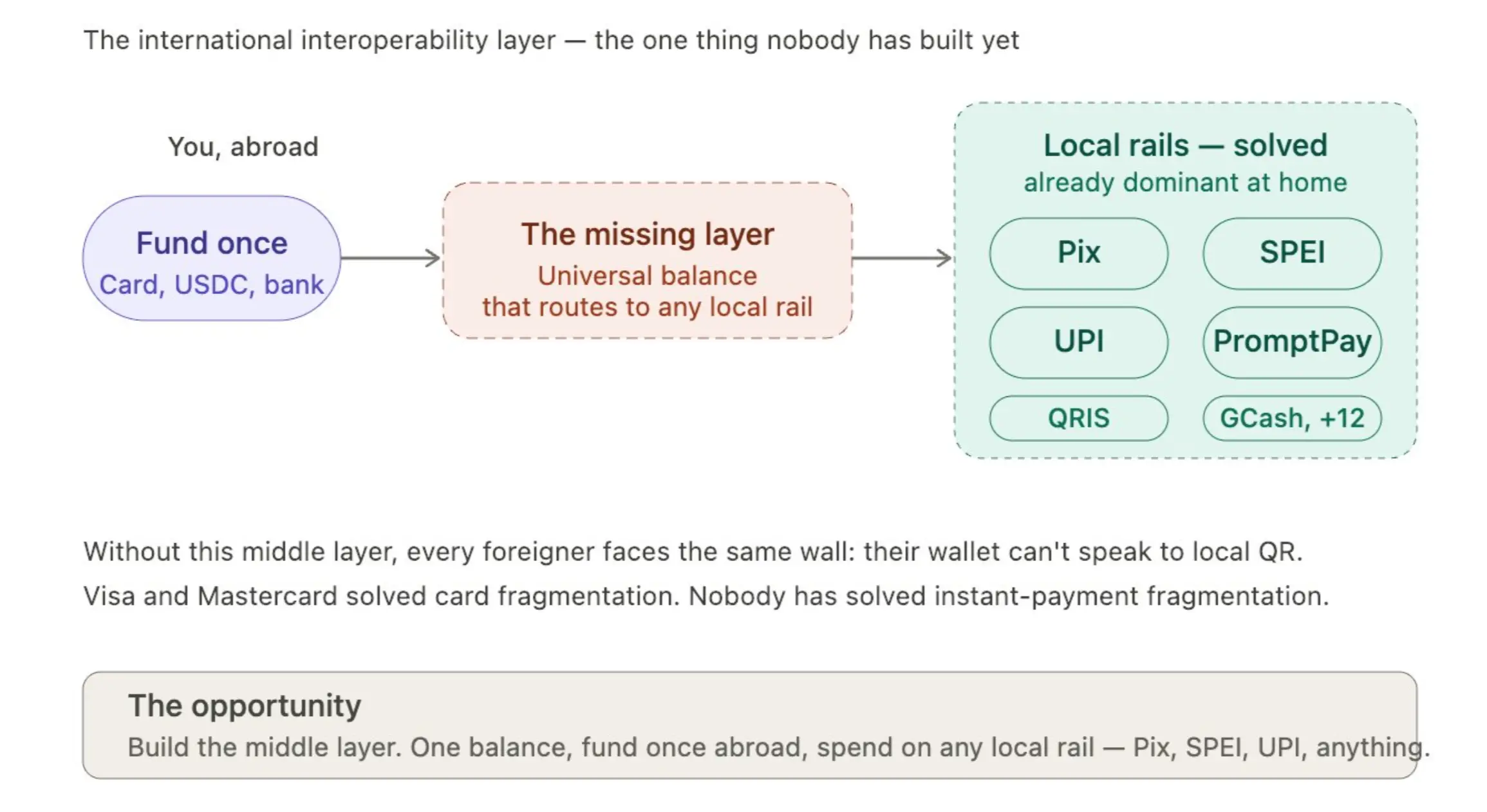
This is one of the biggest unbuilt opportunities in payments.

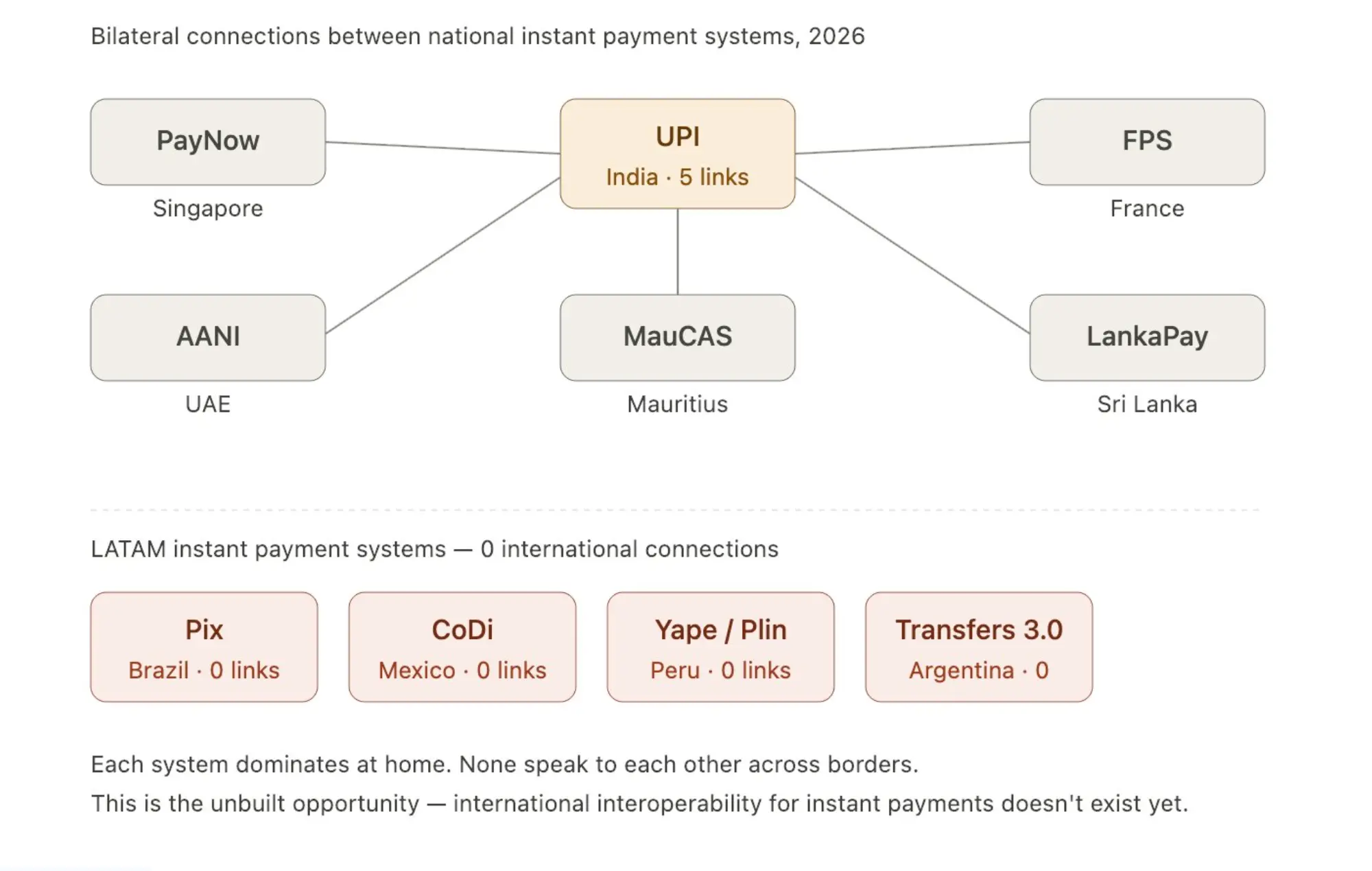
India's UPI already has bilateral connections with Singapore (PayNow), UAE (AANI), France, Sri Lanka, Mauritius. Meanwhile, Latin America's instant payment systems are almost entirely unconnected internationally. The Bank for International Settlements (BIS) Nexus project is working on this, but multilateral interoperability won't happen before 2027.
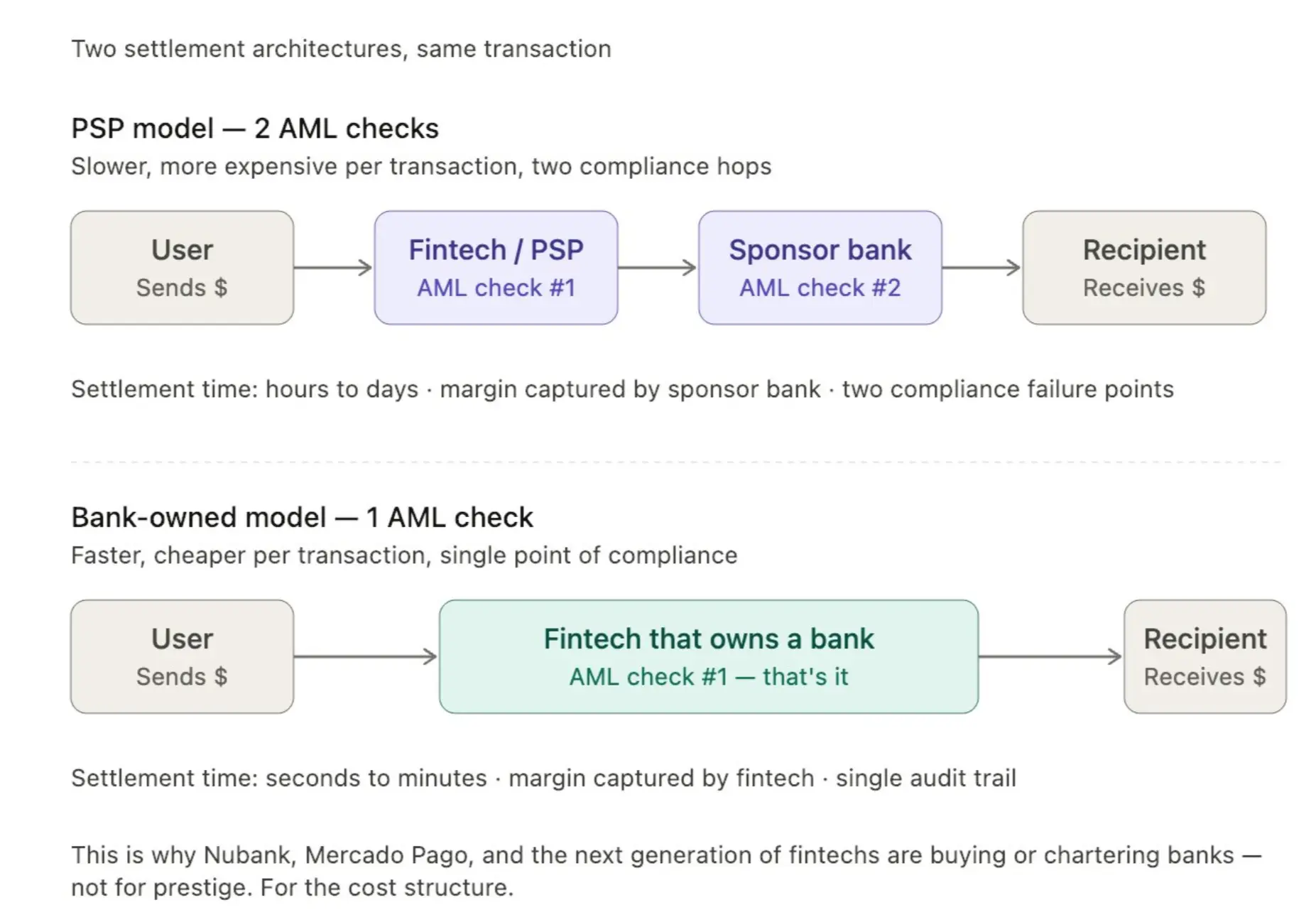
4. Payment Competition Is No Longer About Acquiring Users, It's About Owning Settlement

Most companies integrate a PSP (Payment Service Provider), letting the PSP shoulder the compliance and AML burden. At small scale, this model works.

But leading payment companies are now starting to buy banks directly. Why? Because owning a bank means doing AML checks only once per transaction, not twice. Settlement is faster, profits are earned not rented.

Hence you see Nubank's moves into banking, the wave of Brazilian fintechs acquiring small banks, and several stablecoin companies quietly applying for banking licenses.

Brazil now has over 1,400 licensed payment institutions, over 90 chartered banks. The model of "fintech with a banking license" is growing 3x faster than pure-PSP fintechs (Central Bank of Brazil 2024 data). In Mexico, just having an IFPE license is no longer enough; top players are seeking SOFOM or full banking licenses for cost reasons.
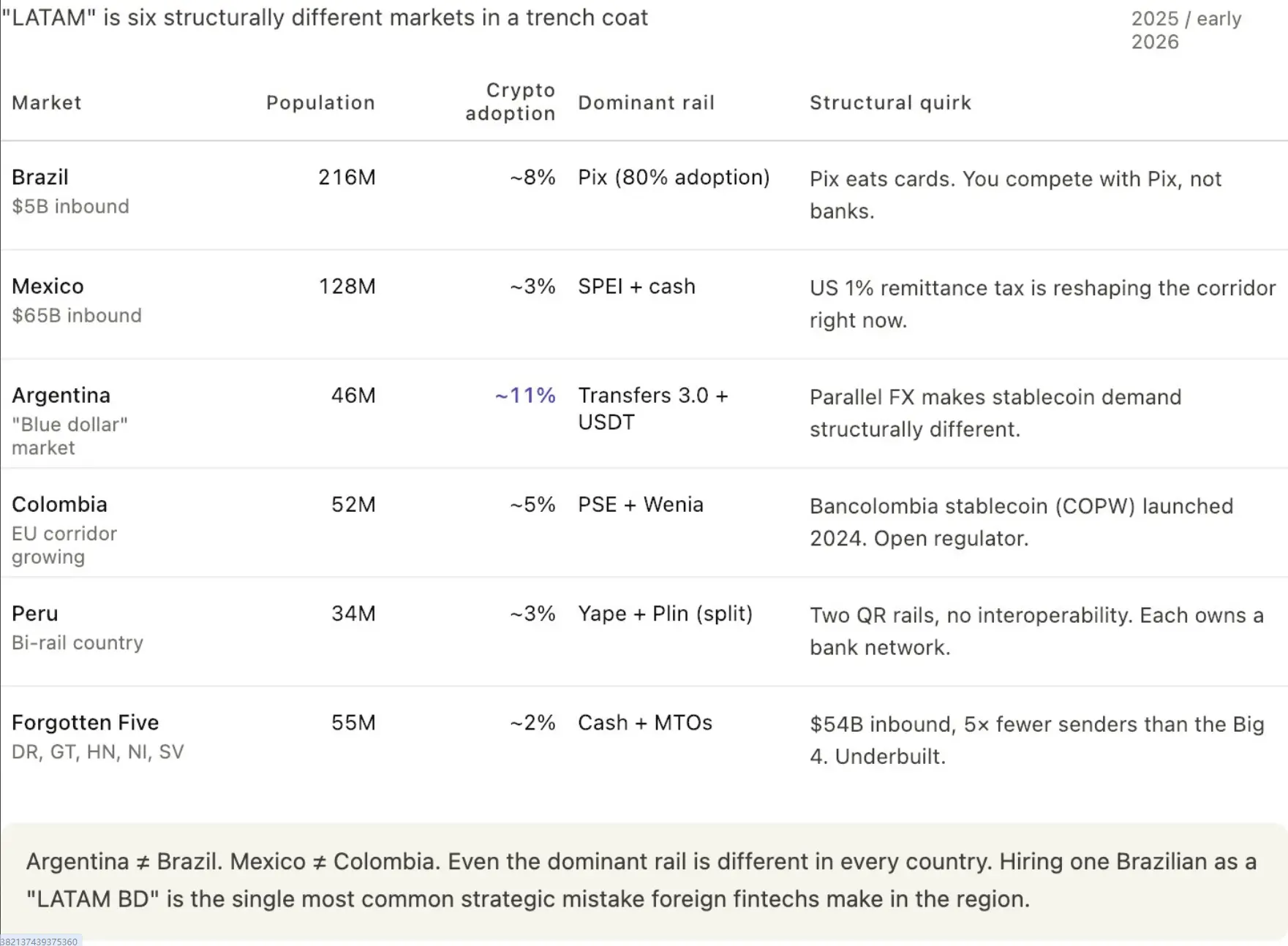
5. "Latin America" Is Not One Market

Most companies hire a Brazilian as a "Latin America BD" or community manager. This is a mistake.

Argentina is a big market, the transaction volume there is real. And because of history, culture, and football rivalry, Argentinians and Brazilians don't really get along, sometimes calling each other "monkeys" (both ways). Each country has its own currency logic, its own informal economy patterns, its own diaspora groups, its own history of capital controls.

If you can't tell the difference between Argentina's capital controls, Brazil's parallel exchange rate, and the Mexican peso's free float, you can't do Latin American payments.

Worth noting data: Argentina's population is only 46 million, yet it has over 5 million crypto users (~11% penetration, among the highest globally). Argentina's parallel FX market ("Blue Dollar") creates a structurally different demand for stablecoins than Brazil.

Mexico's remittance flow ($65 billion annually) is the world's second largest, but is being squeezed by both a US 1% remittance tax (passed Summer 2025) and tighter dollar supply from the Mexican central bank.
6. Neobanks Are Pivoting to Become FX

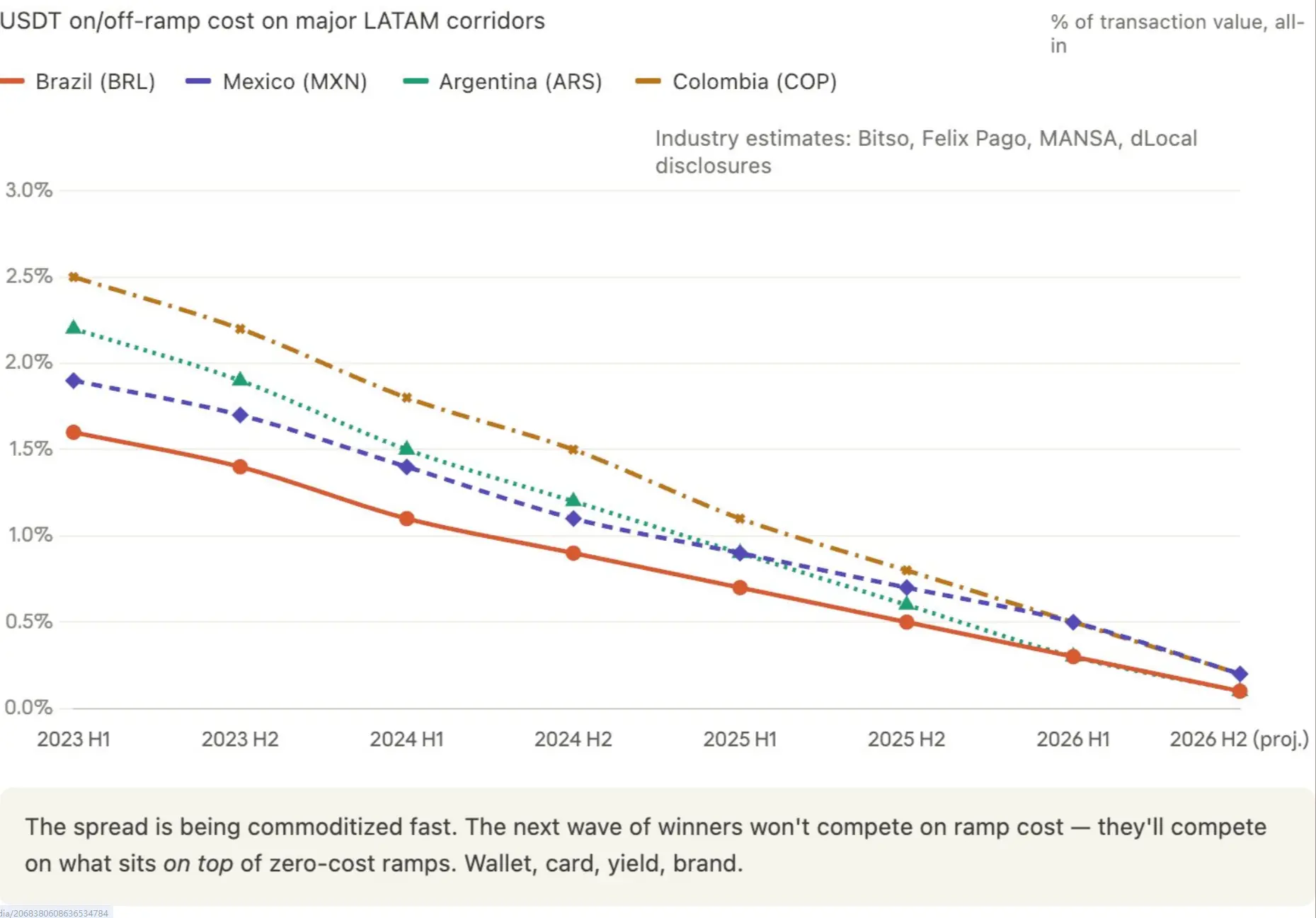
That stablecoin conference held in Mexico City this year was essentially a remittance and FX conference. Money from different countries was flowing cross-border, and that flow is being commoditized, becoming a price war.

Margins are approaching zero. My prediction: Within the next 6 to 12 months, the cost of converting between USD and USDT will drop to zero on major LatAm corridors. Companies trying to make money on spreads will find themselves squeezed by infrastructure players who treat conversion as a loss leader for bigger products.

From July 2023 to June 2024, stablecoin transaction volume in Latin America was approximately $415 billion (Chainalysis data). Currently, about 71% of LatAm institutions use stablecoins for cross-border payments (Fireblocks 2025 data).

Cross-border stablecoin transfer costs dropped from 1.5% to 2% in 2023 to 0.3% to 0.8% in 2025. Cost compression is accelerating, with Bitso, Felix Pago, and a dozen smaller players racing to drive spreads to zero.
7. Cross-Border Expansion Is the New Frontier

Classic payments advice is: Pick a remittance corridor, go deep. Build relationships, get licenses, lock in merchants, become the default.

This advice is breaking down. VCs are telling me payments have become hard to invest in because of over-localization. Every company goes deep in one country, takes local profits, but then can't get out. They become kings of one corridor but can't be invested in as a cross-regional brand.

The next generation of payment companies needs international brand recognition from day one, with tech stacks that can scale cross-border. This is a generational shift in what fintech considers "good."

Stripe's over $90 billion valuation comes from cross-corridor expansion, not single-corridor depth.

Nubank's expansion to Mexico, Colombia, and now eyeing Argentina is precisely this multi-country play that unlocked its valuation, not just its depth in Brazil.

DollarAPP recently started entering Brazil too. Most down-round financings among LatAm fintechs between 2024 and 2025 happened to companies focused on a single country.

8. Brazil and Mexico Are Red Oceans

I spoke with Piero del Risco about the "Forgotten Five."

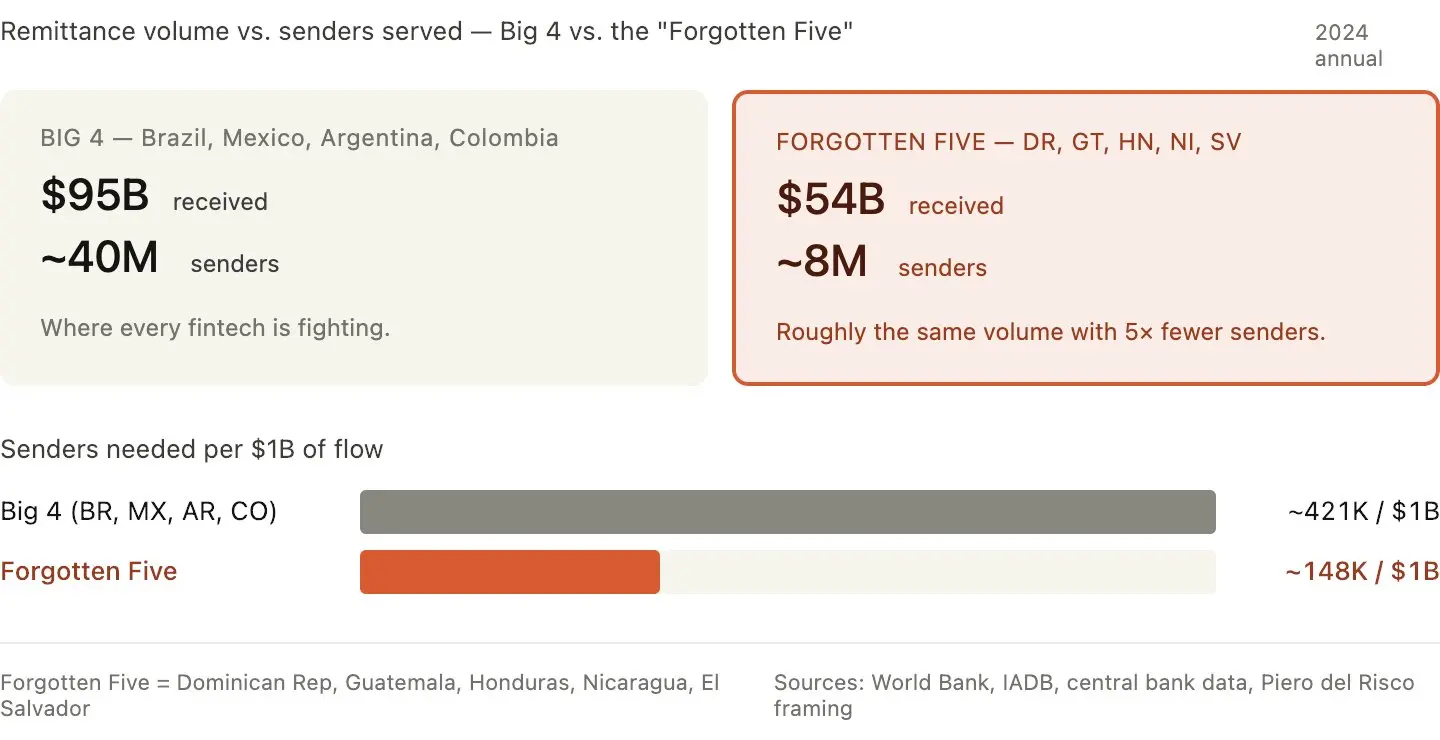
"Think about it: Dominican Republic, Guatemala, Honduras, Nicaragua, and El Salvador collectively receive about $60 billion in remittances. That's roughly equal to the total of Brazil, Mexico, Argentina, and other major markets combined. But serving these 'Forgotten Five' are only 8 million remittance senders, while serving the big markets are 40 million. We moved upstream, becoming program managers in the US, thus gaining a regulatory moat, providing banking services to senders at the top of the funnel, and owning the payment rails in each country downstream."

It's not just these five; there are a few small countries with a small but concentrated group of senders in the US receiving money equal to the entire "big" market. Everyone is fighting for Brazil and Mexico; almost no one is seriously building infrastructure for Guatemala or Honduras. With the same transaction volume, competition density here is 5x lower.

A few other overlooked corridors I'm watching:

Colombia → Europe (Spain, Italy, Netherlands)
Argentina → Bolivia (small but extremely concentrated)
Venezuela → Colombia (largest non-US LatAm corridor)

Guatemala received $20.3 billion in remittances in 2024 (15% of GDP). Other countries: Honduras $9.7b, El Salvador $8.6b, Nicaragua $4.8b, Dominican Republic $10.2b. Total $53.6 billion, about 33% of all LatAm remittances. Their combined population is less than a quarter of Brazil and Mexico's, with almost no fintech competition.

Cost per remittance for the "Forgotten Five" is also higher (6.5% to 8%, vs LatAm average of 6%), meaning more margin to capture.
9. Marketing Budgets Should Be Spent on the Right Places

Take Brazil as an example.

Every fintech pitching "Brazil" treats it as one user group. It's not. This country has at least five different money-flow segments, each requiring a different product, messaging, and payment rail. If you can't draw your user's money flow on a napkin, you're spending your marketing budget on the wrong people.

Here are the five segments I mapped on the ground:
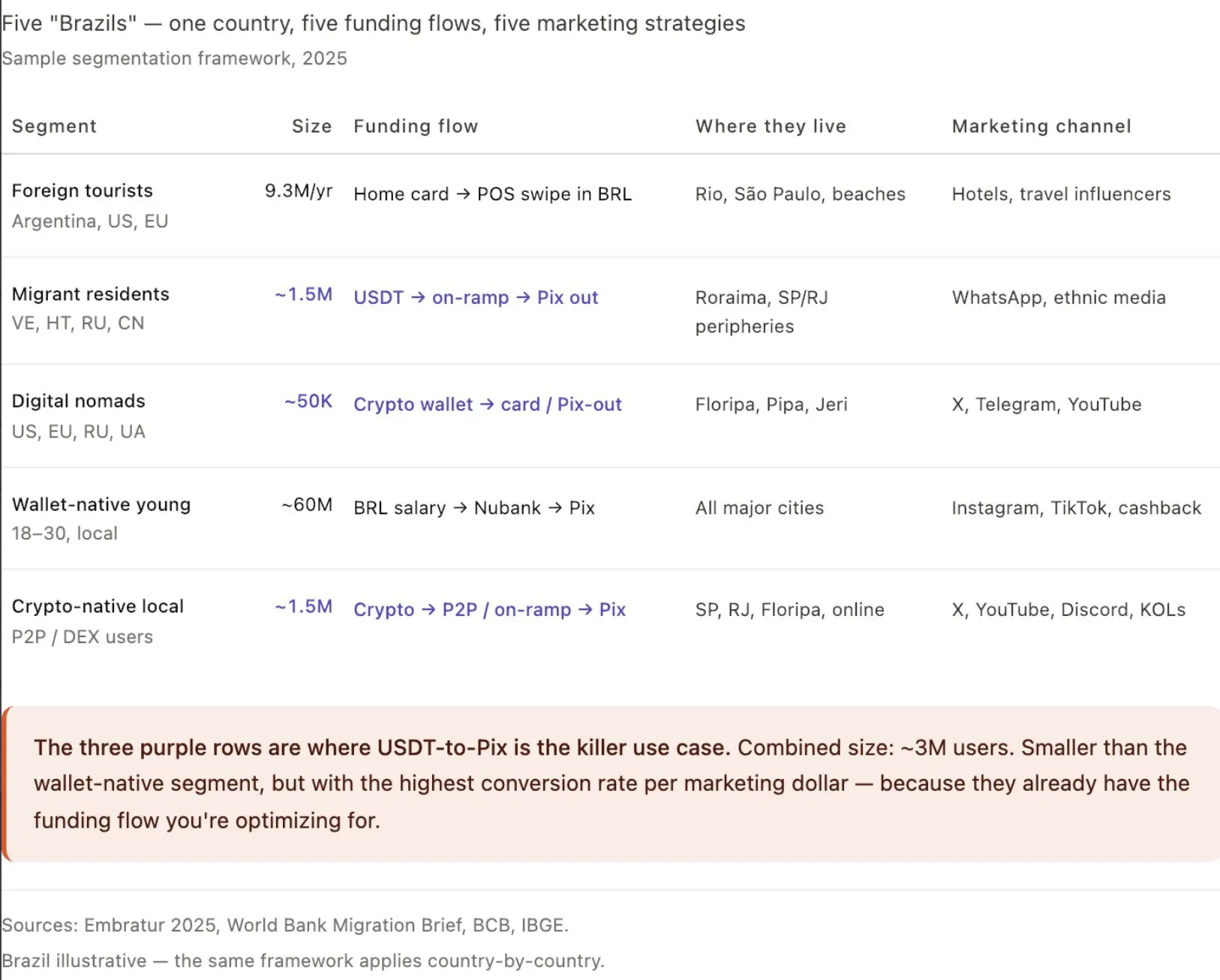
Segment 1: Foreign tourists. 9.3 million people in 2025, total spend $7.9 billion (~$847 per capita).

Main sources: Argentina 3.4 million (price-sensitive, love beaches), Chile 800k (high-value), US 760k (high-spending), followed by Paraguay, Uruguay, France, Portugal, Germany.

Their money flow: home country debit/credit card → swipe on Brazilian POS. They never directly touch BRL.

Effective marketing entry: airport transfers, FX savings vs home bank, one-click payments with no fees for attractions.

Segment 2: Long-term foreign residents without Brazilian bank accounts. Venezuelans (79% of immigrant population in Brazil), Haitians, Bolivians, Russians, Chinese, Syrians, totaling ~1.5 million immigrants. 62% already use digital wallets, not traditional accounts.

Their money flow: international USDT or USD income → conversion → Pix out for BRL spending. This is the highest-value segment for native stablecoin products; USDT to Pix is their killer use case. Zero education cost, direct conversion.

Segment 3: Digital nomads. Concentrated in Florianópolis, Rio, São Paulo, Pipa, Jericoacoara. Mostly Americans, Europeans, Russians, Ukrainians. Income from abroad, often USDT or BTC. Refuse to open Brazilian bank accounts due to bureaucratic hassle.

Money flow: crypto wallet → card spend or Pix out for rent, restaurants, Uber, phone bills. They are not sensitive to FX price, but extremely sensitive to experience. They'll switch providers for one less click.

Segment 4: Brazilian young digital wallet natives. They have "accounts," but with Nubank, Mercado Pago, PicPay, RecargaPay, not Itaú or Bradesco. They don't see themselves as bank customers, but as app users.

Money flow: BRL salary → digital wallet → Pix everywhere. Crypto exposure increasing, but core flow entirely local. Marketing entry is cashback, yield, convenience, not "stablecoin rails."

Segment 5: Crypto-native Brazilians. Hold USDT or BTC, frequent P2P use. Money flow: crypto balance → P2P or conversion → Pix → spending. Brazil has over 1.5 million active crypto users. This is the easiest to convert, but also the smallest.

This is where most fintechs get it wrong: they build one product, run one marketing campaign, targeting all of "Brazil." Result: sky-high CAC because segments 1, 2, 3, 4, 5 require completely different acquisition channels, different messaging, different money rails.

Russian-language YouTube ads targeting digital nomads in Florianópolis have vastly different conversion rates than Portuguese Instagram ads targeting young Brazilians in São Paulo. WhatsApp groups for Venezuelan immigrants in Roraima perform completely differently from US travel influencer partnerships targeting tourists.

After mapping these segments, the framework I use in any Latin American country is:
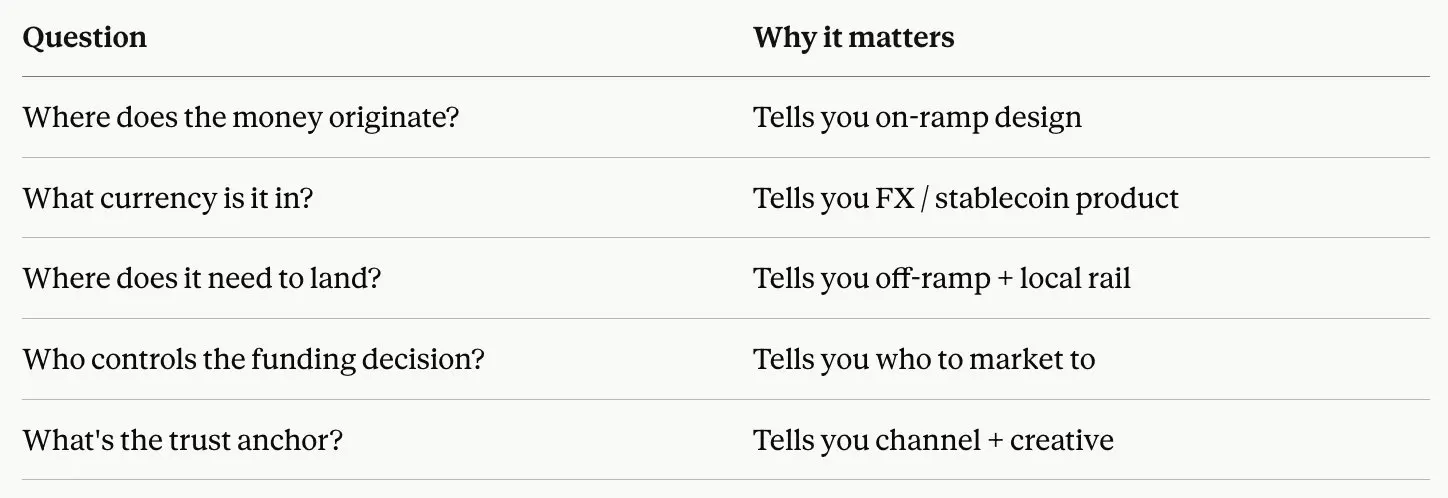
If you can't answer these five questions for each priority segment, you're not ready to spend marketing budget. What you should do is more user research.

The same logic applies to every Latin American country.

This Brazil example can be mapped one-to-one to Mexico (remittance senders from the US, Mexican professionals, US-Mexico cross-border SMEs, crypto-native youth, unbanked rural population), to Argentina (Blue Dollar holders, dollarized salary professionals, crypto-native traders, MercadoPago users, tourist arbitrageurs), and every market in the region.

Don't ask "Should I do Brazil?"

Ask "Which of these five Brazils am I doing?"

That's the only question that turns Latin American expansion into a fundable venture, not a money pit.

10. On Regulation, Latin America Is 5 Years Ahead of the US

Throughout the trip, I spoke with over 10 regulators. The biggest surprise: they aren't phased at all by stablecoins, P2P rails, crypto-fiat interoperability.

The Western narrative about LatAm regulation is "fragmented, slow, behind." But on the ground, it's the opposite. The US is playing catch-up.

Brazil. The central bank built Pix in 18 months and made it free on the payment side—something the Fed is still studying. The crypto regulatory framework is now set: Resolutions 519, 520, 521 issued in November 2025, effective Feb 2, 2026. Hard deadline for existing VASPs to apply for authorization is Oct 30, 2026.

After that, every institution regulated by the Brazilian Central Bank, including every Brazilian bank, every payment processor, every Pix service provider, is prohibited from doing virtual asset business with unlicensed counterparties. Read that sentence again.

This deadline isn't "you need a license," it's "if you don't have a license, every Brazilian bank you work with is legally required to cut ties with you." As of writing, about 4 months left.

Mexico. Mexico passed the Fintech Law in 2018, while the US still has no federal fintech law in 2026. The Mexican Central Bank's IFPE plus remittance licensing framework was built specifically for cross-border digital money flows. The US just passed a 1% federal remittance tax in Summer 2025 (the Big Beautiful Act). Mexican regulators noticed this earlier than US fintech practitioners. Several told me they're adjusting licensing strategy to capture money flows that will circumvent US cash channels.

Colombia. The Financial Superintendency approved Bancolombia's COPW peso stablecoin in 2024, a fully regulated end-to-end commercial bank stablecoin. The Fed hasn't approved a single US bank stablecoin yet.

Argentina. Despite the central bank prohibiting banks from touching crypto in 2022, the new VASP licensing sandbox (launched 2025) is more flexible than New York's BitLicense. Argentine regulators told me directly: "We can't stop dollarization, we can only make it safer." This level of candor is something most US regulators wouldn't have publicly.

Costa Rica and Paraguay. Both are running stablecoin remittance sandboxes, with clearer licensing paths than over 30 US states.

The most surprising part: LatAm regulators aren't trying to slow stablecoin adoption. Several proactively asked me "how can we make it safer for our citizens?" not "how can we stop it?"

This isn't a regulatory environment "behind" the US. It's a regulatory environment ahead of the US; they've moved past the existential debate the US is still stuck in.

If you're doing cross-border in LatAm and still waiting for "regulatory clarity," you've misread the situation. Clarity has been here.

The ambiguity is actually on the US side of the corridor.

In fact, most of these points are the opposite of what I believed before the trip.

The biggest shock for me was point 6. I went to LatAm thinking stablecoins were a structurally high-margin business. The reality seen on the ground is they're already racing to zero.

The winner won't be the one with the best conversion channel, but the one that builds the next layer on top of conversion (wallet, card, yield, brand) the best.

To every taxi driver, bartender, bank manager, and regulator who took the time to explain things to a foreigner with bad Spanish and worse Portuguese.

The wheel on my suitcase will get fixed, eventually.

But what I learned on this trip won't get worn down.

Kripto yang Sedang Tren

Pertanyaan Terkait

QAccording to the article, who are the primary users generating most of the transaction volume for crypto cards in Brazil, and what is their typical use case?

AThe primary users are high-net-worth professionals, not retail users making small daily purchases. The typical use case is a professional receiving their salary in USD or USDT (often from multinational or crypto-native employers), loading it onto a crypto card, and then using Pix to withdraw Brazilian Reais (BRL) to a local bank account when needed. The transaction volume is highly concentrated in amounts over $500, which reflects salary top-ups rather than retail spending.

QWhat major structural shift in payment methods is occurring in emerging markets like Latin America, and why does the author believe this challenges the logic of crypto cards?

AThe major structural shift is the widespread adoption and dominance of QR code-based instant payment systems (like Pix in Brazil, UPI in India, Alipay/WeChat Pay in China). These systems are replacing cards as the primary settlement layer. The author argues that this challenges the logic of crypto cards because their business model assumes Visa/Mastercard networks will remain the dominant rails in emerging markets. However, data shows QR-code systems are processing more volume than cards in many countries, and the gap is widening faster than card networks can adapt. Therefore, the real competition for crypto cards in 2026 is not other cards, but these card-less payment rails.

QWhat does the author identify as one of the biggest unbuilt opportunities in the payments space, based on their experience in Brazil?

AThe author identifies the lack of international interoperability between domestic instant payment systems (like Brazil's Pix, Mexico's CoDi, Peru's Yape) as a major unbuilt opportunity. Currently, a foreigner has no seamless way to pay via these local QR-code systems. The opportunity lies in building a layer that connects these fragmented national systems, allowing cross-border payments to flow as easily as domestic ones, bypassing the high fees and friction of traditional card networks or localized app setups.

QWhy are leading payment companies in Latin America starting to acquire banks directly, according to the article?

ALeading payment companies are acquiring banks to move 'up the stack' from being Payment Service Providers (PSPs) to becoming direct settlement entities. Owning a bank means they only need to perform Anti-Money Laundering (AML) checks once per transaction instead of twice (once for themselves and once for their partner bank). This leads to faster settlement and allows them to retain more profit, as they are earning it directly rather than 'renting' infrastructure. This trend is reflected in the faster growth of 'fintechs with banking licenses' compared to pure PSPs.

QHow does the author's view of Latin American regulatory attitudes towards cryptocurrencies and stablecoins differ from common Western narratives?

AThe author argues that contrary to the Western narrative of Latin American regulators being 'fragmented, slow, and behind,' they are actually ahead of the United States by about five years. Regulators in Brazil, Mexico, Colombia, and Argentina have been more proactive and pragmatic. They have implemented specific frameworks for crypto assets (VASP licenses), launched instant payment systems (Pix), and in some cases, approved bank-issued stablecoins. The author notes that these regulators are not trying to slow crypto adoption but are asking, 'How do we make it safer for our citizens?' This represents a more advanced and settled regulatory stance compared to the ongoing debates and lack of federal clarity in the U.S.

Bacaan Terkait

TechFlow Intel: Peluang IPO Anthropic Lebih dari 80%, Iran Tutup Lagi Selat Hormuz Picu Gejolak Harga Minyak

Market memperkirakan Anthropic akan mengumumkan IPO sebelum November 2026, dengan valuasi yang ditargetkan mencapai triliunan dolar. Namun, pertanyaannya adalah apakah valuasi sebesar itu dapat selaras dengan janji keamanan AI inti mereka. Sementara itu, militer Iran kembali mengumumkan penutupan Selat Hormuz, menyebabkan gejolak harga minyak, meskipun data pelacakan kapal menunjukkan beberapa kapal masih melintas. Di sisi lain, Iran melanjutkan pemuatan minyak di Pulau Kharg, dengan hingga 20 juta barel minyak akan memasuki pasar. Di sektor teknologi, merek-merek mulai menggunakan influencer virtual AI untuk pemasaran produk. Elon Musk berbicara tentang menghabiskan "septillion dolar" untuk penelitian antimateri untuk perjalanan antariksa. Goldman Sachs memperingatkan bahwa belanja modal AI senilai $5,3 triliun mendekati titik jenuh kredit. Cloudflare meluncurkan fitur akun sementara untuk agen AI. Google melaporkan lalu lintas IPv6-nya melebihi 50% untuk pertama kalinya. Hyundai Motor Group berencana mengakuisisi 9,65% saham Boston Dynamics. Di pasar saham, investor ritel membeli saham SpaceX senilai $370 juta dalam tiga hari. Di Eropa, terjadi default ekuitas CLO pasca-krisis pertama, menyalakan alarm di pasar kredit. Garis bawah hari ini: Tiga berita tentang Iran, default CLO Eropa, dan peringatan Goldman Sachs semuanya menunjukkan logika dasar yang sama: likuiditas global sedang menyempit dan biaya marginal meningkat di berbagai sektor. Namun, pada saat yang sama, modal masih mencari narasi baru, seperti yang terlihat pada rencana IPO Anthropic, antusiasme ritel terhadap SpaceX, dan visi antimateri Musk.

marsbit12j yang lalu

TechFlow Intel: Peluang IPO Anthropic Lebih dari 80%, Iran Tutup Lagi Selat Hormuz Picu Gejolak Harga Minyak

marsbit12j yang lalu

Pemburu Jadi Mangsa, MEV Bot yang Paling Cuan Diretas

Penyerang MEV Bot yang Terkenal, Jaredfromsubway.eth, Kehilangan Lebih dari $7,5 Juta dalam Serangan 'Perangkap Madu'. Alamat MEV Bot Ethereum yang terkenal dan sangat aktif, Jaredfromsubway.eth, mengalami serangan rantai yang sangat bertarget pada hari Sabtu, yang mengakibatkan kerugian lebih dari $7,5 juta. Menurut investigasi Blockaid, serangan ini bukanlah serangan phishing tradisional atau eksploitasi kerentanan kontrak pintar, melainkan serangan 'perangkap madu MEV balik' (counter-MEV honeypot attack) yang dirancang khusus untuk mengeksploitasi logika perilaku MEV Bot. Penyerang telah menyebarkan 66 kontrak token palsu dan kumpulan likuiditas palsu selama beberapa minggu sebelumnya. Aset-aset ini disamarkan sebagai aset stabil utama seperti WETH, USDC, dan USDT, dan membangun jalur perdagangan arbitrase yang tampak nyata. Rantai serangan berkembang: kumpulan likuiditas palsu menciptakan sinyal 'kesenjangan harga yang dapat diarbitrase'; bot MEV secara otomatis mengidentifikasi peluang dan mengeksekusi perdagangan; bot memberikan otorisasi ke kontrak bantu yang dikendalikan penyerang selama proses perdagangan; otorisasi ini tidak dicabut tepat waktu, menciptakan paparan izin yang terus-menerus; akhirnya, penyerang memanggil logika 'pintu belakang' yang telah dipasang sebelumnya dalam satu transaksi, secara langsung mentransfer aset ETH, USDC, dan USDT yang dipegang oleh alamat MEV bot tersebut. Jaredfromsubway.eth adalah salah satu bot MEV paling aktif dan menguntungkan di jaringan Ethereum, yang terkenal karena menjalankan serangan 'sandwich' secara sistematis untuk menangkap keuntungan dari pergerakan harga. Cointelegraph Research menunjukkan bahwa sekitar 70% dari sekitar 60.000 hingga 90.000 serangan sandwich bulanan di Ethereum antara November 2024 dan Oktober 2025 terkait dengan strateginya. Diperkirakan bot ini telah menghasilkan puluhan juta dolar AS. Peristiwa ini menjadi peringatan keras tentang meningkatnya ancaman keamanan di ekosistem crypto. Bahkan pemain tingkat atas seperti Jaredfromsubway.eth, yang biasanya berada di sisi 'predator', kini menjadi target dari serangan canggih yang mengeksploitasi logika operasional otomatis mereka sendiri. Selain itu, setelah peretasan, sebuah akun X tidak dikenal dengan 94.000 pengikut mengubah namanya menjadi Jaredfromsubway.eth dan secara palsu mengklaim akan menawarkan hadiah $1 juta untuk pengembalian dana, memicu peringatan dari pengembang agar pengguna tetap waspada terhadap kemungkinan penipuan.

marsbit13j yang lalu

Pemburu Jadi Mangsa, MEV Bot yang Paling Cuan Diretas

marsbit13j yang lalu

Trading

Spot
Futures

Artikel Populer

Apa Itu $S$

Memahami SPERO: Tinjauan Komprehensif Pengenalan SPERO Seiring dengan perkembangan lanskap inovasi, munculnya teknologi web3 dan proyek cryptocurrency memainkan peran penting dalam membentuk masa depan digital. Salah satu proyek yang telah menarik perhatian di bidang dinamis ini adalah SPERO, yang dilambangkan sebagai SPERO,$$s$. Artikel ini bertujuan untuk mengumpulkan dan menyajikan informasi terperinci tentang SPERO, untuk membantu para penggemar dan investor memahami dasar-dasar, tujuan, dan inovasi dalam domain web3 dan crypto. Apa itu SPERO,$$s$? SPERO,$$s$ adalah proyek unik dalam ruang crypto yang berusaha memanfaatkan prinsip desentralisasi dan teknologi blockchain untuk menciptakan ekosistem yang mendorong keterlibatan, utilitas, dan inklusi finansial. Proyek ini dirancang untuk memfasilitasi interaksi peer-to-peer dengan cara baru, memberikan pengguna solusi dan layanan keuangan yang inovatif. Pada intinya, SPERO,$$s$ bertujuan untuk memberdayakan individu dengan menyediakan alat dan platform yang meningkatkan pengalaman pengguna dalam ruang cryptocurrency. Ini termasuk memungkinkan metode transaksi yang lebih fleksibel, mendorong inisiatif yang dipimpin komunitas, dan menciptakan jalur untuk peluang finansial melalui aplikasi terdesentralisasi (dApps). Visi mendasar dari SPERO,$$s$ berputar di sekitar inklusivitas, bertujuan untuk menjembatani kesenjangan dalam keuangan tradisional sambil memanfaatkan manfaat teknologi blockchain. Siapa Pencipta SPERO,$$s$? Identitas pencipta SPERO,$$s$ tetap agak samar, karena ada sumber daya publik yang terbatas yang memberikan informasi latar belakang terperinci tentang pendiriannya. Kurangnya transparansi ini dapat berasal dari komitmen proyek terhadap desentralisasi—sebuah etos yang banyak proyek web3 bagi, memprioritaskan kontribusi kolektif di atas pengakuan individu. Dengan memusatkan diskusi di sekitar komunitas dan tujuan kolektifnya, SPERO,$$s$ mewujudkan esensi pemberdayaan tanpa menonjolkan individu tertentu. Dengan demikian, memahami etos dan misi SPERO tetap lebih penting daripada mengidentifikasi pencipta tunggal. Siapa Investor SPERO,$$s$? SPERO,$$s$ didukung oleh beragam investor mulai dari modal ventura hingga investor malaikat yang berdedikasi untuk mendorong inovasi di sektor crypto. Fokus investor ini umumnya sejalan dengan misi SPERO—memprioritaskan proyek yang menjanjikan kemajuan teknologi sosial, inklusivitas finansial, dan tata kelola terdesentralisasi. Fondasi investor ini biasanya tertarik pada proyek yang tidak hanya menawarkan produk inovatif tetapi juga memberikan kontribusi positif kepada komunitas blockchain dan ekosistemnya. Dukungan dari investor ini memperkuat SPERO,$$s$ sebagai pesaing yang patut diperhitungkan di domain proyek crypto yang berkembang pesat. Bagaimana SPERO,$$s$ Bekerja? SPERO,$$s$ menerapkan kerangka kerja multi-faceted yang membedakannya dari proyek cryptocurrency konvensional. Berikut adalah beberapa fitur kunci yang menekankan keunikan dan inovasinya: Tata Kelola Terdesentralisasi: SPERO,$$s$ mengintegrasikan model tata kelola terdesentralisasi, memberdayakan pengguna untuk berpartisipasi aktif dalam proses pengambilan keputusan mengenai masa depan proyek. Pendekatan ini mendorong rasa kepemilikan dan akuntabilitas di antara anggota komunitas. Utilitas Token: SPERO,$$s$ memanfaatkan token cryptocurrency-nya sendiri, yang dirancang untuk melayani berbagai fungsi dalam ekosistem. Token ini memungkinkan transaksi, hadiah, dan fasilitasi layanan yang ditawarkan di platform, meningkatkan keterlibatan dan utilitas secara keseluruhan. Arsitektur Berlapis: Arsitektur teknis SPERO,$$s$ mendukung modularitas dan skalabilitas, memungkinkan integrasi fitur dan aplikasi tambahan secara mulus seiring dengan perkembangan proyek. Kemampuan beradaptasi ini sangat penting untuk mempertahankan relevansi di lanskap crypto yang selalu berubah. Keterlibatan Komunitas: Proyek ini menekankan inisiatif yang dipimpin komunitas, menggunakan mekanisme yang memberikan insentif untuk kolaborasi dan umpan balik. Dengan memelihara komunitas yang kuat, SPERO,$$s$ dapat lebih baik memenuhi kebutuhan pengguna dan beradaptasi dengan tren pasar. Fokus pada Inklusi: Dengan menawarkan biaya transaksi yang rendah dan antarmuka yang ramah pengguna, SPERO,$$s$ bertujuan untuk menarik basis pengguna yang beragam, termasuk individu yang mungkin sebelumnya tidak terlibat dalam ruang crypto. Komitmen ini terhadap inklusi sejalan dengan misi utamanya untuk memberdayakan melalui aksesibilitas. Garis Waktu SPERO,$$s$ Memahami sejarah proyek memberikan wawasan penting tentang trajektori dan tonggak perkembangannya. Berikut adalah garis waktu yang disarankan yang memetakan peristiwa signifikan dalam evolusi SPERO,$$s$: Fase Konseptualisasi dan Ideasi: Ide awal yang membentuk dasar SPERO,$$s$ dikembangkan, sangat selaras dengan prinsip desentralisasi dan fokus komunitas dalam industri blockchain. Peluncuran Whitepaper Proyek: Setelah fase konseptual, whitepaper komprehensif yang merinci visi, tujuan, dan infrastruktur teknologi SPERO,$$s$ dirilis untuk menarik minat dan umpan balik komunitas. Pembangunan Komunitas dan Keterlibatan Awal: Upaya jangkauan aktif dilakukan untuk membangun komunitas pengguna awal dan investor potensial, memfasilitasi diskusi seputar tujuan proyek dan mendapatkan dukungan. Acara Generasi Token: SPERO,$$s$ melakukan acara generasi token (TGE) untuk mendistribusikan token asli kepada pendukung awal dan membangun likuiditas awal dalam ekosistem. Peluncuran dApp Awal: Aplikasi terdesentralisasi (dApp) pertama yang terkait dengan SPERO,$$s$ diluncurkan, memungkinkan pengguna untuk terlibat dengan fungsionalitas inti platform. Pengembangan Berkelanjutan dan Kemitraan: Pembaruan dan peningkatan berkelanjutan terhadap penawaran proyek, termasuk kemitraan strategis dengan pemain lain di ruang blockchain, telah membentuk SPERO,$$s$ menjadi pemain yang kompetitif dan berkembang di pasar crypto. Kesimpulan SPERO,$$s$ berdiri sebagai bukti potensi web3 dan cryptocurrency untuk merevolusi sistem keuangan dan memberdayakan individu. Dengan komitmen terhadap tata kelola terdesentralisasi, keterlibatan komunitas, dan fungsionalitas yang dirancang secara inovatif, ia membuka jalan menuju lanskap keuangan yang lebih inklusif. Seperti halnya investasi di ruang crypto yang berkembang pesat, calon investor dan pengguna dianjurkan untuk melakukan riset secara menyeluruh dan terlibat dengan perkembangan yang sedang berlangsung dalam SPERO,$$s$. Proyek ini menunjukkan semangat inovatif industri crypto, mengundang eksplorasi lebih lanjut ke dalam berbagai kemungkinan yang ada. Meskipun perjalanan SPERO,$$s$ masih berlangsung, prinsip-prinsip dasarnya mungkin benar-benar mempengaruhi masa depan cara kita berinteraksi dengan teknologi, keuangan, dan satu sama lain dalam ekosistem digital yang saling terhubung.

85 Total TayanganDipublikasikan pada 2024.12.17Diperbarui pada 2024.12.17

Apa Itu $S$

Apa Itu AGENT S

Agent S: Masa Depan Interaksi Otonom di Web3 Pendahuluan Dalam lanskap Web3 dan cryptocurrency yang terus berkembang, inovasi secara konstan mendefinisikan ulang cara individu berinteraksi dengan platform digital. Salah satu proyek perintis, Agent S, menjanjikan untuk merevolusi interaksi manusia-komputer melalui kerangka agen terbuka. Dengan membuka jalan untuk interaksi otonom, Agent S bertujuan untuk menyederhanakan tugas-tugas kompleks, menawarkan aplikasi transformasional dalam kecerdasan buatan (AI). Eksplorasi mendetail ini akan menyelami seluk-beluk proyek, fitur uniknya, dan implikasinya untuk domain cryptocurrency. Apa itu Agent S? Agent S berdiri sebagai kerangka agen terbuka yang inovatif, dirancang khusus untuk mengatasi tiga tantangan mendasar dalam otomatisasi tugas komputer: Memperoleh Pengetahuan Spesifik Domain: Kerangka ini secara cerdas belajar dari berbagai sumber pengetahuan eksternal dan pengalaman internal. Pendekatan ganda ini memberdayakannya untuk membangun repositori pengetahuan spesifik domain yang kaya, meningkatkan kinerjanya dalam pelaksanaan tugas. Perencanaan Selama Rentang Tugas yang Panjang: Agent S menggunakan perencanaan hierarkis yang ditingkatkan pengalaman, pendekatan strategis yang memfasilitasi pemecahan dan pelaksanaan tugas-tugas rumit dengan efisien. Fitur ini secara signifikan meningkatkan kemampuannya untuk mengelola beberapa subtugas dengan efisien dan efektif. Menangani Antarmuka Dinamis dan Tidak Seragam: Proyek ini memperkenalkan Antarmuka Agen-Komputer (ACI), solusi inovatif yang meningkatkan interaksi antara agen dan pengguna. Dengan memanfaatkan Model Bahasa Besar Multimodal (MLLM), Agent S dapat menavigasi dan memanipulasi berbagai antarmuka pengguna grafis dengan mulus. Melalui fitur-fitur perintis ini, Agent S menyediakan kerangka kerja yang kuat yang mengatasi kompleksitas yang terlibat dalam mengotomatisasi interaksi manusia dengan mesin, membuka jalan untuk berbagai aplikasi dalam AI dan seterusnya. Siapa Pencipta Agent S? Meskipun konsep Agent S secara fundamental inovatif, informasi spesifik tentang penciptanya tetap samar. Pencipta saat ini tidak diketahui, yang menyoroti baik tahap awal proyek atau pilihan strategis untuk menjaga anggota pendiri tetap tersembunyi. Terlepas dari anonimitas, fokus tetap pada kemampuan dan potensi kerangka kerja. Siapa Investor Agent S? Karena Agent S relatif baru dalam ekosistem kriptografi, informasi terperinci mengenai investor dan pendukung keuangannya tidak secara eksplisit didokumentasikan. Kurangnya wawasan yang tersedia untuk umum mengenai fondasi investasi atau organisasi yang mendukung proyek ini menimbulkan pertanyaan tentang struktur pendanaannya dan peta jalan pengembangannya. Memahami dukungan sangat penting untuk mengukur keberlanjutan proyek dan potensi dampak pasar. Bagaimana Cara Kerja Agent S? Di inti Agent S terletak teknologi mutakhir yang memungkinkannya berfungsi secara efektif dalam berbagai pengaturan. Model operasionalnya dibangun di sekitar beberapa fitur kunci: Interaksi Komputer yang Mirip Manusia: Kerangka ini menawarkan perencanaan AI yang canggih, berusaha untuk membuat interaksi dengan komputer lebih intuitif. Dengan meniru perilaku manusia dalam pelaksanaan tugas, ia menjanjikan untuk meningkatkan pengalaman pengguna. Memori Naratif: Digunakan untuk memanfaatkan pengalaman tingkat tinggi, Agent S memanfaatkan memori naratif untuk melacak sejarah tugas, sehingga meningkatkan proses pengambilan keputusannya. Memori Episodik: Fitur ini memberikan panduan langkah demi langkah kepada pengguna, memungkinkan kerangka untuk menawarkan dukungan kontekstual saat tugas berlangsung. Dukungan untuk OpenACI: Dengan kemampuan untuk berjalan secara lokal, Agent S memungkinkan pengguna untuk mempertahankan kontrol atas interaksi dan alur kerja mereka, sejalan dengan etos terdesentralisasi Web3. Integrasi Mudah dengan API Eksternal: Versatilitas dan kompatibilitasnya dengan berbagai platform AI memastikan bahwa Agent S dapat dengan mulus masuk ke dalam ekosistem teknologi yang ada, menjadikannya pilihan menarik bagi pengembang dan organisasi. Fungsionalitas ini secara kolektif berkontribusi pada posisi unik Agent S dalam ruang kripto, saat ia mengotomatisasi tugas-tugas kompleks yang melibatkan banyak langkah dengan intervensi manusia yang minimal. Seiring proyek ini berkembang, aplikasi potensialnya di Web3 dapat mendefinisikan ulang bagaimana interaksi digital berlangsung. Garis Waktu Agent S Pengembangan dan tonggak Agent S dapat dirangkum dalam garis waktu yang menyoroti peristiwa pentingnya: 27 September 2024: Konsep Agent S diluncurkan dalam sebuah makalah penelitian komprehensif berjudul “Sebuah Kerangka Agen Terbuka yang Menggunakan Komputer Seperti Manusia,” yang menunjukkan dasar untuk proyek ini. 10 Oktober 2024: Makalah penelitian tersebut dipublikasikan secara terbuka di arXiv, menawarkan eksplorasi mendalam tentang kerangka kerja dan evaluasi kinerjanya berdasarkan tolok ukur OSWorld. 12 Oktober 2024: Sebuah presentasi video dirilis, memberikan wawasan visual tentang kemampuan dan fitur Agent S, lebih lanjut melibatkan pengguna dan investor potensial. Tanda-tanda dalam garis waktu ini tidak hanya menggambarkan kemajuan Agent S tetapi juga menunjukkan komitmennya terhadap transparansi dan keterlibatan komunitas. Poin Kunci Tentang Agent S Seiring kerangka Agent S terus berkembang, beberapa atribut kunci menonjol, menekankan sifat inovatif dan potensinya: Kerangka Inovatif: Dirancang untuk memberikan penggunaan komputer yang intuitif seperti interaksi manusia, Agent S membawa pendekatan baru untuk otomatisasi tugas. Interaksi Otonom: Kemampuan untuk berinteraksi secara otonom dengan komputer melalui GUI menandakan lompatan menuju solusi komputasi yang lebih cerdas dan efisien. Otomatisasi Tugas Kompleks: Dengan metodologinya yang kuat, ia dapat mengotomatisasi tugas-tugas kompleks yang melibatkan banyak langkah, membuat proses lebih cepat dan kurang rentan terhadap kesalahan. Perbaikan Berkelanjutan: Mekanisme pembelajaran memungkinkan Agent S untuk belajar dari pengalaman masa lalu, terus meningkatkan kinerja dan efektivitasnya. Versatilitas: Adaptabilitasnya di berbagai lingkungan operasi seperti OSWorld dan WindowsAgentArena memastikan bahwa ia dapat melayani berbagai aplikasi. Saat Agent S memposisikan dirinya di lanskap Web3 dan kripto, potensinya untuk meningkatkan kemampuan interaksi dan mengotomatisasi proses menandakan kemajuan signifikan dalam teknologi AI. Melalui kerangka inovatifnya, Agent S mencerminkan masa depan interaksi digital, menjanjikan pengalaman yang lebih mulus dan efisien bagi pengguna di berbagai industri. Kesimpulan Agent S mewakili lompatan berani ke depan dalam pernikahan AI dan Web3, dengan kapasitas untuk mendefinisikan ulang cara kita berinteraksi dengan teknologi. Meskipun masih dalam tahap awal, kemungkinan aplikasinya sangat luas dan menarik. Melalui kerangka komprehensifnya yang mengatasi tantangan kritis, Agent S bertujuan untuk membawa interaksi otonom ke garis depan pengalaman digital. Saat kita melangkah lebih dalam ke dalam ranah cryptocurrency dan desentralisasi, proyek-proyek seperti Agent S pasti akan memainkan peran penting dalam membentuk masa depan teknologi dan kolaborasi manusia-komputer.

936 Total TayanganDipublikasikan pada 2025.01.14Diperbarui pada 2025.01.14

Apa Itu AGENT S

Cara Membeli S

Selamat datang di HTX.com! Kami telah membuat pembelian Sonic (S) menjadi mudah dan nyaman. Ikuti panduan langkah demi langkah kami untuk memulai perjalanan kripto Anda.Langkah 1: Buat Akun HTX AndaGunakan alamat email atau nomor ponsel Anda untuk mendaftar akun gratis di HTX. Rasakan perjalanan pendaftaran yang mudah dan buka semua fitur.Dapatkan Akun SayaLangkah 2: Buka Beli Kripto, lalu Pilih Metode Pembayaran AndaKartu Kredit/Debit: Gunakan Visa atau Mastercard Anda untuk membeli Sonic (S) secara instan.Saldo: Gunakan dana dari saldo akun HTX Anda untuk melakukan trading dengan lancar.Pihak Ketiga: Kami telah menambahkan metode pembayaran populer seperti Google Pay dan Apple Pay untuk meningkatkan kenyamanan.P2P: Lakukan trading langsung dengan pengguna lain di HTX.Over-the-Counter (OTC): Kami menawarkan layanan yang dibuat khusus dan kurs yang kompetitif bagi para trader.Langkah 3: Simpan Sonic (S) AndaSetelah melakukan pembelian, simpan Sonic (S) di akun HTX Anda. Selain itu, Anda dapat mengirimkannya ke tempat lain melalui transfer blockchain atau menggunakannya untuk memperdagangkan mata uang kripto lainnya.Langkah 4: Lakukan trading Sonic (S)Lakukan trading Sonic (S) dengan mudah di pasar spot HTX. Cukup akses akun Anda, pilih pasangan perdagangan, jalankan trading, lalu pantau secara real-time. Kami menawarkan pengalaman yang ramah pengguna baik untuk pemula maupun trader berpengalaman.

1.4k Total TayanganDipublikasikan pada 2025.01.15Diperbarui pada 2026.06.02

Cara Membeli S

Diskusi

Selamat datang di Komunitas HTX. Di sini, Anda bisa terus mendapatkan informasi terbaru tentang perkembangan platform terkini dan mendapatkan akses ke wawasan pasar profesional. Pendapat pengguna mengenai harga S (S) disajikan di bawah ini.

活动图片