Standard Chartered Bank Places a 40x 'Bet', Calls for UNI to Rise to $100

marsbitDipublikasikan tanggal 2026-06-16Terakhir diperbarui pada 2026-06-16

Abstrak

Standard Chartered Bank’s digital asset research head, Geoff Kendrick, initiated coverage on Uniswap with a highly bullish long-term price target of $100 for its UNI token by 2030—a roughly 40-fold increase from its ~$2.60 trading price at the time of the report. The bank’s thesis hinges on the exponential growth of tokenized real-world assets (RWA), projected to surge from ~$340 billion to $4 trillion by 2028. It expects the share of these assets deployed in DeFi to rise from 3.5% to 30%, driving total DeFi TVL to around $2.7 trillion. As the leading decentralized exchange (DEX), Uniswap is positioned to capture a significant portion of this liquidity influx. A key catalyst is Uniswap’s “fee switch,” activated in late 2024, which directs a portion of protocol fees to UNI token buybacks and burns. This transforms UNI from a pure governance token into a yield-generating, deflationary asset, narrowing its valuation gap with centralized exchanges like Coinbase. The report draws an analogy: Coinbase operates like Netflix (centralized, high-cost), while Uniswap functions like YouTube (open, user-generated, network-effect driven). Despite its dominant market share and recent institutional adoption—such as BlackRock’s BUIDL fund and Fidelity’s stablecoin using Uniswap for liquidity—the path faces challenges. Competition from Solana-based DEXs and aggregators threatens user mindshare, while regulatory delays or setbacks in RWA adoption could slow the projected growth. Furthermore,...

Author: Jae, PANews

A research report from a traditional bank has ignited the somewhat quiet DeFi sector.

On June 15, Geoff Kendrick, Global Head of Digital Assets Research at Standard Chartered Bank, released a first-time coverage report on the DEX (decentralized exchange) Uniswap, making a radical prediction that turned heads in the crypto market: the price of Uniswap's governance token UNI is expected to surge approximately 40-fold before the end of 2030, reaching the $100 milestone.

At the time, UNI was trading at only around $2.6.

Once derided as a "governance token with no substance," UNI is being repriced by Wall Street as a productive asset with network effects. Although the distant narrative of a 40x gain is tempting enough, the journey to that endpoint may not be entirely smooth.

Wall Street's 40x Growth Script for UNI: Four Numbers, One Main Theme

In Standard Chartered's deconstruction logic, Uniswap is being embedded within a valuation framework for the deep integration of traditional finance and the on-chain world.

Exponential Expansion of RWA Tokenization ($340B → $4T)

The starting point for growth is the wave of RWA (Real World Asset) tokenization. Standard Chartered predicts that the global scale of on-chain tokenized assets will experience exponential growth, soaring from the current approximately $340 billion to $4 trillion by the end of 2028. Asset management giants like Fidelity and BlackRock are batch-uploading traditional assets like stocks, government bonds, and money market funds onto blockchains, meaning the liquidity of on-chain tokenized assets will expand at a pace far exceeding industry expectations.

This is equivalent to building a much larger reservoir for the DeFi track: the asset scale must be established first, and only then can subsequent financial activities like trading, lending, and staking have sufficient underlying assets to carry them.

DeFi Penetration Rate Leap (3.5% → 30%) Drives TVL Higher (37x)

Getting assets on-chain is only the first step; stagnant water needs to become flowing water. Simply put, only when assets flow into DeFi protocols can they be converted into protocol revenue and value. Standard Chartered expects that currently only about 3.5% of tokenized assets are deployed in the DeFi ecosystem. This proportion is projected to increase to 30% by 2030.

Driven by the dual engines of native crypto asset growth and RWA migration to chains, the overall DeFi TVL (Total Value Locked) is projected to skyrocket 37-fold from current levels by 2030, reaching approximately $2.7 trillion.

Fee Switch Provides Price Support (40x)

Uniswap, as the primary hub for on-chain liquidity, will become the biggest beneficiary of this tidal wave of capital. Its token, UNI, is also expected to rise from $2.6 to $100, capturing a near 40-fold increase.

The long-term price path for UNI provided by Standard Chartered is: $6.5 by end of 2026 → $20 by end of 2027 → $40 by end of 2028 → $65 by end of 2029 → $100 by end of 2030.

In the past, UNI was once mocked by the market as an "air token" because it only conferred governance rights and had no cash flow capture capability. At the end of last year, Uniswap activated the fee switch, officially ushering UNI into a deflationary era.

The report points out that on December 28th of last year, Uniswap destroyed 100 million UNI in a single move, and additionally burned 5 million UNI, reducing the total supply from 1 billion to 895 million. The circulating supply has also dropped to 622 million. This contraction in supply will provide support for the UNI price.

Furthermore, Uniswap has also generated approximately $21 million in protocol fees. The linear relationship between fees and trading volume means that as tokenized assets flood into the protocol, the fee switch will automatically trigger more burn. This signifies that UNI is transitioning from a "pure governance tool" to a "productive asset with deflationary properties," directly narrowing the valuation multiple gap between Uniswap and listed exchanges like Coinbase.

It is worth mentioning that Geoffrey Kendrick also proposed a vivid business analogy in the report: likening Uniswap to YouTube, and Coinbase to Netflix.

  • Coinbase (Netflix model): Centralized operation, heavy asset investment, requiring high capital support. Listing assets and compliance involve multi-layered screening, with high marginal costs for expansion, making it easier to limit the variety of asset classes covered.

  • Uniswap (YouTube model): An open liquidity pool architecture where any user can be a "content creator" (liquidity provider). The platform does not incur high costs for listing assets. In scenarios like stablecoin trading, liquid staking derivatives, and niche tokens, the network effects and long-tail advantages of this open model are hard for centralized exchanges (CEXs) to match.

This two-sided effect, which grows more prosperous with use, is precisely the moat that allows Uniswap to maintain its leading position in the long run.

More importantly, Standard Chartered believes Uniswap is far from a simple "retail DEX application." Its essence is a set of integrable market infrastructure. Once RWA scales up, traditional financial institutions can directly "plug" assets into Uniswap's liquidity pools for trading. This is a functionality that traditional financial markets themselves cannot achieve.

Uniswap Becomes Preferred On-ramp for Traditional Funds, Yet Faces Pincer Attack from Emerging DEXs and Aggregators

Wall Street's distant lens is captivating enough, but returning to the reality of the crypto market, Uniswap's actual situation is not as straightforwardly linear as portrayed in the research report.

Since its founding in 2018, Uniswap's cumulative trading volume has exceeded $3.7 trillion, with cumulative fees as high as $5.6 billion. Its TVL is approximately $2.88 billion.
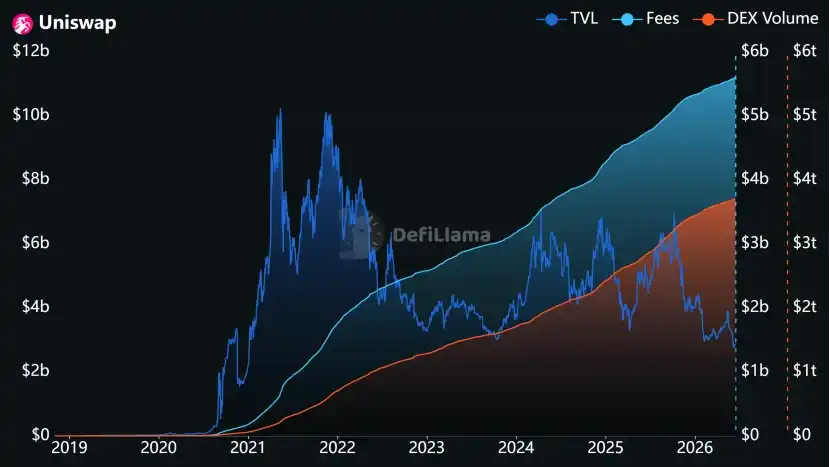
In terms of market share, Uniswap's DEX throne remains solid. Whether on the Ethereum mainnet or across major L2 ecosystems, Uniswap's trading volume and liquidity depth hold a dominant position, with no competitor posing a substantive threat.

More significant signals come from the institutional side. In February this year, BlackRock's tokenized money market fund BUIDL announced it would be available for trading on UniswapX and strategically purchased UNI tokens. With the adoption of UniswapX, which introduces features like off-chain routing, gasless transactions, and MEV (Miner Extractable Value) resistance, the experience gap between DEXs and CEXs is significantly narrowed, making it the preferred on-ramp for traditional capital.

Similarly, last Friday (June 12th), Fidelity also deployed liquidity for its stablecoin, FIDD, on Uniswap. The protocol's concentrated liquidity model is currently the most efficient pricing mechanism on-chain. Once compliant RWA assets are tokenized on a large scale, Uniswap is poised to become the "New York Stock Exchange" on-chain, holding the power of asset pricing.

Wall Street's water is flowing on-chain. And Uniswap is that faucet. Wall Street institutions are treating Uniswap as the on-chain interface for compliant assets, and UNI is also moving towards a pricing logic akin to "on-chain routing infrastructure."

Although the vision of a $100 endpoint is quite enticing, two major obstacles still lie in Uniswap's path to the summit, which could significantly delay or even nullify this distant promise.

  • Traffic Hijacking by Emerging DEXs and Aggregators (Competitive Risk): Solana-based DEXs like Jupiter and Raydium, riding on Meme mania and extremely low transaction costs, have captured a massive amount of retail traffic. Meanwhile, aggregators like 1inch and CowSwap intercept users at the front-end, reducing Uniswap to a mere "backend liquidity pool" in certain ecosystems, continuously eroding its brand premium and user mindshare.

  • Delays in Tokenization Adoption (Macro Risk): Standard Chartered's valuation heavily relies on the assumption that "DeFi TVL will reach $2.7 trillion by 2030." If global legislative progress on tokenization falls short of expectations, or if large-scale security incidents or systemic risks occur, the penetration rate of RWA could slow down significantly, potentially severely postponing the realization cycle of this grand narrative.

Returning to the most intuitive price perspective, UNI is currently trading below $3, down more than 92% from its all-time high in May 2021.

The fee switch brought deflation but not a price reversal. Market apathy towards the DeFi narrative, depleted liquidity, and high macro interest rates have all put significant pressure on UNI's valuation.

However, this might be precisely the source of the "40x potential" in Standard Chartered's eyes: starting from a low base.

Standard Chartered's first-time coverage of UNI with a $100 target price carries more symbolic significance than the price itself. In reality, the accuracy of the prediction is not the most important thing; what matters is that Wall Street's perception of DeFi is evolving: shifting from the early days of "unbridled growth and speculative bubbles" towards a rational business judgment based on "capital efficiency, network effects, and cash flow value."

It should be noted that Wall Street research reports are often strong on macro logic but short on micro risks. For investors immersed in this space, the 40x endpoint is undoubtedly attractive, but the road to 2030 is also destined to be strewn with thorns.

Whether UNI can truly capture the $4 trillion tokenization红利 depends on how skillfully it performs the high-difficulty dance between the principles of decentralization and global regulatory compliance in the real world.

More challenging than a 40x gain might be the four-year wait, which tests faith even more.

Kripto yang Sedang Tren

Pertanyaan Terkait

QWhat is the key prediction made by Standard Chartered Bank's research report on Uniswap's UNI token?

AStandard Chartered Bank predicts that Uniswap's governance token, UNI, will surge approximately 40 times, reaching $100 by the end of 2030.

QWhat are the two main business models Geoffrey Kendrick compares Uniswap and Coinbase to in the report?

AThe report compares Coinbase to Netflix (centralized, high capital costs, curated assets) and Uniswap to YouTube (open, user-generated liquidity, low marginal costs, strong network effects).

QAccording to the report, what two major factors are critical for achieving the $100 UNI price target?

AThe $100 price target relies on: 1) The massive expansion of tokenized real-world assets (RWA) to $4 trillion, and 2) A significant increase in the proportion of these assets flowing into DeFi, from 3.5% to 30% by 2030.

QWhat recent development changed UNI's economic model from a 'pure governance tool'?

AThe activation of the 'fee switch' mechanism. It initiated token burns (reducing total supply) and allows UNI to capture protocol fees, transforming it into a deflationary, revenue-generating asset.

QWhat are the two main challenges or risks identified for Uniswap's growth path to 2030?

AThe two main challenges are: 1) Competitive pressure from emerging DEXs (like Jupiter, Raydium) and aggregators that can divert user flow. 2) The macro risk of delayed adoption of tokenized assets if regulatory progress or market conditions slow down.

Bacaan Terkait

OpenAI Tidak Lagi Mengandalkan Model Termahal untuk Menghasilkan Uang

OpenAI tidak lagi mengandalkan model termahal untuk menghasilkan uang. Pada 30 Juli, perusahaan mengumumkan penyesuaian harga, menurunkan harga model GPT-5.6 Luna sebesar 80% dan Terra sebesar 20%. Yang lebih penting dari angka penurunan harga adalah pesan intinya: untuk banyak tugas, model terkuat (seperti Sol) tidak selalu diperlukan. OpenAI secara eksplisit merekomendasikan strategi di mana model mahal (Sol) menangani perencanaan dan analisis kompleks, sementara model yang lebih terjangkau (Luna) mengeksekusi tugas, menulis kode, dan menjalankan pengujian. Pergeseran ini mencerminkan perubahan industri AI dari hanya mengejar kecerdasan tertinggi menuju optimisasi biaya dan efisiensi untuk penggunaan skala besar. Anthropic juga mengikuti pola serupa dengan meluncurkan Claude Opus 5 dengan harga setengah dari model andalannya, Fable 5. Kedua raksasa Silicon Valley ini menunjukkan bahwa model flagship kini berfungsi lebih untuk nilai merek dan pembuktian teknologi, sementara model "kendaraan massal" yang lebih murah (seperti Luna, Terra, Opus) yang akan mendorong adopsi komersial luas dan menghasilkan pendapatan utama. OpenAI mengungkapkan bahwa penurunan biaya ini sebagian didorong oleh model AI (Sol) yang mengoptimalkan kode produksi dan alur kerjanya sendiri, menciptakan siklus peningkatan efisiensi yang dapat mempercepat penurunan biaya di masa depan. Intinya, kompetisi AI bergeser dari "siapa yang paling pintar" menjadi "mana yang paling bernilai". Perusahaan tidak lagi membeli satu model tunggal, tetapi merancang sistem dengan beberapa model yang cocok untuk tugas yang berbeda—mirip dengan arsitektur komputasi awan. Tujuan akhir OpenAI adalah membangun ekosistem yang mengunci alur kerja pengembang melalui volume panggilan API yang sangat besar dan biaya yang sangat rendah, sehingga menciptakan daya tarik yang kuat. Ketika AI menjadi murah dan tersebar luas seperti listrik, tertanam dalam setiap proses tanpa diperdebatkan, era sesungguhnya baru dimulai.

marsbit44m yang lalu

OpenAI Tidak Lagi Mengandalkan Model Termahal untuk Menghasilkan Uang

marsbit44m yang lalu

Gaji Puluhan Miliar untuk Rebut Tukang Listrik, Meta Buru-buru Buka Sekolah Kejuruan Sendiri

Perlombaan AI kini menghadapi hambatan baru: **kelangkaan tenaga ahli teknik**, terutama tukang listrik. Proyek data center raksasa seperti "Stargate" OpenAI membutuhkan ratusan pekerja konstruksi yang bekerja hingga 7 hari seminggu. Menurut prediksi, AS membutuhkan **130.000 tukang listrik tambahan** hingga 2030, namun puluhan ribu lowongan per tahun tetap tak terisi. Gaji yang ditawarkan sangat tinggi, mencapai **$240.000-$280.000 per tahun** untuk tukang listrik andal. Namun, kelambatan proyek karena kekurangan tenaga kerja bisa menyebabkan kerugian **$14,2 juta per bulan**. Presiden Microsoft menyebut kelangkaan tukang listrik sebagai **hambatan utama** ekspansi data center. Kompleksitas data center AI sangat tinggi karena kebutuhan daya besar (setara puluhan ribu rumah), sistem distribusi listrik rumit, dan tantangan pendinginan yang membutuhkan ahli pipa dan HVAC. Akibatnya, perusahaan seperti Meta dan Alphabet berinvestasi besar dalam pelatihan. Meta mengalokasikan **$115 juta** untuk mendirikan sekolah pelatihan konstruksi, menawarkan program gratis dengan tunjangan hidup. Upaya ini menarik minat generasi Z, dengan lonjakan pendaftaran sekolah kejuruan. Namun, tantangan berlanjut: konsumsi listrik data center AI melonjak **84,2% per tahun**, mendorong harga listrik naik. Selain itu, pekerjaan konstruksi bersifat proyek - setelah data center selesai, ribuan pekerja terlatih harus mencari pekerjaan baru, berpotensi membanjiri sektor lain dan menekan upah. Masa depan pasar tenaga kerja teknik pasca-boom AI masih belum pasti.

marsbit44m yang lalu

Gaji Puluhan Miliar untuk Rebut Tukang Listrik, Meta Buru-buru Buka Sekolah Kejuruan Sendiri

marsbit44m yang lalu

The Fed Harus Naikkan Suku Bunga di September? Bagaimana Tekanannya pada Crypto dan Saham AS?

Pasar telah meningkatkan perkiraan suku bunga Federal Reserve (The Fed) pada September menjadi lebih dari 73%, meningkat pesat dari kurang dari 53% sepekan sebelumnya. Lonjakan ini dipicu oleh perbedaan suara dalam rapat The Fed Juli (9-3) dan kekhawatiran inflasi akibat kenaikan harga minyak, yang didorong oleh ketegangan geopolitik di dekat Selat Hormuz. Kunci penentu berikutnya adalah data CPI bulan Juli pada 12 Agustus. Jika inflasi menunjukkan kenaikan berlanjut, probabilitas kenaikan suku bunga September akan semakin kuat. Untuk aset kripto seperti Bitcoin, ekspektasi kenaikan suku bunga biasanya menekan harga karena meningkatkan biaya peluang memegang aset tidak menghasilkan dan menarik aliran modal ke aset yang lebih aman. Namun, dampaknya mungkin terbatas jika pasar memandang kenaikan ini sebagai akhir dari siklus pengetatan. Saham AS terkait kripto (seperti Coinbase, MicroStrategy) cenderung bereaksi lebih volatil. Kenaikan suku bunga meningkatkan tingkat diskonto dalam valuasi, memberi tekanan lebih besar pada saham pertumbuhan dan teknologi. Hal ini bertepatan dengan musim laporan keuangan dimana investor kini lebih kritis, menilai apakah pengeluaran modal besar-besaran untuk AI dapat benar-benar menghasilkan pendapatan dan arus kas. Perusahaan dengan cerita pertumbuhan lemah dan arus kas negatif mungkin menghadapi volatilitas lebih tinggi jika The Fed benar-benar menaikkan suku bunga.

marsbit54m yang lalu

The Fed Harus Naikkan Suku Bunga di September? Bagaimana Tekanannya pada Crypto dan Saham AS?

marsbit54m yang lalu

Penambang Bitcoin Mulai Menyerah, Tapi Saham Mereka Malah Meroket

Penambang Bitcoin Menyerah, Namun Saham Mereka Melonjak. Hashrate Bitcoin telah menurun selama berbulan-bulan, dan kesulitan penambangan juga baru saja mencatat salah satu penurunan terbesar. Biasanya, ini adalah cerita sederhana: penambang mematikan mesin karena tidak menguntungkan. Namun, kali ini, saham perusahaan penambang publik justru mengalami salah satu performa terkuat dalam beberapa tahun terakhir, sementara harga BTC sendiri tertekan. Setiap penurunan hashrate yang lebih lama dari ini dalam sejarah Bitcoin dapat dihitung dengan jari. Kesulitan penambangan telah turun 19.9% dari puncaknya, salah satu penurunan terdalam sejak dominasi ASIC. Alasan di balik kenaikan saham perusahaan tambang adalah narasi AI. Aset-aset ini kini lebih banyak bergerak seiring dengan sektor AI daripada dengan Bitcoin itu sendiri. Sementara itu, pendapatan penambang dari blok reward (subsidi) dalam denominasi BTC mencapai rekor terendah baru. Subsidi blok berkurang setengah setiap empat tahun, dan logika bahwa kenaikan harga akan mengimbangi pengurangan ini masih bertahan sejauh ini, dengan metrik Puell Multiple saat ini sekitar 0.75. Jawaban jangka panjang selalu adalah biaya transaksi (fee), yang suatu hari nanti harus sepenuhnya mendanai keamanan jaringan. Namun, realitanya masih sangat jauh. Rata-rata harian fee selama 28 hari terakhir bahkan tidak cukup untuk menutupi subsidi satu blok, sementara jaringan menghasilkan sekitar 144 blok per hari. Bentuk "penyerahan diri" penambang kali ini berbeda dari siklus sebelumnya. Penambang telah menemukan penggunaan perangkat keras yang lebih menguntungkan, sementara harga BTC turun, subsidi menyusut, dan pendapatan dari fee stagnan. Masalah yang perlu diselesaikan seringkali baru ditangani secara serius selama pasar bearish.

marsbit55m yang lalu

Penambang Bitcoin Mulai Menyerah, Tapi Saham Mereka Malah Meroket

marsbit55m yang lalu

Trading

Spot

Artikel Populer

Cara Membeli UNI

Selamat datang di HTX.com! Kami telah membuat pembelian Uniswap (UNI) menjadi mudah dan nyaman. Ikuti panduan langkah demi langkah kami untuk memulai perjalanan kripto Anda.Langkah 1: Buat Akun HTX AndaGunakan alamat email atau nomor ponsel Anda untuk mendaftar akun gratis di HTX. Rasakan perjalanan pendaftaran yang mudah dan buka semua fitur.Dapatkan Akun SayaLangkah 2: Buka Beli Kripto, lalu Pilih Metode Pembayaran AndaKartu Kredit/Debit: Gunakan Visa atau Mastercard Anda untuk membeli Uniswap (UNI) secara instan.Saldo: Gunakan dana dari saldo akun HTX Anda untuk melakukan trading dengan lancar.Pihak Ketiga: Kami telah menambahkan metode pembayaran populer seperti Google Pay dan Apple Pay untuk meningkatkan kenyamanan.P2P: Lakukan trading langsung dengan pengguna lain di HTX.Over-the-Counter (OTC): Kami menawarkan layanan yang dibuat khusus dan kurs yang kompetitif bagi para trader.Langkah 3: Simpan Uniswap (UNI) AndaSetelah melakukan pembelian, simpan Uniswap (UNI) di akun HTX Anda. Selain itu, Anda dapat mengirimkannya ke tempat lain melalui transfer blockchain atau menggunakannya untuk memperdagangkan mata uang kripto lainnya.Langkah 4: Lakukan trading Uniswap (UNI)Lakukan trading Uniswap (UNI) dengan mudah di pasar spot HTX. Cukup akses akun Anda, pilih pasangan perdagangan, jalankan trading, lalu pantau secara real-time. Kami menawarkan pengalaman yang ramah pengguna baik untuk pemula maupun trader berpengalaman.

603 Total TayanganDipublikasikan pada 2024.12.12Diperbarui pada 2026.06.02

Cara Membeli UNI

Diskusi

Selamat datang di Komunitas HTX. Di sini, Anda bisa terus mendapatkan informasi terbaru tentang perkembangan platform terkini dan mendapatkan akses ke wawasan pasar profesional. Pendapat pengguna mengenai harga UNI (UNI) disajikan di bawah ini.

活动图片













