Super-Rich Hoarded Record Cash in February, Stock Market Hit New Highs Four Months Later: Who's Getting Fooled?

marsbitDipublikasikan tanggal 2026-06-15Terakhir diperbarui pada 2026-06-15

Abstrak

In February, the total assets in US money market funds reached a record high of approximately $8.25 trillion, a trend highlighted by high-net-worth individuals increasing their cash holdings. Notably, Warren Buffett's Berkshire Hathaway amassed a $381.7 billion cash pile ahead of his 2025 retirement, while other prominent figures like Peter Thiel sold tech stocks, fueling narratives of wealthy investors seeking safety. However, by June, the trend reversed. Money market fund assets fell to around $7.87 trillion, indicating a flow of capital back into equities. Concurrently, the S&P 500 and Nasdaq reached all-time highs, with the S&P 500 surpassing 7600 points. This market surge occurred despite the earlier defensive moves, highlighting a potential opportunity cost for those who retreated to cash. Analysis shows that since early 2022, the S&P 500's total return significantly outpaced that of prime money market funds. The capital shifted from equities appears to have been partly reallocated into alternative investments like real estate, art, and private credit, especially among ultra-high-net-worth individuals. Meanwhile, major investment banks like Goldman Sachs and Morgan Stanley have raised their year-end targets for the S&P 500, citing AI-driven earnings growth, while also cautioning about risks including market concentration and economic fragility beneath the surface rally.

Author: Claude, Deep Tide TechFlow

Deep Tide Introduction: In February of this year, US money market funds surged to a historical peak of about $8.25 trillion. Buffett left behind $381.7 billion in cash before retirement, and rumors swirled that the super-rich were fleeing the stock market.

But now in June, the plot has reversed: the S&P 500 repeatedly hits new highs, breaching the 7600-point level for the first time on June 2nd, while money market fund assets have fallen back to $7.87 trillion as of June 10th. Money is flowing from cash back into stocks. The safe-haven bet placed by the wealthiest group is now being proven wrong by the market.

The Story in February: Cash in the Hands of the Rich Piled Up to a Record High

Let's rewind to the beginning of the year.

According to a Goldman Sachs survey from October 2025, high-net-worth individuals with over $1 million in investable assets held, on average, about 20% of their net worth in cash and cash equivalents—a proportion considered high for traditional allocation.

The most symbolic figure was Buffett.

As reported by Bloomberg, before his retirement on December 31, 2025, the former CEO of Berkshire Hathaway had built the company's cash reserves to approximately $381.7 billion as of the end of the third quarter of 2025. This cash pile even ended up making money—despite market turmoil, Buffett's personal net worth still grew by about $21 billion last year.

He wasn't the only one reducing holdings. According to Reuters' disclosures of holdings documents, PayPal co-founder Peter Thiel, through his hedge fund Thiel Macro, sold about $100 million worth of Nvidia stock in Q3 2025. Nvidia rose nearly 35% in 2025; Thiel exiting at a high point added fuel to concerns about an "AI bubble."

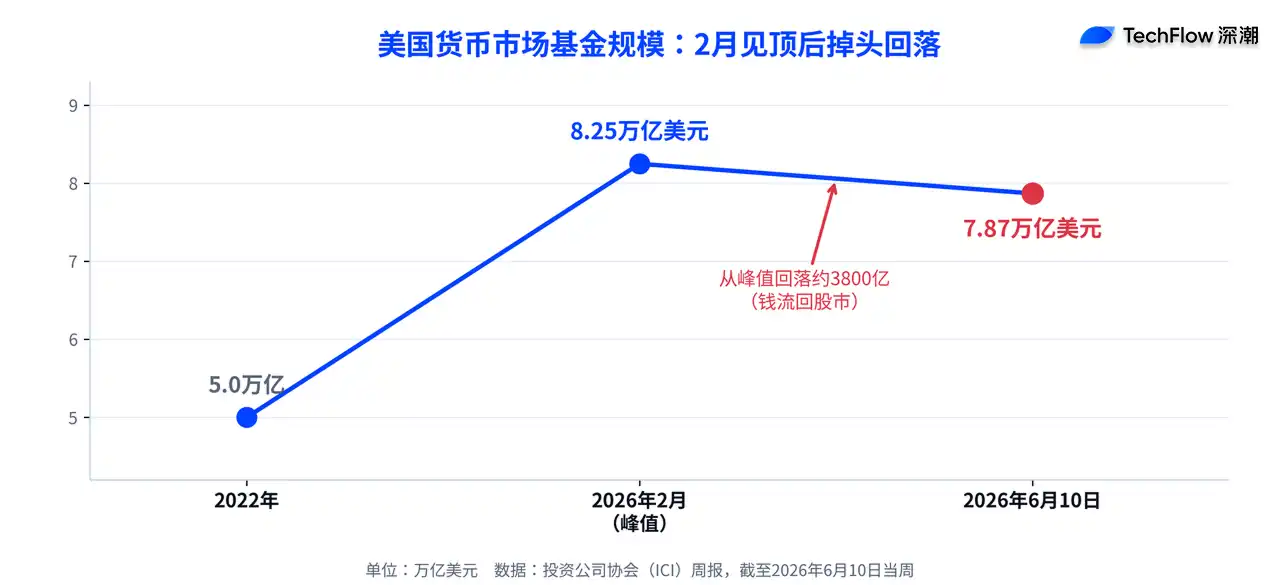
The market direction was the same. According to data from the Investment Company Institute (ICI), US money market fund assets surged to a historical peak of about $8.25 trillion at the end of February this year, a 65% increase from about $5 trillion in 2022. The narrative back then was clear: smart money was hiding in cash.
The June Reversal: Money is Flowing from Cash Back into Stocks

The problem is, it's June now, and the story has flipped.

According to official ICI data, as of the week ending June 10th, money market fund assets dropped to $7.87 trillion, with a single-week outflow of $21.48 billion; the previous week, June 4th, it was $7.89 trillion. From the February peak of $8.25 trillion, assets have shrunk by about $380 billion. Money is flowing *out* of cash, not in.

Where is it going? Stocks. According to CNBC, the S&P 500 closed at 7609.78 points on June 2nd, breaking above the 7600-point level for the first time in history, marking its ninth consecutive day of gains; the Nasdaq also hit new highs. Nvidia surged over 6% in a single day after releasing its new generation of PC chips, boosting Dell and HP. In short, the money that hid in cash back in February is now watching the market hit new highs without them.

There was an early signal behind this. According to investingLive reports, Bank of America (BofA) warned as early as late May that as the market surged to new highs and bullish sentiment peaked, cash levels were actually declining. The $8.25 trillion record was old news from February; by June, the market landscape was a different story.

The Cost of Hoarding Cash: Lagging Stocks by More Than Double

Why is the wealthy's safe-haven move being proven wrong? Look at the return gap.

According to calculations by The Motley Fool, if one had held from the point before the 2022 bear market when cash was flowing into money market funds all the way to the present, the total return for the S&P 500 would be about 42%, while the Vanguard Federal Money Market Fund returned only 18% over the same period—a gap of more than double. Hiding in cash seems safe, but the cost is missing a big chunk of the rally.

This is also why many analysts remain skeptical of the "pile into cash at the first sign of trouble" approach:

Historically, events like geopolitical conflicts are often short-term and can instead be buying opportunities at low points, not reasons to sell out.

Those Who Moved Money Out of Stocks Went into Real Estate and Art

The money freed up by those who did reduce stock holdings hasn't been idle. The Goldman Sachs survey shows that among those with $1 million to $5 million in investable assets, nearly 40% hold alternative investments; among those with over $10 million, this proportion reaches 80%. The greater the assets, the more they move beyond traditional stocks.

Art is one destination. According to UBS's 2025 Art Market Report, high-net-worth collectors allocated an average of about 20% of their wealth to art in 2025. Real estate, private credit, and hedge funds are also absorbing funds flowing out of the stock market. The logic is that in an environment of sticky inflation, high interest rates, and uncertain tariff prospects, these asset classes resemble safer harbors. But even safe harbors have a cost, as the earlier set of return numbers demonstrates.

Major Banks Are Still Doubling Down: Goldman Sachs, Morgan Stanley Raise Price Targets

If the wealthy's moves in February leaned defensive, Wall Street banks' stance in June is the opposite.

According to Bloomberg, Goldman Sachs' strategy team (led by Ben Snider) raised its year-end target for the S&P 500 from 7600 points to 8000 points in late May, citing AI-driven earnings growth. Goldman increased its 2026 S&P 500 earnings-per-share forecast to $340, representing a 24% year-on-year growth, and believes AI infrastructure beneficiaries will contribute about half of this year's index earnings growth. However, Goldman also cautioned: "AI sentiment and interest rates present risks in both directions."

Morgan Stanley is even more bullish. Chief Investment Officer for Wealth Management Lisa Shalett, in an outlook on May 20th, set a one-year target of 8300 points for the S&P 500, implying about 11% to 12% upside. But she also listed five risks: gains excessively concentrated in a few large-cap AI stocks, deteriorating US consumer finances, corporate profits reliant on price hikes rather than productivity, pressure on long-term interest rates, and better performance outside the US (Japan and some emerging markets). Shalett's core judgment is that the market's surface is stronger than the underlying economy.


Kripto yang Sedang Tren

Pertanyaan Terkait

QAccording to the article, what significant record did U.S. money market funds reach in February, and what was the narrative at that time?

AIn February, U.S. money market funds surged to a historical peak of approximately $8.25 trillion. The prevailing narrative at that time was that smart money was seeking shelter in cash, with super-wealthy individuals appearing to withdraw from the stock market.

QHow has the situation changed by June, specifically regarding the flow of funds and stock market performance?

ABy June, the situation reversed. Money market fund assets had decreased to $7.87 trillion by June 10, indicating an outflow of cash. Conversely, the stock market reached new highs, with the S&P 500 closing above 7600 points for the first time on June 2, marking a nine-day winning streak.

QWhat was the performance gap between holding cash (in a money market fund) and holding stocks (the S&P 500) from the start of the 2022 bear market to the present, as cited in the article?

AFrom the start of the 2022 bear market to the present, the S&P 500 delivered a total return of approximately 42%, while the Vanguard Federal Money Market Fund returned only about 18%. Holding cash thus resulted in missing more than double the returns of the stock market over that period.

QWhere are wealthy individuals, who reduced their stock holdings, reallocating their capital according to the Goldman Sachs survey mentioned in the article?

AAccording to the Goldman Sachs survey, wealthy individuals who reduced stock holdings are reallocating capital into alternative investments. This includes areas such as real estate, art, private credit, and hedge funds. Nearly 40% of those with $1-5 million in investable assets and 80% of those with over $10 million hold such alternative investments.

QWhat are the updated year-end price targets for the S&P 500 from Goldman Sachs and Morgan Stanley, and what are their primary reasons for these bullish forecasts?

AGoldman Sachs, led by strategist Ben Snider, raised its year-end target for the S&P 500 to 8000 points from 7600, citing AI-driven earnings growth. Morgan Stanley's Chief Investment Officer Lisa Shalett set a one-year target of 8300 points, forecasting about 11-12% upside, based on continued market strength, though she also listed several underlying economic risks.

Bacaan Terkait

Mengapa Bitcoin Bertahan di $64.000 Setelah Jeda Ketat dari The Fed

Bitcoin berakhir di bulan Juli mendekati level $64.000, bertahan di tengah volatilitas pasca keputusan Federal Reserve AS untuk mempertahankan suku bunga dalam kisaran 3,50-3,75%. Meskipun tiga anggota komite voting mendukung kenaikan suku bunga, sinyal keseluruhan dari Fed tetap ketat, membatasi minat terhadap aset berisiko. Pasar kripto menunjukkan ketahanan dengan aliran bersih masuk $32,1 juta ke ETF Bitcoin spot, mengakhiri serangkaian arus keluar. Di sisi lain, ETF Ethereum mengalami penarikan dana sekitar $18,65 juta. Kapitalisasi pasar agregat bertahan di sekitar $2,29 triliun. Secara teknis, Bitcoin menemukan dukungan di zona $63.000-63.500 dengan hambatan utama di dekat $66.000. Sementara Ethereum diperdagangkan sekitar $1.900 dengan tekanan harga, metrik jaringan seperti antrian validator yang panjang menunjukkan komitmen jangka panjang. Pergerakan di altcoin beragam: ETF Solana mencatat aliran masuk yang kuat sekitar $19 juta, sementara XRP dan BNB bergerak dalam konsolidasi. Regulasi juga menjadi perhatian setelah penundaan pembahasan CLARITY Act di Senat AS hingga musim gugur, mengurangi harapan disahkannya undang-undang tersebut pada tahun 2026. Hari terakhir bulan Juli akan dipantau untuk data makro AS seperti inflasi dan pengeluaran konsumen, yang dapat memengaruhi pergerakan pasar. Skenario dasar untuk Bitcoin adalah konsolidasi dalam kisaran $63.000-66.000. Kelangsungan aliran masuk institusional dan pertahanan level kunci akan menjadi sinyal penting untuk pemulihan pasar di paruh kedua tahun 2026.

cryptonews.ru1j yang lalu

Mengapa Bitcoin Bertahan di $64.000 Setelah Jeda Ketat dari The Fed

cryptonews.ru1j yang lalu

Parker Lewis Menjawab Mengapa Bitcoin Tetap Menjadi Uang Terbaik

Parker Lewis, salah satu analis Bitcoin paling terkemuka, mengkritik keras strategi pemasaran perusahaan publik yang memposisikan diri sebagai perbendaharaan kripto. Menurutnya, upaya mereka mengumpulkan modal melalui penjualan "kredit digital" dalam bentuk saham preferen abadi mendistorsi esensi mata uang kripto pertama. Lewis menekankan bahwa Bitcoin tidak memiliki hasil tetap pada tingkat algoritmanya, dan janji dividen reguler adalah permainan berisiko tinggi yang didanai terutama oleh investor baru di pasar yang naik. Untuk menunjukkan risikonya, ia membandingkan pasar kredit global sebesar $300 triliun dengan pasar saham preferen abadi yang hanya $1 triliun, menunjukkan bahwa lembaga keuangan menghindari risiko abadi ini, mengalihkannya ke investor ritel. Ia juga membantah klaim bahwa Bitcoin "terlalu volatil untuk 99% populasi". Volatilitas, katanya, adalah konsekuensi matematis alami dari adopsi massal aset baru dengan pasokan tetap. Setiap gelombang pengguna baru menyebabkan lonjakan harga karena mereka harus menawar lebih tinggi kepada pemegang awal. Lewis menyarankan untuk membeli Bitcoin langsung daripada saham perusahaan seperti MicroStrategy, karena lebih aman secara matematis daripada mempercayakan dana kepada manajer korporat. Fokus pada derivatif korporat mengalihkan perhatian dari ancaman utama: depresiasi uang fiat yang cepat. Lewis mengilustrasikan inflasi sebenarnya dengan "Indeks Ribeye"-nya, mencatat kenaikan harga steak premium dari $19,99 menjadi $37,99 sejak musim semi 2020, setara dengan inflasi 12-13% per tahun, lebih tinggi dari data resmi. Strategi keuangan yang paling bijaksana dan aman dalam inflasi global adalah kepemilikan langsung atas Bitcoin pertama dan kendali penuh atas kunci pribadi. Mengejar imbal hasil korporat yang meragukan melalui saham perbendaharaan kripto hanya meningkatkan risiko sistemik, sementara pemahaman tentang uang terdesentralisasi yang sejati dapat melindungi tabungan dari gejolak makroekonomi.

cryptonews.ru1j yang lalu

Parker Lewis Menjawab Mengapa Bitcoin Tetap Menjadi Uang Terbaik

cryptonews.ru1j yang lalu

Trading

Spot

Artikel Populer

Cara Membeli SUPER

Selamat datang di HTX.com! Kami telah membuat pembelian SuperFarm (SUPER) menjadi mudah dan nyaman. Ikuti panduan langkah demi langkah kami untuk memulai perjalanan kripto Anda.Langkah 1: Buat Akun HTX AndaGunakan alamat email atau nomor ponsel Anda untuk mendaftar akun gratis di HTX. Rasakan perjalanan pendaftaran yang mudah dan buka semua fitur.Dapatkan Akun SayaLangkah 2: Buka Beli Kripto, lalu Pilih Metode Pembayaran AndaKartu Kredit/Debit: Gunakan Visa atau Mastercard Anda untuk membeli SuperFarm (SUPER) secara instan.Saldo: Gunakan dana dari saldo akun HTX Anda untuk melakukan trading dengan lancar.Pihak Ketiga: Kami telah menambahkan metode pembayaran populer seperti Google Pay dan Apple Pay untuk meningkatkan kenyamanan.P2P: Lakukan trading langsung dengan pengguna lain di HTX.Over-the-Counter (OTC): Kami menawarkan layanan yang dibuat khusus dan kurs yang kompetitif bagi para trader.Langkah 3: Simpan SuperFarm (SUPER) AndaSetelah melakukan pembelian, simpan SuperFarm (SUPER) di akun HTX Anda. Selain itu, Anda dapat mengirimkannya ke tempat lain melalui transfer blockchain atau menggunakannya untuk memperdagangkan mata uang kripto lainnya.Langkah 4: Lakukan trading SuperFarm (SUPER)Lakukan trading SuperFarm (SUPER) dengan mudah di pasar spot HTX. Cukup akses akun Anda, pilih pasangan perdagangan, jalankan trading, lalu pantau secara real-time. Kami menawarkan pengalaman yang ramah pengguna baik untuk pemula maupun trader berpengalaman.

293 Total TayanganDipublikasikan pada 2024.12.11Diperbarui pada 2026.06.02

Cara Membeli SUPER

Diskusi

Selamat datang di Komunitas HTX. Di sini, Anda bisa terus mendapatkan informasi terbaru tentang perkembangan platform terkini dan mendapatkan akses ke wawasan pasar profesional. Pendapat pengguna mengenai harga SUPER (SUPER) disajikan di bawah ini.

活动图片












