What Kind of People Is Anthropic Actually Hiring? Insights from 1,680 Resumes Provide the Answer

marsbitDipublikasikan tanggal 2026-06-15Terakhir diperbarui pada 2026-06-15

Abstrak

Contrary to the common perception of Anthropic as a PhD-heavy AI research lab, an analysis of 1,680 engineer profiles reveals its core talent is experienced "builders." The engineering team, largely assembled in the past 18 months (median tenure 10 months), hires senior engineers with a median of 12.2 years of prior experience. They primarily come from major engineering-focused companies like Google, Meta, Amazon, Microsoft, Stripe, Databricks, Snowflake, and Palantir, not primarily from other AI labs. Their backgrounds are infrastructure-heavy (40%), focusing on backend, distributed systems, databases, and security, with skills like Python, Java, C++, and AWS being common. Only 13.7% hold PhDs. The dominant job title is "Member of Technical Staff." For early-career hires (<6 years experience), entry is not based on standard work history but on prestigious signals: top internships (e.g., at FAANG or quant trading firms), competition rankings, research publications, or AI safety fellowship experience. The key insight for applicants is to present as infrastructure builders, highlighting experience with large-scale systems, not as pure researchers, reflecting Anthropic's identity as a highly engineered infrastructure company.

Editor's Note: Anthropic is often imagined by outsiders as an AI lab composed of PhDs, researchers, and frontier model experts. However, this analysis of 1,680 engineer profiles offers a more realistic answer: the core of Anthropic is not just "research," but "building."


By analyzing 5,306 LinkedIn profiles listing Anthropic as the current employer and further filtering down to 1,680 engineer profiles, this article reaches a counter-intuitive conclusion: the most core talent profile at Anthropic is not the "researcher" imagined by the outside world, but a group of experienced "builders" (people who can truly set up, run, and scale large-scale systems).

Data shows that Anthropic's engineering team was largely formed rapidly in the past 18 months: over half of current engineers joined less than a year ago. However, the new hires are generally very senior, with a median of 12.2 years of work experience before joining. A significant number came from companies renowned for engineering prowess and infrastructure, such as Google, Meta, Amazon, Microsoft, Stripe, Databricks, Snowflake, and Palantir.

This also explains the real focus of Anthropic's engineering organization: compared to the model research that outsiders focus on, it operates more like a highly engineered infrastructure company. Its engineers' backgrounds are concentrated in areas like infrastructure, backend, distributed systems, databases, and security. Only 13.7% hold PhDs; the majority are senior engineers with bachelor's or master's degrees.

Opportunities for early-career talent are not nonexistent, but the bar is equally high: top tech company internships, competition achievements, publications, or experience in AI safety/alignment projects often serve as screening signals in place of years of experience.

The author's final advice is straightforward: if you want to join Anthropic, don't write your resume as if applying to a research lab. Instead, highlight the large-scale systems you have actually built, scaled, and maintained. At its foundation, the competition in frontier AI is increasingly becoming a competition of engineering capability and infrastructure capability.

The original text is below:

Builders, Not Researchers

I scraped all LinkedIn profiles listing Anthropic as the current employer, totaling 5,306 people. I then filtered for the 1,680 individuals in genuine engineering roles and further examined the 7,986 records in their past job descriptions to analyze what they were doing before joining Anthropic.

Here are the results.

The Organization Was Scaled Up Almost Overnight
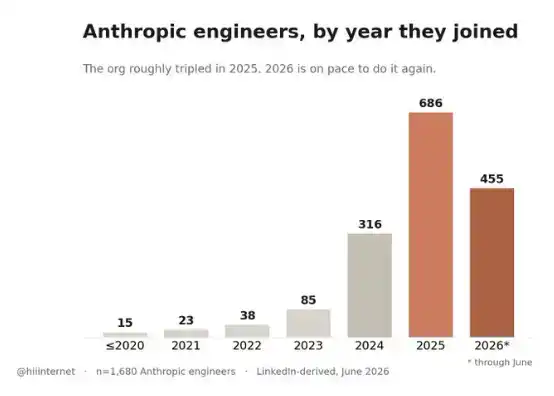
Only 15 engineers who joined Anthropic before 2021 are still employed there today. In 2025, this organization's engineering team nearly tripled in size, adding 686 engineers that year; the hiring pace for 2026 is projected to be similar, with 455 added by June.

Currently, half of the engineering team has been at Anthropic for less than a year. 53% joined within the past 12 months. Median tenure: 10 months.

This is a large-scale organization that was essentially built up in about 18 months.

They Almost Exclusively Hire Senior Engineers
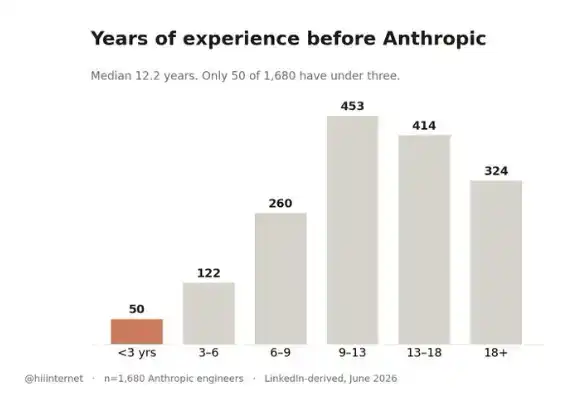
The median years of work experience before joining Anthropic is 12.2 years. The middle 50% have between 8.8 and 16.5 years of experience. Among these 1,680 people, only 50 have less than 3 years of experience. 44% have 13 or more years of experience. New graduate hiring is virtually nonexistent.

In other words, the typical new hire at Anthropic is an engineer with 12 years of experience who has only been at Anthropic for 10 months.

Clear Bias Towards Infrastructure Over Traditional Research
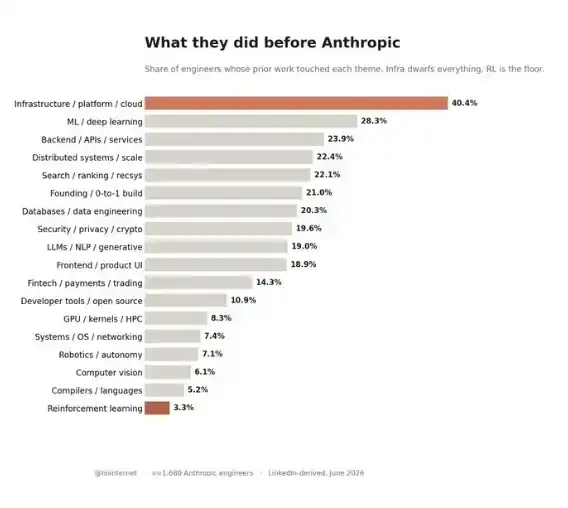
Infrastructure background appears in 40% of the engineers' profiles. Backend, distributed systems, databases, and security each appear in about 20% of profiles. Reinforcement learning, the "RL" in RLHF, appears in only 3.3%.

The typical Anthropic engineer spent the past decade building large-scale production systems at either a hyperscale cloud provider or an infrastructure-heavy startup.

Their self-listed skills tell the same story: Python (585 people), Java (566), C++ (443), JavaScript (376), SQL (302), Linux (230), Distributed Systems (189), AWS (154). The more "sexy"-sounding model training work certainly exists, but it's a low percentage.

The Largest Talent Source Is Not a Lab, It's Google
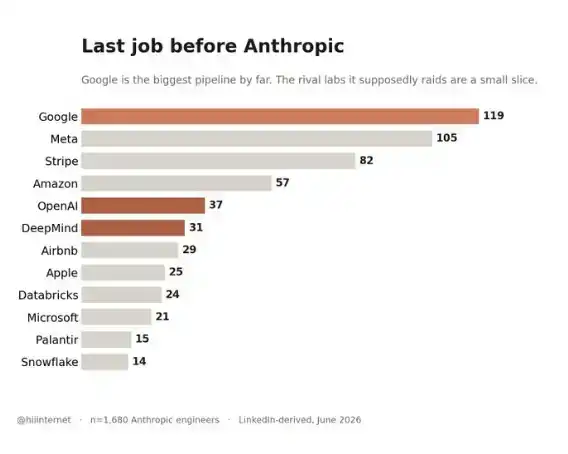
Everyone thinks Anthropic mainly hires from OpenAI and DeepMind. But its largest talent pipeline, by far, is Google. Those competitor labs are just two small bars in the middle of the chart.

Anthropic clearly prefers companies known for engineering rigor: Stripe, Databricks, Snowflake, Palantir, Airbnb.

Looking at where these engineers have worked historically, the ranking is: Google (405 people), Meta (273), Amazon (197), Microsoft (171), Stripe (124), Apple (87), Stanford (68), DeepMind (62), Airbnb (51), OpenAI (48). Half of the current engineering team, 50%, have at least one FAANG company in their career history.

Of course, they also hire from other AI labs. OpenAI is a top-five direct source, and DeepMind is a top-six direct source. About 94 engineers moved directly from other frontier AI labs to Anthropic.

The Myth of the PhD
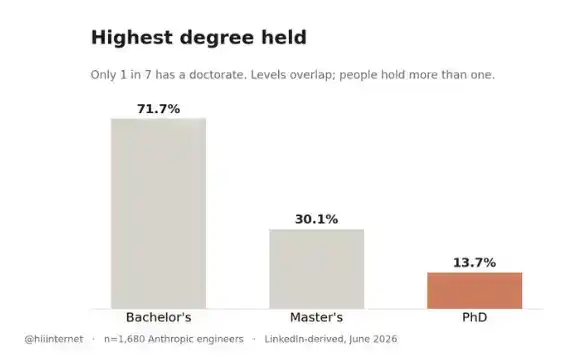
Only 13.7% hold a doctoral degree. That's roughly one in seven people.

The typical Anthropic recruitment target is not a research scientist, but a senior engineer with a bachelor's or master's degree. The image of a "lab full of PhDs" is largely incorrect at the engineering team level.

The distribution of academic majors also perfectly fits the profile of a "building organization": Computer Science (819 people), followed by Mathematics (78), Physics (70), Computer Engineering (69). Philosophy also makes the top 20, with 13 people, likely related to safety.

Stanford Is Clearly the Leading Source by University
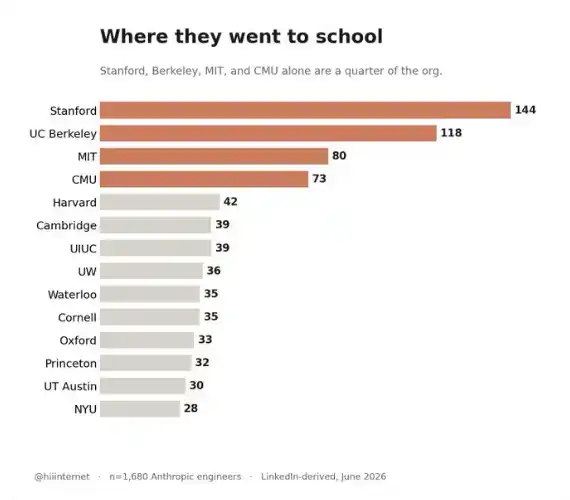
Looking at universities, the historical cumulative ranking is: Stanford (144 people), Berkeley (118), MIT (80), CMU (73), Harvard (42), Cambridge (39), UW (36), Waterloo and Cornell (35 each), Oxford (33), Princeton (32). The top four schools combined account for a quarter of the entire engineering team.

80% of people share the same job title.

"Member of Technical Staff."

A former Instagram CTO, a few former Adept founders, and Stanford faculty at Anthropic all share the title "MoTS." This flattening of job titles is clearly intentional. Seniority and specific function are, by design, hidden.

Where is the One Entry Point for Early-Career People into Anthropic?
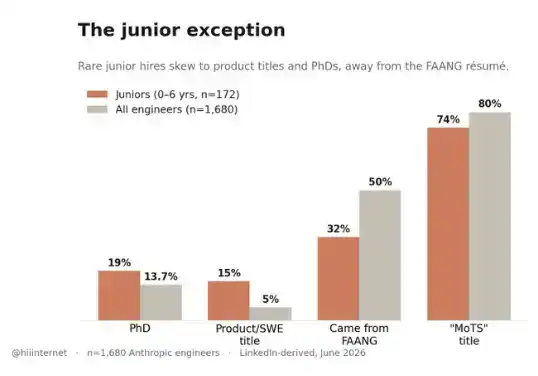
There are 172 engineers with less than 6 years of experience, and 50 of them have less than 3 years. But they are not typical new graduates. They roughly fall into two categories, with almost no ordinary mid-level engineers in between.

Compared to the entire engineering team, they show distinctly different characteristics: a higher PhD rate of 19% vs. 13.7% overall; product/SWE titles are three times more common, at 15% vs. 5% overall; they are also far less likely to have FAANG experience, only 32% vs. 50% overall.

In place of years of experience, they possess a different form of prestige capital:

The Internship Pipeline. 50% of them list internships at these companies: Meta (16 people), Google (10), DeepMind (6), Microsoft (5), Amazon (5), plus Jane Street, Two Sigma, HRT, Optiver, Nvidia.

From Quant Trading to AI Labs. 9% had stints at top trading firms, including Jane Street, Two Sigma, Five Rings, HRT, Optiver, Citadel. This is a group of young math/coding competition talent entering AI labs via the high-frequency trading industry.

Alignment Fellowships. 6% had exposure to MATS, SERI, Redwood, or ARC. This is an entry point that is almost exclusively for early-career talent and virtually absent among the senior cohort.

A very clear profile emerges: MIT, IOI Silver Medalist, Codeforces rating 2900+, entered reinforcement learning and safety directly after four years of work. Their screening criteria aren't years of experience, but competition rankings and publications.

These young engineers are also more international than their senior counterparts. School sources for low-seniority engineers include: Berkeley (15), Stanford (14), Cambridge (10), MIT (7), Tsinghua (7), Oxford (6), plus Imperial, NUS, Shanghai Jiao Tong University, ETH Zürich.

So, How Should You Interpret This?

If you want to join Anthropic as an engineer, don't write your resume as if applying to a research lab. Write it as if applying to an infrastructure company. Show the systems you've actually built and scaled. That's the resume getting hired.

The early-career stage is the only exception. At this stage, the barrier isn't regular work experience, but top internships, competition rankings, or publications.

If you're competing with Anthropic for talent, your target isn't "PhDs" or "lab background" per se, but those senior Builders from hyperscale cloud providers or companies with stellar engineering reputations: they have about 12 years of experience, likely from Stripe, Databricks, Snowflake, Palantir. Anthropic is already fishing heavily in this talent pool.


Pertanyaan Terkait

QWhat is the core talent profile that Anthropic primarily hires for, according to the analysis of engineer resumes?

AThe core talent profile at Anthropic is not 'researchers,' but rather experienced 'builders'—engineers who can build, scale, and maintain large-scale production systems. The majority are senior engineers with a background in infrastructure, backend, distributed systems, databases, and security, not necessarily AI model research.

QWhat does the data say about the experience level of a typical new engineer joining Anthropic?

AThe median prior work experience for engineers joining Anthropic is 12.2 years. The middle 50% have between 8.8 and 16.5 years of experience. New hires are predominantly senior engineers, with nearly zero recent graduate hiring.

QWhich company is the largest direct source of engineering talent for Anthropic, and what does this indicate about their hiring preference?

AGoogle is by far the largest direct source of engineering talent for Anthropic. This indicates a strong preference for candidates from companies renowned for engineering rigor and infrastructure capabilities (like Meta, Amazon, Microsoft, Stripe, Databricks), rather than exclusively from AI research labs like OpenAI or DeepMind.

QWhat is the percentage of engineers at Anthropic with a PhD, and what is the most common educational background?

AOnly 13.7% of the engineers analyzed hold a PhD. The most common educational background is a Bachelor's or Master's degree in Computer Science (819 people), which aligns with the profile of a 'builder' organization focused on engineering and infrastructure.

QFor early-career individuals with limited work experience, what are the primary pathways to secure an engineering role at Anthropic?

AEarly-career individuals primarily gain entry through alternative prestige signals: top-tier internship experiences (e.g., at Meta, Google, DeepMind), exceptional competition rankings (e.g., IOI medals, high Codeforces scores), research publications, or participation in specialized AI safety/alignment fellowships (e.g., MATS, SERI).

Bacaan Terkait

AGI Bukan Akhir, Makalah Baru DeepMind: Menuju ASI, Kemajuan AI yang Sesungguhnya Baru Dimulai

Jika Kecerdasan Buatan Umum (AGI) tercapai, apakah itu titik akhir? Tim Google DeepMind dalam laporan terbarunya berpendapat bahwa AGI **bukanlah akhir perjalanan**. AI diprediksi akan terus berkembang melampaui kemampuan tim ahli manusia terbaik, menuju Superintelligence (ASI). Laporan ini membedakan tiga konsep: AGI (kecerdasan setara manusia rata-rata), ASI (melampaui manusia di hampir semua bidang), dan UAI (batas teoretis maksimal). Transisi dari AGI ke ASI dapat melalui empat jalur potensial: 1. **Ekspansi Lanjutan**: Meningkatkan skala komputasi, model, dan data. 2. **Inovasi Algoritma**: Penyempurnaan paradigma yang ada atau pergeseran paradigma baru. 3. **Peningkatan Diri Secara Rekursif**: AI yang lebih kuat membantu mengembangkan generasi AI berikutnya yang lebih kuat. 4. **Koordinasi Multi-Agen**: Kecerdasan kolektif dari banyak sistem AGI yang berkolaborasi. Namun, terdapat enam kemacetan potensial: dinding data, tekanan sumber daya ekonomi & alam, batasan paradigma jaringan saraf saat ini, meningkatnya kesulitan penelitian, hambatan abstraksi, serta tantangan regulasi dan penerimaan sosial. Laporan ini juga menyoroti bahwa jika AI melampaui manusia, sistem evaluasi (benchmark) yang ada menjadi tidak relevan. Diperlukan kerangka pengukuran baru, seperti tugas kolaborasi/kompetisi multi-agen, pengujian yang dihasilkan otomatis, atau indikator tidak langsung seperti produktivitas ekonomi. ASI bukanlah sistem ajaib yang mahatahu; perkembangannya tetap dibatasi oleh hukum fisika, kompleksitas komputasi, data, sumber daya, dan umpan balik dunia nyata. Arah dan kecepatan kemajuan AI masih penuh ketidakpastian, sehingga memerlukan penelitian, prediksi, dan mekanisme evaluasi yang terus diperbarui.

marsbit1j yang lalu

AGI Bukan Akhir, Makalah Baru DeepMind: Menuju ASI, Kemajuan AI yang Sesungguhnya Baru Dimulai

marsbit1j yang lalu

Penetapan Harga Pra-Pasar untuk OpenAI: Bisnis Baru dengan Masa Hidup Setengah Tahun di Hyperliquid

Penulis: Curry, TechFlow Deep潮 Di tengah demitasi SpaceX, kontrak pra-pencatatan SPCX di Hyperliquid viral, namun sedikit yang tahu bahwa di baliknya ada tim bernama Trade.xyz. Tim anonim yang baru muncul tahun ini ini menguasai lebih dari 90% posisi kontrak pra-pencatatan di Hyperliquid, menjadi penggerak utama tren Pre-IPO SpaceX di on-chain. Hanya tiga hari setelah SpaceX IPO, Ventuals, pesaing dengan backing Paradigm yang menawarkan kontrak pra-pencatatan untuk SpaceX, OpenAI, dan Anthropic, mengumumkan penutupan setelah beroperasi sembilan bulan. Menariknya, Ventuals tutup bukan karena bangkrut, tetapi melalui akuisisi, dengan modal pengguna dikembalikan 1:1. Perbedaan kesuksesan keduanya terletak pada pemilihan aset. Trade.xyz memilih SpaceX yang tanggal IPO dan harga patokannya (Nasdaq) jelas, sehingga harga pra-pencatatannya memiliki "jangkar" realitas. Sebaliknya, Ventuals mematok pada OpenAI dan Anthropic yang belum ada rencana IPO nyata. Harga acuannya setengah berasal dari transaksi saham internal (private) dan setengah lagi dari rata-rata harganya sendiri di platform, menciptakan siklus harga yang terisolasi dari pasar sebenarnya. Akibatnya, likuiditas rendah dan harga cenderung mandek di level tertinggi. Saat tutup, Ventuals membekukan harga akhir berdasarkan rata-rata 24 jam terakhir: OpenAI di $1341.80 dan Anthropic di $1618.90 per saham. Ironisnya, harga yang dianggap kurang representatif ini justru digunakan oleh beberapa karyawan dan investor internal perusahaan tersebut sebagai acuan valuasi, menunjukkan kebutuhan kuat akan harga real-time untuk aset privat. Bisnis penentuan harga pra-pencatatan ini semakin ramai. Coinbase meluncurkan kontrak berkelanjutan pra-pencatatan, Polymarket membuat pasar prediksi, dan Citi menawarkan saham perusahaan privat yang ditokenisasi. Kebutuhan akan akses perdagangan aset privat seperti ini nyata, terutama bagi investor ritel. Namun, penutupan Ventuals menggarisbawahi tantangan utama: harga memerlukan mekanisme koreksi dari pasar yang terbuka dan likuid. Tantangan ini tetap ada terlepas dari siapa penyelenggaranya, sampai perusahaan seperti OpenAI benar-benar go public dan memiliki harga pasar yang sesungguhnya.

marsbit1j yang lalu

Penetapan Harga Pra-Pasar untuk OpenAI: Bisnis Baru dengan Masa Hidup Setengah Tahun di Hyperliquid

marsbit1j yang lalu

Dialog dengan Kepala Strategi Digital Morgan Stanley: Bitcoin Mencapai Satu Juta Dolar Bukan Tidak Mungkin, Tapi Saya Harap Perlahan

Morgan Stanley mengelola triliunan dolar aset dan sekarang membawa Bitcoin ke klien mereka. Amy Oldenburg, Kepala Strategi Aset Digital di Morgan Stanley, membagikan wawasannya tentang perjalanan Bitcoin. Ia menyoroti kontras antara ETF Bitcoin (MSBT) yang mencetak rekor peluncuran hari pertama di bank tersebut, dengan sebagian besar penasihat keuangan yang masih enggan merekomendasikannya karena harga Bitcoin cenderung stagnan sejak rekomendasi resmi bank. Oldenburg berpendapat bahwa adopsi Bitcoin selanjutnya mungkin memerlukan katalis berupa peristiwa yang mengganggu sistem keuangan tradisional. Ia tidak terkejut jika Bitcoin mencapai satu juta dolar dalam lima tahun, tetapi berharap kenaikan tersebut terjadi secara perlahan untuk stabilitas aset. Dia menekankan pentingnya pendidikan dalam mengatasi kesenjangan pemahaman, termasuk perbedaan mendasar antara memegang Bitcoin secara langsung dan melalui ETP, serta perbedaan antara berbagai aset kripto. Meskipun institusi keuangan besar seperti Morgan Stanley menawarkan layanan terpusat yang memudahkan likuiditas dan perencanaan warisan, Oldenburg menghargai dan berharap semangat 'cypherpunk' dan kedaulatan diri dalam ekosistem Bitcoin tetap hidup. Menurutnya, perjalanan aset digital masih sangat panjang dan akan terus berkembang seiring dengan kemajuan teknologi.

marsbit1j yang lalu

Dialog dengan Kepala Strategi Digital Morgan Stanley: Bitcoin Mencapai Satu Juta Dolar Bukan Tidak Mungkin, Tapi Saya Harap Perlahan

marsbit1j yang lalu

Trading

Spot
Futures

Artikel Populer

Cara Membeli PEOPLE

Selamat datang di HTX.com! Kami telah membuat pembelian ConstitutionDAO (PEOPLE) menjadi mudah dan nyaman. Ikuti panduan langkah demi langkah kami untuk memulai perjalanan kripto Anda.Langkah 1: Buat Akun HTX AndaGunakan alamat email atau nomor ponsel Anda untuk mendaftar akun gratis di HTX. Rasakan perjalanan pendaftaran yang mudah dan buka semua fitur.Dapatkan Akun SayaLangkah 2: Buka Beli Kripto, lalu Pilih Metode Pembayaran AndaKartu Kredit/Debit: Gunakan Visa atau Mastercard Anda untuk membeli ConstitutionDAO (PEOPLE) secara instan.Saldo: Gunakan dana dari saldo akun HTX Anda untuk melakukan trading dengan lancar.Pihak Ketiga: Kami telah menambahkan metode pembayaran populer seperti Google Pay dan Apple Pay untuk meningkatkan kenyamanan.P2P: Lakukan trading langsung dengan pengguna lain di HTX.Over-the-Counter (OTC): Kami menawarkan layanan yang dibuat khusus dan kurs yang kompetitif bagi para trader.Langkah 3: Simpan ConstitutionDAO (PEOPLE) AndaSetelah melakukan pembelian, simpan ConstitutionDAO (PEOPLE) di akun HTX Anda. Selain itu, Anda dapat mengirimkannya ke tempat lain melalui transfer blockchain atau menggunakannya untuk memperdagangkan mata uang kripto lainnya.Langkah 4: Lakukan trading ConstitutionDAO (PEOPLE)Lakukan trading ConstitutionDAO (PEOPLE) dengan mudah di pasar spot HTX. Cukup akses akun Anda, pilih pasangan perdagangan, jalankan trading, lalu pantau secara real-time. Kami menawarkan pengalaman yang ramah pengguna baik untuk pemula maupun trader berpengalaman.

649 Total TayanganDipublikasikan pada 2024.12.12Diperbarui pada 2026.06.02

Cara Membeli PEOPLE

Diskusi

Selamat datang di Komunitas HTX. Di sini, Anda bisa terus mendapatkan informasi terbaru tentang perkembangan platform terkini dan mendapatkan akses ke wawasan pasar profesional. Pendapat pengguna mengenai harga PEOPLE (PEOPLE) disajikan di bawah ini.

活动图片