In April, Anthropic released a preview version of the Mythos model. This model was not made available to the public because during testing, it demonstrated extremely strong cybersecurity and vulnerability discovery capabilities, being able to autonomously find thousands of high-risk zero-day vulnerabilities. If leaked, it could easily be used for malicious attacks.
To confine this capability to defensive scenarios, Anthropic launched Project Glasswing, granting access permissions only to 12 core security partners like Apple, Google, Microsoft, and over 40 critical infrastructure providers, with usage controlled throughout the process.
The act of locking it away before release itself created buzz.
Two months later, on June 10th at 12 AM Beijing time, Anthropic officially launched Fable 5 and Mythos 5.
Judging by benchmark scores, they achieved the highest scores in almost all benchmarks, especially in software engineering and long-task execution, creating a clear gap with other models.
But discussions about this model quickly moved beyond just how powerful it is.
Fable 5 and Mythos 5 actually share the same underlying model. The difference is that Fable 5 is for general users, while Mythos 5 remains locked within the hands of trusted security partners. The same model, two sets of rules, targeting two groups—this is a first in Anthropic's product line.
Furthermore, general users do not get the complete version either. Anthropic has added a security classifier on the outer layer of Fable 5. Once a request touches sensitive directions like cybersecurity, biochemistry, or model distillation, the system will automatically switch to respond using the previous-generation, less capable model, Opus 4.8.
The pricing is also noteworthy: $10 for input, $50 for output per million tokens. The company states this is approximately twice the price of Opus 4.8. Starting June 23rd, Fable 5 will also be removed from subscription plans like Pro, Max, etc. Users who want to continue using it will need to spend additional credits.
This combination of moves makes sense when taken apart. The capabilities are too strong, hence security restrictions; the cost is higher, hence the price increase; the risks are sensitive, hence the tiered release. But when put together, the signal becomes subtle. This differs from the competitive logic of recent years where major model companies raced for speed and openness. Everyone was trying to get their models to reach more users, while Anthropic chose to actively narrow the entry point, making restrictions part of its product strategy.
So, is this so-called unprecedented "most powerful model" being mythologized?
01. Significant Capability Improvements, Automatic Downgrade Becomes Controversial
Regardless of tiers, let's first see how capable it really is.
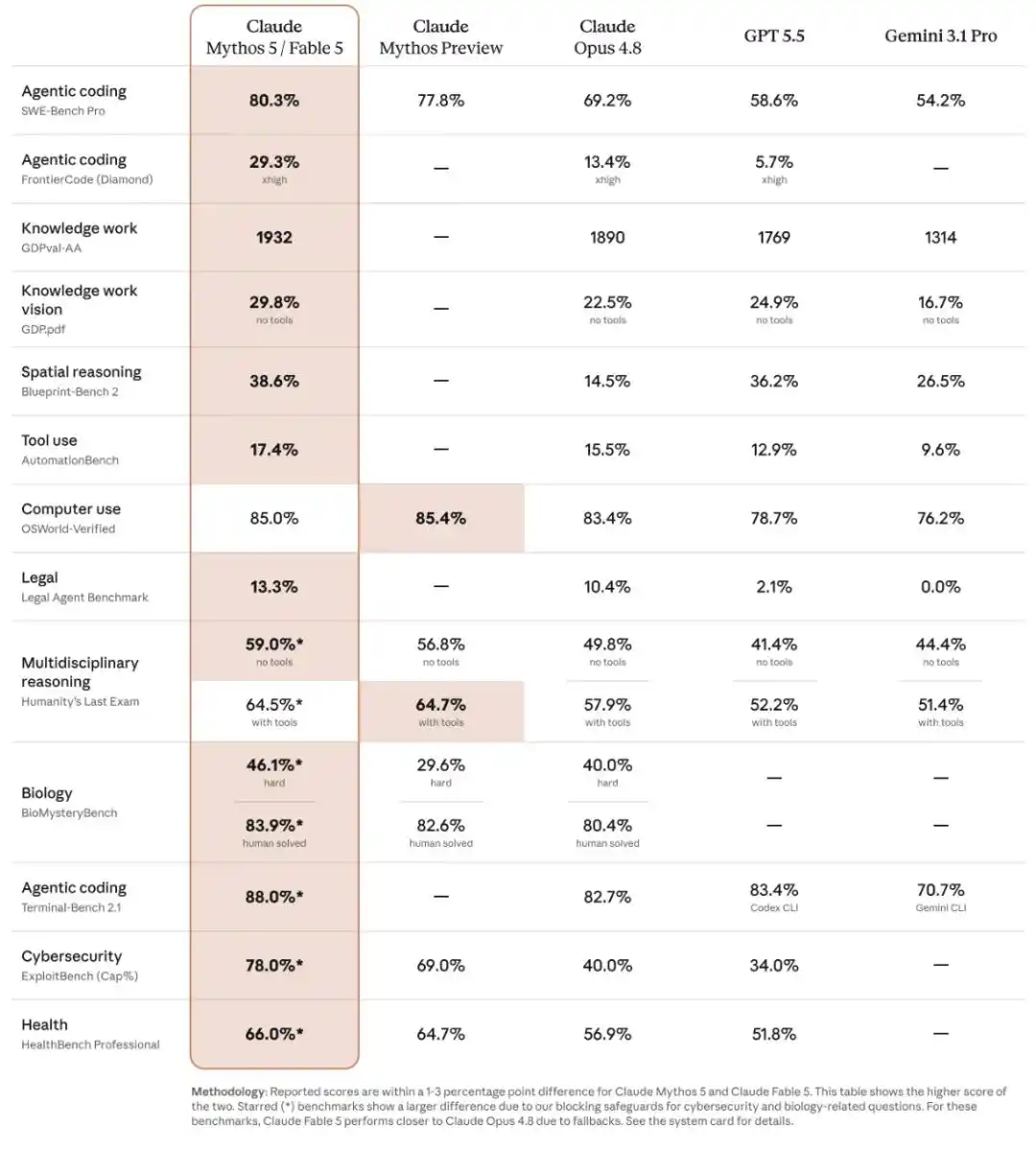
Software engineering is the core highlight of Anthropic's update this time. On the SWE-Bench Pro test, Fable 5 scored 80.3%. This test mainly evaluates whether the model can locate bugs in real GitHub repositories, understand context, and write usable fix code. An 80.3% score means for every 5 real engineering problems, Fable 5 can solve 4.
On the Terminal-Bench 2.1 leaderboard, Fable 5 scored 88.0%, surpassing OpenAI's Codex CLI. Notably, Fable 5 is a general-purpose model, while Codex CLI is a vertical tool specifically built for programming scenarios. The gap between them better reflects Fable 5's programming prowess.
But the real difference can be seen in FrontierCode Diamond. This test examines whether the code generated by the model can meet the quality standards of production-level codebases. Fable 5 achieved 29.3%, while Opus 4.8 only got 13.4%, and GPT-5.5 (Anthropic's internal test result for comparison) only 5.7%.
Over the past few years, the ability of AI models to write code has been improving, but it has long been stuck at a bottleneck: the code can run, but is not easy to maintain; it can pass benchmarks, but problems frequently arise when deployed in real projects.
Fable 5's breakthrough in this dimension shows that Anthropic's upgrade this time is not just about problem-solving ability, but about pushing the model toward genuine engineering delivery.
Programmer Li Xia told "AIX Finance" that AI-generated code often suffers from contextual incoherence. It can precisely understand requirements initially but tends to forget information during long tasks, leading to high maintenance costs later.
In his view, Fable 5 shows clear improvement in logical coherence during long tasks. Similar coding tasks can be completed in one go with higher accuracy. However, compared to Opus 4.8, Fable 5's generation speed is slower, with longer reasoning chains, resulting in an overall decrease in response speed.
Visual capabilities have also improved. Anthropic claims that Fable 5 can extract precise numbers from complex scientific charts and can reconstruct application source code directly from webpage screenshots. The company also demonstrated a practical case where Fable 5 completed the game "Pokémon FireRed" using only screenshots of the game screen, without needing auxiliary tools. Previous-generation models required complex auxiliary systems for similar tasks.
Regarding long context and memory, the official statement is that the longer and more complex the task, the more pronounced Fable 5's advantage becomes.
Additionally, life sciences is another direction highlighted. Anthropic revealed that a single-cell data analysis model built on Mythos 5, covering 138 species, outperforms similar models recently published in "Science," despite having only one-hundredth the parameter count.
Based solely on benchmark scores, comprehensive capabilities have indeed reached a new level.
Now let's look beyond the benchmarks.
Fable 5 comes equipped with a security classifier. As soon as a user request involves directions like cybersecurity, biochemistry, or model distillation, the system automatically switches to Opus 4.8 to respond and informs the user of the model downgrade. The company states that over 95% of daily conversations will not trigger this, and tasks like writing, programming, and analysis are mostly unaffected. However, actual experience may vary depending on the usage scenario.
In practical use, this boundary is actually easy to trigger. Li Xia mentioned that when he wanted to experience Apple's Siri AI features on a Mac in China, which required modifying some system-level serial number parameters, Fable 5 directly refused the operation. Currently, the classifier settings are relatively conservative, prone to misjudgment, and the company states it will be continuously adjusted.
But Anthropic also disclosed another layer of restriction. For requests related to large model development, such as building pre-training pipelines, designing distributed training infrastructure, etc., the model will actively reduce output quality in the background without informing the user.
Overall, Fable 5 has indeed made progress in various hard metrics, but the automatic downgrade mechanism affects the user experience to some extent.
02. The Most Powerful Model Is Not Accessible to Everyone
Anthropic's model upgrade this time uses the same underlying model packaged into two products for two groups.
Mythos 5 stays within the Project Glasswing framework, accessible only to 12 core security partners like Apple, Google, Microsoft, and over 40 critical infrastructure providers, with restrictions on cybersecurity and biology removed. Fable 5 targets C-end subscription users.
Subsequently, Anthropic also plans to open a trusted channel in the biology direction to vetted researchers, providing a version of Fable 5 with biology and chemistry restrictions removed.
This touches on a problem the large model industry hasn't faced before: when a model's capability is sufficient to autonomously discover vulnerabilities, a full public release becomes a risk.

Source / pexels
This explains why Fable 5 and Mythos 5 were split into two versions. In the past, model tiers were based on parameters—the gap between large and small models was one of capability. Now, models with the same parameters are also tiered, but the division is based on trust thresholds.
Independent developer Zhan Bo believes this logic is very reasonable from a security perspective. If Mythos-level vulnerability discovery capabilities were opened to individuals without restriction, it would significantly lower the cost of attacks and could easily be abused for malicious purposes. Locking it down first and then gradually opening trusted access is the most prudent path currently.
But security only explains why layering is needed. Another question is: do all general users who can use Fable 5 actually benefit from it?
Judging from the benchmarks and cases released by Anthropic, this round of upgrades primarily serves programmers and engineering teams.
Zhan Bo used Fable 5 to assist in optimizing his interpreter project written in Rust. In comparable web service scenarios, he compared it with FastAPI (based on Python) and Hono (based on Node.js). The interpreter using Fable 5 required only 9.8MB of resident memory, while FastAPI and Hono required 43.3MB and 63.0MB respectively, with leading throughput and latency metrics as well.
He believes that for the same task, using Fable 5 might complete it much faster and with better results. For developers, output quality is more important than price. As long as the model can significantly improve project outcomes, a higher price is acceptable.
Li Xia also mentioned that for programmers, model generation quality correlates positively with income. Higher output quality means more obvious efficiency gains and greater returns. The improvement in model capability can be directly converted into project quality and time saved, naturally leading to stronger willingness to pay.
But in a different usage scenario, the conclusion changes.
AI blogger Xu Zilong, taking his daily work as an example, said his work is divided into writing code, data analysis, and writing papers. He believes current large models have excessive code capabilities but deficient language abilities. For groups like researchers, content creators, and professionals in law and finance, the core demand for AI focuses on Chinese language understanding, long-form writing, and document processing.
Zhan Bo mentioned that the current trend is not users choosing models, but models selecting users. Heavy programming users are being filtered out by high-end models, while casual light users are pushed toward more cost-effective alternatives. This indicates that AI is no longer a universal tool, but rather a process of screening users layer by layer based on their payment ability and usage intensity.
Even the most powerful model is only worth its cost in the hands of those who need it.
03. Is the Era of Unaffordable AI Coming?
The API pricing for Fable 5 is $10 for input, $50 for output per million tokens. This is double the price of Opus 4.8 and is currently the most expensive among publicly available frontier models globally.
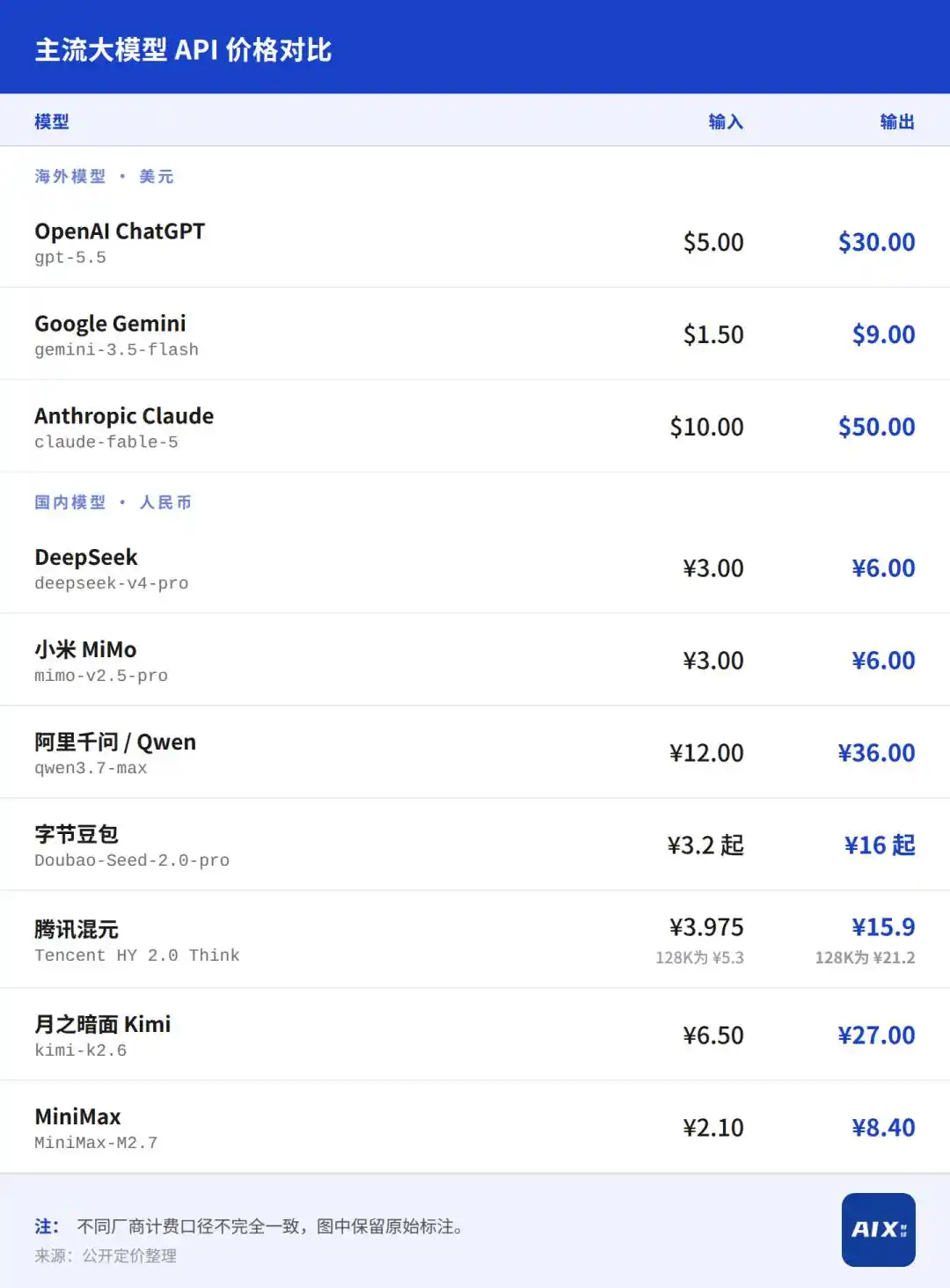
Comparison of Mainstream Large Model API Prices
But what's really worth noting is not that the price doubled, but that the payment method changed.
After Fable 5's launch, Pro, Max, Team, and other subscription users could use it for free for two weeks. Starting June 23rd, the model will be removed from subscription plans. To continue using it, users need to purchase additional credits, settled according to API rates. Using Fable 5 during a subscription period also consumes usage quota at twice the rate of Opus 4.8.
Offering a free trial first and then removing it from subscriptions is also sending a signal: pushing users from fixed monthly fees toward pay-as-you-go. The benefit of a subscription is predictability—users know how much they spend each month. Pay-as-you-go is more favorable for the platform—the more you use, the more you pay, opening up the user's spending ceiling. Simply put, Anthropic wants to tell users: the most advanced things shouldn't be part of a monthly package in the first place.
The timing of this shift is also noteworthy. On June 1st, Anthropic secretly filed its IPO prospectus with the SEC, with a valuation reaching $965 billion, targeting an IPO as early as October this year. From the beginning of the year to the end of May, Anthropic's annualized revenue grew from $9 billion to $47 billion, with Claude Code contributing over $2.5 billion, and enterprise customers contributing the vast majority of revenue.
A company about to go public needs to demonstrate revenue growth potential and pricing power to the capital markets. Separating the most powerful model from fixed subscriptions and guiding high-value users toward pay-as-you-go makes sense from a financial narrative perspective.
Meanwhile, domestic models are doing the exact opposite.
At the end of May, DeepSeek announced a permanent 75% price cut for its V4-Pro API. Xiaomi followed closely, with MiMo-V2.5-Pro seeing a drop of up to 99%, nearly aligning its price with DeepSeek.
On one side, DeepSeek is slashing prices to the floor; on the other, Anthropic is raising the ceiling. Different players have different strategies.
The price cuts by domestic models are partly due to the release of technological dividends; changes in the underlying architecture have saved space, which is being used to capture a larger market.
Anthropic's logic is exactly the reverse. It doesn't need to compete for market share with low prices. The high price itself is also a filter, retaining high-value users willing to pay for cutting-edge capabilities.
Xu Zilong believes AI will become increasingly expensive in the future because demand expansion far exceeds supply expansion. Computing power involves electricity, chips, and model training, and its growth is too slow. AI computing power will become infrastructure like 5G in the future, but unlike 5G, computing power supply is much tighter than bandwidth, so prices will increase accordingly.
From a business model perspective, the AI industry is developing a layered structure similar to the early days of cloud computing. The bottom layer consists of highly standardized, nearly zero-priced general capabilities that anyone can call, monetized through volume. The top layer consists of cutting-edge capabilities controlled by a few vendors, with concentrated pricing power, monetized through customer unit price. The price of general capabilities will continue to be driven down, but the premium for cutting-edge capabilities will persist for a long time.
From capability tiers to payment tiers, the AI industry is replicating the path cloud computing took. Cheap models are becoming more numerous, while the best models are becoming more expensive.
*Li Xia is a pseudonym upon the interviewee's request.
This article is from WeChat public account "AIX Finance," author: Lei Jing, editor: Jin Yufan