Luxury Cars Become Targets, Families Used as Pawns: Crypto 'Wrench Attacks' Sweep Across Europe and America

marsbitDipublikasikan tanggal 2026-06-10Terakhir diperbarui pada 2026-06-10

Abstrak

In a significant U.S. federal case, 22-year-old Saif Faiq of Missouri pleaded guilty to conspiracy to commit Hobbs Act robbery, related to an attempted Bitcoin theft and the kidnapping of two individuals in Danbury, Connecticut. Prosecutors state the 2024 plot targeted the parents of a person involved in a separate large-scale Bitcoin theft, intending to use them as hostages to coerce the transfer of crypto assets. Faiq's role involved recruiting accomplices and surveillance. This case, involving a Lamborghini Urus carjacking, exemplifies the growing threat of "wrench attacks"—physical violence and coercion to steal cryptocurrency—where a holder's family, vehicles, and visible wealth become targets. The guilty plea, alongside that of co-conspirator Adam Iza, marks the formal entry of such crypto-related violent crimes into the U.S. federal judiciary. It highlights that while blockchain technology itself is secure, the human endpoint is vulnerable. Attackers leverage personal connections and luxury items as indicators of crypto wealth to plan kidnappings and extortion. Though this case occurred in the U.S., Europe remains the epicenter for such attacks. CertiK's 2026 report notes 34 confirmed wrench attacks in the first four months of 2026, with 82% occurring in Europe, primarily France, causing an estimated $101 million in losses. The Danbury case serves as a stark warning for crypto holders globally: operational security must now extend beyond digital threats to include ph...

Author: Liam 'Akiba' Wright

Compiled by: Saoirse, Foresight News

Quick Summary Key Points

  • A Missouri man pleaded guilty in Hartford federal court to participating in a robbery conspiracy involving an attempted Bitcoin theft and a double kidnapping in Danbury, Connecticut.
  • Prosecutors state this case highlights that holding crypto assets can make an individual's family and vehicles potential targets for physical coercion.
  • Saif Faiq is scheduled for sentencing on August 28; this 'wrench attack' crime pattern is spreading from Europe and now appearing in US court cases.

Saif Faiq, a 22-year-old man from St. Louis, Missouri, pleaded guilty on June 8th in Hartford federal court to conspiracy to commit robbery affecting interstate commerce. Prosecutors allege the case originated from a plot in August 2024 to steal Bitcoin from a family connected to another Bitcoin theft case involving hundreds of millions of dollars.

The charge carries a statutory maximum penalty of 20 years in prison. Saif Faiq's sentencing hearing is set for August 28.

According to prosecutors, the two kidnapped victims were the parents of a person involved in the Bitcoin case. Saif Faiq's role involved recruiting accomplices, coordinating with Adam Iza, and conducting surveillance on the victims' home.

The Danbury case is further evidence of the escalating threat of physical violence linked to crypto wealth. Prosecutors connected key elements: targeting relatives, prolonged surveillance, luxury vehicles, and the criminals' logic of taking hostages to coerce the transfer of Bitcoin.

Previous CryptoSlate reports indicated a surge in cases in France where crypto holders' identities were leaked, leading to violence against their families. The court documents from this Danbury case demonstrate that this same security threat has now emerged within the US federal justice system.

US Court Documents: Real Physical Violence Cases Triggered by Crypto Assets

In September 2024, Danbury police responded to a reported Lamborghini Urus carjacking and kidnapping, leading to charges against six Florida residents. Authorities stated two victims were forced from their vehicle, bound, and placed in a van before police intervened and arrested the suspects.

A June 2026 US Department of Justice announcement stated that six other individuals involved in the carjacking and kidnapping had pleaded guilty.

Saif Faiq is not the only one to plead guilty. The DOJ identified his brother, Adam Iza, as a key organizer. Adam Iza pleaded guilty on June 1st to the same Hobbs Act robbery conspiracy charge related to the attempted Bitcoin robbery and Danbury kidnapping.

Prosecutors said Adam Iza used phones and encrypted messaging apps to communicate with multiple kidnappers, coordinated logistics, and funded the criminal operation.

This federal criminal case includes several classic violent crime charges: recruitment, funding, surveillance, carjacking, kidnapping, and robbery conspiracy. The crypto connection lies in the plan to hold family members hostage to physically coerce a Bitcoin holder into surrendering assets.

This guilty plea formally categorizes crimes involving physical coercion against crypto asset holders as part of US federal violent crime prosecutions.

For cryptocurrency holders, this case delivers a stark security warning: if criminals believe someone holds Bitcoin, their family, vehicles, residence, or any public signs of wealth can become targets.

All 'wrench attack' cases operate on this logic of coercion.

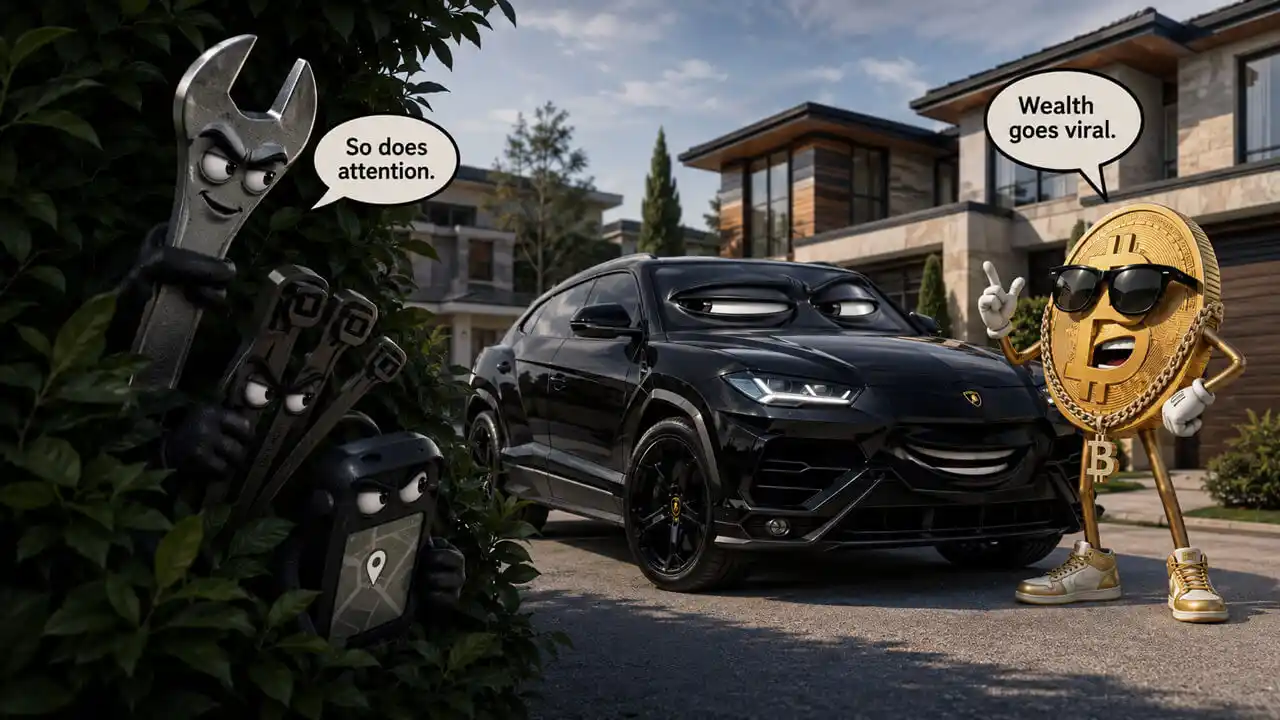
The presence of a Lamborghini in the case is not incidental—prosecutors' narrative shows the luxury car served as a visual wealth indicator, signaling to criminals that the target held significant Bitcoin worth robbing.

Thus, flashy luxury vehicles can serve as a security alarm, reminding holders to be vigilant about their exposed wealth, loved ones, and access to digital assets.
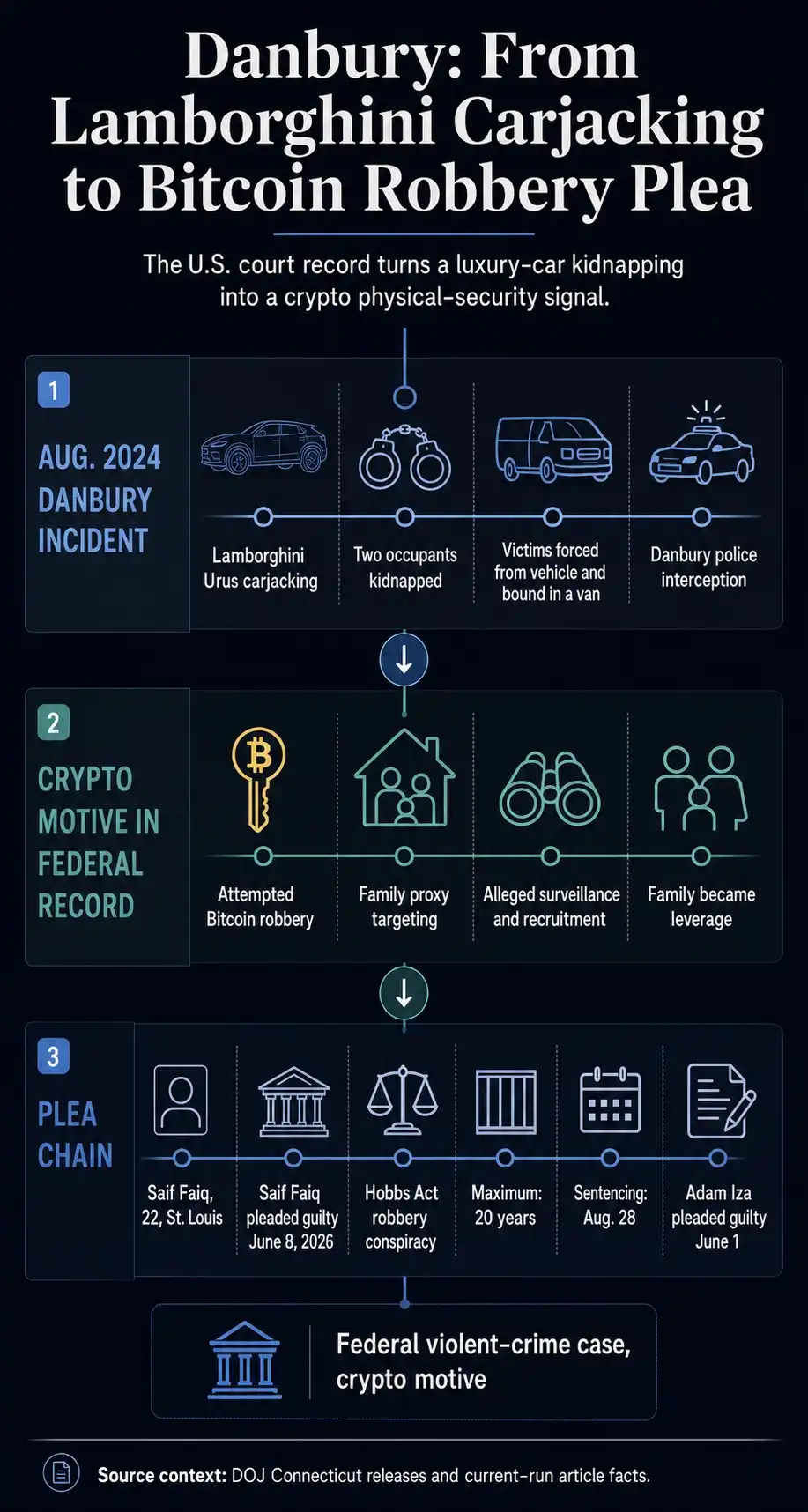
This infographic details a 2024 violent incident in Danbury, USA, involving a Lamborghini carjacking and kidnapping aimed at seizing Bitcoin, disclosing plot details and the 2026 guilty pleas and pending sentencing of two suspects.

The Attack Vector is Always the Human Element

In security research, a 'wrench attack' is defined as a crime involving physical violence or coercion to force a victim to reveal passwords, private keys, or access to digital assets.

CertiK's "2025 SkyNet Wrench Attack Report" categorizes such crimes as attacks on the 'human endpoint,' reporting 72 verified cases in 2025, a 75% year-on-year increase.

This is crucial for Bitcoin holders: the security of the blockchain protocol and the holder's personal safety are two separate systems. Even if the blockchain code is virtually unbreakable and Bitcoin cannot be stolen remotely, the individual controlling the assets is highly vulnerable to physical coercion.

Once criminals believe hardware wallets, seed phrases, exchange accounts, mobile devices, or a target's relatives can lead to transferable crypto assets, all become potential pressure points.

In the Danbury case, the pressure point was the victims' relatives. The US DOJ explicitly stated the two kidnapped parents were not involved in the Bitcoin theft.

They were targeted because their child was involved in the multi-hundred-million-dollar Bitcoin theft case. This also makes it a case of 'indirect target' hostage-taking for robbery.

Similar cases in France prove this is now a widespread personal safety hazard. A March report by this publication noted that victims of violent attacks in France are no longer limited to industry insiders or corporate executives; criminals are increasingly targeting ordinary individuals and private residences.

The Danbury case brings this established modus operandi into US court records. Conspicuous luxury cars are wealth markers, family is leverage, and the ultimate target asset is Bitcoin.

The criminals' core logic: find a person to physically coerce in order to access crypto assets.

The Danbury case clearly demonstrates that relatives can become indirect hostages in crypto-related crimes. The series of cases in France shows that as such attacks become recurrent, local public safety guidelines, travel and protection habits of industry executives, and self-protection methods for ordinary holders are all forced to adapt.
Europe Remains the Core Hotspot for Wrench Attack Cases

Apart from the Danbury guilty plea, overall case data shows Europe remains the concentrated epicenter for 'wrench attack' crimes.

CertiK's "2026 Wrench Attack Overview Report" states that 34 attack cases were verified from January to April 2026, with estimated total losses of approximately $101 million.

Of these 34 cases, 28 occurred in Europe, accounting for 82% of all recorded cases, with France having the highest number of incidents.

A May CryptoSlate special analysis on wrench attacks reached the same conclusion: the wave of offline violent extortion targeting crypto holders continues to accelerate, with the core region still being Europe, particularly France.
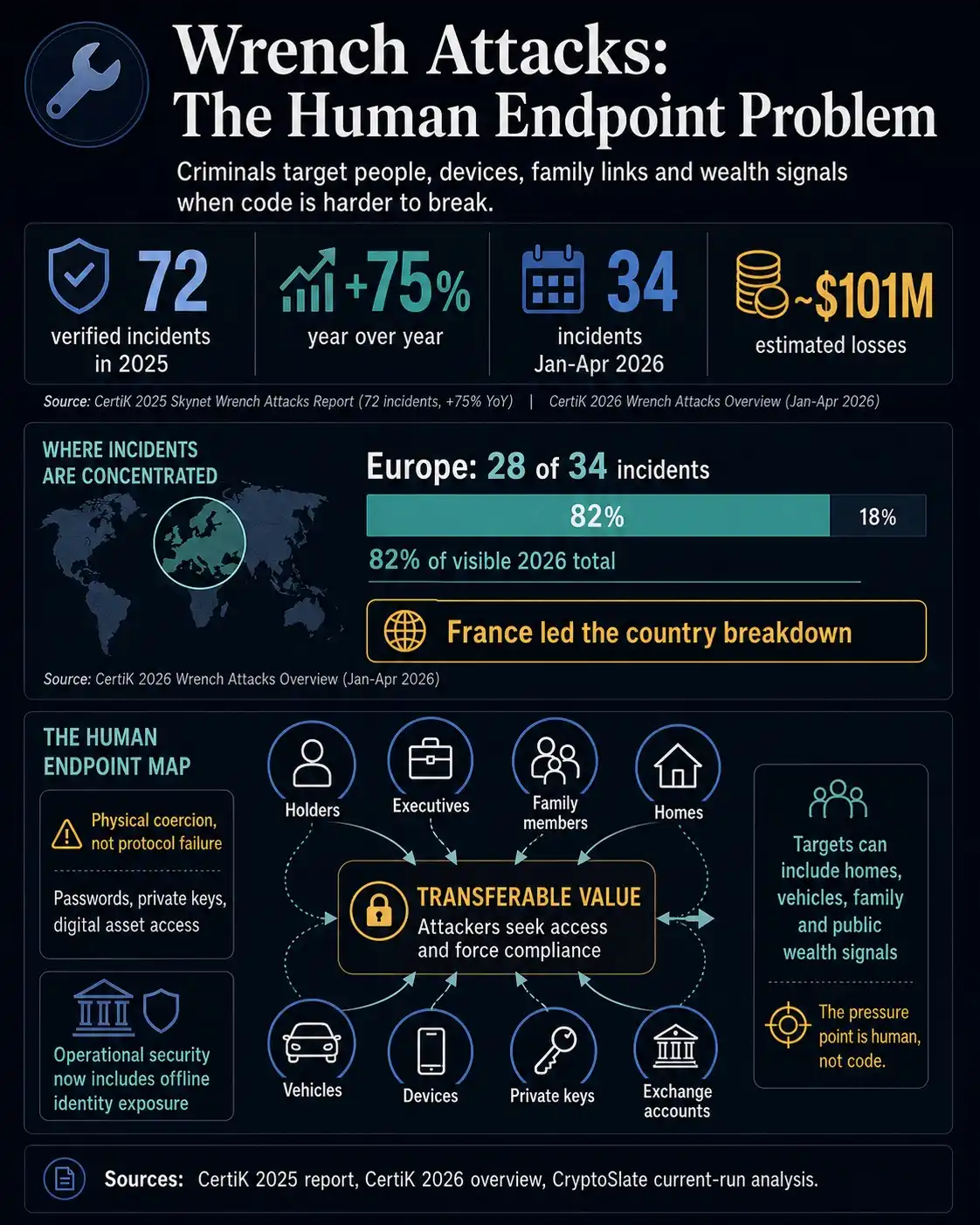
CertiK data shows that crypto 'wrench attacks' targeting holders, family, devices, and other physical endpoints confirmed 72 incidents in 2025, a 75% year-on-year increase. Of 34 cases in the first 4 months of 2026, 82% occurred in Europe, with estimated total losses of ~$101M. The core risk lies in the human/physical endpoint, not code vulnerabilities.

The Danbury case confirms that this attack model against crypto holders is now a judicial challenge for US prosecutors and federal courts.

Court records fully illustrate how the offline safety crisis sparked by crypto assets integrates into standard violent crime enforcement: gang recruitment, cross-regional operations, surveillance, hostage-taking of family, luxury car target identification, and hostage coercion for Bitcoin—the entire criminal chain is clearly documented.

For crypto asset holders and industry businesses, the scope of operational security has broadened significantly. Beyond online risks like phishing, wallet theft, exchange account breaches, and smart contract vulnerabilities, offline exposure risks related to identity, home addresses, electronic devices, and family must be seriously addressed.

The next key judicial signal will be the sentencing outcome. Saif Faiq's August 28th hearing will demonstrate how federal courts define and punish his culpability in this robbery conspiracy.

Long-term, all cases warranting close attention share a commonality: criminals identify crypto holders through offline clues like family, residences, vehicles, and public social profiles. It is precisely these cases that are transforming a safety crisis once concentrated in France into a societal issue that law enforcement across the US must confront—each court filing serves as a risk warning.


Kripto yang Sedang Tren

Pertanyaan Terkait

QWhat is a 'wrench attack' in the context of cryptocurrency, as described in the article?

AA 'wrench attack' is a type of crime where physical violence or coercion is used to force a victim into surrendering passwords, private keys, or access to their digital assets.

QAccording to the article, what was the primary target of the assailants in the Danbury, Connecticut case?

AThe primary target was Bitcoin. The assailants planned to kidnap the parents of an individual involved in a separate Bitcoin theft case to coerce that individual into handing over the cryptocurrency.

QBased on the data from CertiK's reports cited in the article, which region is identified as the core hotspot for 'wrench attacks'?

AEurope, specifically France, is identified as the core hotspot for 'wrench attacks'. Data shows 82% of recorded attacks in early 2026 occurred in Europe.

QWhat role did the Lamborghini Urus play in the Danbury kidnapping case, according to the prosecutors?

AThe Lamborghini Urus served as a visible marker of wealth, signaling to the criminals that the target likely held significant Bitcoin and was worth targeting for robbery.

QWhat broader security lesson does the Danbury case highlight for cryptocurrency holders?

AIt highlights that while blockchain protocols themselves may be secure, the human holders are vulnerable. Physical security is crucial, as family members, luxury possessions, and public displays of wealth can make holders and their loved ones targets for violent coercion aimed at seizing crypto assets.

Bacaan Terkait

Panduan Membeli di Titik Terendah oleh Grayscale: Menilai Nilai Cryptocurrency Menggunakan Arus Kas

**Panduan Investasi di Titik Terendah Pasar dengan Analisis Arus Kas untuk Kripto** Pasar kripto telah turun sejak awal tahun, menimbulkan pertanyaan tentang aset mana yang bernilai investasi pada harga saat ini. Banyak aset kripto, seperti token DeFi, mirip dengan instrumen keuangan dan dapat dinilai berdasarkan arus kas mereka. Laporan ini menggunakan Aave, platform pinjam-meminjam terdepan, sebagai studi kasus. Analisis menggunakan model Discounted Cash Flow (DCF) dan perbandingan rasio harga terhadap laba (P/E) menunjukkan bahwa token AAVE (AAVE) memiliki nilai wajar antara $80 - $100 pada level harga saat ini (~$75). Dengan asumsi pertumbuhan yang dipercepat karena adopsi stablecoin dan tokenisasi aset riil (RWA), valuasi bisa mencapai sekitar $175 dalam setahun. Laporan ini menekankan pentingnya mengklasifikasikan aset kripto (sebagai "aset komoditas" seperti Bitcoin atau "aset arus kas" seperti token DeFi) dan menggunakan kerangka penilaian yang sesuai. DeFi telah membuktikan dirinya sebagai sektor yang menghasilkan pendapatan nyata. Kunci penilaiannya bukan hanya pendapatan protokol, tetapi mekanisme "value capture" yang jelas – bagaimana keuntungan protokol dialirkan kembali ke pemegang token melalui mekanisme seperti pembelian kembali (buyback) atau distribusi. Aave, sebagai DAO yang matang dengan pendapatan beragam, neraca yang kuat, dan roadmap produk yang solid (seperti stablecoin GHO dan pasar institusional Horizon), menunjukkan bagaimana kesuksesan protokol dapat terikat dengan nilai token. Namun, ketidakpastian regulasi untuk DAO tetap menjadi tantangan. Undang-undang seperti **CLARITY Act** (dengan probabilitas disahkan 51% pada 2026) dapat memberikan kejelasan dengan mengkategorikan aset seperti AAVE sebagai "aset jaringan". Kesimpulannya, pasar semakin matang dan menghargai proyek dengan fundamental bisnis nyata, pendapatan berkelanjutan, dan alokasi modal yang disiplin. Investor harus beralih dari spekulasi naratif ke analisis fundamental berbasis arus kas dan multipler untuk mengidentifikasi peluang di proyek-proyek seperti Aave, Uniswap, dan lainnya.

marsbit9m yang lalu

Panduan Membeli di Titik Terendah oleh Grayscale: Menilai Nilai Cryptocurrency Menggunakan Arus Kas

marsbit9m yang lalu

Setelah Semikonduktor Memimpin Kenaikan, Apakah Dana Membeli Pesanan AI Atau Pemulihan Makro?

**Inti Artikel:** Setelah konflik geopolitik mereda, saham teknologi AS naik, terutama di sektor semikonduktor dan rantai perangkat keras AI. Kunci pertanyaannya: apakah kenaikan ini didorong oleh pemulihan makro (valuasi) atau pesanan AI yang riil? **Poin Utama:** 1. **Pemicu Awal: Risiko Geopolitik Turun.** Kesepakatan AS-Iran untuk perpanjangan gencatan senjata dan navigasi di Selat Hormuz mengurangi ketakutan akan lonjakan harga minyak dan inflasi. Ini meredakan tekanan pada suku bunga dan memberikan ruang bagi pemulihan valuasi saham pertumbuhan, termasuk teknologi. 2. **Uang Mengalir ke Rantai Perangkat Keras AI.** Aliran dana tidak merata ke semua sektor teknologi. Dana lebih terkonsentrasi pada chip, interkoneksi optik, memori, dan manufaktur domestik. Ini menunjukkan investor lebih selektif, mencari perusahaan dengan pendapatan riil dari pembangunan infrastruktur AI/data center (misalnya, Astera Labs dengan laporan pendapatan yang kuat). 3. **Contoh Kasus: Intel.** Lonjakan saham Intel (~10-11%) dipicu pernyataan Trump tentang kolaborasi dengan Apple, yang masuk dalam narasi manufaktur domestik dan kebijakan. Namun, ini masih berupa katalis kebijakan. Fundamental Intel (skala kontrak, timeline, profitabilitas) perlu dibuktikan lebih lanjut. 4. **Peringatan dan Verifikasi Ke Depan.** Kenaikan ini adalah **perbaikan selektif dalam selera risiko**, bukan konfirmasi siklus AI yang dipercepat kembali. Kelanjutannya bergantung pada: * **Data Makro:** Stabilitas navigasi Selat Hormuz dan harga minyak. * **Data Mikro (Kunci):** Laporan Q2 harus menunjukkan pengeluaran modal (_capital expenditure_) vendor cloud yang tetap kuat, pesanan server AI yang berkelanjutan, serta pandangan pendapatan perusahaan interkoneksi optik dan memori yang terus tumbuh. * **Kasus Intel:** Perlu konfirmasi detail kolaborasi dengan Apple yang berdampak finansial. **Kesimpulan:** Pasar memanfaatkan jendela perbaikan valuasi dari meredanya risiko geopolitik untuk membeli kembali aset-aset dalam rantai perangkat keras AI yang memiliki visibilitas pendapatan lebih nyata. Namun, tren jangka panjang bergantung pada verifikasi order dan profitabilitas di kuartal-kuartal mendatang.

marsbit18m yang lalu

Setelah Semikonduktor Memimpin Kenaikan, Apakah Dana Membeli Pesanan AI Atau Pemulihan Makro?

marsbit18m yang lalu

Kraken Tambahkan Perdagangan Token On-Chain Solana Langsung di Dalam Aplikasinya

**Kraken Tambahkan Perdagangan Token On-Chain Solana Langsung di Aplikasinya** Kraken kini mengizinkan perdagangan token on-chain Solana langsung dalam aplikasi utamanya. Fitur ini tersedia bagi pengguna di AS dan lebih dari 100 negara, dengan sekitar 2.500 token berbasis Solana yang terverifikasi pada peluncurannya. Dengan fitur baru ini, pengguna tidak perlu lagi membuat dompet eksternal, menyimpan frasa seed, atau beralih antar aplikasi untuk berdagang aset di jaringan Solana. Kraken membungkus seluruh proses on-chain ke dalam antarmuka yang sudah dikenal pengguna, sehingga aset on-chain muncul bersama aset Kraken lainnya di portofolio yang sama. Langkah ini merupakan upaya Kraken untuk menjembatani kesenjangan antara perdagangan terpusat (CEX) dan terdesentralisasi (DeFi). Solana dipilih sebagai jaringan pertama karena likuiditas dan aktivitas perdagangan token barunya yang tinggi, yang seringkali terbentuk on-chain sebelum terdaftar di bursa terpusat. Infrastruktur fitur ini didukung oleh teknologi dompet tersemat dari Privy dan protokol DEX Solana, yang menangani mekanisme dompet dan transaksi di latar belakang. Meski antarmuka lebih sederhana, Kraken mengingatkan bahwa token yang diperdagangkan melalui DEX ini belum tentu direview seperti pencatatan terpusat, sehingga risiko pasar tetap ada. Perilisan ini mencerminkan tren besar di mana bursa terpusat berusaha mengakomodasi aktivitas DeFi ke dalam platform mereka, agar tidak kehilangan pengguna yang beralih ke perdagangan on-chain.

bitcoinist1j yang lalu

Kraken Tambahkan Perdagangan Token On-Chain Solana Langsung di Dalam Aplikasinya

bitcoinist1j yang lalu

Seluruh Dunia Mengagumi Kedatangan Noam, Namun Utang OpenAI Semakin Menebal

OpenAI mengumumkan perekrutan Noam Shazeer, salah satu penulis kunci makalah "Attention Is All You Need", sebagai pemimpin penelitian arsitektur, yang disambut antusias. Namun, di saat yang sama, laporan keuangan teraudit perusahaan mengungkapkan kerugian operasional besar: $20,92 miliar pada 2025 dan pembakaran tunai $3,7 miliar pada kuartal pertama 2026. Artikel ini mempertanyakan logika di balik perekrutan bintang mahal ini dengan latar belakang tekanan keuangan yang parah. Inti masalah OpenAI bukanlah kekurangan bakat teknis, tetapi model bisnisnya: biaya komputasi yang sangat tinggi (termasuk $10,59 miliar untuk sewa daya komputasi dari Microsoft), sambil mengandalkan basis pengguna gratis yang luas dengan hanya 50 juta pengguna berbayar. Sementara itu, OpenAI telah kehilangan banyak pendiri dan peneliti inti seperti Ilya Sutskever dan Jan Leike, menunjukkan pergeseran fokus dari penelitian eksplorasi ke iterasi produk. Perekrutan Noam dilihat sebagai "pembelian cemas" yang lebih bertujuan untuk menciptakan narasi yang kuat guna mendukung valuasi IPO yang sangat tinggi (hingga $1 triliun), daripada menyelesaikan masalah profitabilitas mendasar. Sebagai perbandingan, Anthropic dilaporkan mendekati profitabilitas dengan fokus pada klien korporat yang memberikan aliran pendapatan yang lebih stabil dan dapat diprediksi. Artikel menyimpulkan bahwa tanah subur untuk inovasi berkelanjutan datang dari budaya internal yang mempertahankan talenta, bukan dari menyewa bintang mahal, dan bahwa lembar neraca tidak peduli dengan kejeniusan individu, melainkan dengan jalur yang jelas menuju keberlanjutan keuangan.

marsbit2j yang lalu

Seluruh Dunia Mengagumi Kedatangan Noam, Namun Utang OpenAI Semakin Menebal

marsbit2j yang lalu

Trading

Spot
Futures

Artikel Populer

Cara Membeli QUICK

Selamat datang di HTX.com! Kami telah membuat pembelian Quickswap (QUICK) menjadi mudah dan nyaman. Ikuti panduan langkah demi langkah kami untuk memulai perjalanan kripto Anda.Langkah 1: Buat Akun HTX AndaGunakan alamat email atau nomor ponsel Anda untuk mendaftar akun gratis di HTX. Rasakan perjalanan pendaftaran yang mudah dan buka semua fitur.Dapatkan Akun SayaLangkah 2: Buka Beli Kripto, lalu Pilih Metode Pembayaran AndaKartu Kredit/Debit: Gunakan Visa atau Mastercard Anda untuk membeli Quickswap (QUICK) secara instan.Saldo: Gunakan dana dari saldo akun HTX Anda untuk melakukan trading dengan lancar.Pihak Ketiga: Kami telah menambahkan metode pembayaran populer seperti Google Pay dan Apple Pay untuk meningkatkan kenyamanan.P2P: Lakukan trading langsung dengan pengguna lain di HTX.Over-the-Counter (OTC): Kami menawarkan layanan yang dibuat khusus dan kurs yang kompetitif bagi para trader.Langkah 3: Simpan Quickswap (QUICK) AndaSetelah melakukan pembelian, simpan Quickswap (QUICK) di akun HTX Anda. Selain itu, Anda dapat mengirimkannya ke tempat lain melalui transfer blockchain atau menggunakannya untuk memperdagangkan mata uang kripto lainnya.Langkah 4: Lakukan trading Quickswap (QUICK)Lakukan trading Quickswap (QUICK) dengan mudah di pasar spot HTX. Cukup akses akun Anda, pilih pasangan perdagangan, jalankan trading, lalu pantau secara real-time. Kami menawarkan pengalaman yang ramah pengguna baik untuk pemula maupun trader berpengalaman.

219 Total TayanganDipublikasikan pada 2024.12.11Diperbarui pada 2026.06.02

Cara Membeli QUICK

Diskusi

Selamat datang di Komunitas HTX. Di sini, Anda bisa terus mendapatkan informasi terbaru tentang perkembangan platform terkini dan mendapatkan akses ke wawasan pasar profesional. Pendapat pengguna mengenai harga QUICK (QUICK) disajikan di bawah ini.

活动图片