Tornado Cash sanctions will ultimately undermine the US and strengthen crypto

CointelegraphDipublikasikan tanggal 2022-08-18Terakhir diperbarui pada 2022-08-18

Abstrak

Like any aging empire, America is reacting to its competition.

The United States government’s sanctioning of the open-source code that makes up the Tornado Cash privacy protocol may be shocking, but it’s not surprising. America has been tightening its grip over the global financial system for decades ostensibly to cut down on bad behavior but also to project power abroad.

Economic sanctions, like the ones enforced by the aptly named Office of Foreign Assets Control, are a powerful weapon. The agency’s website states that it “enforces economic and trade sanctions based on U.S. foreign policy and national security goals.” It does this to fight drug dealers, terrorists, and “other threats to the national security, foreign policy or economy of the United​ States.”

Scary stuff, particularly when enforced by the issuer of the global reserve currency. But therein lies the rub because the more the U.S. weaponizes access to the dollar, the greater the incentive for every other country to find an alternative. One likely winner from this dynamic is Bitcoin (BTC). To see why, we need to study the architecture of money.

Fiat currencies like the U.S. dollar have no inherent transfer mechanism. Large payments can only be made through the banking system, and banks need government charters to operate. This symbiotic relationship enables governments to not only control the issuance of their money, but also access to it. For the issuer of a reserve currency, monetary censorship becomes a powerful weapon, arguably as destructive as bombs and bullets.

Bitcoin is different because it has its own censorship-resistant payment system. Anyone can make payments to anyone else — with or without the involvement of a licensed intermediary. Governments can still wield power over individual exchanges, custodians, or miners, but they can’t stop the protocol or the community that runs it.

Bitcoin is also apolitical in ways that fiat currencies can never be. Along with ever stricter sanctions regimes, the U.S. has recently taken the drastic step of freezing the foreign exchange reserves of Russia and Afghanistan. Regardless of one’s opinion of the legitimacy of such acts, they drive home the point that dollar reserves are only useful so long as their owners stay on America’s good side.

A critic could argue that the sanctioning of Tornado Cash proves cryptocurrencies are not immune from politics. Indeed, the U.S. has been sanctioning Ethereum and Bitcoin addresses for years. What makes crypto unique is the fact that the decentralized protocols in question don’t care, at least not in a way a bank might.

After all, the permissionless nature of these networks means that anyone can do anything, including continuing to process transactions for sanctioned addresses. That doesn’t mean that a European miner or South American exchange wants to upset Washington, but it does mean that they could if they had to. This optionality may come in handy in a crisis.
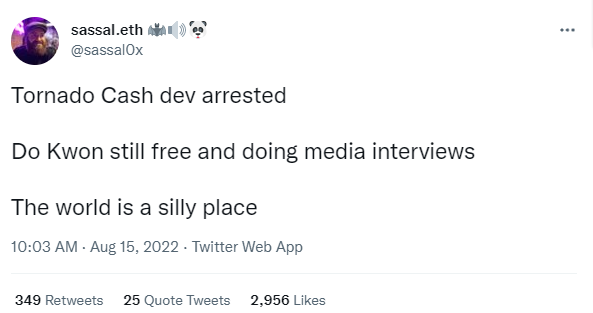
None of this means that global adoption of Bitcoin is imminent. The infrastructure remains raw, and most governments remain cautious, in part because censorship resistance also challenges their monetary grip at home. But the more globalization reverses, and the more America tries to enforce her will on other countries, the greater the need for a backup plan.

This relatively new threat to the dollar is one explanation for why America refuses to pass sensible crypto regulations, despite a thriving domestic industry. The more the U.S. normalizes Bitcoin as a store of value internally, the higher the odds that it gets adopted as a reserve asset abroad. If it’s good for Blackrock, then why not a central bank?

Countries don’t need to put their entire reserves in Bitcoin to benefit from its utility. Given its relative youth and volatility, it would be risky to own too much — just ask El Salvador. But as a “break-glass-in-case-of-emergency” reserve asset, a little bit would go a long way.

Like any aging empire, America is likely to react to this competition. If other countries do start adopting Bitcoin, then Washington may become even more Draconian with the use of sanctions, trying to blacklist coins held by regimes it doesn’t like, and punishing miners who process certain transactions. But that would mostly hurt the American crypto industry while reinforcing the need for a global alternative.

Historically, the most popular reserve currencies have been issued by countries with trustworthy legal systems. The more arbitrary American sanctions become, the less trust others will have in its money. Bitcoin always does what it’s supposed to, making it an ideal reserve currency.


Bacaan Terkait

STRC Saham Preferen Terlepas dari Patokan 11%, Akankah Mesin Abadi Strategy Tetap Berputar?

Penulis: Azuma, Odaily Planet Daily Saham preferen STRC milik MicroStrategy terus mengalami "de-pegging" (lepas dari patokan). Sejak 15 Mei, harga STRC telah menyimpang dari nilai target US$100, dan diskonnya semakin dalam, bahkan sempat menyentuh US$83,26 dan ditutup di US$88,59, atau terlepas lebih dari 11% dari nilai target. STRC dirancang sebagai sekuritas pendapatan yang beroperasi di sekitar nilai US$100. Pelepasannya dari patokan ini menantang logika produk ini. Sebagai saluran pendanaan utama MicroStrategy untuk menambah cadangan Bitcoin, harga STRC mencerminkan kepercayaan pasar terhadap model operasi modal perusahaan. STRC adalah mesin dari "flywheel" (roda gila) modal MicroStrategy. Ia memungkinkan penerbitan berkelanjutan melalui mekanisme ATM selama harganya stabil di atas US$100, menciptakan daya beli tanpa mengencerkan ekuitas pemegang saham biasa (MSTR). Roda gila ini bergantung pada stabilitas harga STRC di sekitar US$100. Untuk mempertahankannya, MicroStrategy menerapkan mekanisme penyesuaian dividen bulanan. Namun, meskipun dividen dinaikkan menjadi 11,5% dan frekuensinya menjadi dua minggu sekali, de-pegging tetap berlanjut. Penyebab de-pegging terutama adalah masalah kepercayaan. Selain tekanan jual dari pelaku arbitrase yang menggunakan leverage, kekhawatiran utama adalah likuiditas MicroStrategy. Laporan JPMorgan menyebut kewajiban dividen tahunan sekitar US$1,7 miliar, dengan cadangan tunai hanya cukup untuk sekitar 6,3 bulan. MicroStrategy membantah, menyatakan cadangan Bitcoin-nya dapat menutupi dividen selama 32 tahun, namun itu mengasumsikan penjualan Bitcoin jika diperlukan. Baru-baru ini, MicroStrategy untuk pertama kalinya menjual 32 Bitcoin, yang mengguncang pasar karena bertentangan dengan narasi "HODL" (hold/tahan) jangka panjang mereka. STRC yang terus terdiskonto akan melemahkan kemampuan pendanaan MicroStrategy. Jika situasi ini berlanjut sementara cadangan tunai terkuras, kekhawatiran akan penjualan Bitcoin lebih lanjut untuk membayar dividen akan meningkat. Sebagai pembeli besar Bitcoin, pergeseran potensial MicroStrategy dari pembeli menjadi penjual dapat memberikan tekanan signifikan pada harga Bitcoin.

marsbit16m yang lalu

STRC Saham Preferen Terlepas dari Patokan 11%, Akankah Mesin Abadi Strategy Tetap Berputar?

marsbit16m yang lalu

Baru Saja, Pemenang Nobel Bergabung sebagai Karyawan Baru Anthropic

Baru-baru ini, John Jumper, pemenang Hadiah Nobel Kimia dan pemimpin inti AlphaFold, mengumumkan keluar dari Google DeepMind setelah hampir 9 tahun untuk bergabung dengan Anthropic. Langkah ini terjadi hanya dua hari setelah Noam Shazeer, salah satu penulis kunci makalah "Attention Is All You Need", meninggalkan Google untuk OpenAI. Kedua kepindahan ini menjadi pukulan besar bagi Google, dengan para pengamat menilai perusahaan kehilangan dua aset berharga dalam 72 jam. Jumper bergabung dengan DeepMind pada 2017, hanya 6 bulan setelah meraih gelar PhD, dan langsung ditunjuk untuk memimpin tim AlphaFold. Di bawah kepemimpinannya, AlphaFold 2 pada 2020 memecahkan masalah pelipatan protein yang telah berlangsung 50 tahun. Pada 2024, ia dan Demis Hassabis memenangkan Hadiah Nobel Kimia atas karyanya. Prestasinya dikatakan mempercepat penemuan struktur protein hingga 1000 kali lipat. Kepindahan Jumper ke Anthropic memperkuat ambisi perusahaan tersebut di bidang ilmu kehidupan. Sebelumnya, Anthropic telah mengakuisisi Coefficient Bio seharga $400 juta dan meluncurkan produk khusus seperti Claude for Life Sciences. Di sisi lain, OpenAI juga gencar berinvestasi di sektor ini dengan model GPT-Rosalind dan komitmen dana miliaran dolar. Sementara itu, Google DeepMind melalui Isomorphic Labs tetap menjadi pemain kuat berkat teknologi AlphaFold. Perpindahan para peneliti top dari Google memicu pertanyaan tentang daya tarik perusahaan besar versus lab AI yang lebih gesit. Seorang investor berkomentar bahwa lab AI frontier menawarkan sesuatu yang tidak dimiliki Google: perasaan bahwa satu orang dapat mengubah jalur perusahaan. Industri kini menyaksikan persaingan sengit antara Anthropic, OpenAI, dan Google DeepMind untuk mendominasi revolusi AI di bidang ilmu kehidupan.

marsbit22m yang lalu

Baru Saja, Pemenang Nobel Bergabung sebagai Karyawan Baru Anthropic

marsbit22m yang lalu

Trading

Spot
Futures
活动图片