From Spring Festival Gala Robots to the Computing Power Energy War: Why Does China Hold the 'Trump Card' in the AI Era?

marsbitDipublikasikan tanggal 2026-02-22Terakhir diperbarui pada 2026-02-22

Abstrak

China's 2026 Spring Festival Gala showcased a breakthrough in embodied AI, featuring robots from companies like Magic Atom, Unitree, and Galaxy General performing complex tasks such as dancing, martial arts, and comedy. This demonstrated China's advanced progress in robotics and AI physical integration. Meanwhile, the U.S. faces an escalating energy crisis, with electricity prices rising 36% by early 2026. Training AI models like GPT-4 consumes power equivalent to 100,000 households annually, and U.S. data centers are projected to use 600,000 GWh by 2028. Aging infrastructure, fragmented grids, and lengthy approval processes for new transmission lines exacerbate the problem. In contrast, China has built a strategic advantage through decades of infrastructure investment. It operates 45 ultra-high-voltage (UHV) power transmission projects, spanning 40,000 kilometers, efficiently delivering clean energy from the west to eastern data centers. Renewable energy accounts for over 60% of China’s power capacity, with 40% of electricity coming from green sources. China also dominates transformer production, holding 60% of global capacity. While the U.S. excels in AI algorithms, China’s robust energy infrastructure—UHV grids, renewable energy, and manufacturing capacity—provides a foundational edge in the AI era, turning energy into a critical competitive asset.

In the Spring Festival of 2026, while the world was still marveling at OpenAI's latest model parameters, China used a Spring Festival Gala to showcase another facet of AI to the world—the physical implementation of embodied intelligence.

Looking at the program list of the 2026 CCTV Spring Festival Gala, we witnessed an unprecedented "AI military parade." This was no longer the simple mechanical dance displays of a few years ago but a concentrated explosion of China's robotics industry featuring "multiple enterprises, multiple models, and full-scene applications."
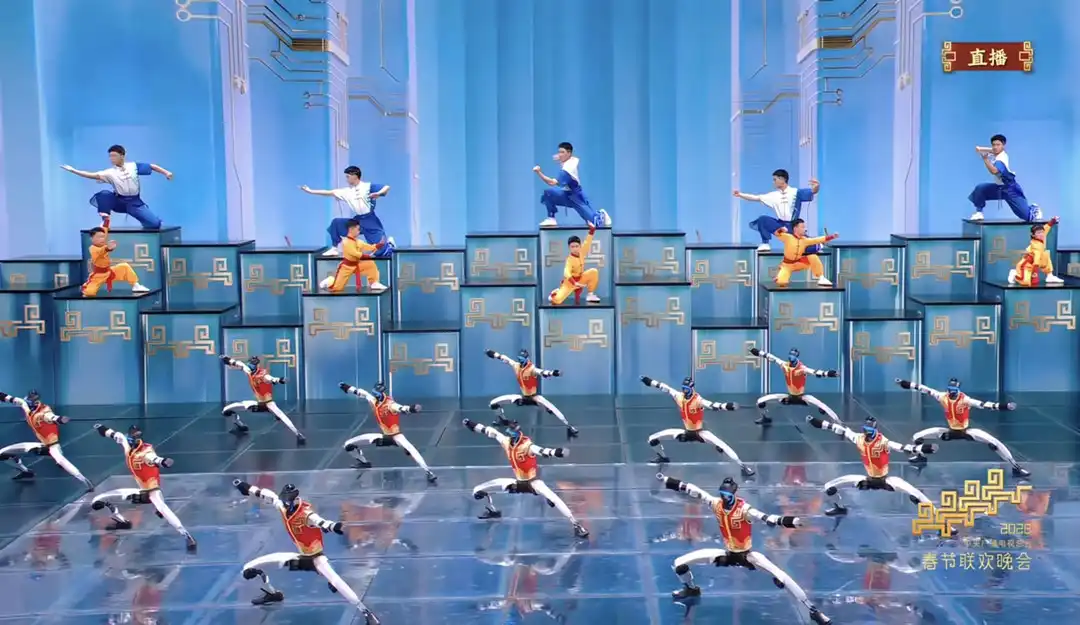
  • Magic Atom's full-stack cluster made robots the best "atmosphere group," accompanying Chen Xiaochun and Yi Yangqianxi in "Intelligent Manufacturing Future" with coordination so seamless it was hard to distinguish from humans.
  • Unitree's G1 and H2 robots demonstrated astonishing motion control capabilities in "Wǔ BOT"—without real-time remote control, relying entirely on edge-side computing power for autonomous balance. When the H2, draped in a red robe, performed a sword dance, it proved that the motion cerebellum of Chinese robots had matured.
  • Songyan Power, in the skit "Grandma's Favorite," assigned robots the comedic role of delivering and responding to punchlines, completing the transition from "prop" to "actor."
  • Galaxy General's Galbot G1 performed "walnut rolling" in a microfilm—a seemingly simple action that showcased the pinnacle of dexterous hand and tactile feedback technology.

The Gala sent a clear signal: China's AI is not just confined to servers; it has grown limbs and entered reality.

However, just as we were cheering for the robots, Wall Street was plunged into silent panic. They discovered that the "lifeblood" powering these systems—electricity—was running dry. Shifting our gaze from the Gala stage to Silicon Valley's data centers, we encounter the elephant in the room—power.

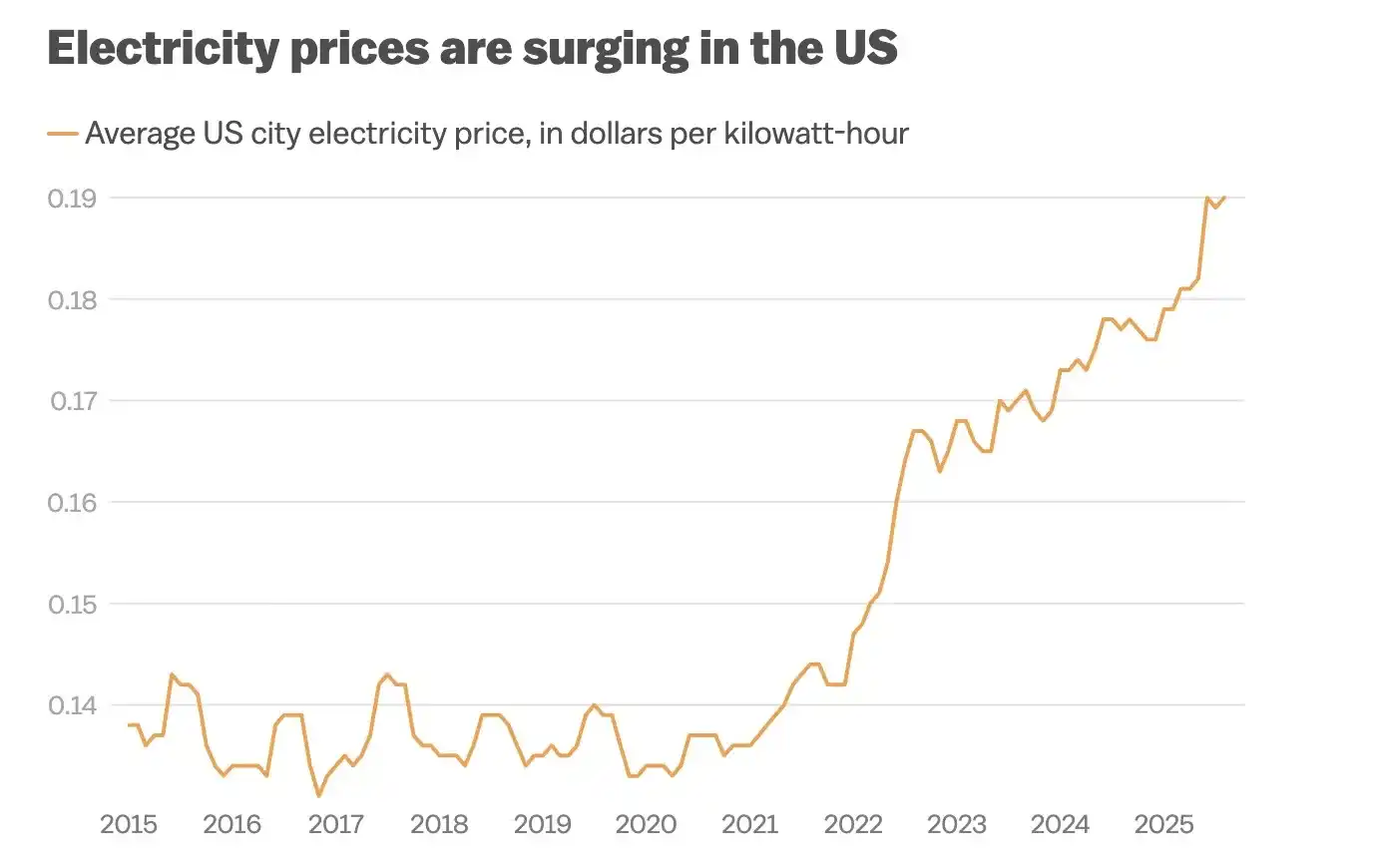
By early 2026, U.S. residential electricity prices had surged by 36%, reaching $0.18 per kWh. But this was just the surface; the core crisis lay in the collapse of the supply side. Training a GPT-4-level model consumes as much electricity as 100,000 households use in a year. By 2028, the annual electricity consumption of U.S. data centers is projected to skyrocket to 600,000 GWh.
The U.S. power grid is facing a dual crisis of "heart disease" and "vascular blockage." Five percent of its electricity relies on aging fossil fuels and nuclear power, and these units are facing a retirement wave. The U.S. grid is fragmented into three major islands—East, West, and Texas—with poor interconnectivity. Approving an interstate transmission line can take up to 15 years, preventing wind power from the Midwest from reaching East Coast data centers.

As Sam Altman said, "Energy is currency." In Silicon Valley today, CEOs are no longer troubled by chip quotas but by—where can they find enough electricity to run these chips?

If computing power is the engine of AI, then electricity is its fuel. In this energy game, China, with a decade of超前布局 (forward-looking planning), has built a strategic moat that the U.S. cannot easily replicate. If computing power is the engine of AI, then electricity is its fuel. In this energy game, China, with a decade of超前布局 (forward-looking planning), has built a strategic moat that the U.S. cannot easily replicate.

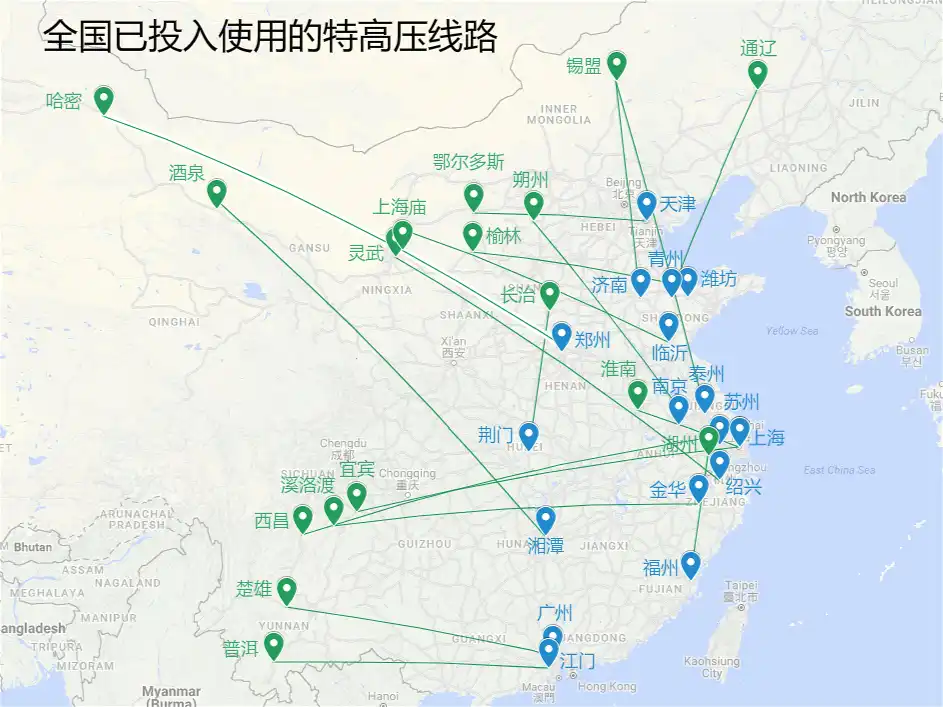
By 2025, China had completed 45 ultra-high voltage (UHV) projects, with the total length of UHV DC transmission lines exceeding 40,000 kilometers. These "electricity superhighways" can transmit abundant clean energy from the west to data centers in the east at millisecond speeds, or directly support the "East Data West Computing" hubs. China possesses 35 of the world's 37 largest high-voltage direct current cable systems—an infrastructure gap that is an insurmountable chasm for the U.S. in the short term.
The high energy consumption of AI inherently demands clean energy. In 2025, the proportion of renewable energy installed capacity in China historically surpassed 60%, with new wind and solar installations exceeding 430 million kilowatts. Of the total electricity consumption, nearly 4 out of every 10 kWh came from green power. While the U.S. is still grappling with nuclear power plant delays, China has achieved grid parity for photovoltaics and wind power, providing a cheap and green energy solution for high-consumption AI data centers.

China is the global manufacturing center for transformers, accounting for over 60% of global production. The biggest pain point for U.S. grid upgrades is transformer shortages, with delivery times now stretching to 3-4 years. Whether through transshipment via Mexico or direct procurement, the maintenance of the U.S. grid is highly dependent on Chinese manufacturing. While U.S. data centers face shutdowns due to transformer shortages, China's power equipment companies are operating at full capacity, supporting the rapid expansion of domestic computing infrastructure.

The 2026 Spring Festival Gala was not just a carnival of robots but also a profile of China's industrial strength.

When we watch Unitree's robotic dogs tumble and Galaxy General's robots perform tasks on screen, we must not forget: behind every agile movement, there is not only advanced algorithms but also a stable current transmitted thousands of kilometers through UHV lines, supported by a robust power grid.

In the second half of this AI revolution, the marginal cost of computing power growth will no longer depend on the nanometer size of chips but on the cost of acquiring joules. The U.S. possesses top-tier algorithm design, but China has the most powerful energy conversion and delivery system.

For investors, the logic is clear: in this gold rush, if NVIDIA is selling shovels, then China's infrastructure builders (UHV, power equipment, green energy) control the water source.


Kripto yang Sedang Tren

Pertanyaan Terkait

QWhat was the significance of the 2026 CCTV Spring Festival Gala in showcasing China's AI capabilities?

AThe 2026 CCTV Spring Festival Gala served as a significant demonstration of China's advancements in embodied AI and physical robotics. It featured a multi-enterprise, multi-model, and all-scenario display of China's robot industry, moving beyond simple mechanical dances to show highly coordinated performances, advanced motion control, and robots taking on complex roles like comedy and delicate manipulation, signaling that China's AI has tangible, real-world applications.

QWhat is the core energy crisis facing the United States in relation to AI development as described in the article?

AThe core energy crisis facing the U.S. is a severe shortage of electricity to power its AI data centers. The U.S. grid is struggling with an aging infrastructure reliant on fossil fuels and nuclear power, which is facing a retirement wave. Additionally, the grid is fragmented into three major isolated networks, and bureaucratic delays in approving new transmission lines (taking up to 15 years) prevent the efficient transfer of renewable energy from the Midwest to data centers on the coasts. This has caused electricity prices to soar and threatens the operational capacity of AI systems.

QHow has China built a strategic advantage in the AI energy game according to the article?

AChina has built a strategic advantage through a decade of超前布局 (forward-looking planning) in its energy infrastructure. It has constructed 45 ultra-high voltage (UHV) power transmission projects, creating a 'power highway' over 40,000 kilometers long that efficiently transmits clean energy from the west to data centers in the east. China also dominates global transformer manufacturing (over 60% capacity) and has achieved a historic milestone with renewable energy accounting for over 60% of its installed capacity, providing a cheap and green power solution for its AI data centers.

QWhat does the article suggest is the new limiting factor for AI's computational growth?

AThe article suggests that the new limiting factor for AI's computational growth is no longer the nanometer size of chips, but the cost of acquiring energy (the cost per joule). The marginal cost of increasing computing power is becoming dependent on the availability and cost of the electrical energy required to run the powerful hardware.

QWhat analogy does the article use to describe the role of Chinese infrastructure companies in the AI 'gold rush'?

AThe article uses the analogy of a gold rush. It states that if NVIDIA is selling shovels (the hardware/tools for AI), then Chinese infrastructure builders—those involved in ultra-high voltage power transmission, power equipment, and green energy—control the water source. This means they provide the essential, foundational resource (energy) that is required for the entire AI industry to function and grow.

Bacaan Terkait

BlackRock Luncurkan ETF Bitcoin Covered-Call dengan Ticker BITA

BlackRock telah meluncurkan iShares Bitcoin Premium Income ETF (BITA), menambahkan lapisan baru pada lini produk bitcoinnya. Tidak seperti reksa dana spot bitcoin biasa, BITA dirancang untuk menghasilkan pendapatan dengan menggunakan strategi opsi covered-call yang terhubung dengan eksposur bitcoin dan iShares Bitcoin Trust (IBIT). Strategi ini menawarkan cara berbeda bagi investor untuk mendapatkan eksposur bitcoin. Alih-alih hanya memegang aset dan menunggu apresiasi harga, BITA bertujuan mengumpulkan premi opsi dan mendistribusikan pendapatan bulanan. Produk ini mungkin menarik bagi investor yang menginginkan hasil berbasis kripto tanpa langsung menggunakan protokol DeFi atau produk pinjaman lepas pantai. Dengan strategi covered-call, investor menerima pendapatan premi tetapi mengorbankan sebagian keuntungan jika harga bitcoin melonjak tajam di atas harga kesepakatan opsi. Ini menjadikan BITA menarik di pasar yang bergerak sideways atau bergejolak, tetapi mungkin tertinggal dari kinerja spot murni saat terjadi breakout. Peluncuran BITA menunjukkan pasar ETF bitcoin berkembang melampaui produk spot sederhana, menuju strategi yang lebih beragam seperti penghasilan premi dan integrasi portofolio. Produk ini terutama ditujukan bagi investor yang sudah menerima tesis bitcoin tetapi menginginkan produk berorientasi pendapatan yang lebih halus dalam akun pialang, atau bagi penasihat keuangan yang ingin membahas eksposur bitcoin tanpa hanya mengandalkan apresiasi harga. Penting bagi investor untuk memahami pertukaran risiko-imbal hasil ini sebelum membandingkan kinerjanya dengan bitcoin.

bitcoinist7j yang lalu

BlackRock Luncurkan ETF Bitcoin Covered-Call dengan Ticker BITA

bitcoinist7j yang lalu

Jepang Naikkan Suku Bunga, Mengapa Seluruh Dunia Merasa Cemas?

Bank sentral Jepang menaikkan suku bunga kebijakan menjadi 1% pada Juni 2026, tingkat pertama kali dalam 1% sejak 1995. Meski angka ini masih rendah dibandingkan AS dan Eropa, kenaikan ini sangat diperhatikan pasar global karena menandai perubahan mendasar dari kebijakan suku bunga ultra-rendah yang berlangsung selama tiga dekade. Inti kekhawatiran global terletak pada peran Jepang sebagai "pusat pendanaan berbiaya terendah global." Selama lebih dari 20 tahun, investor internasional meminjam yen dengan biaya hampir nol untuk berinvestasi di aset berimbal hasil tinggi di seluruh dunia (saham AS, obligasi emerging market, dll.), menciptakan "carry trade" yen. Praktik ini menjadi sumber likuiditas murah penting yang mendorong kenaikan harga aset global. Kini, kenaikan suku bunga Jepang mengancam logika fundamental ini. Biaya pinjaman yen yang meningkat memaksa investor global mengevaluasi ulang dan berpotensi mengurangi posisi leverage mereka, yang dapat memicu kontraksi likuiditas dan volatilitas di pasar keuangan global. Pasar tidak terlalu khawatir dengan level bunga 1%, tetapi lebih pada perubahan tren dan runtuhnya konsensus bahwa "Jepang akan selamanya menyediakan uang murah." Faktor pendorong kenaikan suku bunga antara lain: inflasi yang bertahan di atas target 2%, kenaikan upah berkelanjutan ("siklus positif upah-inflasi"), dan tekanan pada yen yang melemah. Namun, arah akhir aliran modal global tetap akan sangat dipengaruhi oleh kebijakan The Fed AS. Jika AS mulai menurunkan suku bunga sementara Jepang menaikkan, penyempitan selisih suku bunga AS-Jepang dapat berdampak lebih besar pada pasar.

marsbit9j yang lalu

Jepang Naikkan Suku Bunga, Mengapa Seluruh Dunia Merasa Cemas?

marsbit9j yang lalu

Trading

Spot
Futures

Artikel Populer

Cara Membeli GALA

Selamat datang di HTX.com! Kami telah membuat pembelian GALA (GALA) menjadi mudah dan nyaman. Ikuti panduan langkah demi langkah kami untuk memulai perjalanan kripto Anda.Langkah 1: Buat Akun HTX AndaGunakan alamat email atau nomor ponsel Anda untuk mendaftar akun gratis di HTX. Rasakan perjalanan pendaftaran yang mudah dan buka semua fitur.Dapatkan Akun SayaLangkah 2: Buka Beli Kripto, lalu Pilih Metode Pembayaran AndaKartu Kredit/Debit: Gunakan Visa atau Mastercard Anda untuk membeli GALA (GALA) secara instan.Saldo: Gunakan dana dari saldo akun HTX Anda untuk melakukan trading dengan lancar.Pihak Ketiga: Kami telah menambahkan metode pembayaran populer seperti Google Pay dan Apple Pay untuk meningkatkan kenyamanan.P2P: Lakukan trading langsung dengan pengguna lain di HTX.Over-the-Counter (OTC): Kami menawarkan layanan yang dibuat khusus dan kurs yang kompetitif bagi para trader.Langkah 3: Simpan GALA (GALA) AndaSetelah melakukan pembelian, simpan GALA (GALA) di akun HTX Anda. Selain itu, Anda dapat mengirimkannya ke tempat lain melalui transfer blockchain atau menggunakannya untuk memperdagangkan mata uang kripto lainnya.Langkah 4: Lakukan trading GALA (GALA)Lakukan trading GALA (GALA) dengan mudah di pasar spot HTX. Cukup akses akun Anda, pilih pasangan perdagangan, jalankan trading, lalu pantau secara real-time. Kami menawarkan pengalaman yang ramah pengguna baik untuk pemula maupun trader berpengalaman.

548 Total TayanganDipublikasikan pada 2024.12.11Diperbarui pada 2026.06.02

Cara Membeli GALA

Diskusi

Selamat datang di Komunitas HTX. Di sini, Anda bisa terus mendapatkan informasi terbaru tentang perkembangan platform terkini dan mendapatkan akses ke wawasan pasar profesional. Pendapat pengguna mengenai harga GALA (GALA) disajikan di bawah ini.

活动图片












