Ethereum Foundation Backs SEAL Initiative as LiquidChain L3 Protocol Gains Traction

bitcoinistDipublikasikan tanggal 2026-02-10Terakhir diperbarui pada 2026-02-10

Abstrak

The Ethereum Foundation has officially backed the Security Alliance (SEAL), a coalition of white-hat hackers and researchers, to strengthen the crypto industry’s coordinated defense against drainer attacks. SEAL’s "SEAL 911" initiative enables real-time reporting of exploits, helping intercept stolen funds before they are laundered. This move signals a shift from reactive security measures to more structural solutions that reduce complexity and risk. LiquidChain ($LIQUID), a Layer 3 protocol, is gaining traction as a architectural solution to cross-chain vulnerabilities. By unifying liquidity across Bitcoin, Ethereum, and Solana into a single execution layer, it eliminates the need for risky bridging operations—a common attack vector. The project has raised over $533K in its presale, reflecting growing institutional interest in infrastructure that abstracts away cross-chain complexity and enhances security through design rather than intervention.

Trusted Editorial content, reviewed by leading industry experts and seasoned editors. Ad Disclosure

Quick Facts:

  • ➡️ The Ethereum Foundation has officially backed the Security Alliance (SEAL), strengthening the industry’s coordinated response against crypto drainers.
  • ➡️ Market focus is shifting from reactive security measures to architectural solutions that reduce complexity.
  • ➡️ LiquidChain is capitalizing on this trend by unifying Bitcoin, Ethereum, and Solana liquidity into a single, secure L3 execution layer.
  • ➡️ Institutional support for white-hat initiatives signals a maturing market where security is treated as a public good rather than a luxury.

The decentralized finance security landscape just shifted.

By formally backing the Security Alliance (SEAL), the Ethereum Foundation is acknowledging a hard truth: code audits alone aren’t enough to stop the rising tide of sophisticated crypto drainers.

SEAL, a coalition of white-hat hackers and researchers, has quietly become the industry’s emergency response team. Their ‘SEAL 911’ initiative lets victims and protocols report active exploits in real-time, often intercepting funds before they hit mixers.

The Foundation’s backing isn’t just financial; it’s an institutional nod to coordinated defense. Previously, protocols fought threats in silos. Now, the centralization of threat intelligence creates a “herd immunity” effect that makes drainer-as-a-service operations significantly harder to scale.

But let’s be honest: while SEAL treats the symptoms (exploits), the market is hunting for a cure to the root cause: complexity. Most losses happen during the intricate dance of bridging assets and signing obscure permissions.

Ironically, for an industry built on trustless code, our security still relies heavily on human intervention. Recognizing this, investors are rotating toward architectural solutions that remove the need for risky bridging entirely.

This thesis is driving capital into LiquidChain ($LIQUID), a Layer 3 infrastructure project designed to unify liquidity across Bitcoin, Ethereum, and Solana.

Learn more about LiquidChain here.

LiquidChain Unifies Liquidity To Remove Bridge Risk

Fragmentation is the enemy of security. Every time you wrap an asset or use a third-party bridge, you introduce a new point of failure, a vector that drainers exploit with ruthless efficiency. LiquidChain ($LIQUID) positions itself as the structural antidote, fusing the liquidity of the three largest ecosystems into a single execution environment.

By operating as a Layer 3 (L3) protocol, LiquidChain allows developers to deploy applications once that access Bitcoin, Ethereum, and Solana simultaneously.

For the end-user, this means ‘single-step execution.’ Instead of the perilous multi-step process of bridging $ETH to $SOL, swapping, and then staking, actions that often require signing multiple blind approvals, LiquidChain handles the cross-chain complexity at the protocol level.

This creates a verifiable settlement layer where the friction (and risk) of interoperability is abstracted away. The project’s unique proposition isn’t building a better bridge; it’s creating an environment where bridges are rendered invisible. Developers gain access to a Cross-Chain VM, allowing them to tap into Bitcoin’s capital base while using Solana’s speed.

No more navigating the dark forest of cross-chain transfers.

$LIQUID is available here.

Smart Money Rotates Into L3 Infrastructure As Presale Crosses $533K

While the broader market reacts to security headlines, astute capital is quietly positioning itself in infrastructure plays that streamline the user experience. The data tells the story: LiquidChain ($LIQUID) has raised over $533K to date.

Currently priced at $0.0136, the token represents a bet on the ‘abstraction narrative’, the idea that the next billion users won’t care (or know) which chain they’re using.
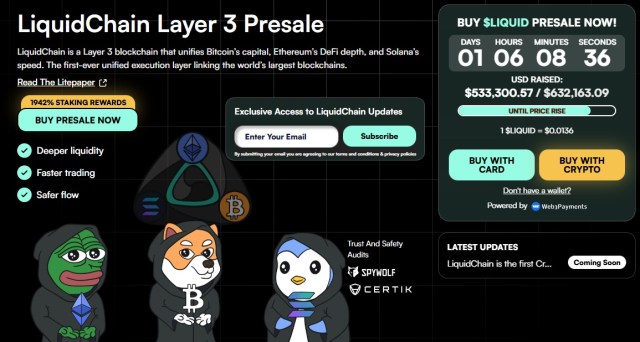
The capital inflow suggests investors are looking beyond commoditized Layer 2 scaling solutions toward Layer 3 protocols with specific interoperability use cases.

The utility of the $LIQUID token extends beyond simple governance. It functions as the transaction fuel for this cross-chain environment and facilitates liquidity staking. In a market where yield is often chased at the expense of safety, LiquidChain’s model offers a compelling alternative: rewards derived from the friction of unifying the world’s disparate blockchains.

With the presale gaining momentum, the window for early entry at these valuations is narrowing as the project approaches mainnet deployment.

Buy $LIQUID here.

Disclaimer: The content provided in this article is for informational purposes only and does not constitute financial advice. Cryptocurrency investments carry inherent risks, including high volatility and potential loss of principal. Always conduct your own research.

Editorial Process for bitcoinist is centered on delivering thoroughly researched, accurate, and unbiased content. We uphold strict sourcing standards, and each page undergoes diligent review by our team of top technology experts and seasoned editors. This process ensures the integrity, relevance, and value of our content for our readers.

patrubogdan

Follow

Full Profile

Related Posts

Crypto Exchange Backpack Targets Token Launch Soon, as BMIC Fires Up Quantum Defense

Vitalik Buterin Outlines Ethereum’s AI Future, While SUBBD Token Targets the Creator Economy

Binance Dominates Trump’s USD1 Supply as Bitcoin Hyper Breaks Records

Cathie Wood’s Ark Invest Buys More Bullish Assets Just Days After Last Purchase, While LiquidChain Turns Heads

Polymarket Sues Massachusetts Over Prediction Market Regulation – SUBBD Token Takes Advantage

Bitcoin Hyper Could Conquer 2026 if Bitcoin Regains Lost Ground

Kripto yang Sedang Tren

Pertanyaan Terkait

QWhat is the SEAL initiative and why is the Ethereum Foundation backing it?

AThe SEAL (Security Alliance) initiative is a coalition of white-hat hackers and researchers that serves as the industry's emergency response team against crypto drainers. The Ethereum Foundation is backing it to strengthen the coordinated defense against exploits, providing both financial support and institutional validation for centralized threat intelligence to create a 'herd immunity' effect.

QHow does LiquidChain's L3 protocol address security concerns in DeFi?

ALiquidChain's Layer 3 protocol unifies liquidity from Bitcoin, Ethereum, and Solana into a single execution layer, eliminating the need for risky cross-chain bridges. It reduces complexity by allowing 'single-step execution' and abstracting away interoperability friction, thereby removing common attack vectors used by drainers.

QWhat is the current presale status and token price of LiquidChain ($LIQUID)?

ALiquidChain's presale has raised over $533,000 to date, with the $LIQUID token currently priced at $0.0136.

QHow does SEAL's 'SEAL 911' initiative work?

ASEAL's 'SEAL 911' initiative allows victims and protocols to report active exploits in real-time, enabling white-hat hackers to intercept funds before they reach mixers or are laundered.

QWhat is the core investment thesis behind capital flowing into L3 infrastructure like LiquidChain?

AThe investment thesis centers on the 'abstraction narrative' - that next-generation users won't care about underlying blockchain complexity. Investors are betting on infrastructure that streamlines user experience by unifying liquidity across chains and eliminating bridging risks, treating security as a fundamental architectural feature rather than an add-on.

Bacaan Terkait

「Saham Konsep Nvidia」Wawancara dengan Co-Founder CoreWeave: Permintaan AI Terus Meningkat Setiap Hari

Wawancara dengan para eksekutif CoreWeave, penyedia cloud khusus AI, menggarisbawahi bahwa permintaan akan komputasi AI terus meningkat dan berkembang setiap hari, mendorong perubahan besar dalam infrastruktur. Fokus tidak lagi hanya pada ketersediaan GPU, tetapi meluas ke tantangan kompleks seperti daya untuk pusat data, CPU, penyimpanan, dan pasokan komponen. CoreWeave, yang melayani klien utama seperti OpenAI dan Microsoft, melihat pergeseran struktural dalam beban kerja AI. Dengan munculnya AI agen dan model penalaran, pentingnya CPU dan penyimpanan semakin meningkat. Perusahaan merancang ulang pusat datanya untuk mengakomodasi lebih banyak CPU (seperti Vera CPU dari Nvidia) dan penyimpanan di samping server GPU generasi mendatang (seperti Vera Rubin). Para eksekutif menekankan bahwa model bisnis mereka sepenuhnya didorong oleh kontrak dan permintaan pelanggan. Mereka bersaing berdasarkan rekam jejak eksekusi yang terbukti, kemampuan teknikal, dan kemampuan menyediakan kinerja serta efisiensi biaya per token terbaik. Saat ini, hambatan utama bukanlah GPU, melainkan ketersediaan "powered shells" (bangunan pusat data yang siap daya) dan komponen di dalamnya. Mereka juga menjelaskan bahwa biaya komponen seperti HBM (memori bandwidth tinggi) diteruskan kepada pelanggan melalui kontrak yang sudah ditetapkan sebelumnya, sehingga melindungi margin CoreWeave. Untuk generasi hardware baru seperti server Vera Rubin, pola deployment diperkirakan akan meningkat signifikan sekitar tahun 2027, mengikuti pola pendahulunya, platform Blackwell.

marsbit48m yang lalu

「Saham Konsep Nvidia」Wawancara dengan Co-Founder CoreWeave: Permintaan AI Terus Meningkat Setiap Hari

marsbit48m yang lalu

STRC Lepas Anker 11%, Mesin Uang Abadi Strategy Masih Berputar?

Prioritas saham STRC Strategy, yang dirancang untuk diperdagangkan di sekitar nilai nominal $100, terus mengalami disosiasi ("de-pegging"). Harga sempat turun hingga $83.26, jauh di bawah nilai target. STRC adalah mesin utama dalam "roda modal" Strategy, memungkinkan perusahaan mengumpulkan uang tanpa mengencerkan ekuitas pemegang saham biasa (MSTR). Model ini bergantung pada harga STRC yang stabil di $100 agar mekanisme penerbitan saham terus berjalan. Meskipun Strategy telah meningkatkan dividen menjadi 11.5% dan mempercepat pembayarannya untuk menarik investor, harga tetap turun. Penyebabnya diduga karena tekanan jual dari dana arbitrase yang menggunakan leverage dan, yang lebih penting, kekhawatiran pasar terhadap likuiditas Strategy. Laporan Morgan Stanley menyoroti cadangan kas Strategy yang terbatas untuk membayar dividen, sementara Strategy berargumen bahwa cadangan Bitcoin-nya cukup untuk jangka panjang. Namun, keputusan Strategy baru-baru ini untuk menjual sejumlah kecil Bitcoin (meski disebut sebagai "uji coba") telah mengguncang kepercayaan pasar pada narasi "HODL" mereka yang lama. Jika STRC tetap diskon dan kemampuan pendanaan Strategy melemah, kekhawatiran bahwa perusahaan mungkin perlu menjual lebih banyak Bitcoin untuk memenuhi kewajibannya bisa meningkat. Ini berpotensi mengubah Strategy dari pembeli besar Bitcoin menjadi penjual, memberikan tekanan signifikan pada harga pasar.

链捕手1j yang lalu

STRC Lepas Anker 11%, Mesin Uang Abadi Strategy Masih Berputar?

链捕手1j yang lalu

Di Balik Skor AI, Ada "Pembuat Soal" Seorang Tionghoa

Setiap peluncuran model AI terbaru, industri sering merujuk pada sejumlah "rapor" standar seperti MMLU-Pro, MMMU, dan MMMU-Pro. Di balik sistem evaluasi kunci ini, terdapat seorang "penyusun soal" bernama Chen Wenhu, asisten profesor di University of Waterloo. MMLU-Pro dikembangkan oleh Chen dan timnya sebagai respons atas keterbatasan MMLU lama. Ketika model-model mutakhir seperti o3 OpenAI mulai mencapai skor hampir sempurna, MMLU-Pro hadir dengan 12.032 soal yang lebih menantang, memperluas pilihan jawaban dan menekankan penalaran, sehingga berhasil membedakan kemampuan model yang sebelumnya tampak setara. Chen juga terlibat dalam MMMU, tolok ukur multimodal yang mengevaluasi pemahaman model terhadap gambar, grafik, dan teks secara terintegrasi. MMMU-Pro kemudian menyempurnakannya dengan memastikan model tidak bisa mengandalkan teks saja. Latar belakang Chen dalam pemahaman informasi kompleks dan pengembangannya di Google DeepMind untuk proyek Gemini memberinya wawasan mendalam. Ia mendirikan TIGERLab (atau "Geng Harimau"), yang tidak hanya fokus pada evaluasi tetapi juga riset model, seperti UniVideo untuk video dan MoCha untuk karakter virtual. Saat ini, Chen bergabung dengan Meta Super Intelligence Lab, terus berkontribusi pada data dan evaluasi multimodal. Karyanya mengingatkan bahwa di balik kemajuan AI yang terlihat, ada banyak talenta seperti dirinya yang membangun fondasi penting bagi perkembangan industri.

marsbit2j yang lalu

Di Balik Skor AI, Ada "Pembuat Soal" Seorang Tionghoa

marsbit2j yang lalu

Trading

Spot
Futures

Artikel Populer

Cara Membeli L3

Selamat datang di HTX.com! Kami telah membuat pembelian Layer3 (L3) menjadi mudah dan nyaman. Ikuti panduan langkah demi langkah kami untuk memulai perjalanan kripto Anda.Langkah 1: Buat Akun HTX AndaGunakan alamat email atau nomor ponsel Anda untuk mendaftar akun gratis di HTX. Rasakan perjalanan pendaftaran yang mudah dan buka semua fitur.Dapatkan Akun SayaLangkah 2: Buka Beli Kripto, lalu Pilih Metode Pembayaran AndaKartu Kredit/Debit: Gunakan Visa atau Mastercard Anda untuk membeli Layer3 (L3) secara instan.Saldo: Gunakan dana dari saldo akun HTX Anda untuk melakukan trading dengan lancar.Pihak Ketiga: Kami telah menambahkan metode pembayaran populer seperti Google Pay dan Apple Pay untuk meningkatkan kenyamanan.P2P: Lakukan trading langsung dengan pengguna lain di HTX.Over-the-Counter (OTC): Kami menawarkan layanan yang dibuat khusus dan kurs yang kompetitif bagi para trader.Langkah 3: Simpan Layer3 (L3) AndaSetelah melakukan pembelian, simpan Layer3 (L3) di akun HTX Anda. Selain itu, Anda dapat mengirimkannya ke tempat lain melalui transfer blockchain atau menggunakannya untuk memperdagangkan mata uang kripto lainnya.Langkah 4: Lakukan trading Layer3 (L3)Lakukan trading Layer3 (L3) dengan mudah di pasar spot HTX. Cukup akses akun Anda, pilih pasangan perdagangan, jalankan trading, lalu pantau secara real-time. Kami menawarkan pengalaman yang ramah pengguna baik untuk pemula maupun trader berpengalaman.

276 Total TayanganDipublikasikan pada 2024.12.06Diperbarui pada 2026.06.02

Cara Membeli L3

Diskusi

Selamat datang di Komunitas HTX. Di sini, Anda bisa terus mendapatkan informasi terbaru tentang perkembangan platform terkini dan mendapatkan akses ke wawasan pasar profesional. Pendapat pengguna mengenai harga L3 (L3) disajikan di bawah ini.

活动图片