KuCoin Consensus Hong Kong 2026 Participation Benefits LiquidChain and the L3 Narrative

bitcoinistDipublikasikan tanggal 2026-02-09Terakhir diperbarui pada 2026-02-09

Abstrak

The pivot of crypto's center of gravity to Asia is accelerating, highlighted by events like Consensus Hong Kong 2026 and participation from major players like KuCoin. A key challenge in Asian markets is fragmented liquidity across major chains like Bitcoin, Ethereum, and Solana, leading to inefficiencies and risks with wrapped assets. LiquidChain ($LIQUID) emerges as a Layer 3 (L3) solution designed to unify these liquidity pools into a single execution layer, eliminating reliance on bridges and wrapped tokens. It offers a "deploy-once" model for developers to access users across all three chains seamlessly. The project’s presale has raised over $532K, with tokens priced at $0.0136, attracting early capital focused on infrastructure and interoperability. The $LIQUID token serves as transaction fuel and offers staking rewards, positioning it as a potential key player in the cross-chain narrative leading up to 2026.

The pivot of crypto’s center of gravity from West to East isn’t just a forecast anymore; it’s an active migration. With Consensus, the industry’s premier gathering, planting its flag in Hong Kong for 2025 and setting the stage for future iterations, the narrative has firmly shifted toward Asian liquidity dominance.

This momentum is further solidified by major players like KuCoin, which recently announced its participation in Consensus Hong Kong 2026. On February 12, Edwin Wong, KuCoin’s Vice President and Head of Risk Control, will join the featured panel ‘Turning Intelligence Into Action’ on the Explorations Stage to discuss how on-chain signals and AI capabilities can be translated into trust-first infrastructure and practical governance.

Hong Kong’s aggressive regulatory clarity has created a vacuum for liquidity hubs. While major exchanges figure out the licensing maze, the underlying trend is the unification of fragmented markets. Traders in the Asian session historically drive massive volume across Bitcoin, Ethereum, and increasingly, Solana. But there’s a catch: the friction of moving capital between these chains remains the industry’s glaring inefficiency.

Context matters. Bitcoin recently tested the $100K psych-level before retracing, while Ethereum struggles to maintain dominance against Solana’s monolithic speed. This ‘chain tribalism’ fractures liquidity, making execution expensive and slow. The winners of the 2026 cycle won’t be the L1s fighting for dominance. It’ll be the L3s that connect them. (It’s somewhat ironic that while users argue over which chain is ‘best,’ smart money is quietly funding the protocols that make the underlying chain irrelevant to the end-user.)

This infrastructure gap is where new interoperability layers enter the chat. As exchanges and institutions look toward the 2026 horizon, they need ‘deploy-once’ architectures. This macroeconomic setup creates a perfect storm for LiquidChain ($LIQUID), a project designed to dissolve the barriers between the industry’s three largest liquidity pools.

LiquidChain Solves the ‘Wrapped Asset’ Risk Plaguing Asian Markets

Fragmentation defines the current market structure. To trade $BTC on Solana, users rely on wrapped assets, derivatives that introduce counterparty risk and bridge vulnerability. LiquidChain flips this dynamic by operating as a Layer 3 (L3) infrastructure that fuses Bitcoin, Ethereum, and Solana liquidity into a single execution environment.

That matters for one big reason: institutional capital, the kind courted at events like Consensus Hong Kong, can’t tolerate bridge exploits. LiquidChain offers verifiable settlement without the complex user flows that currently plague DeFi. By enabling a ‘single-step execution’ model, it allows developers to build apps that access users on all three chains simultaneously.
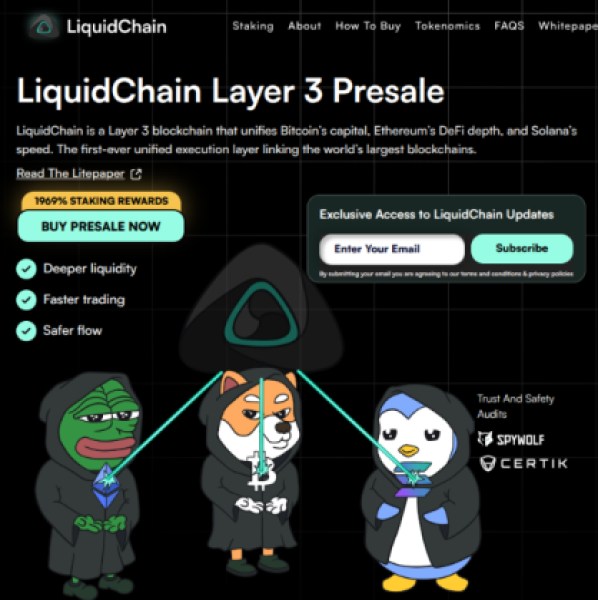
For a developer, the pitch is efficiency: deploy code once on LiquidChain, and instantly access liquidity from the top three ecosystems. No need to maintain fragmented liquidity pools across different networks, a redundancy that currently bleeds capital efficiency. As the dialogue moves toward the 2026 institutional horizon, protocols offering this level of unification are positioning themselves as the ‘TCP/IP’ of the blockchain era, invisible, essential, and highly valued.

CHECK OUT THE UNIFIED LIQUIDITY LAYER

Early Capital Flows into $LIQUID Presale Signal Infrastructure Demand

While headlines fixate on meme coin volatility, capital allocators are rotating into infrastructure plays that solve the interoperability crisis. The LiquidChain presale data reflects this methodical accumulation. It has already raised over $532K, and tokens are priced at $0.0136. Early investors also have access to staking rewards, currently sitting at 1943%.

This sub-million market cap entry point is notable compared to legacy interoperability protocols, which often trade in the billions. The pricing suggests the project is still in a discovery phase, distinct from the retail mania that usually follows major exchange listings.

The utility of the $LIQUID token extends beyond simple governance. It functions as the transaction fuel for the cross-chain VM and is required for liquidity staking. The tokenomics are designed to incentivize bonding assets from $BTC, $ETH, and $SOL into the LiquidChain ecosystem, rewarding users who provide the ‘glue’ for this unified layer. We see it as one of the next crypto to explode, due to its offering.

Investors are eyeing the $0.0136 price point not just for immediate gains, but as a derivative bet on cross-chain volume growth. If the thesis holds, that Asia will demand seamless execution across chains, LiquidChain’s ability to merge these ecosystems places it in a prime position to capture value from every transaction it facilitates.

CHECK OUT THE $LIQUID PRESALE

This article is for informational purposes only and does not constitute financial advice. Cryptocurrency investments, including presales like LiquidChain, carry high risks. Always conduct independent due diligence before participating.


Kripto yang Sedang Tren

Pertanyaan Terkait

QWhat is the significance of KuCoin's participation in Consensus Hong Kong 2026?

AKuCoin's participation, with its Vice President Edwin Wong joining the 'Turning Intelligence Into Action' panel, signifies the exchange's commitment to discussing and shaping the future of trust-first infrastructure and practical governance using on-chain signals and AI, aligning with the event's focus on Asia's growing dominance in the crypto space.

QAccording to the article, what is the primary market inefficiency that LiquidChain aims to solve?

ALiquidChain aims to solve the industry's glaring inefficiency of friction and high cost when moving capital between major blockchains like Bitcoin, Ethereum, and Solana, which fractures liquidity and makes execution expensive and slow.

QHow does LiquidChain function to unify liquidity from Bitcoin, Ethereum, and Solana?

ALiquidChain operates as a Layer 3 (L3) infrastructure that fuses liquidity from Bitcoin, Ethereum, and Solana into a single execution environment, eliminating the need for wrapped assets and their associated counterparty risk by enabling verifiable settlement and a 'single-step execution' model.

QWhat are some key details about the LiquidChain ($LIQUID) presale mentioned in the article?

AThe LiquidChain presale has raised over $532,000, with tokens priced at $0.0136. Early investors have access to staking rewards, currently at 1943% APY, and the project's low market cap entry point is seen as a discovery phase distinct from typical retail mania.

QWhat is the core utility of the $LIQUID token within its ecosystem?

AThe $LIQUID token functions as the transaction fuel for the cross-chain Virtual Machine (VM), is required for liquidity staking, and is used to incentivize users to bond assets from $BTC, $ETH, and $SOL into the LiquidChain ecosystem, rewarding those who provide liquidity for the unified layer.

Bacaan Terkait

Korea Selatan Bergerak Mengatur Transfer Crypto Lintas Batas di Bawah Kerangka Kerja Baru

Pemerintah Korea Selatan berencana memasukkan perusahaan fintech ke dalam kerangka kerja perizinan baru untuk transfer aset virtual lintas batas, yang dijadwalkan berlaku pada Desember. Peraturan ini mewajibkan perusahaan yang melakukan transfer lintas batas menggunakan aset kripto untuk mendaftar di Kementerian Ekonomi dan Keuangan serta melaporkan transaksinya melalui sistem pelaporan devisa. Kerangka regulasi ini dibuat untuk membawa transfer lintas batas berbasis kripto ke dalam pengawasan formal, menyusul temuan bahwa banyak transfer aset digital beroperasi di luar sistem pengawasan devisa dan berpotensi digunakan untuk pencucian uang serta kejahatan. Aturan VASP (Virtual Asset Service Provider) yang ada saat ini terutama membatasi akses ke bursa kripto seperti Upbit dan Bithumb. Namun, regulator berencana memperluas cakupan entitas yang memenuhi syarat untuk mencakup pelaku non-tradisional, seperti perusahaan fintech, jika mereka dapat melakukan transfer tersebut secara efisien. Otoritas masih menganalisis proses perizinan dan kepatuhan bagi calon pelamar. Kementerian dan Bank of Korea terus berkolaborasi dengan pemangku kepentingan industri untuk menyelesaikan aturan implementasi sebelum peluncuran di Desember. Perkembangan ini sejalan dengan upaya Korea Selatan memperkuat pengawasan aset digital, termasuk aturan baru untuk sekuritisasi token yang dijadwalkan terbit pada Juli.

TheNewsCrypto1j yang lalu

Korea Selatan Bergerak Mengatur Transfer Crypto Lintas Batas di Bawah Kerangka Kerja Baru

TheNewsCrypto1j yang lalu

「Saham Konsep Nvidia」Wawancara dengan Co-Founder CoreWeave: Permintaan AI Terus Meningkat Setiap Hari

Wawancara dengan para eksekutif CoreWeave, penyedia cloud khusus AI, menggarisbawahi bahwa permintaan akan komputasi AI terus meningkat dan berkembang setiap hari, mendorong perubahan besar dalam infrastruktur. Fokus tidak lagi hanya pada ketersediaan GPU, tetapi meluas ke tantangan kompleks seperti daya untuk pusat data, CPU, penyimpanan, dan pasokan komponen. CoreWeave, yang melayani klien utama seperti OpenAI dan Microsoft, melihat pergeseran struktural dalam beban kerja AI. Dengan munculnya AI agen dan model penalaran, pentingnya CPU dan penyimpanan semakin meningkat. Perusahaan merancang ulang pusat datanya untuk mengakomodasi lebih banyak CPU (seperti Vera CPU dari Nvidia) dan penyimpanan di samping server GPU generasi mendatang (seperti Vera Rubin). Para eksekutif menekankan bahwa model bisnis mereka sepenuhnya didorong oleh kontrak dan permintaan pelanggan. Mereka bersaing berdasarkan rekam jejak eksekusi yang terbukti, kemampuan teknikal, dan kemampuan menyediakan kinerja serta efisiensi biaya per token terbaik. Saat ini, hambatan utama bukanlah GPU, melainkan ketersediaan "powered shells" (bangunan pusat data yang siap daya) dan komponen di dalamnya. Mereka juga menjelaskan bahwa biaya komponen seperti HBM (memori bandwidth tinggi) diteruskan kepada pelanggan melalui kontrak yang sudah ditetapkan sebelumnya, sehingga melindungi margin CoreWeave. Untuk generasi hardware baru seperti server Vera Rubin, pola deployment diperkirakan akan meningkat signifikan sekitar tahun 2027, mengikuti pola pendahulunya, platform Blackwell.

marsbit2j yang lalu

「Saham Konsep Nvidia」Wawancara dengan Co-Founder CoreWeave: Permintaan AI Terus Meningkat Setiap Hari

marsbit2j yang lalu

Trading

Spot
Futures

Artikel Populer

Cara Membeli L3

Selamat datang di HTX.com! Kami telah membuat pembelian Layer3 (L3) menjadi mudah dan nyaman. Ikuti panduan langkah demi langkah kami untuk memulai perjalanan kripto Anda.Langkah 1: Buat Akun HTX AndaGunakan alamat email atau nomor ponsel Anda untuk mendaftar akun gratis di HTX. Rasakan perjalanan pendaftaran yang mudah dan buka semua fitur.Dapatkan Akun SayaLangkah 2: Buka Beli Kripto, lalu Pilih Metode Pembayaran AndaKartu Kredit/Debit: Gunakan Visa atau Mastercard Anda untuk membeli Layer3 (L3) secara instan.Saldo: Gunakan dana dari saldo akun HTX Anda untuk melakukan trading dengan lancar.Pihak Ketiga: Kami telah menambahkan metode pembayaran populer seperti Google Pay dan Apple Pay untuk meningkatkan kenyamanan.P2P: Lakukan trading langsung dengan pengguna lain di HTX.Over-the-Counter (OTC): Kami menawarkan layanan yang dibuat khusus dan kurs yang kompetitif bagi para trader.Langkah 3: Simpan Layer3 (L3) AndaSetelah melakukan pembelian, simpan Layer3 (L3) di akun HTX Anda. Selain itu, Anda dapat mengirimkannya ke tempat lain melalui transfer blockchain atau menggunakannya untuk memperdagangkan mata uang kripto lainnya.Langkah 4: Lakukan trading Layer3 (L3)Lakukan trading Layer3 (L3) dengan mudah di pasar spot HTX. Cukup akses akun Anda, pilih pasangan perdagangan, jalankan trading, lalu pantau secara real-time. Kami menawarkan pengalaman yang ramah pengguna baik untuk pemula maupun trader berpengalaman.

276 Total TayanganDipublikasikan pada 2024.12.06Diperbarui pada 2026.06.02

Cara Membeli L3

Diskusi

Selamat datang di Komunitas HTX. Di sini, Anda bisa terus mendapatkan informasi terbaru tentang perkembangan platform terkini dan mendapatkan akses ke wawasan pasar profesional. Pendapat pengguna mengenai harga L3 (L3) disajikan di bawah ini.

活动图片