Curve Governance Upheaval: 17 Million CRV Funding Proposal Rejected, Capital Entities Become New Decision-Making Core

marsbitDipublikasikan tanggal 2025-12-26Terakhir diperbarui pada 2025-12-26

Abstrak

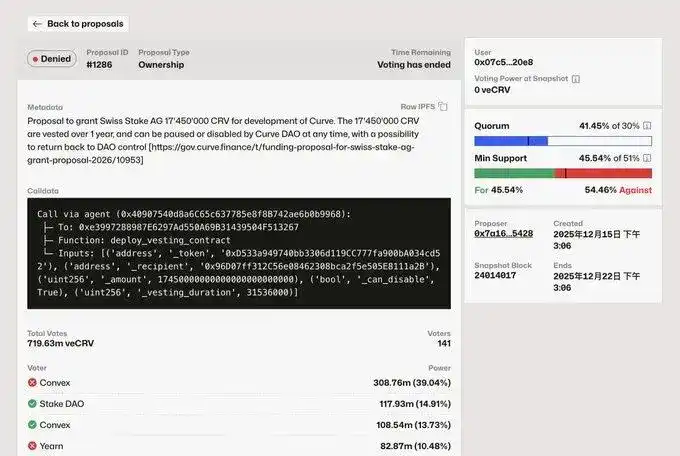
A significant governance proposal within the Curve DAO, requesting 17 million CRV in funding for development team Swiss Stake AG, was recently rejected. Major veCRV holders, including Convex and Yearn, voted against the proposal, effectively blocking its passage. The rejection reflects two key concerns within the community: a demand for greater transparency and accountability regarding the use of previous grants and future spending plans, and a reluctance from large token holders to dilute the value of their veCRV holdings without a clear, direct return on investment. The article highlights a shift in DeFi governance, moving away from a model of automatic funding approval. It contrasts the veToken model, used by Curve, with standard governance systems. The ve model binds voting power to long-term token lock-ups, attracting capital-heavy players focused on long-term gains. This, combined with the prevalence of vote-aggregating protocols like Convex, is centralizing decision-making power with large capital providers rather than the broader community or even project founders. The outcome of this vote suggests that future governance power in Curve may lie primarily with these major stakeholders.

Original Author: CM(X:@cmdefi)

A few days ago, a funding proposal on Curve was rejected. It involved allocating 17M $CRV in development funds to the development team (Swiss Stake AG). Both Convex and Yearn voted against it, and their voting power was sufficient to influence the final outcome.

Since the governance issues at Aave began to gain attention, governance has started to be scrutinized by the market, and the habitual practice of approving funding requests is being broken. Behind this Curve proposal lie two key points:

1. Some voices in the community are not opposed to funding AG, but they want clarity on how previous funds were used, future plans for usage, sustainability, and whether the projects have generated returns for the protocol. Simultaneously, this primitive grant model means that once funds are disbursed, there are no constraints. In the future, the DAO needs to establish a Treasury, ensure transparent revenue and expenditure, or add governance constraints.

2. The large veCRV holders do not want to dilute their value. This is a clear conflict of interest. If the projects supported by CRV grants cannot foreseeably create benefits for veCRV holders, they likely won't receive support. Of course, Convex and Yearn also have their own private interests and agendas, but we won't delve into those issues here.

This proposal was initiated by Curve founder Mich. AG is also one of the teams that has been maintaining the core codebase since 2020. For this funding round, AG's presented roadmap included continuing to advance llamalend, including support for PT and LP, as well as expansion into on-chain foreign exchange markets and crvUSD. These seem like worthwhile endeavors, but whether they justify a 17M $CRV grant is another calculation. Particularly because Curve's governance differs significantly from Aave's; its power is distributed among several teams with distinct stances.

Let's compare the ve model with conventional governance models:

First, the conclusion: most conventional governance models currently have essentially no design advantages. Of course, if a DAO is mature enough, traditional structures can also function well, but unfortunately, no project in Crypto has yet matured to that level, as evidenced by the problems even at market-consensus leaders like Aave.

So, if we talk specifically about model design, the ve model has some advanced aspects. Firstly, it has cash flow; it is backed by liquidity control rights. When there is external demand for liquidity, this power is "bribed." Therefore, even if you don't want to lock your tokens long-term, you can delegate them to proxy projects like Convex/Yearn to earn收益 (yield).

Thus, the ve model binds voting rights with cash flow. Its future evolution will likely follow the path of "governance capitalism." The vetoken binds voting rights with "long-term locking," essentially筛选 (screening for) those with large capital, the ability to bear liquidity loss, and the capacity for long-term博弈 (game theory). Over time, the result is that governors gradually shift from ordinary users to the "capital class."

Furthermore, due to the existence of proxy layers like Convex/Yearn, many ordinary users, even loyal ones, who wish to gain yield without losing liquidity and flexibility, will increasingly choose to delegate their governance power to these projects.

This vote also reveals some clues. In the future, Mich may not be the main character in Curve's governance; instead, power lies with these large vote holders. When governance issues arose at Aave, some proposed ideas of "delegated governance/elite governance," which is quite similar to the current structure of Curve. As for whether this is good or bad, it will take time to tell.
Kripto yang Sedang Tren

Pertanyaan Terkait

QWhat was the main reason for the rejection of the 17M CRV grant proposal for Swiss Stake AG?

AThe proposal was rejected primarily because major veCRV holders, such as Convex and Yearn, voted against it. They were concerned about the dilution of their token value and the lack of a clear, sustainable plan for how the funds would be used to generate tangible benefits for veCRV holders.

QHow does the ve (vote-escrowed) tokenomics model differ from conventional governance models according to the article?

AThe ve model binds voting rights to long-term token lock-ups, which inherently attracts large capital providers who can afford illiquidity and engage in long-term planning. This contrasts with conventional governance models, which the article argues have few inherent design advantages and often struggle without a highly mature DAO structure. The ve model also provides direct cash flow to holders through 'bribes' from protocols seeking liquidity.

QWhat role do proxy platforms like Convex and Yearn play in the Curve ecosystem?

AProxy platforms like Convex and Yearn allow ordinary CRV holders to delegate their voting power and locked tokens to them. In return, the users receive a share of the platform's revenue (e.g., from bribes) while maintaining liquidity and flexibility, as they are not locking tokens directly with Curve. This consolidation of voting power makes these platforms major decision-makers in governance.

QWhat does the article suggest about the future of Curve's governance power dynamics?

AThe article suggests that future governance power in Curve will increasingly reside with large capital holders and proxy platforms like Convex and Yearn, rather than with the founder, Michael Egorov, or the broader community. This shift represents a move towards 'governance capitalism,' where decision-making is concentrated among those with significant financial stakes.

QWhat were the key community concerns regarding the grant proposal, beyond simple opposition to funding?

ABeyond simply rejecting the grant, a part of the community wanted greater transparency and accountability. Their concerns included how previous funds had been used, the sustainability of the development plan, whether the projects would generate measurable returns for the protocol, and a desire for a more structured Treasury with transparent revenue and expenditure reporting, rather than an open-ended grant model.

Bacaan Terkait

Perusahaan Kripto Diborong Raksasa, Baik atau Buruk?

*Laporan oleh Blockchain Knight* Di tengah pasar bear, raksasa tradisional justru aktif melakukan akuisisi strategis di industri crypto. Dalam sebulan terakhir, setidaknya ada 5 akuisisi penting: 1. **Robinhood** membeli **WonderFi** (Kanada) senilai $180 juta untuk akses pasar dan lisensi. 2. **Figure** mengakuisisi **Kiavi** senilai $717 juta untuk ekspansi ke pinjaman properti berbasis RWA (Real World Assets). 3. **Franklin Templeton** membeli **250Digital** untuk membentuk divisi crypto baru yang melayani dana pensiun. 4. **Samsung Securities** membeli 2% saham **Dunamu**, operator Upbit Korea. 5. **Blockworks** (media) membeli **Messari** (data) dengan diskon >90% dari valuasi puncaknya. **Analisis Tren:** - **Harga Murah:** Akuisisi terjadi saat valuasi startup crypto anjlok, memungkinkan pembeli dengan kas kuat mendapatkan aset berharga dengan harga diskon besar. - **Loncatan Regulasi:** Membeli perusahaan yang sudah memegang lisensi lokal (seperti di Kanada dan Korea) adalah cara cepat dan aman untuk berekspansi di tengah lingkungan regulasi yang ketat. - **Validasi Teknologi:** Akuisisi besar di sektor RWA (Figure-Kiavi) menandakan adopsi blockchain sebagai infrastruktur keuangan masa depan sudah dimulai. - **Persiapan Masa Depan:** Raksasa keuangan dengan visi jangka panjang (3-5 tahun) memanfaatkan masa sepi ini untuk membangun fondasi, menguji infrastruktur, dan memposisikan diri untuk menguasai pasar saat siklus makro berbalik dan likuiditas kembali. **Kesimpulan:** Gelombang akuisisi ini menandai transisi industri crypto dari era "liar" menuju tahap institusional dan teratur. Bagi pemain besar dengan strategi matang, pasar bear justru menjadi peluang emas untuk konsolidasi dan persiapan menyambut pertumbuhan berikutnya.

marsbit41m yang lalu

Perusahaan Kripto Diborong Raksasa, Baik atau Buruk?

marsbit41m yang lalu

Strive Rugi Besar di Laporan Keuangan Mengingatkan: Tekanan Saham Preferen Strategy Telah Menyebar ke Seluruh Lini Perbendaharaan Bitcoin

Artikel ini membahas dampak risiko keuangan dari saham preferen yang diterbitkan oleh perusahaan cadangan bitcoin, dengan fokus pada kasus Strive dan Strategy. Strive, perusahaan cadangan bitcoin terbesar ketujuh, mengungkapkan kerugian sebesar $7,08 juta dalam 8 hari pada portofolio saham preferen STRC milik Strategy, meskipun jumlah sahamnya tidak berubah. Hal ini menunjukkan bagaimana penurunan nilai saham preferen dapat menyebar ke seluruh sektor melalui kepemilikan silang antar perusahaan. Strategy merespons dengan memperkenalkan kerangka kerja manajemen risiko kredit baru, termasuk meningkatkan dividen tahunan STRC menjadi 12%, aturan cadangan tunai, serta rencana pembelian kembali saham dan penjualan bitcoin untuk mendukung struktur modalnya. Namun, kalkulator nilai wajar pihak ketiga untuk STRC hanya memperkirakan nilai $49,887 per saham, jauh di bawah nilai nominal, menyoroti ketergantungan kuat valuasi pada keberlanjutan pembayaran dividen. Pasar kini mempertimbangkan dua skenario: apakah risiko terisolasi hanya pada Strategy, atau akan menyebar ke seluruh industri jika diskon terhadap nilai nominal STRC dan saham preferen lainnya seperti SATA milik Strive terus berlanjut, serta jika rencana penjualan bitcoin benar-benar dilakukan. Indikator kunci untuk dipantau adalah tingkat diskon saham preferen, kemampuan menutup dividen dengan kas, dan potensi peningkatan penjualan aset.

Foresight News1j yang lalu

Strive Rugi Besar di Laporan Keuangan Mengingatkan: Tekanan Saham Preferen Strategy Telah Menyebar ke Seluruh Lini Perbendaharaan Bitcoin

Foresight News1j yang lalu

Era MiCA dan Peta Baru Crypto Eropa, Mengapa Jerman Tampil di Panggung Utama?

Dengan MiCA memasuki tahap akhir transisi, industri kripto Eropa telah melalui penyaringan regulasi besar-besaran. Hanya sekitar 12% perusahaan kripto di UE yang telah mendapatkan otorisasi CASP hingga 1 Juli. Di peta baru ini, Jerman menonjol dengan 57 penyedia layanan aset kripto yang diotorisasi MiCA, sekitar 23% dari total otorisasi UE, menjadikannya pintu masuk kepatuhan utama ke pasar tunggal Eropa. Posisi kuat Jerman didukung oleh fondasi regulasi fungsional yang telah ada, yang mengintegrasikan layanan kripto ke dalam kerangka perbankan, sekuritas, dan pasar modal sebelum MiCA. Pendekatan ini memungkinkan transisi yang lebih mulus ke aturan UE. Bank-bank tradisional Jerman kini berperan aktif, tidak hanya sebagai bagian dari rantai kepatuhan tetapi juga sebagai saluran distribusi langsung bagi pengguna ritel. Contohnya, DZ Bank dan Sparkassen berencana menawarkan layanan perdagangan aset kripto melalui aplikasi bank mereka kepada nasabah. Lebih jauh, posisi Jerman berkembang dari pusat perdagangan menjadi hub infrastruktur aset digital Eropa. Lembaga infrastruktur pasar seperti Deutsche Börse Group dan Clearstream sedang membangun platform untuk sekuritas digital dan aset tokenisasi, yang mencakup siklus hidup penuh dari penerbitan hingga penyelesaian. Bank-bank Jerman juga terlibat dalam proyek stablecoin euro Qivalis, menunjukkan peran dalam membangun infrastruktur pembayaran digital dan penyelesaian aset masa depan di tingkat Eropa.

marsbit1j yang lalu

Era MiCA dan Peta Baru Crypto Eropa, Mengapa Jerman Tampil di Panggung Utama?

marsbit1j yang lalu

Trading

Spot

Artikel Populer

Cara Membeli CRV

Selamat datang di HTX.com! Kami telah membuat pembelian Curve DAO Token (CRV) menjadi mudah dan nyaman. Ikuti panduan langkah demi langkah kami untuk memulai perjalanan kripto Anda.Langkah 1: Buat Akun HTX AndaGunakan alamat email atau nomor ponsel Anda untuk mendaftar akun gratis di HTX. Rasakan perjalanan pendaftaran yang mudah dan buka semua fitur.Dapatkan Akun SayaLangkah 2: Buka Beli Kripto, lalu Pilih Metode Pembayaran AndaKartu Kredit/Debit: Gunakan Visa atau Mastercard Anda untuk membeli Curve DAO Token (CRV) secara instan.Saldo: Gunakan dana dari saldo akun HTX Anda untuk melakukan trading dengan lancar.Pihak Ketiga: Kami telah menambahkan metode pembayaran populer seperti Google Pay dan Apple Pay untuk meningkatkan kenyamanan.P2P: Lakukan trading langsung dengan pengguna lain di HTX.Over-the-Counter (OTC): Kami menawarkan layanan yang dibuat khusus dan kurs yang kompetitif bagi para trader.Langkah 3: Simpan Curve DAO Token (CRV) AndaSetelah melakukan pembelian, simpan Curve DAO Token (CRV) di akun HTX Anda. Selain itu, Anda dapat mengirimkannya ke tempat lain melalui transfer blockchain atau menggunakannya untuk memperdagangkan mata uang kripto lainnya.Langkah 4: Lakukan trading Curve DAO Token (CRV)Lakukan trading Curve DAO Token (CRV) dengan mudah di pasar spot HTX. Cukup akses akun Anda, pilih pasangan perdagangan, jalankan trading, lalu pantau secara real-time. Kami menawarkan pengalaman yang ramah pengguna baik untuk pemula maupun trader berpengalaman.

550 Total TayanganDipublikasikan pada 2024.12.11Diperbarui pada 2026.06.02

Cara Membeli CRV

Diskusi

Selamat datang di Komunitas HTX. Di sini, Anda bisa terus mendapatkan informasi terbaru tentang perkembangan platform terkini dan mendapatkan akses ke wawasan pasar profesional. Pendapat pengguna mengenai harga CRV (CRV) disajikan di bawah ini.

活动图片