As the sector continues to gain global momentum, Taiwanese authorities have announced that a locally issued stablecoin could be launched next year, pending the imminent approval of the country’s regulatory crypto framework and related legislation.
First Local Stablecoin To Debut Next Year
On Wednesday, Taiwan’s Financial Supervisory Commission (FSC) Chairman Peng Jin-long revealed that the island’s first regulated stablecoin could debut in the latter half of 2026, local news outlet Focus Taiwan reported.
The FSC chair affirmed that the Virtual Assets Service Act (VASA), which incorporates stablecoin regulation, could be passed during its third hearing in the next legislative session, scheduled for this week, after clearing initial reviews with a “high level of consensus.”
After the framework’s approval, stablecoin-centered regulations would be developed within six months, setting the launch of a locally issued token pegged to the New Taiwan Dollar (NTD) or the US Dollar (USD) to the second half of the year.
The VASA supports the efforts by Taiwanese authorities to establish a comprehensive crypto framework that promotes industry growth and safeguards investors. Last year, the FSC announced an overhaul of the Anti-Money Laundering (AML) framework to include crypto businesses, introducing stricter AML guidelines for Virtual Asset Service Providers (VASPs) and requiring all crypto firms to complete the AML registration by September 2025.
In January, Peng stated that investors could have a “convenient” entrance to crypto assets in the future through stablecoins, which could serve as a bridge between the country’s legal tender and virtual currency.
In March, the FSC published the finalized draft of its landmark crypto legislation, which the VASA’s draft proposed authorizing banks to issue stablecoins pegged to the New Taiwan Dollar or the US Dollar.
Meanwhile, Premier Cho Jung-tai and Central Bank Governor Yang Chin-long recently expressed support for a formal Bitcoin (BTC) policy, pledging to study the flagship cryptocurrency as a strategic reserve asset, accelerate pro-BTC rulemaking, and pilot treasury exposure through government-seized assets.
Taiwan Sets Financial Institutions’ Role
At the legislative hearing, the FSC’s chair highlighted that the bill’s draft draws from the European Union (EU)’s Markets in Crypto-Assets Regulation (MiCA). He explained that the Virtual Assets Service Act doesn’t require stablecoins to be issued exclusively by financial institutions, which has been a divisive topic in other jurisdictions.
As reported by Bitcoinist, South Korea’s long-awaited stablecoin legislation could be delayed until next year as the Korean Financial Services Commission clashes with the Bank of Korea (BOK) over the role of banks in the sector.
A local news media outlet recently noted that the BOK and regulators agree that financial institutions must be involved in the issuance of won-pegged tokens, but differ on the extent of their role.
The central bank is pushing for a consortium of banks owning at least 51% of any stablecoin issuer seeking regulatory approval. Meanwhile, regulators are concerned that giving a majority stake to banks could reduce participation from tech companies and limit the market’s innovation. Earlier this week, authorities set December 10 as the deadline for the government to deliver a draft bill.
Unlike South Korea’s financial authorities, Focus Taiwan reported that the regulator and the central bank have agreed that only financial institutions will be allowed to issue stablecoins in the initial stage to reduce risk management, suggesting that companies could join at a later stage of the project.
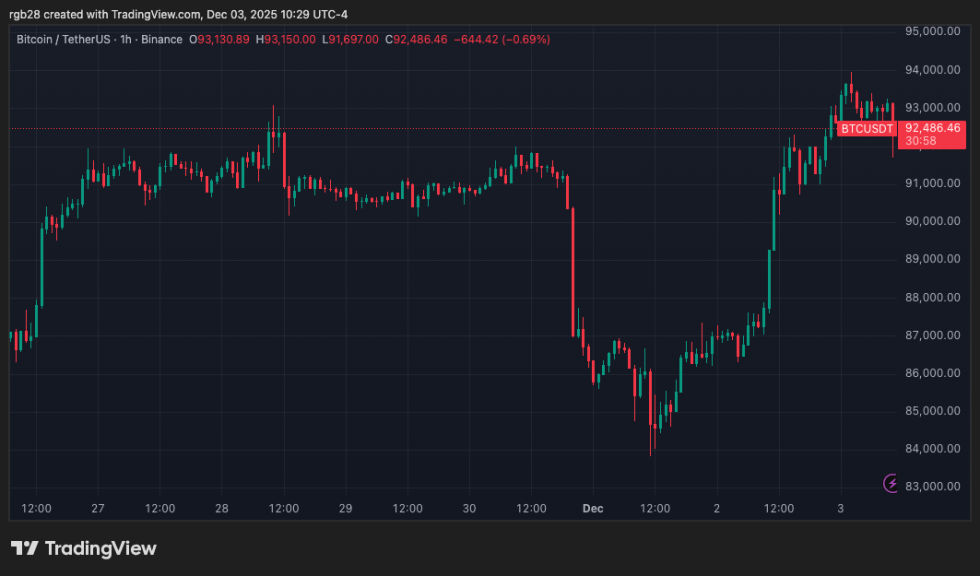
Bitcoin (BTC) trades at $92,488 in the one-week chart. Source: BTCUSDT on TradingView

Related Posts