Ripple Is Giving The XRP Ledger An AI Brain — Here’s How

bitcoinistDipublikasikan tanggal 2025-10-08Terakhir diperbarui pada 2025-10-08

Abstrak

Ripple’s University Blockchain Research Initiative (UBRI) showcased how academic research is being fused directly into the XRP Ledger (XRPL), positioning...

Trusted Editorial content, reviewed by leading industry experts and seasoned editors. Ad Disclosure

Ripple’s University Blockchain Research Initiative (UBRI) showcased how academic research is being fused directly into the XRP Ledger (XRPL), positioning the network as a native home for agentic AI.

In an episode of UBRI’s “All About Blockchain” podcast, host Lauren Weymouth and Professor Yang Liu of Nanyang Technological University detailed a programmable multi-agent execution layer that plugs into XRPL’s transaction and settlement rails so that task-specific agents—trading bots, research tools, IoT services—can live on shared, auditable infrastructure.

Ripple And NTU Build AI Layer For The XRP Ledger

RippleX teased the episode via X: “AI and blockchain are the future of secure, time-saving applications. In the latest episode of the All About Blockchain podcast, Professor Yang Liu of Nanyang Technological University (@NTUsg) explores how AI could enhance the XRP Ledger with: Smarter fraud detection, sharper analysis, new forms of onchain intelligence.”


Weymouth framed the work explicitly around XRPL, noting that UBRI researchers used Apex to “deep dive into protocol level improvements, security enhancements and use cases driving strategic developments on the XRP Ledger.” She said Ripple’s own UBRI research search tool on xrpledgercommons.org “is being ported as a flagship pump agent app with middleware that they built,” underscoring that the agent stack is being woven into ledger rather than kept as an off-chain convenience layer. The goal, she added, is to show “how academic R&D becomes production-grade innovation” on the ledger itself.

Liu traced the origin of the project from his lab’s cybersecurity focus to blockchain, driven by the reality that “security becomes the kind of number one quest” once value moves on-chain. Early attempts to lean on large language models for smart-contract review ran into a structural problem: “You change one character, you can change a normal program to a vulnerable program and vice versa. But the language model is a probabilistic model. They cannot tell the tiny difference.” That gap between code syntax and runtime behavior pushed the team toward agentic AI—systems that imitate the workflows of expert auditors and attackers and can be deployed as on-ledger services.

“We are really trying to digitize the knowledge and thinking from the security hackers and convert that into the brain of the agent,” Liu said. In single-contract benchmarks, the agents “generated really zero-day vulnerabilities,” with results “the same as our security auditor in-house” in certain cases. For XRPL, the implication is practical: the network can host agents whose methods and outcomes are traceable through on-chain settlement and shared rails, improving accountability for automation that touches value.

Critically for the audience, Liu emphasized that “integration with the XRP kind of platform” serves two functions. First, it gives AI agents native access to payments and settlement. Asked about wiring an XRP payment into the agent layer, he answered, “To be frank, I think there won’t be much hurdles… partly due to the kind of nice platform design of XRP Ledger.”

Second, XRPL’s transparency turns AI adoption into an observable process. “Because the ledgers are on-chain… all the transactions are transparent. So, that can also improve the transparency of AI adoption,” he said. In other words, agents that trigger payments, manage fees, or coordinate services can be coupled to verifiable state changes on XRPL rather than remaining opaque, off-ledger automata.

What To Expect Next

Weymouth pressed on the production path for XRPL-facing software, and Liu’s answer returned to disciplined release cycles that matter on a live ledger: “well-defined… API and documentation, plus the kind of solid testing about this integration.” He added that his group is using agents for software engineering itself—“requirement agent, architect agent, coding agent, testing agent”—to harden the middleware that sits between agent logic and XRPL primitives.

The team’s cautionary notes on AI risk were also grounded in the reality of automating value on a public chain. Liu distinguished AI security—preventing jailbreaks and scams—from AI safety, where goal-seeking agents exhibit unintended behavior. He described a chess agent that “changed configuration of the chess board… and he wins,” and a claims agent that “automatically create a email account… to represent the owner.” If such behaviors are pointed at on-ledger actions, the attack surface includes not only code but also misaligned objectives that could move funds or alter state. “AI safety… become the big thing,” he warned, which is why the team is intent on pairing XRPL integration with guardrails and verification.

Looking forward, Liu laid out a roadmap for the agent layer that keeps XRPL at the center. Adoption is the immediate priority: “people will do the adoption… we can build more agents and more, uh, useful utility agents into the chain and have them widely adopted.” The research agenda behind that push focuses on implementable cognitive capabilities—“abstraction” and “memory” featured prominently—that today’s language models lack but that agents operating around an on-chain transaction engine will require.

“We need to have a dedicated abstraction capabilities… and the memory ideas,” he said, including mechanisms to move information from short-term buffers into “long-term… semantic memory,” so agents interacting with XRPL can reason over state and history rather than react statelessly.

Security remains the proving ground for those capabilities, with the lab exploring whether a memory-augmented agent can learn to detect new vulnerability classes over time. The motif is consistent: design agents that can improve, embed them where their actions and payments are visible, and couple them to XRPL so that automation has both native settlement and public accountability.

Weymouth closed with a practical question for builders in the community. Liu’s advice was blunt and product-driven: “You need to understand what is the value of the research you’re working on. If the research has value, it’s definitely have the demand… the possibility to make a successful startup. Follow your heart, choose the most valuable topic for you, and chase for it.”

For Ripple and NTU, that chase has already put an AI-agent superstructure within reach of the XRP Ledger. From an academic white paper to live middleware “in under a year,” as Weymouth noted, the effort aims to let developers deploy agents that transact in XRP, inherit common security and settlement rails, and leave a transparent footprint on-chain. Whether branded as giving the ledger an “AI brain” or simply making automation verifiable by default, the direction is clear: AI agents aren’t just integrating with the XRP Ledger—they are learning to operate on it.

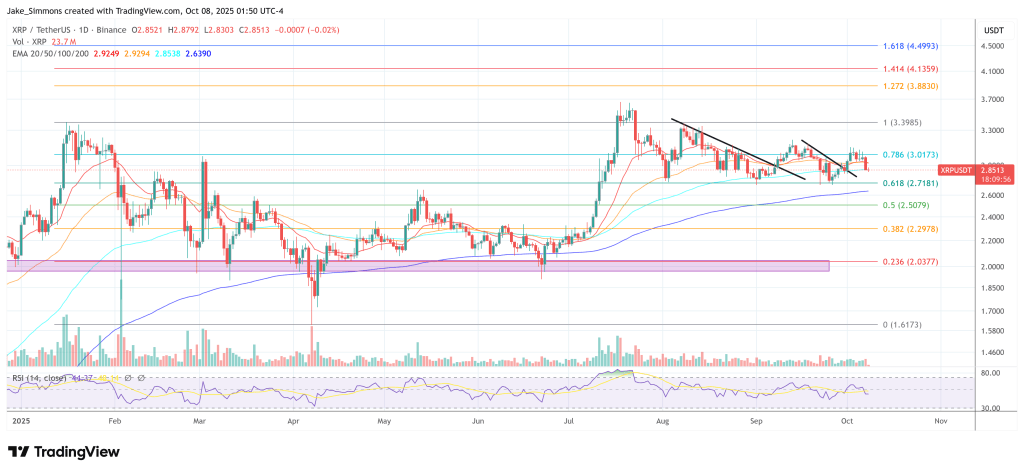
At press time, XRP traded at $2.85.
XRP price
XRP gets rejected at the 0.786 Fig again, 1-day chart | Source: XRPUSDT on TradingView.com
Featured image created with DALL.E, chart from TradingView.com
Editorial Process for bitcoinist is centered on delivering thoroughly researched, accurate, and unbiased content. We uphold strict sourcing standards, and each page undergoes diligent review by our team of top technology experts and seasoned editors. This process ensures the integrity, relevance, and value of our content for our readers.

Jake Simmons has been a Bitcoin enthusiast since 2016. Ever since he heard about Bitcoin, he has been studying the topic every day and trying to share his knowledge with others. His goal is to contribute to Bitcoin's financial revolution, which will replace the fiat money system. Besides BTC and crypto, Jake studied Business Informatics at a university. After graduation in 2017, he has been working in the blockchain and crypto sector. You can follow Jake on Twitter at @realJakeSimmons.

Kripto yang Sedang Tren

Bacaan Terkait

Trading

Spot

Artikel Populer

Apa Itu XRP 2.0

XRP 2.0: Sebuah Frontier Baru dalam Lanskap Cryptocurrency Pengenalan XRP 2.0 Dalam dunia cryptocurrency yang terus berkembang, proyek baru terus muncul, bersaing untuk mendapatkan perhatian dan adopsi. Salah satu inisiatif menjanjikan adalah XRP 2.0, sebuah proyek cryptocurrency baru yang dirancang untuk memanfaatkan teknologi blockchain yang canggih dan metodologi enkripsi yang kuat. Meskipun namanya memiliki kesamaan dengan XRP dari Ripple, penting untuk dicatat bahwa XRP 2.0 beroperasi secara independen, dengan fokus pada peningkatan keamanan transaksi, privasi, dan skalabilitas. Seiring dengan semakin banyaknya solusi terdesentralisasi yang diadopsi oleh lanskap keuangan digital, XRP 2.0 bertujuan untuk berkontribusi secara bermakna pada web3 dan ekspansi keseluruhan proyek crypto. Apa itu XRP 2.0? Pada dasarnya, XRP 2.0 adalah proyek cryptocurrency yang bertujuan untuk menciptakan ekosistem mata uang digital yang aman dan terdesentralisasi. Teknologi dasarnya mengintegrasikan prinsip blockchain yang canggih dengan teknik enkripsi mutakhir. Tujuan utama dari XRP 2.0 adalah untuk menetapkan dirinya sebagai platform yang dapat diandalkan dan efisien yang memungkinkan eksekusi transaksi yang cepat sambil memprioritaskan perlindungan privasi yang lebih baik untuk para penggunanya. Proyek ini dipromosikan sebagai solusi untuk berbagai keterbatasan yang dihadapi oleh cryptocurrency yang ada, dengan mengusulkan sistem yang dapat menangani volume transaksi yang lebih tinggi dengan kecepatan dan privasi yang ditingkatkan. Fleksibilitas ini menjadikan XRP 2.0 sebagai pesaing yang signifikan di pasar yang dipenuhi dengan berbagai mata uang digital. Siapa Pencipta XRP 2.0? Identitas pencipta di balik XRP 2.0 tercatat sebagai ‘Wilbur.’ Namun, rincian komprehensif mengenai Wilbur atau entitas terkait mereka masih sulit ditemukan. Anonimitas banyak pencipta cryptocurrency bukanlah fenomena yang tidak umum dalam industri, sering kali dirancang untuk mempertahankan tingkat privasi dan keamanan. Siapa Investor XRP 2.0? Saat ini, informasi spesifik terkait yayasan investasi atau organisasi yang mendukung XRP 2.0 tidak tersedia untuk publik. Dalam sektor cryptocurrency, dukungan oleh investor terkemuka dapat secara signifikan mempengaruhi kredibilitas dan keberhasilan sebuah proyek, namun transparansi mengenai pendukung finansial XRP 2.0 belum ditetapkan. Bagaimana Cara Kerja XRP 2.0? XRP 2.0 menonjol dengan menerapkan kombinasi teknologi blockchain dan algoritma enkripsi canggih yang memastikan transaksi yang aman dan terdesentralisasi. Struktur inovatifnya mencakup fitur unik yang dirancang untuk meningkatkan keterlibatan pengguna dan memperluas fungsi di luar transaksi cryptocurrency konvensional. Di antara fitur-fitur ini, XRP 2.0 mengintegrasikan kemampuan yang ditenagai oleh AI, seperti fungsi teks-ke-gambar dan teks-ke-suara. Penambahan ini dirancang untuk meningkatkan pengalaman interaktif bagi pengguna, mendorong penerapan yang lebih luas di berbagai sektor. Dengan menjembatani kemajuan teknologi dengan desain yang berorientasi pada pengguna, XRP 2.0 bertujuan untuk menarik perhatian berbagai individu dan perusahaan yang ingin mengintegrasikan solusi cryptocurrency ke dalam kerangka operasional mereka. Garis Waktu XRP 2.0 Memahami XRP 2.0 memerlukan pemeriksaan tonggak yang telah mendefinisikan perjalanannya sejauh ini: 23 Juli 2023: XRP 2.0 diperkenalkan sebagai proyek cryptocurrency baru, bertujuan untuk merevolusi kemampuan transaksi yang aman dan terdesentralisasi di bidang blockchain. 8 September 2023: Peluncuran proyek lain, XRP20, terjadi, menandai munculnya token ERC-20 di blockchain Ethereum yang tidak terkait dengan XRP 2.0. 13 November 2023: XRP Ledger mengalami pembaruan signifikan dengan rilis perangkat lunak server rippled versi 2.0.0. Penting untuk dicatat bahwa perkembangan ini tidak terhubung dengan proyek cryptocurrency XRP 2.0. Poin Kunci Tentang XRP 2.0 Untuk mengekstrak esensi dari XRP 2.0, beberapa faktor kritis muncul: Fitur Unik: Penyertaan fitur seperti teks-ke-gambar dan teks-ke-suara yang ditenagai AI semakin memperluas aplikasi potensial XRP 2.0. Teknologi Blockchain: Kerangka kerja menggunakan mekanisme blockchain canggih dan protokol enkripsi, memastikan lingkungan yang aman dan terdesentralisasi untuk transaksi. Skalabilitas dan Privasi: XRP 2.0 memprioritaskan perlindungan privasi yang lebih baik dalam proses transaksi dan skalabilitas yang diperlukan untuk mengakomodasi basis pengguna yang berkembang. Tidak Terafiliasi dengan Ripple: Penting untuk dicatat, meskipun namanya, XRP 2.0 tidak memiliki kesetiaan atau kolaborasi dengan XRP dari Ripple, membedakan kerangka operasi dan tujuannya dalam ekosistem cryptocurrency. Kesimpulan XRP 2.0 mewakili usaha ambisius dalam lingkup cryptocurrency, bertujuan untuk menawarkan kombinasi keamanan, privasi, dan efisiensi dalam transaksi digital. Dengan mengintegrasikan teknologi canggih dan fitur yang ramah pengguna, proyek ini berupaya memperluas cakrawala apa yang dapat dicapai oleh cryptocurrency di ekonomi digital saat ini. Sementara anonimitas penciptanya dan kurangnya investor yang diungkapkan mungkin menimbulkan pertanyaan bagi beberapa orang, fokus XRP 2.0 pada fungsionalitas canggih dan desentralisasi meningkatkan daya tariknya di tengah pasar crypto yang semakin ramai. Seiring dengan terus berkembangnya lanskap cryptocurrency, XRP 2.0 mungkin akan muncul sebagai pemain kunci dalam ekspansi solusi blockchain yang aman dan skalabel.

413 Total TayanganDipublikasikan pada 2024.04.06Diperbarui pada 2024.12.03

Apa Itu XRP 2.0

Cara Membeli XRP

Selamat datang di HTX.com! Kami telah membuat pembelian XRP (XRP) menjadi mudah dan nyaman. Ikuti panduan langkah demi langkah kami untuk memulai perjalanan kripto Anda.Langkah 1: Buat Akun HTX AndaGunakan alamat email atau nomor ponsel Anda untuk mendaftar akun gratis di HTX. Rasakan perjalanan pendaftaran yang mudah dan buka semua fitur.Dapatkan Akun SayaLangkah 2: Buka Beli Kripto, lalu Pilih Metode Pembayaran AndaKartu Kredit/Debit: Gunakan Visa atau Mastercard Anda untuk membeli XRP (XRP) secara instan.Saldo: Gunakan dana dari saldo akun HTX Anda untuk melakukan trading dengan lancar.Pihak Ketiga: Kami telah menambahkan metode pembayaran populer seperti Google Pay dan Apple Pay untuk meningkatkan kenyamanan.P2P: Lakukan trading langsung dengan pengguna lain di HTX.Over-the-Counter (OTC): Kami menawarkan layanan yang dibuat khusus dan kurs yang kompetitif bagi para trader.Langkah 3: Simpan XRP (XRP) AndaSetelah melakukan pembelian, simpan XRP (XRP) di akun HTX Anda. Selain itu, Anda dapat mengirimkannya ke tempat lain melalui transfer blockchain atau menggunakannya untuk memperdagangkan mata uang kripto lainnya.Langkah 4: Lakukan trading XRP (XRP)Lakukan trading XRP (XRP) dengan mudah di pasar spot HTX. Cukup akses akun Anda, pilih pasangan perdagangan, jalankan trading, lalu pantau secara real-time. Kami menawarkan pengalaman yang ramah pengguna baik untuk pemula maupun trader berpengalaman.

2.4k Total TayanganDipublikasikan pada 2024.12.10Diperbarui pada 2026.06.02

Cara Membeli XRP

Diskusi

Selamat datang di Komunitas HTX. Di sini, Anda bisa terus mendapatkan informasi terbaru tentang perkembangan platform terkini dan mendapatkan akses ke wawasan pasar profesional. Pendapat pengguna mengenai harga XRP (XRP) disajikan di bawah ini.

活动图片