From Rally to Correction

insights.glassnodeDipublikasikan tanggal 2025-09-24Terakhir diperbarui pada 2025-09-25

Excerpt

Bitcoin shows signs of exhaustion after the FOMC rally. Long-term holders have realized 3.4M BTC in profits, while ETF inflows slowed. With spot and futures under stress, the short-term holder cost basis at $111k is the key level to hold or risk deeper cooling.

Executive Summary

  • Bitcoin has entered a corrective phase after the FOMC-driven rally, showing signs of “buy the rumour, sell the news” dynamics. The broader market structure points toward fading momentum.
  • On-chain drawdown remains mild at 8%, but realized cap inflows of $678B and 3.4M BTC in long-term holder profits highlight the unprecedented scale of capital rotation and distribution.
  • ETF inflows, once a key absorber of supply, slowed sharply around the FOMC as long-term holder distribution accelerated, creating a fragile balance in flows.
  • Spot volumes spiked during the sell-off, futures markets saw heavy deleveraging, and liquidation clusters revealed vulnerability to liquidity-driven swings on both sides of the market.
  • Options markets repriced aggressively, with skew surging and puts in high demand, signalling defensive positioning. Combined with peak gamma conditions, the macro backdrop suggests a market increasingly exhausted.
💡
View all charts in this edition in The Week On-chain Dashboard.

From Rally to Correction

Following the FOMC-driven rally that peaked near $117k, Bitcoin has transitioned into a corrective phase, echoing a textbook “buy the rumour, sell the news” pattern. In this edition, we step back from short-term swings to assess the broader market structure, using long-term on-chain indicators, ETF demand, and derivatives positioning to evaluate whether this pullback reflects healthy consolidation or the early stages of deeper contraction.

On-Chain Analysis

Volatility in Context

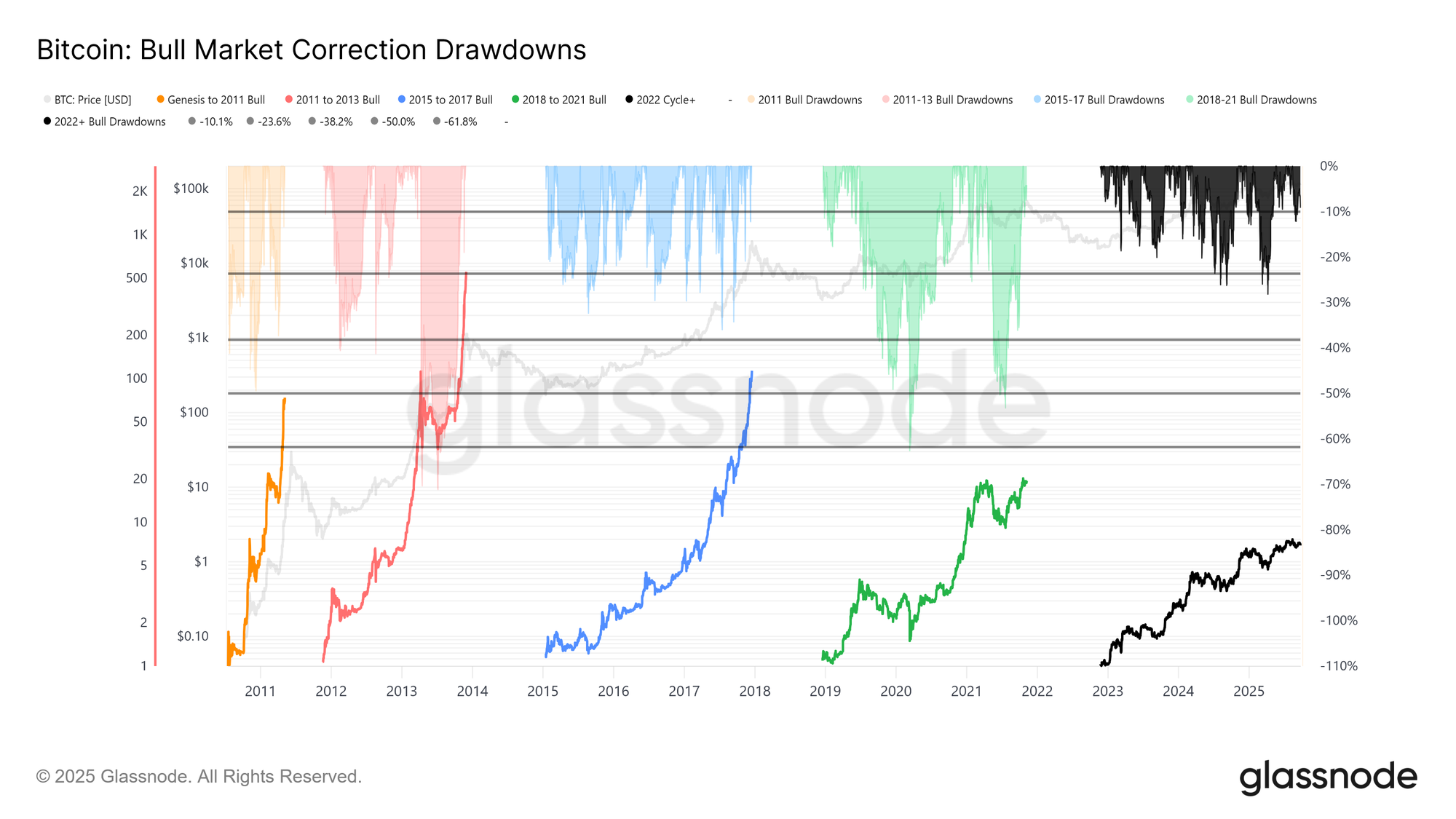
Building on this, the current drawdown from the $124k ATH to $113.7k is just 8%, mild compared to the cycle’s 28% drawdown or the 60% declines of prior cycles. This aligns with the long-term trend of diminishing volatility, both across macro cycles and within intra-cycle phases, resembling the steady advance of 2015–2017, so far without its late-stage blow-off rally.
Live Chart

Cycle Duration

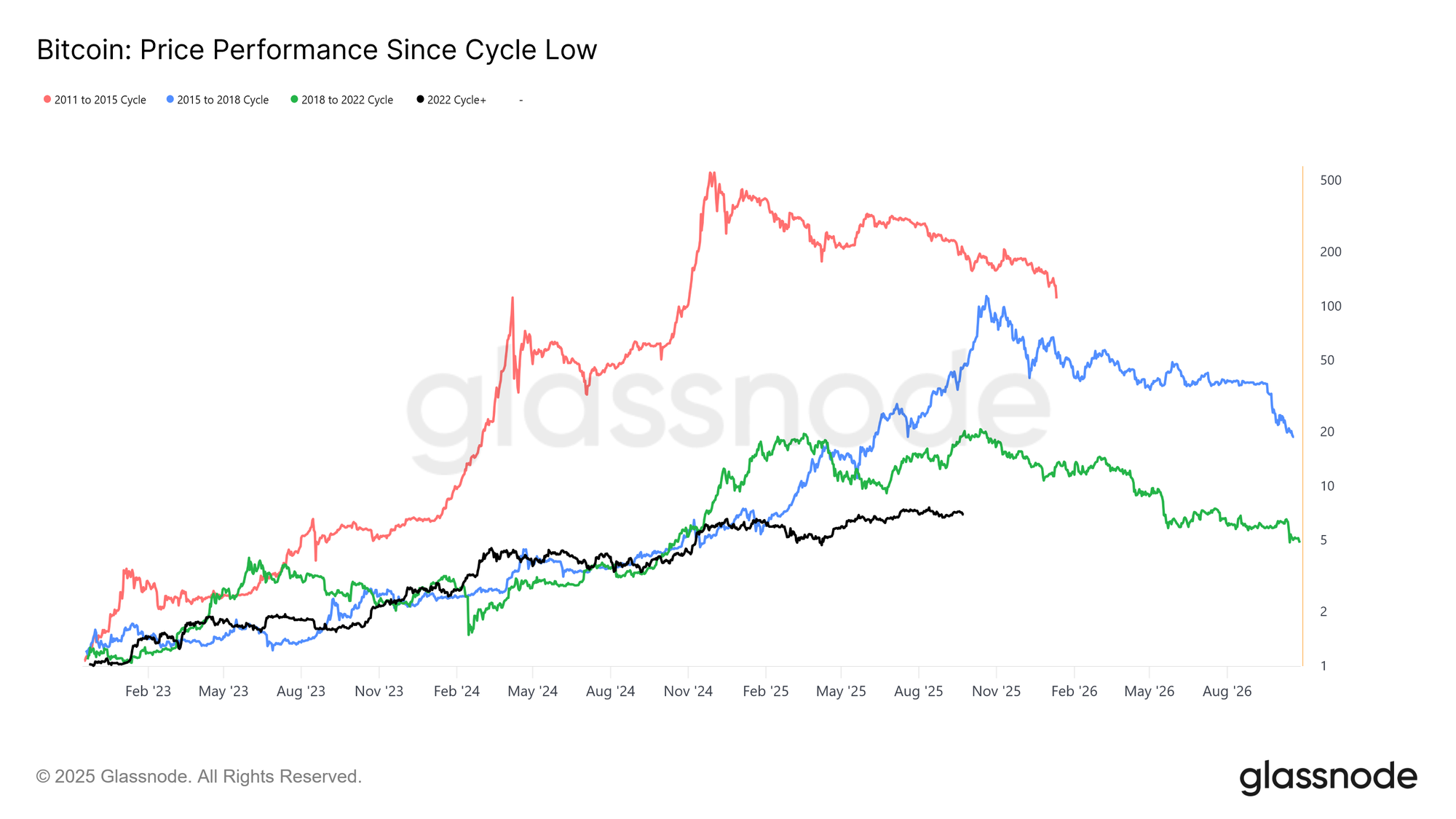
Extending the view, overlaying the last four cycles highlights how peak returns have diminished over time, even as the present trajectory remains closely aligned with the prior two cycles. Assuming $124k marked the global top, this cycle has lasted roughly 1,030 days, very close to the ~1,060-day lengths of the previous two cycles.
Live Chart

Capital Inflows Measured

Beyond price action, capital deployment provides a more robust lens.
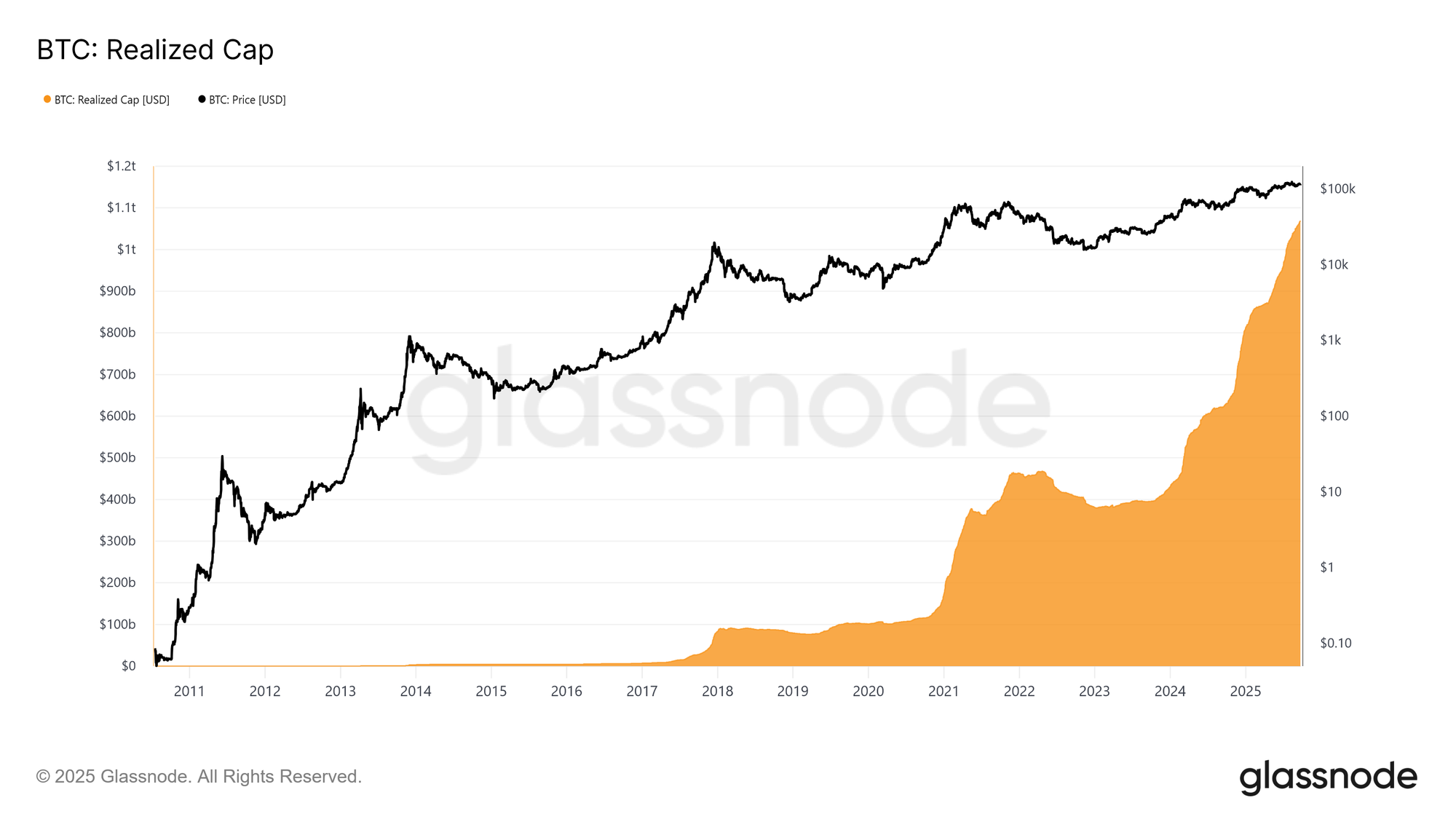
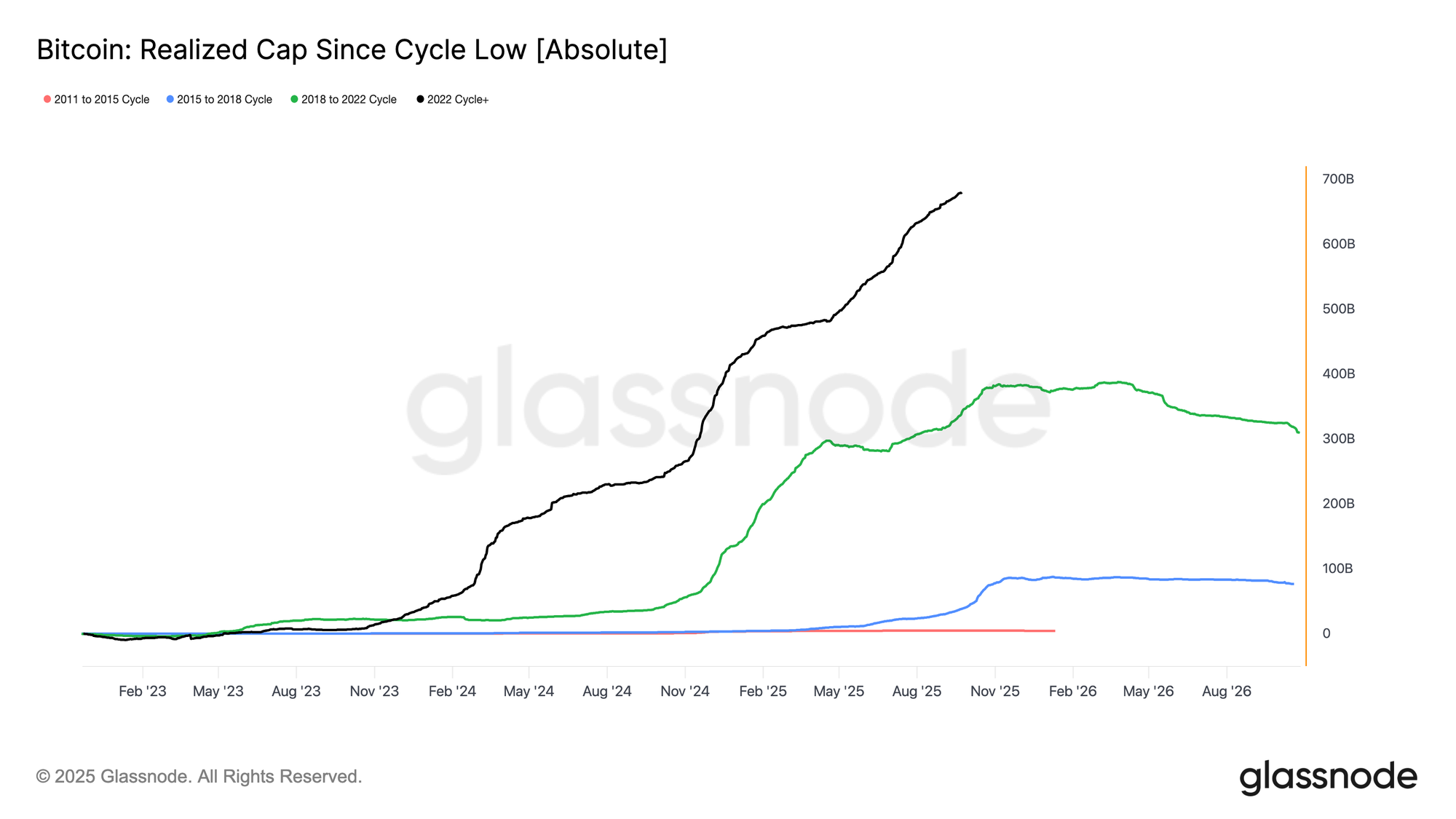
Realized Cap, measuring the cumulative capital invested to absorb older supply at higher values, has risen in three waves since November 2022. Lifting the total to $1.06T, reflecting the scale of inflows underpinning this cycle.
Live Chart

Realized Cap Growth

To contextualize:

  • 2011–2015: $4.2B
  • 2015–2018: $85B
  • 2018–2022: $383B
  • 2022–Present: $678B

This cycle has already absorbed $678B in net inflows, nearly 1.8x larger than the prior cycle, underscoring its unprecedented magnitude in capital rotation.
Live Chart

Profit Realization Peaks

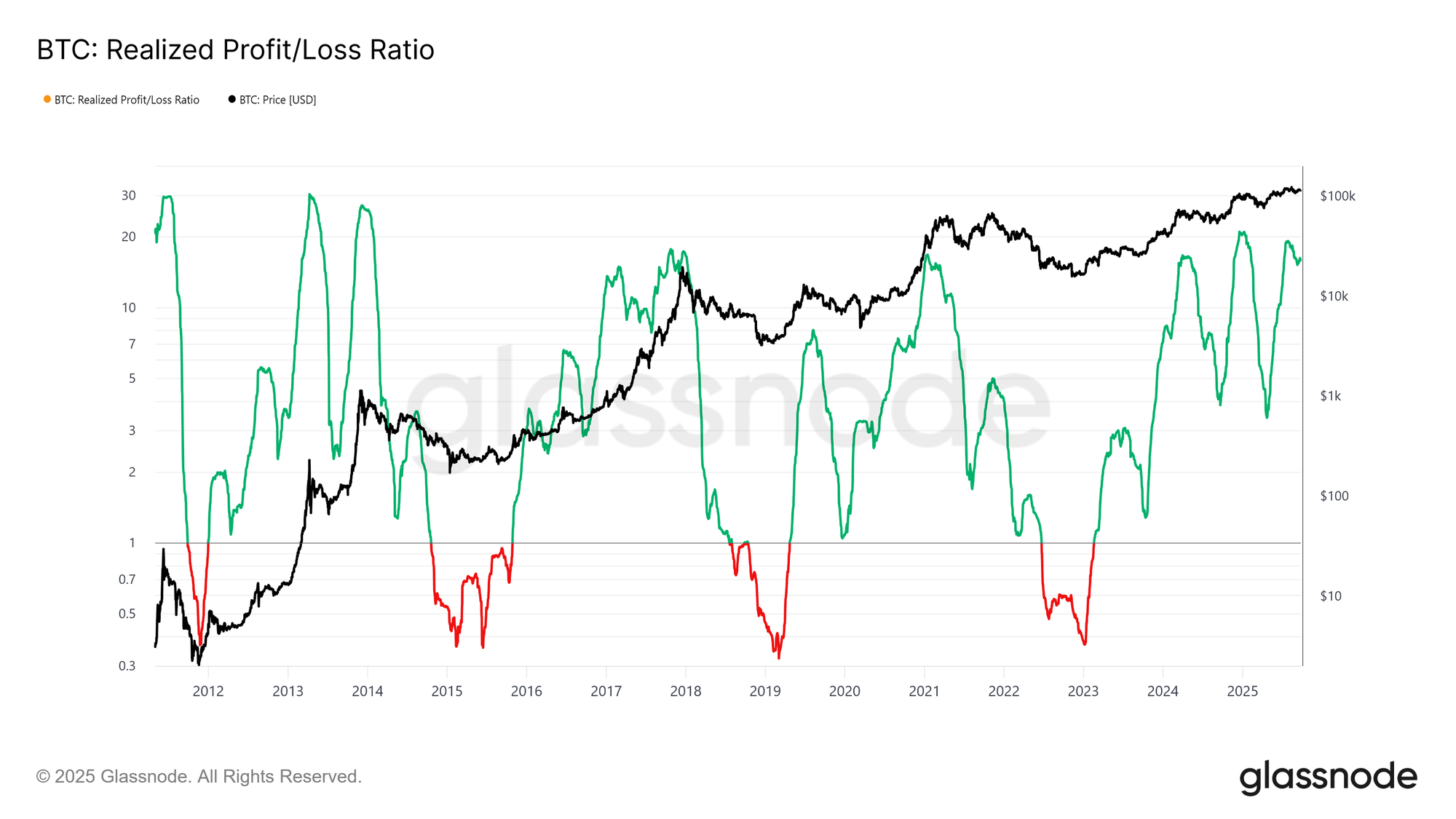
Another difference lies in the inflow structure. Unlike the single prolonged waves of earlier cycles, this cycle has seen three distinct multi-month surges. The Realized Profit/Loss Ratio shows that each time profit-taking exceeded 90% of coins moved, marking cyclical peaks. Having just stepped away from the third such extreme, probabilities favour a cooling phase ahead.
Live Chart

LTH Profit Dominance

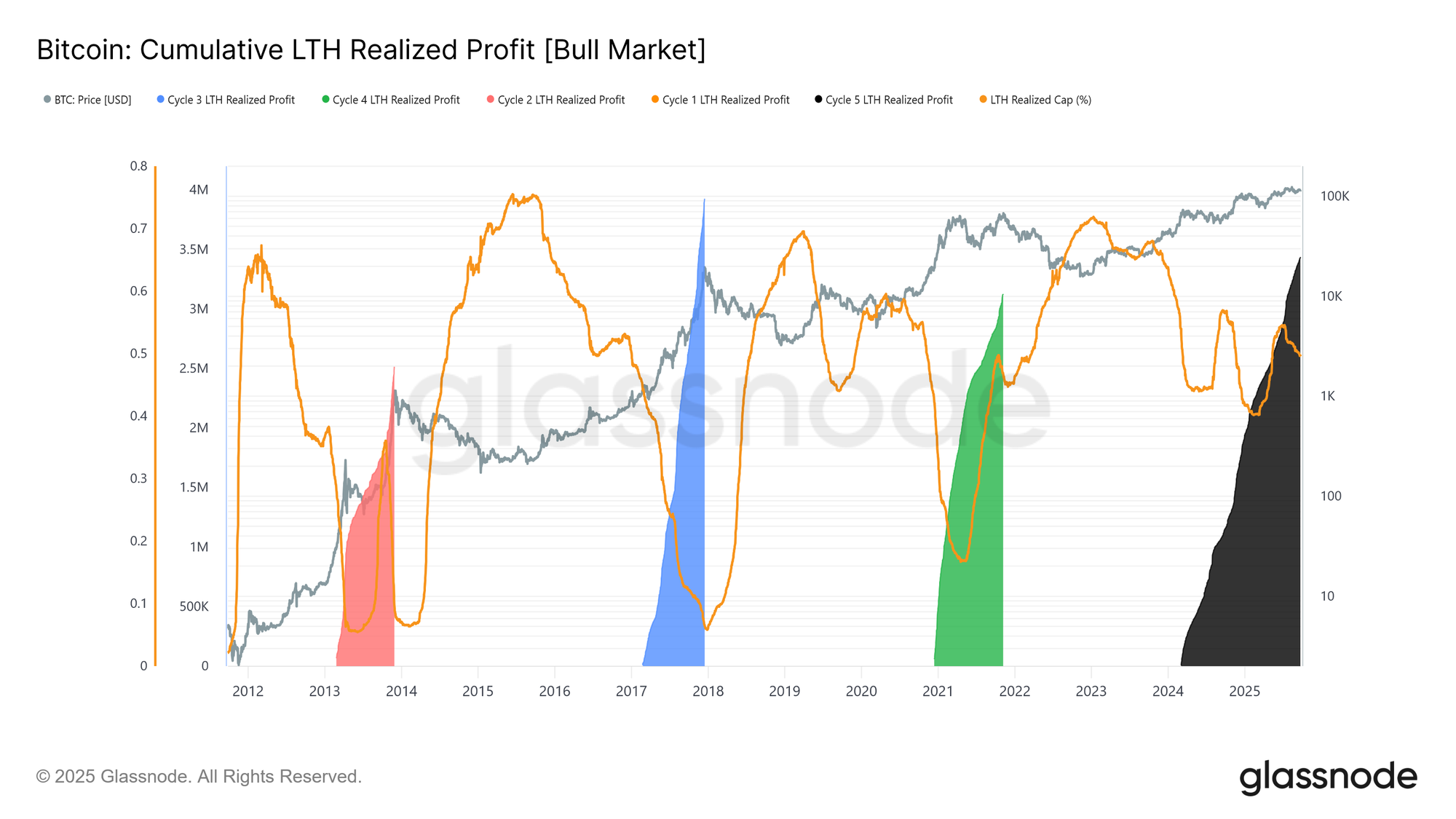
The scale is even clearer when focusing on long-term holders. This measure tracks cumulative LTH profits from a new ATH to the cycle peak. Historically, their heavy distribution marks the tops. In this cycle, LTHs have realized 3.4M BTC, already surpassing previous cycles, highlighting both cohort maturity and the magnitude of capital rotation.
Live Chart

Off-Chain Analysis

ETF Demand vs LTHs

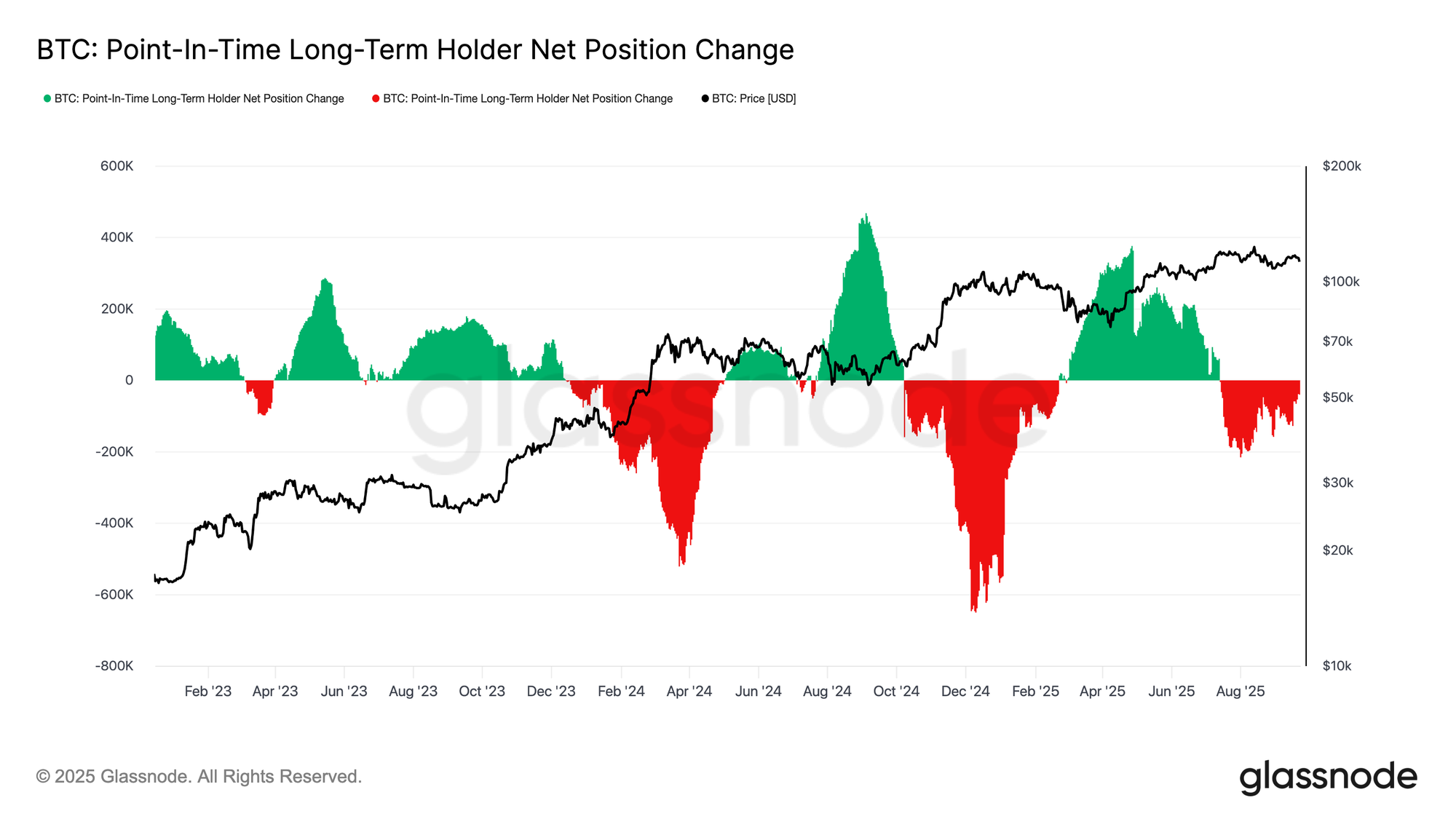
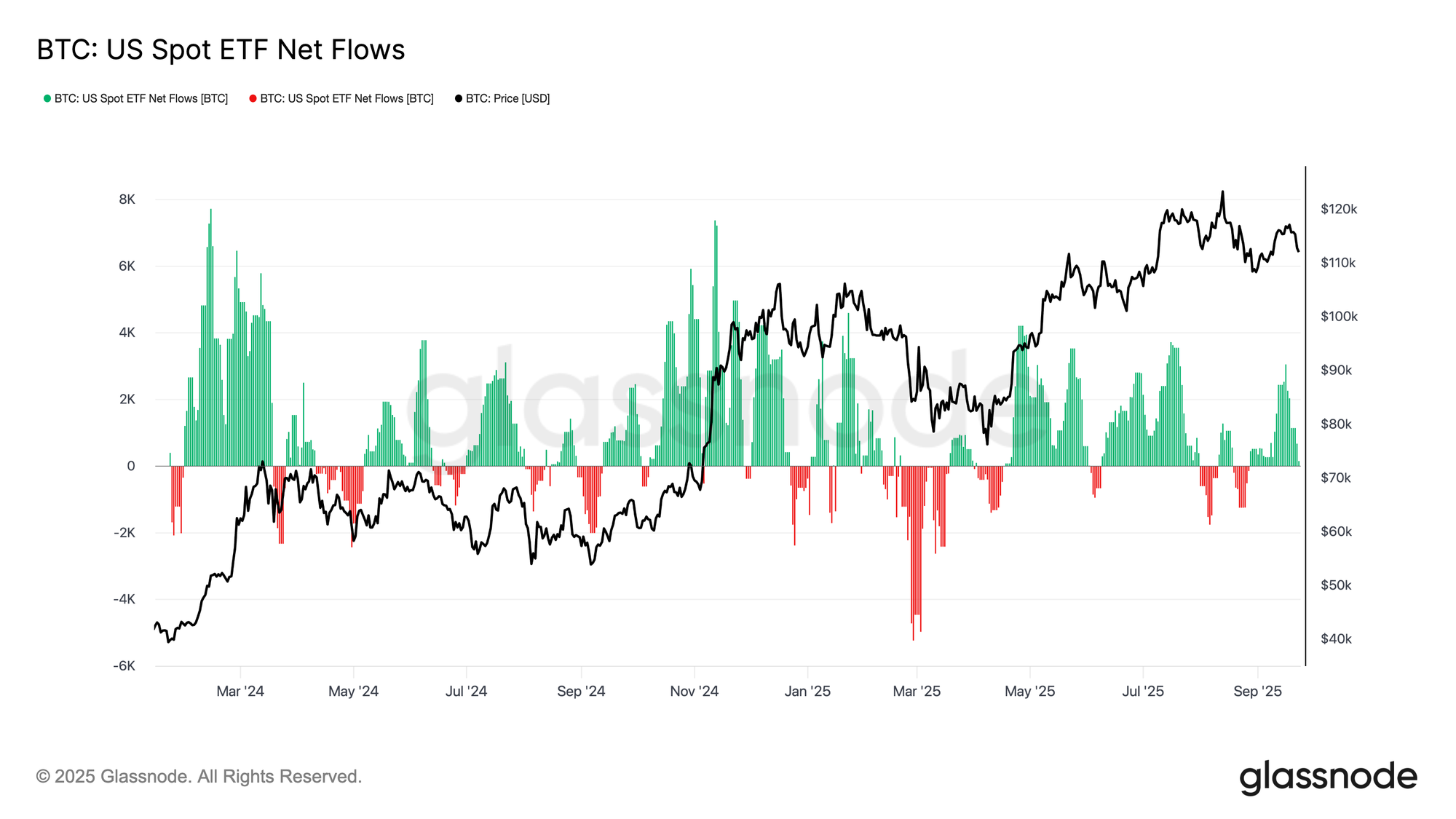
This cycle has also been shaped by the tug-of-war between long-term holders distributing supply and institutional demand via US spot ETFs and DATs. With ETFs a new structural force, price now reflects this push-pull: LTH profit-taking caps upside, while ETF inflows absorb distribution and sustain the cycle’s advance.
Live Chart

Fragile Balance

ETF inflows have so far balanced LTH selling, but with little margin for error. Around the FOMC, LTH distribution surged to 122k BTC/month, while ETF netflows (7D-SMA) collapsed from 2.6k BTC/day to nearly zero. The combination of rising sell pressure and fading institutional demand created a fragile backdrop, setting the stage for weakness.
Live Chart

Spot Market Stress

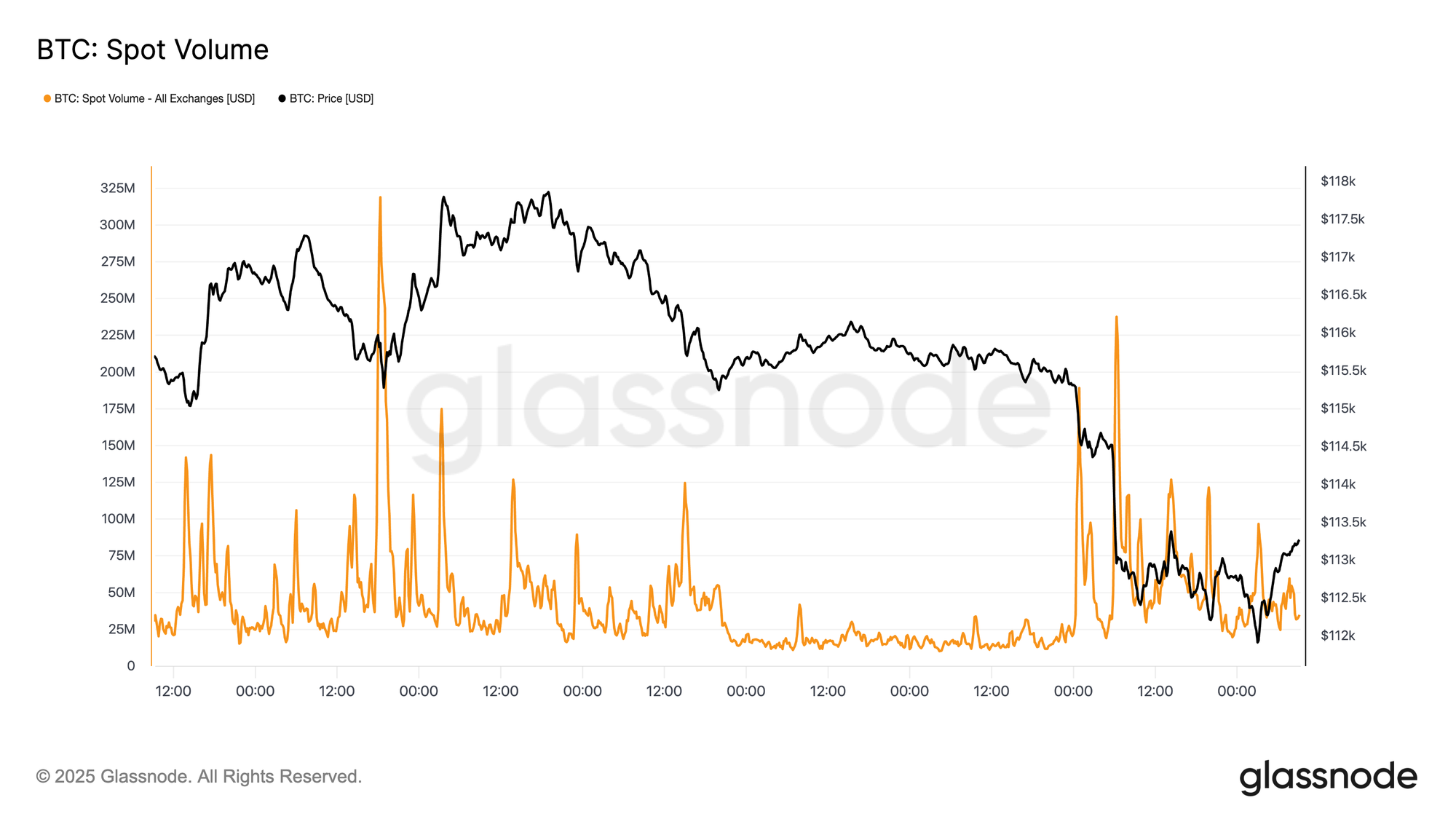
This fragility was visible in spot markets. During the post-FOMC sell-off, volumes spiked as forced liquidations and thin liquidity exaggerated the move lower. Aggressive sell flows overwhelmed order books, accelerating the decline. While painful, this absorption formed a temporary foundation just above the short-term holder cost basis near $111.8k.
Live Chart

Futures Deleveraging

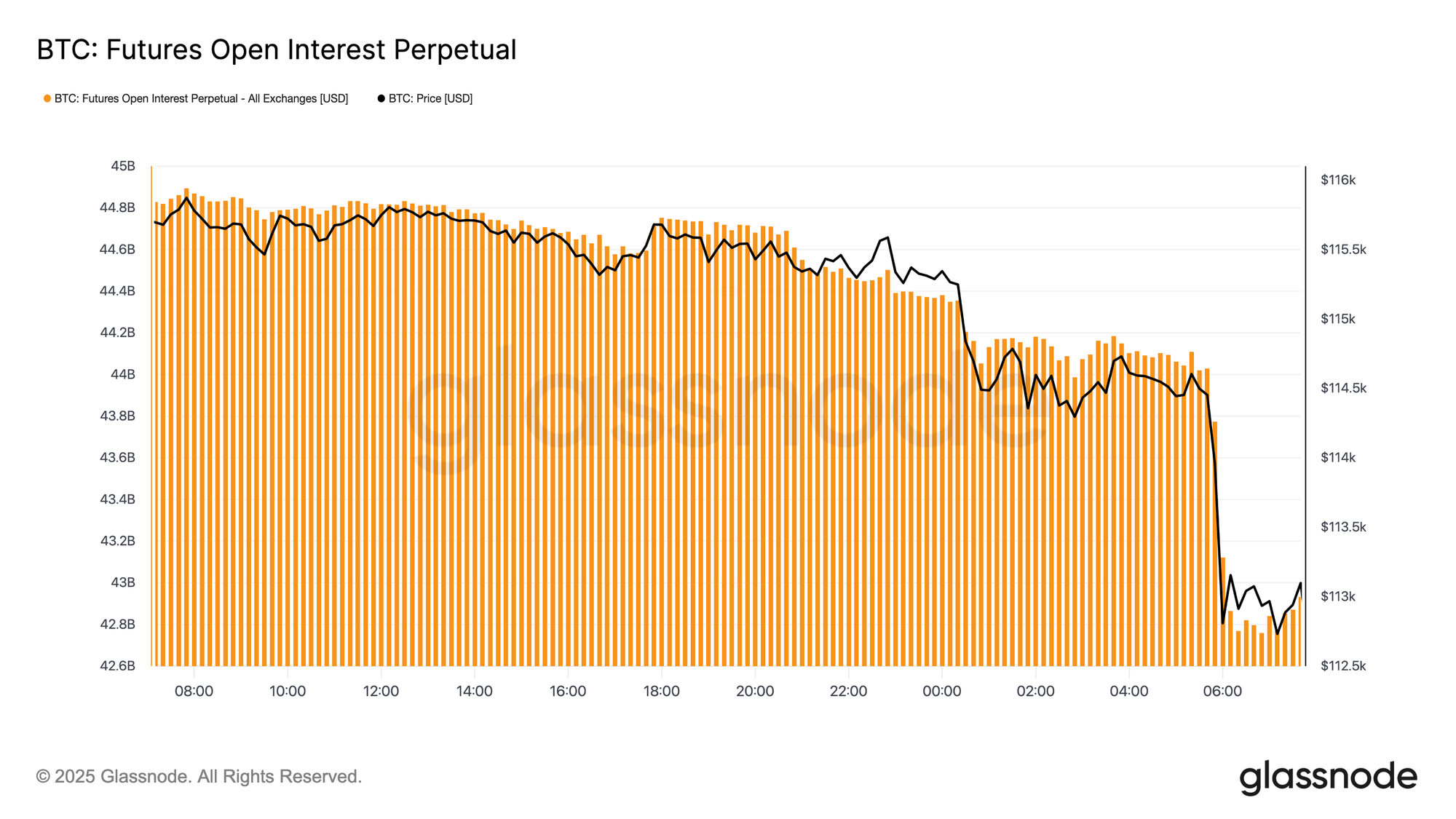
At the same time, futures open interest fell sharply from $44.8B to $42.7B as Bitcoin broke below $113k. This deleveraging event flushed out leveraged longs, amplifying downside pressure. While destabilizing in the moment, the reset helped clear excess leverage and restore balance to derivatives markets.
Live Chart

Liquidation Clusters

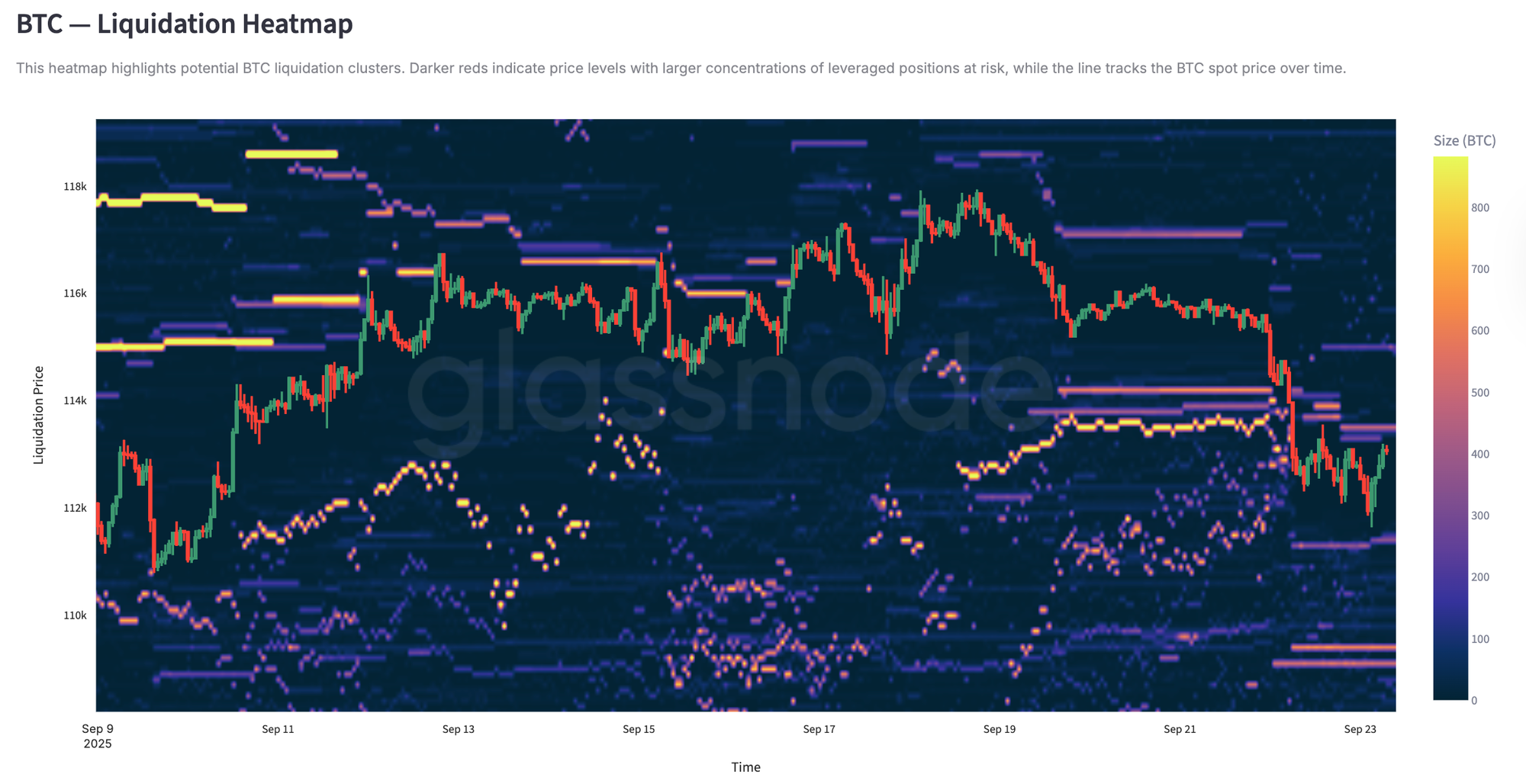
Perpetual liquidation heatmaps add colour. As price broke $114k–$112k, dense clusters of leveraged longs were wiped out, driving heavy liquidations and accelerating downside. Risk pockets remain above $117k, leaving both sides of the market vulnerable to liquidity-driven swings. Without stronger demand, fragility around these levels increases the risk of further sharp moves.
Live Chart

Options Market

Volatility Response

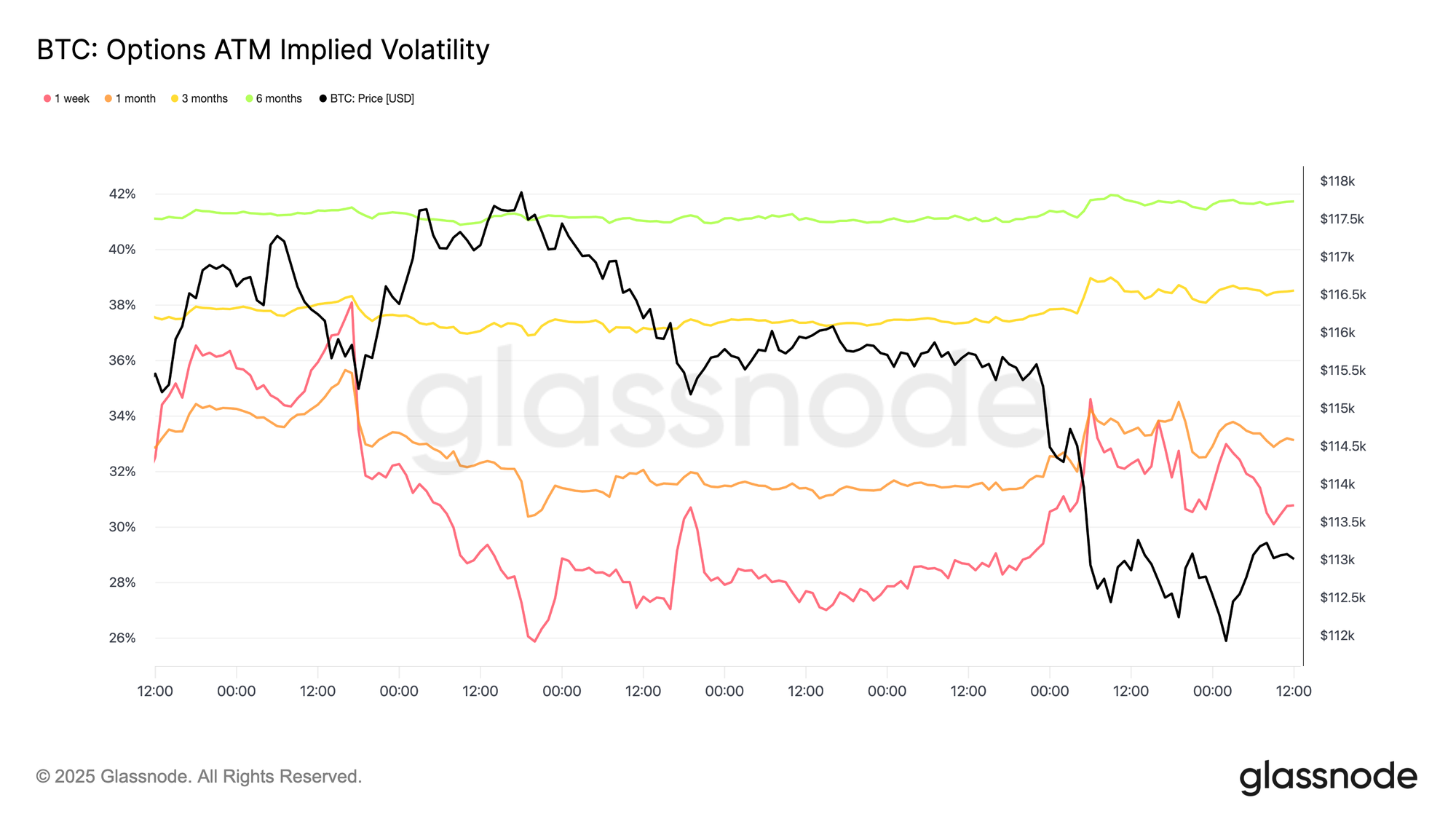
Turning to the options market, implied volatility provides a clear lens on how traders navigated a turbulent week. Two major catalysts shaped the landscape: the first rate cut of the year and the largest liquidation event since 2021. Volatility climbed into the FOMC as hedging demand built, only to fade quickly once the cut was confirmed, signaling the move was largely priced in. However, the sharp Sunday night futures liquidation reignited demand for protection, with one-week IV leading the rebound and strength extending across maturities.
Live Chart

Skew Repricing

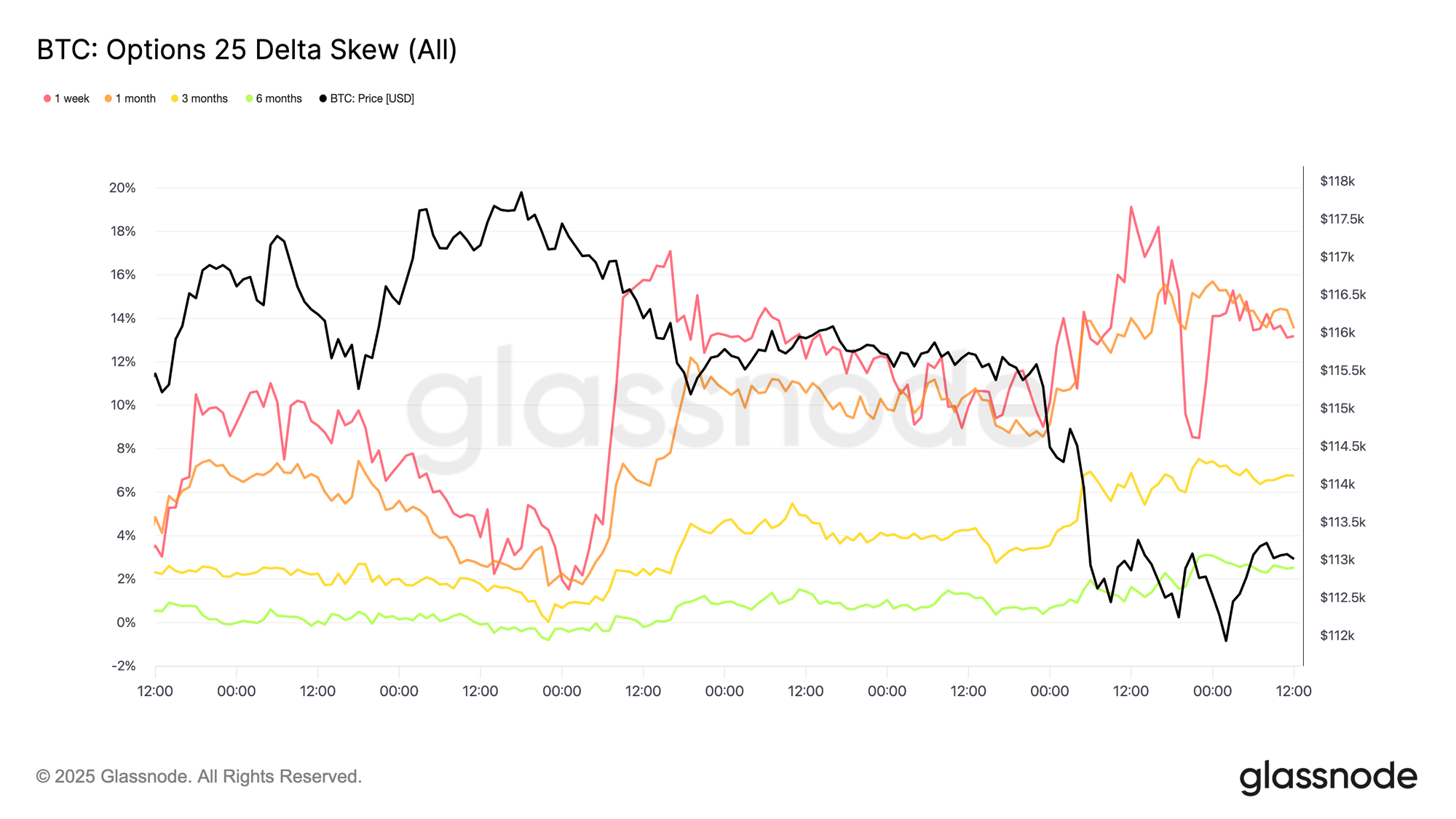
After the FOMC, BTC skew briefly approached equilibrium, with downside puts carrying little premium over calls. That calm quickly faded. On Friday, 1W skew spiked from ~1.5% to 17%, a sharp repricing that also lifted longer expiries.

While skew is often more reactive than predictive, in this case it revealed aggressive demand for puts — either as protection against a sharp drawdown or as a way to monetize volatility. Just two days later, the market delivered on that signal with the largest liquidation event since 2021.
Live Chart

Put/Call Flows

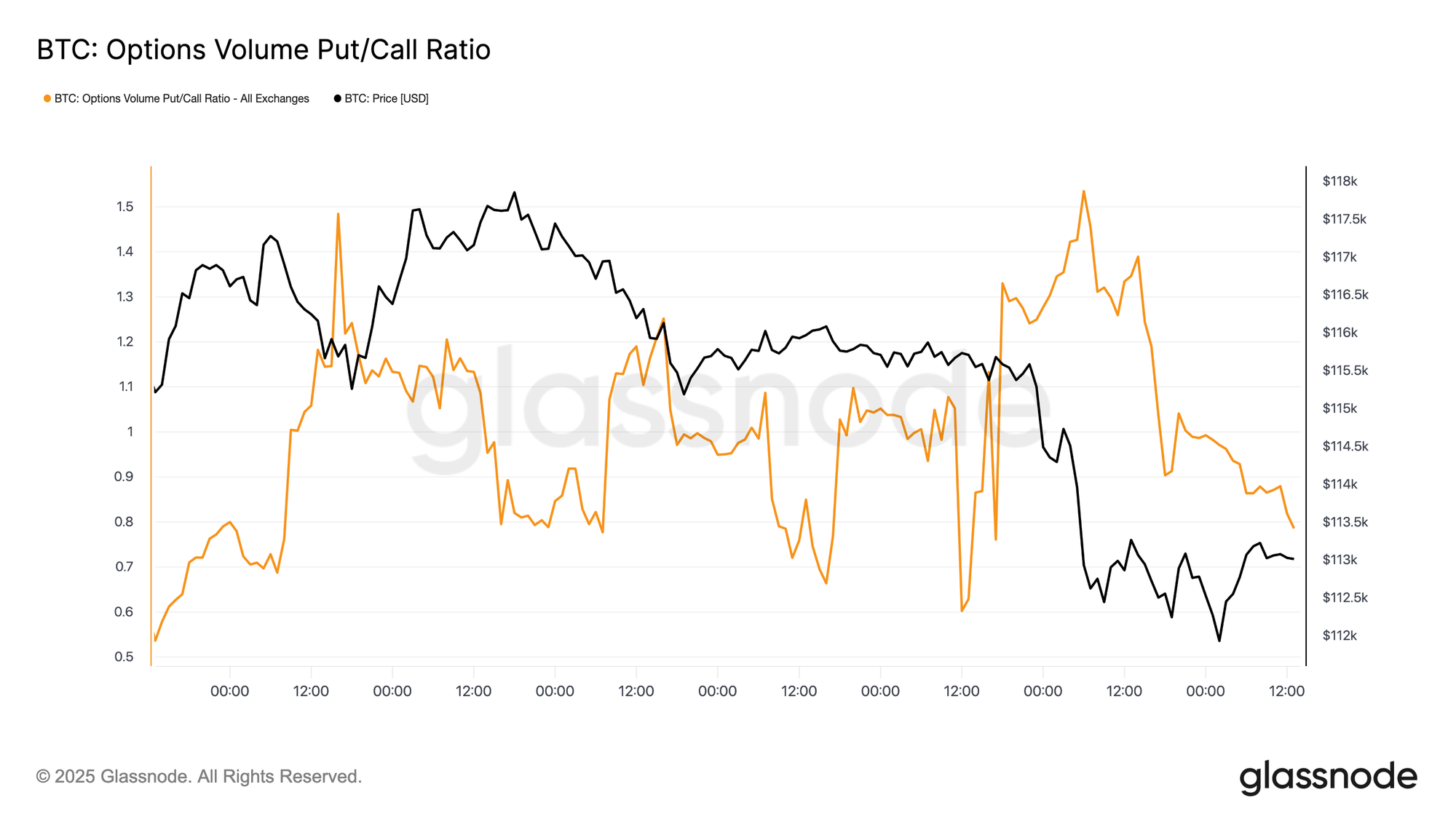
Following the sell-off, the put/call volume ratio has trended lower as traders locked in profits on in-the-money puts and others rotated into cheaper calls. Skew reinforces this picture: short- and mid-dated options remain heavily tilted toward puts, leaving downside protection expensive relative to upside. For participants with a constructive view into year-end, this imbalance creates opportunities — either by accumulating calls at relatively low cost or financing them through selling richly priced downside exposure.
Live Chart

Gamma Overhang

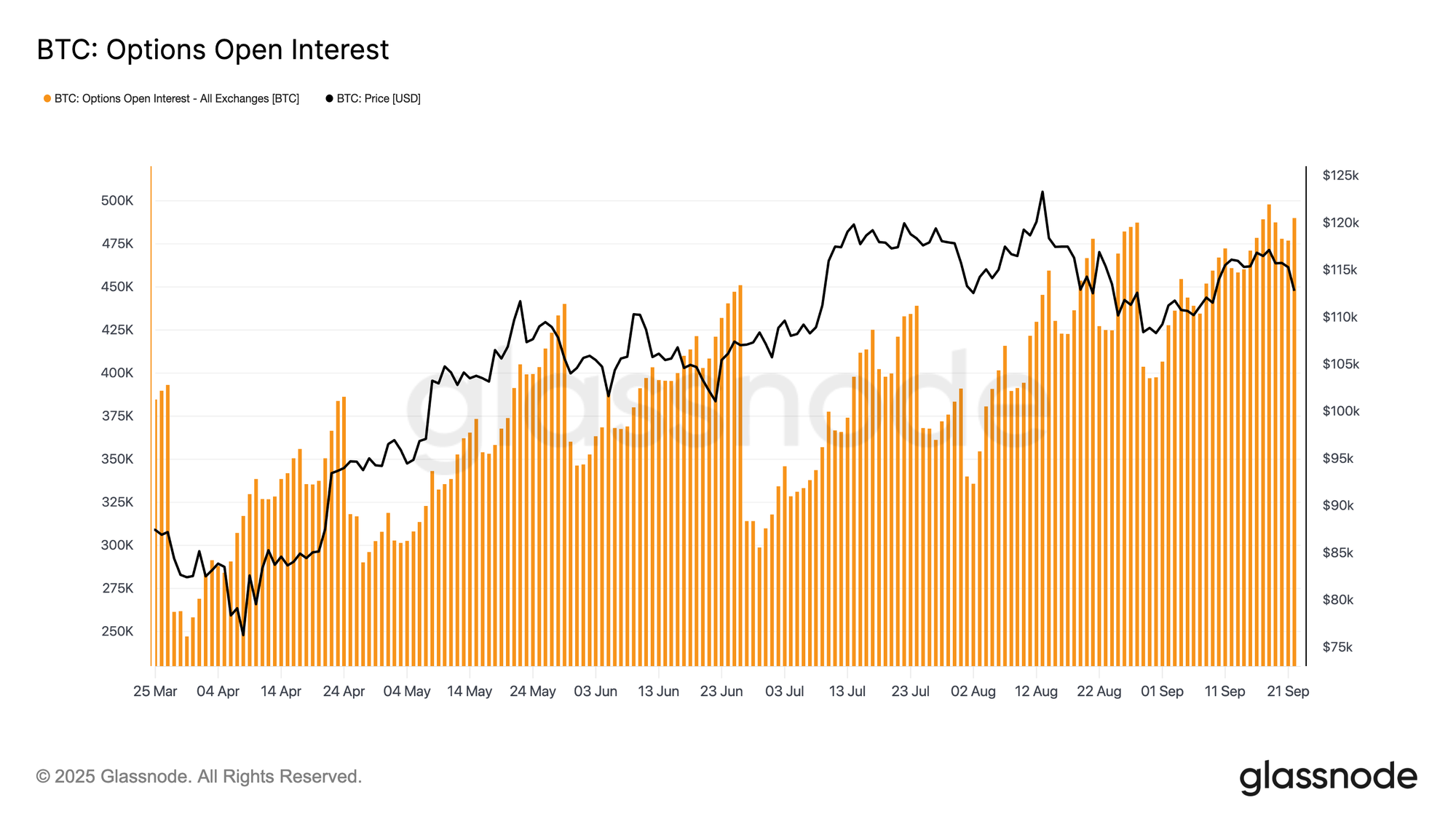
Total options open interest is hovering near all-time highs and will unwind sharply at Friday morning’s expiry, before rebuilding into December. For now, the market sits in a peak gamma zone, where even small price swings force aggressive dealer hedging. Dealers are positioned short gamma on the downside and long gamma on the upside, a structure that amplifies sell-offs while capping rallies. This dynamic skews near-term volatility risk to the downside, reinforcing fragility until expiry clears and positioning resets.
Live Chart

Conclusion

Bitcoin’s retreat following the FOMC reflects a textbook “buy the rumour, sell the news” pattern, but the broader backdrop points to growing exhaustion. On-chain, the current 8% drawdown is modest compared to past cycles, yet comes after three major waves of capital inflows that lifted realized cap by $678B, almost double the prior cycle. Long-term holders have already realized 3.4M BTC in profits, underscoring the heavy distribution and maturity of the rally.

At the same time, ETF inflows that previously absorbed supply have slowed, creating a fragile balance. Spot volumes spiked on forced selling, futures saw sharp deleveraging, and options markets priced in downside risk as skew surged. Together, these signals suggest a market running out of fuel, with liquidity-driven swings dominating.

Unless demand from institutions and holders aligns again, the risk of deeper cooling remains high, highlighting a macro structure that increasingly resembles exhaustion.


Disclaimer: This report does not provide any investment advice. All data is provided for informational and educational purposes only. No investment decision shall be based on the information provided here, and you are solely responsible for your own investment decisions.

Exchange balances presented are derived from Glassnode’s comprehensive database of address labels, which are amassed through both officially published exchange information and proprietary clustering algorithms. While we strive to ensure the utmost accuracy in representing exchange balances, it is important to note that these figures might not always encapsulate the entirety of an exchange’s reserves, particularly when exchanges refrain from disclosing their official addresses. We urge users to exercise caution and discretion when utilizing these metrics. Glassnode shall not be held responsible for any discrepancies or potential inaccuracies. 

Please read our Transparency Notice when using exchange data.


Bacaan Terkait

Rebound Saham Semikonduktor: Akhir Koreksi Teknis atau Pembalikan Tren?

**Ringkasan (sekitar 1500 karakter):** Pasar saham semikonduktor, terutama di Korea Selatan (seperti Samsung dan SK Hynix), mengalami penjualan besar dan pemulihan cepat pada akhir Juni. Inti gejolak ini bukan pada fluktuasi harian, melainkan pergeseran fase penentuan harga saham semikonduktor setelah perdagangan tema AI menjadi sangat ramai. Pemulihan setelah anjlok lebih mencerminkan perbaikan posisi (teknis) dan ekspektasi pembagian hasil pemegang saham (seperti pada Samsung), bukan konfirmasi bahwa tren naik telah berlanjut. Validasi sesungguhnya berasal dari musim laporan keuangan, khususnya dari Micron Technology. HBM (High Bandwidth Memory) adalah variabel kunci. Komponen penting untuk server AI ini telah memberi produsen memori seperti Micron, Samsung, dan SK Hynix kekuatan penetapan harga yang kuat. Pertanyaan pasar sekarang adalah apakah kekuatan ini dan siklus pengeluaran modal AI dapat terus mendukung valuasi tinggi sektor ini. Laporan keuangan Micron (24 Juni) menjadi titik uji utama. Investor tidak hanya mencari hasil kuartal yang kuat, tetapi lebih pada panduan ke depan (guidance) dan konfirmasi bahwa visibilitas pesanan, harga memori, dan margin keuntungan masih kokoh. Jika Micron dapat memberikan sinyal kuat bahwa permintaan HBM dan kekuatan penetapan harganya masih berlanjut, rebound dapat diartikan sebagai akhir koreksi teknis dan tren naik berlanjut. Namun, jika panduannya mulai hati-hati atau ekspektasi kenaikan laba tertinggal dari valuasi, pemulihan saat ini mungkin hanya bersifat sementara sebelum tren melemah. Singkatnya, rebound saham semikonduktor Asia masih berupa perbaikan teknis yang menunggu konfirmasi fundamental lebih lanjut. Nasib perdagangan tema AI dalam waktu dekat sangat bergantung pada kemampuan rantai pasokan, terutama di segmen memori, untuk terus melampaui ekspektasi tinggi yang telah dibangun pasar.

marsbit24m yang lalu

Rebound Saham Semikonduktor: Akhir Koreksi Teknis atau Pembalikan Tren?

marsbit24m yang lalu

Saham Teknologi Global Jatuh: Uji Tekanan Lain dari Pasar Bull AI

Sumber Asli: Wall Street Insights Tanggal 23 Juni, indeks KOSPI Korea anjlok 9,99%, memicu circuit breaker. Penurunan drastis ini dipicu oleh resonansi tiga sinyal dalam 24 jam: 1) Laporan media bahwa SK Hynix memperlambat ekspansi kapasitas HBM4, komponen memori kunci untuk AI; 2) Aksi ambil untuk sebelum laporan keuangan Micron yang sangat dinantikan; 3) Peringatan regulator Korea terhadap ETF berleveraj tunggal yang dianggap berisiko. Dampaknya diperparah oleh struktur pasar Korea yang sangat terpapar leverage: saldo pembiayaan investor ritel mencapai rekor, ETF berleveraj tunggal (aset $300 miliar) menciptakan tekanan jual yang memperkuat diri saat turun, dan Dana Pensiun Nasional (NPS) justru menjadi penjual bersih untuk rebalancing portofolio. Pasca-kejatuhan, perdebatan tentang "gelembung AI" mencuat. Analis Goldman Sachs menyebutnya sebagai masalah "kelelahan likuiditas" jangka pendek, sementara Bank of America memperingatkan sinyal gelembung di Nasdaq namun memperkirakan koreksi fase, bukan akhir tren. Di sisi lain, manajer investasi Li Bei memperingatkan kondisi pemicu pecahnya gelembung AI sudah muncul. Kejatuhan SpaceX (turun tiga hari berturut-turut, hilang $600 miliar) mencerminkan masalah serupa: narasi pasar modal AI mulai beralih dari "imajinasi tak terbatas" ke tahap "menghitung pengembalian". Perhatian kini tertuju pada laporan keuangan Micron tanggal 25 Juni. Kinerja yang kuat dapat dengan cepat memperbaiki penjualan ini, sementara panduan yang mengecewakan dapat mengubah narasi dari masalah likuiditas menjadi keruntuhan keyakinan mendasar. Intinya, kejatuhan KOSPI adalah cermin dari kerentanan pasar ketika semua peserta menggunakan leverage untuk bertaruh pada narasi yang sama. Koreksi terbalik, seberapa pun cepat dan dalamnya, seharusnya tidak dianggap sebagai kejutan.

marsbit26m yang lalu

Saham Teknologi Global Jatuh: Uji Tekanan Lain dari Pasar Bull AI

marsbit26m yang lalu

Yayasan Ethereum Memangkas 20% Staf, 54 Orang Keluar: Logika Bertahan di Balik Restrukturisasi

Yayasan Ethereum (EF) mengumumkan reorganisasi besar, termasuk pengurangan 20% staf (54 orang) yang meninggalkan organisasi. Restrukturisasi ini bukan sekadar pemotongan biaya, tetapi perubahan strategis untuk memusatkan sumber daya pada misi inti yang "hanya bisa dan harus dilakukan oleh EF". EF kini diorganisir menjadi lima klaster utama: 1. **Lapisan Protokol:** Fokus pada pengembangan inti protokol Ethereum, memastikan properti utama seperti anti-sensor, anti-penguasaan, open-source, privasi, dan keamanan. 2. **Lapisan Akses:** Memastikan kedaulatan diri (self-sovereignty) dapat diakses, dipahami, dan berkelanjutan bagi pengguna dalam operasi kunci seperti membaca rantai, bertransaksi, dan mendelegasikan. 3. **Lapisan Pengguna:** Menjembatani EF dengan kebutuhan nyata pengguna dan organisasi, memastikan keputusan di lapisan lain berbasis pada kasus penggunaan aktual dan batasan dunia nyata. 4. **Lapisan Komunitas:** Mengelola citra dan hubungan EF di dalam dan luar ekosistem kripto, membangun aliansi dengan gerakan perangkat lunak sumber terbuka, privasi, dan kebebasan sipil. 5. **Lapisan Institusi:** Bekerja sama dengan lembaga seperti perusahaan, pemerintah, dan universitas untuk mendorong adopsi yang memaksimalkan jaminan kedaulatan diri bagi pengguna akhir. Keputusan pengurangan staf, meski sulit, dianggap perlu untuk memungkinkan EF berkonsentrasi pada pekerjaan penting jangka panjang tanpa gangguan berlebihan dari fluktuasi pasar jangka pendek. Mantan staf menerima paket pesangon dan dukungan transisi. EF yang baru lebih ramping dan terfokus, bertujuan untuk memperkuat fondasi Ethereum sebagai protokol yang mendukung kedaulatan diri secara global.

marsbit29m yang lalu

Yayasan Ethereum Memangkas 20% Staf, 54 Orang Keluar: Logika Bertahan di Balik Restrukturisasi

marsbit29m yang lalu

Hanya Bicara Keuntungan, Tapi Abaikan Penagihan? Likuidasi Goldfinch Jadi Peringatan untuk Kredit RWA

Ringkasan: Goldfinch, platform pinjaman kripto, mengajukan proposal GIP-87 untuk likuidasi. Proposal ini berencana menghentikan pengembangan baru, menutup produk utama Goldfinch Prime, dan mengalokasikan dana untuk proses penagihan pinjaman yang masih beredar senilai jutaan dolar AS. Ini menandai pergeseran fokus dari ekspansi bisnis ke penanganan kredit macet. Kasus ini mengungkap tantangan mendasar dalam sektor kredit privat tokenisasi (RWA). Meskipun transparansi blockchain mencatat utang, penagihan tetap bergantung pada proses di luar rantai (off-chain): kemauan peminjam, prosedur hukum, dokumentasi, dan waktu yang panjang. Proposal menyoroti perbedaan besar antara nilai aset terkunci (TVL) di platform dan portofolio pinjaman aktif, di mana risiko kredit jauh melebihi likuiditas yang tersedia. Goldfinch kini menjadi ujian bagi kemampuan penanganan kredit macet. Keputusan governance tidak lagi tentang pertumbuhan, tetapi tentang pembiayaan operasi pemeliharaan, akses pengguna, dan kerangka hukum untuk penagihan. Ini menjadi pelajaran penting bagi semua platform RWA: mereka harus membuktikan tidak hanya kemampuan dalam pemberian pinjaman, tetapi juga dalam proses seleksi peminjam, penanganan kredit macet, dan memiliki mekanisme governance yang berkelanjutan untuk fase penagihan. Siklus kredit memiliki dua fase: fase pertumbuhan dengan imbal hasil menarik, dan fase penagihan yang menentukan kualitas aset dasar.

Foresight News33m yang lalu

Hanya Bicara Keuntungan, Tapi Abaikan Penagihan? Likuidasi Goldfinch Jadi Peringatan untuk Kredit RWA

Foresight News33m yang lalu

Meta Masuki Pasar Prediksi, Kode "Arena": Tidak Pakai Uang Sungguhan, 3,56 Miliar Pengguna Aktif Harian adalah Taruhan Terbesarnya

Menurut laporan The New York Times (23/6), CEO Meta Mark Zuckerberg telah memerintahkan pengembangan aplikasi pasar prediksi independen bernama kode "Arena". Aplikasi ini awalnya akan menggunakan sistem poin, bukan taruhan uang sungguhan, untuk memprediksi hasil berbagai peristiwa, meskipun kemungkinan transaksi mata uang nyata di masa depan tidak dikesampingkan. Keunggulan utama Meta adalah daya distribusi yang masif, dengan 3,56 miliar pengguna aktif harian di seluruh aplikasinya. Hal ini dianggap sebagai ancaman signifikan bagi platform pasar prediksi mapan seperti Polymarket dan Kalshi. Berita ini langsung berdampak pada penurunan harga saham perusahaan seperti DraftKings dan Robinhood. Pasar prediksi sendiri sedang mengalami ledakan, dengan volume perdagangan bulanan di Kalshi dan Polymarket melonjak dari di bawah $5 miliar (Sept 2025) menjadi sekitar $24 miliar (Apr 2026). Arena dilihat sebagai pola khas Meta: mereplikasi model bisnis yang sudah terbukti dan memanfaatkan keunggulan skala penggunanya, seperti yang dilakukan dengan Stories (Snapchat), Reels (TikTok), dan Threads (X). Bagi pasar prediksi berbasis crypto seperti Polymarket, kehadiran Arena bisa menjadi ancaman sekaligus peluang. Di satu sisi, dapat mengalihkan perhatian dan volume perdagangan. Di sisi lain, dapat memperluas pasar secara keseluruhan dengan memperkenalkan konsep taruhan peristiwa kepada miliaran pengguna non-crypto. Dengan memulai sistem poin, Meta juga berusaha menghindari tantangan regulasi kompleks yang saat ini dihadapi oleh platform taruhan uang sungguhan. Arena masih dalam pengembangan tanpa jadwal peluncuran yang jelas.

marsbit40m yang lalu

Meta Masuki Pasar Prediksi, Kode "Arena": Tidak Pakai Uang Sungguhan, 3,56 Miliar Pengguna Aktif Harian adalah Taruhan Terbesarnya

marsbit40m yang lalu

Trading

Spot
Futures
活动图片