Laos Eyes Bitcoin Mining To Tackle Mounting Debt

bitcoinistDipublikasikan tanggal 2025-09-18Terakhir diperbarui pada 2025-09-18

Abstrak

Laos is exploring a new way to service the debts from its decades-long hydropower build-out: turning excess electricity into Bitcoin....

Trusted Editorial content, reviewed by leading industry experts and seasoned editors. Ad Disclosure

Laos is exploring a new way to service the debts from its decades-long hydropower build-out: turning excess electricity into Bitcoin. In a report published on September 17, the South China Morning Post framed the pivot bluntly: “Saddled with debt and surplus electricity, the ‘battery of Southeast Asia’ is eyeing energy-intensive crypto mining to turn a profit.” The article situates the move within a dam-driven development model that has left Laos with power it cannot always sell and a mounting repayment schedule.

Why Laos Eyes Bitcoin Mining

The policy logic is straightforward. Bitcoin mining converts electrons into a globally liquid asset and can be sited directly at hydropower plants, mitigating transmission bottlenecks and absorbing seasonal surpluses. Laos has promoted electricity exports for years—SCMP notes power accounted for roughly a quarter of the country’s exports last year—yet export deals and grids do not always line up with generation, exacerbating revenue-timing mismatches against hard-currency debt obligations from dam construction.

According to SCMP “environmental campaigners view the turn to crypto as symptomatic of a flawed energy policy that has left Laos indebted and unable to offload its surplus power.” The Chinese news report cites Witoon Permpongsacharoen, director of the Mekong Energy and Ecology Network: “Laos allowing electricity to be used for cryptocurrency mining is clearly not something driven by internal conditions. It stems from the fact that Laos is heavily indebted and unable to pay off its debts.”

If implemented, this would not be Laos’s first embrace of digital-asset mining. In September 2021, the government launched a pilot program authorizing six firms to mine and trade Bitcoin and cryptocurrencies under regulated power-purchase terms, a move widely read as an attempt to capture miners displaced by China’s crackdown.

However, the stance has seesawed amid hydrological stress and grid constraints: in August 2023, the state utility Électricité du Laos (EDL) halted electricity supply to Bitcoin miners citing drought and power shortages; by May 2024, Reuters reported crypto data centers made up “over a third of the country’s power” consumption and contributed to outages, prompting authorities to stop approving new operations even as they weighed proposals to stabilize supply.

The fiscal backdrop helps explain the renewed interest. External public debt service is projected by the World Bank to average about $1.3 billion per year over 2025–2028—around 9% of GDP annually—keeping gross financing needs elevated as key hydropower assets are still ramping. Separate reporting this year underscored the strain: a Chinese dam operator initiated a $555 million arbitration against EDL for alleged unpaid dues, highlighting the financial pressures on the state power sector.

Yet the “surplus power” narrative is not uniform. Hydropower output is volatile, impacted by erratic rainfall and a warming climate, while export pipelines remain politically and commercially complex. Laos produces surplus electricity in the wet season but must import power from neighboring countries during the dry months. These structural frictions are precisely the niches where mobile, interruptible loads like Bitcoin mines can monetize stranded energy—until the water runs low.

Analysts who champion “wasted renewables” see a broader pattern. “Bhutan, Ethiopia, and now Laos use Bitcoin mining to monetize wasted renewable energy,” Bitcoin climate activist Daniel Batten wrote via X as coverage of the SCMP story circulated, casting the strategy as part of a 2025 “vibe shift.”

Bhutan has openly leaned into hydro-powered mining this year, calling bitcoin “a strategic battery” to arbitrage seasonal surpluses and fund development; Ethiopia’s power utility has said it generated about $55 million over 10 months by selling surplus hydro to miners. Laos’s plan would slot into that template, albeit with more fragile hydrology and balance-sheet constraints.

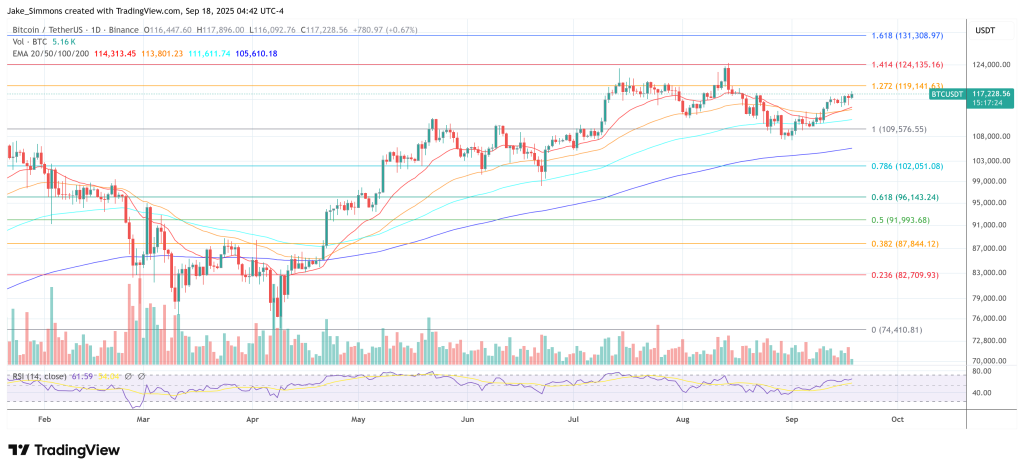
At press time, BTC traded at $117,228.
Bitcoin price
BTC is back above $117,000, 1-day chart | Source: BTCUSDT on TradingView.com
Featured image created with DALL.E, chart from TradingView.com
Editorial Process for bitcoinist is centered on delivering thoroughly researched, accurate, and unbiased content. We uphold strict sourcing standards, and each page undergoes diligent review by our team of top technology experts and seasoned editors. This process ensures the integrity, relevance, and value of our content for our readers.

Jake Simmons has been a Bitcoin enthusiast since 2016. Ever since he heard about Bitcoin, he has been studying the topic every day and trying to share his knowledge with others. His goal is to contribute to Bitcoin's financial revolution, which will replace the fiat money system. Besides BTC and crypto, Jake studied Business Informatics at a university. After graduation in 2017, he has been working in the blockchain and crypto sector. You can follow Jake on Twitter at @realJakeSimmons.

Bacaan Terkait

Pemilik Dompet Perangkat Keras Kehilangan Uang: Nuansa Penyimpanan Dingin Bitcoin di Tahun 2026

Pemilik dompet perangkat keras kehilangan uang: Nuansa penyimpanan dingin Bitcoin pada tahun 2026. Gelombang serangan peretasan menargetkan penyimpanan perangkat keras Coldcard dari perusahaan Kanada, Coinkite, yang mengakibatkan kehilangan hingga 2.417,35 BTC (sekitar $153 juta). Kerentanan utama terdapat pada proses pembuatan frasa benih (seed phrase) di firmware, di mana tingkat entropi kriptografi turun drastis dari 128 bit menjadi hanya 40-72 bit pada beberapa perangkat, sehingga rentan terhadap serangan brute-force. Masalah ini ternyata telah ada sejak 2021 tetapi baru dieksploitasi besar-besaran pada 2026. Produsen dompet perangkat keras utama lain seperti Trezor dan Ledger merespons dengan menegaskan keamanan perangkat mereka, yang menggunakan generator angka acak perangkat keras (TRNG) dengan entropi 128-256 bit. Insiden terpisah juga melibatkan kebocoran data pelanggan SafePal (sekitar 40.000 pengguna) dan Trezor (sekitar 14.000 pengguna) melalui pihak ketiga, meski tanpa membocorkan kunci privat atau aset kripto. Artikel menyimpulkan bahwa meskipun insiden-insiden ini mengguncang kepercayaan, dompet perangkat keras tetap menjadi opsi penyimpanan non-kustodial yang relatif lebih aman dibandingkan alternatif seperti dompet panas atau bursa terpusat (CEX). Perkembangan Kecerdasan Buatan (AI) juga disebut memiliki peran ganda: membantu pengembang meningkatkan keamanan sekaligus memperluas kemampuan peretas dalam menemukan kerentanan baru.

cryptonews.ru22m yang lalu

Pemilik Dompet Perangkat Keras Kehilangan Uang: Nuansa Penyimpanan Dingin Bitcoin di Tahun 2026

cryptonews.ru22m yang lalu

Prakiraan harga Bitcoin $100.000 mungkin terlalu rendah setelah 'short squeeze' rekor

Harga Bitcoin melonjak tajam baru-baru ini, memicu likuidasi posisi short (short squeeze) terbesar dalam catatan data sejak Juni 2021, dengan nilai mendekati $1,44 miliar untuk kontrak BTC saja. Analis Standard Chartered, Geoffrey Kendrick, menyatakan bahwa peristiwa ini meningkatkan kemungkinan target akhir tahunnya sebesar $100.000 untuk Bitcoin mungkin terlalu rendah. Kendrick mencatat bahwa pemulihan harga ini dipicu oleh dua faktor utama: pengumuman Departemen Keuangan AS yang meningkatkan pembelian obligasi pemerintah untuk mendukung likuiditas, dan acara di Gedung Putih yang dihadiri Presiden Trump bersama para pemimpin industri crypto, yang mendorong adopsi regulasi yang lebih jelas. Selain itu, permintaan institusional juga bangkit kembali, ditandai dengan arus masuk bersih ke ETF spot Bitcoin AS yang mencapai sekitar $1,92 miliar dalam lima sesi perdagangan. Kendrick menggambarkan Bitcoin sebagai "barang Giffen" di mata investor jangka panjang, di mana kenaikan harga justru menarik lebih banyak permintaan. Dia berpendapat bahwa momentum ini bisa mendorong harga Bitcoin tidak hanya menuju $100.000, tetapi berpotensi menantang level all-time high sekitar $126.000 pada akhir tahun, terutama setelah melewati tanggal 6 Oktober (peringatan 12 bulan dari rekor sebelumnya). Bank tersebut mempertahankan proyeksi jangka panjang yang sangat optimis, dengan perkiraan harga Bitcoin mencapai $500.000 pada tahun 2030.

cryptonews.ru26m yang lalu

Prakiraan harga Bitcoin $100.000 mungkin terlalu rendah setelah 'short squeeze' rekor

cryptonews.ru26m yang lalu

Trading

Spot
活动图片