Cardano founder Charles Hoskinson used a late-September 1 video to rebut what he called misrepresentations of his stance on client diversity, insisting it has been a design goal “from the very beginning” and warning that social-media “drama” is harming coordination on core upgrades such as Leios. “I’m not anti-client diversity,” Hoskinson said. “There was always from the very beginning a plan for client diversity. We live in the world of facts, not feelings.”
Hoskinson Clarifies Cardano’s Client Diversity Roadmap
Hoskinson framed client diversity as a prerequisite for decentralization rather than an optional feature. “Client diversity is crucial. Ethereum knows it. Solana knows it. Everyone knows it. It’s not some fancy feature. It’s the foundation of decentralization,” he said, adding that developers need implementation choice to customize nodes and push the protocol’s capability frontier. His intervention followed a spate of posts by alternative-client teams on X that he said “tr[ied] to misrepresent” remarks from a recent AMA.
At the heart of his argument is Cardano’s reliance on formal specifications as the “code-independent, implementation-independent blueprint” of the protocol. “If you don’t have a formal specification, then the code is the spec,” he said, underscoring why IOHK invested in specs intended to enable multiple interoperable clients. He stressed that specifications can be expressed in different formalisms as long as rigor and ambiguity management are maintained: “You can write them in TLA, you can write them in Agda, you can write them in Lean… you can write them in markdown if you want to. [But] it does have to have some form of rigor and limited ambiguity.”
Hoskinson outlined a two-track strategy he says he originally proposed for “responsible” diversification: continue maintaining the current Haskell-based Cardano node while building a second, independent implementation—“Cardano 2.x”—in Rust with a microservices architecture. The goal would be to run them in parallel until they meet at feature parity, which he likened to the current plan for Lace 1.x and Lace 2.x to “intersect” later this year. The second codebase, he argued, would pressure-test the specifications, reduce ambiguity and pave the way “to go from two to n” clients.
Instead, he said, the ecosystem took a more fragmented path when builders organized under Pragma began writing their own nodes “not actively contributing to the specifications we’ve written.” That approach, he warned, increases the risk of network partition and raises coordination costs unless teams align on specs and testing. “How do you avoid things like a network partition and how do you ensure peer interoperability? It’s a lot harder. The teams have to work together,” he said, noting IOHK convened a “node diversity workshop” and is currently integrating third-party components—“Namely, with Blockfrost, they are currently integrating Dolos… into the full-node design… being built for the desktop replacement for Daedalus”—to demonstrate it values external work.
Will Underfunded Nodes Won’t Delay Leios?
The most immediate flashpoint is Leios, Cardano’s planned scaling architecture that Hoskinson called the company’s “single most urgent program.” He said IOHK has reorganized and increased staffing to run “a 24/7 follow-the-sun development model… to write Haskell code for the Haskell node for Leios,” adding that dissenters internally were “reassigned or terminated.”
But he also questioned whether alternative client teams have the resources to bring Leios support online next year. “I do not believe the alternative nodes are resourced enough to be able to build Leios in 2026… If I am right, what that means is that they will not be able to launch their alternative nodes in 2026 if we are able to get Leios fully coded and integrated… unless the network wants to wait for them,” he said. The “remedy,” in his view, is either more funding for those teams or accepting a delay to Leios.
To avoid both fragmentation and indefinite deferrals, Hoskinson advocated creating a “certified client” program tied directly to the specifications. “I would like certified clients where you create evidence that those clients follow the specification and thus are certified,” he said. Budgeting could then be structured around baseline features, new functionality, and certification, with Catalyst or treasury requests covering “all three things,” rather than funding features that may not interoperate or meet security expectations. Certification, he suggested, would also answer recurring community questions about an “official client”: “My answer is there is none, but I would like certified clients.”
Looking forward, Hoskinson reaffirmed a multi-client roadmap anchored in a Rust-based “Project Acropolis,” which he described as a microservices “polyglot node” that could unify the partner-chains framework with Cardano’s main stack. He sketched a split between “enterprise” deployments—Kubernetes-orchestrated microservices with horizontal scaling and self-healing—and “retail” nodes combining lighter components like Dolos with Mithril to accelerate full-node sync “in less than an hour.” He also signaled appetite for modernizing networking—potentially adding pub/sub capabilities suitable for partner chains and dapps—while acknowledging the difficulty of re-implementing Cardano’s “mini-protocol” stack in other languages.
Lessons Learned
The broader message was an appeal to de-escalate social-media conflict and re-center on technical delivery and shared incentives. “We’ve gotten a bit too in love with drama and a bit too in love with adversarial behavior,” he said, warning that persistent bad-faith interpretations and intra-ecosystem feuds risk creating “a toxic hellscape” that drives builders away. He drew two personal “red lines”—accusations of criminal conduct and the repurposing of funds intended for the community—while otherwise inviting criticism of his decisions and style. “If you’re attacking my personality, my conduct, my company… I don’t care. Say whatever you want to say,” he said. “If you say I have committed a crime… that’s the red line.”
He also pushed back against narratives that Cardano is chronically underperforming, citing one-year relative returns and the network’s historical uptime, while acknowledging that 2022–2023 were difficult and that feature delivery “took a lot longer” than planned. “We shipped in a period of 24 months everything from Shelley to smart contracts and… governance,” he said, arguing that the ecosystem is now “digesting” those milestones ahead of the Basho scaling phase and Leios.
The video closed on a pragmatic, if combative, optimism that Leios could be the “great unifier” to align client teams around a shared paradigm, provided the ecosystem recommits to coordination, specification discipline, and mutual respect. “The outcome I want is Leios to ship next year… for the Haskell node to continue to grow… and I would also like three to five clients to be horizontal, meaning within 12 to 24 months they can begin to compete,” he said.
Reiterating that IOHK intends to surface client choice to end-users, he added, “Once we have a reasonable degree of security… we will give every Lace user the option of which backend they want to install… because it excites me to give the user choice.”
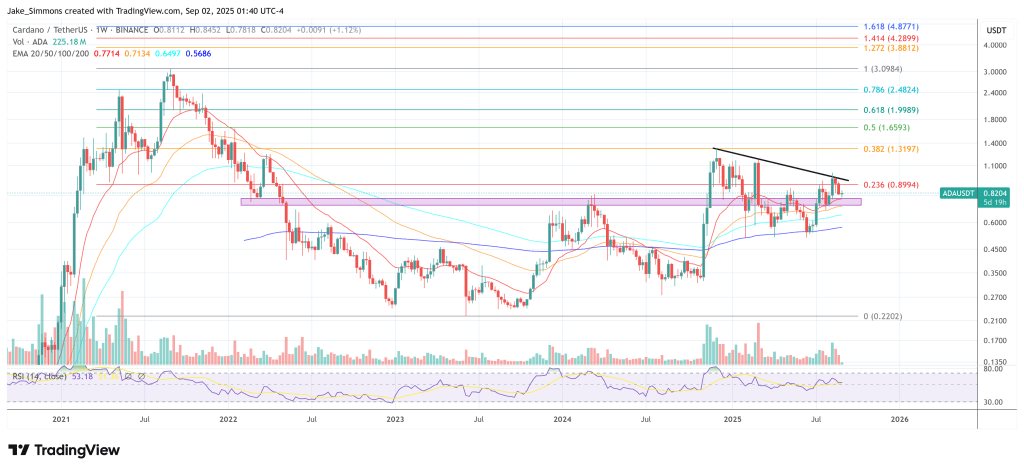
At press time, ADA traded at $0.82.

Related Posts