Deflationary cryptocurrencies have always attracted interest from traders and long-term investors alike. The idea that an asset can become scarcer over time, simply by design, is powerful. Yet in practice, very few projects have managed to create a system where deflation is both credible and sustainable.
FUNToken is one of the rare examples of a project that has implemented deflation not as a marketing tactic but as an integral part of its business model. By combining real product revenue, transparent burn events, and gamified adoption strategies, FUNToken has built an ecosystem where value creation and scarcity go hand in hand.
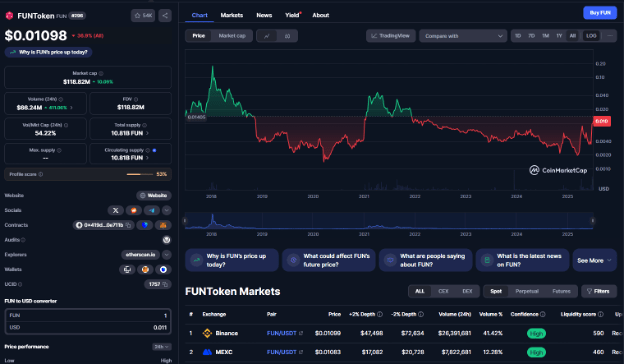
Today, FUNToken trades around $0.01098, with average daily trading volumes over $60 million and a market capitalization near $119 million.
In this article, let’s explore how FUNToken’s model works, why it is gaining traction, and what it signals for the future of deflationary token economies.
Revenue as the Engine of Scarcity
One of the central flaws in many deflationary projects is that their supply reduction mechanisms are detached from actual usage. A team may announce a burn, but if that burn relies on reserves rather than fresh revenue, it quickly loses credibility.
FUNToken has solved this problem by connecting supply reduction directly to the success of its platform. The most recent burn, completed on June 24, permanently removed 25 million FUN tokens from circulation. This burn was funded by revenue generated from platform activities, which is a core element of the project’s model.
Here is how it works in practice:
- Each quarter, FUNToken calculates its total income from ecosystem services, which includes engagement within its Telegram AI bot and planned gaming products.
- A part of that revenue is allocated to buybacks and burns.
- Once purchased, tokens are sent to a designated burn address where they are irreversibly removed from circulation.
Why This Matters for Value
The significance of revenue-backed burns can be seen in market performance. After the June 24 burn, FUNToken’s price jumped from approximately $0.0045 to around $0.0064, a surge of over 41% within 24 hours.
This immediate reaction was driven by the clarity of the event. Investors could verify the burn transaction on-chain, see that it was funded by actual earnings, and understand that it permanently reduced available supply.
Unlike buybacks that get recycled back into treasury or staking pools, these burns are final. That finality is crucial because it aligns with investor expectations of deflationary economics.
A Roadmap That Converts Engagement into Growth
Sustainable deflation requires more than just supply cuts. It depends on a steady pipeline of engagement to drive revenue.
FUNToken’s roadmap is structured to maintain this engine. Throughout Q3 and Q4 of 2025, the project plans to roll out:
- A dedicated mobile wallet that will support in-app token management, staking, and simplified swaps
- A portfolio of 30 free-to-play games designed to encourage casual participation and daily transactions
- Advanced integrations with the Telegram AI bot to further gamify the experience
Each of these roadmap items has a dual purpose. They attract new users by replicating familiar Web2 experiences, and they create revenue that sustains the burn model.
When the mobile wallet launches, users will be able to stake their tokens easily and track burn events in real time. This kind of visibility reinforces the perception of deflation as a transparent, ongoing process rather than an occasional headline.
The Role of the Telegram AI Bot in Driving Activity
No discussion of FUNToken’s deflationary model is complete without recognizing the impact of its Telegram $FUN AI bot.
This bot serves as an always-on engagement hub. Users can earn $FUN tokens by participating in simple activities like answering quiz questions, reacting to posts, or referring friends. With over 110,000 active users already participating, the bot is a major contributor to FUNToken’s recurring revenue.
This is how the model comes full circle:
- Users complete tasks in the bot and generate transaction fees or monetized engagement.
- That revenue becomes part of the quarterly pool used to fund burns.
- As burns reduce supply, the tokens users have already earned become scarcer.
- New users are attracted by transparent burn statistics and clear utility, expanding the cycle further.
This closed-loop structure is an important differentiator. In many projects, incentives are purely inflationary, diluting the rewards of early participants. FUNToken’s combination of activity-driven rewards and deflationary mechanics addresses this issue directly.
CertiK Audit and Skynet Monitoring
Another cornerstone of FUNToken’s credibility is its security posture. The project underwent a full CertiK audit, which verified that the smart contract is immutable and free of hidden minting functions.
CertiK’s findings mean that once tokens are burned, they cannot be reintroduced. This assurance is reinforced by CertiK Skynet, a continuous monitoring solution that scans the contract in real time for any anomalies.
For users who may be new to Web3 or concerned about token integrity, these measures provide reassurance. In effect, CertiK serves as the external validation that FUNToken’s deflationary claims are not just promises but verifiable facts.
What to Watch in the Months Ahead
Looking forward, there are several milestones that could further reinforce FUNToken’s model:
- The release of the mobile wallet by the end of Q4 2025, providing a seamless home for staking and in-app transactions
- Expansion of the free-to-play game library, which is expected to drive new engagement and revenue
- Additional quarterly burns funded by rising platform income
If these milestones are met on schedule, FUNToken’s deflationary structure will only become more compelling to holders and new users.
Conclusion
FUNToken’s deflationary strategy is more than a set of tokenomics bullet points. It is a model that combines:
- Revenue-backed burns that are fully transparent
- User acquisition through accessible, gamified experiences
- A clear roadmap that integrates mobile-first tools and casual gameplay
- Independent verification by CertiK and real-time Skynet monitoring
As FUNToken continues to execute its roadmap and demonstrate quarterly burns, it is positioning itself as a prime example of how crypto projects can sustain both user adoption and long-term scarcity.
Note: The price mentioned was accurate at the time of writing (July 3, 2025) and may have changed since

Related Posts