Ripple Exec Warns: Banks Without A Stablecoin Strategy ‘Will Get Left Behind’

bitcoinistPublished on 2025-12-11Last updated on 2025-12-11

Abstract

Ripple executive Reece Merrick warns that banks and financial institutions without a stablecoin strategy risk being left behind. He emphasized that stablecoins are becoming core to payments and treasury infrastructure. Ripple’s USD-backed stablecoin, RLUSD, recently gained regulatory approval in Abu Dhabi, allowing licensed institutions to use it for regulated activities. Backed by stringent regulators like NYDFS and FSRA, RLUSD aims to be an institutional-grade product. Though its circulation is modest compared to giants like Tether, Ripple targets integration into high-volume institutional flows through recent acquisitions and its existing cross-border payment network, which has processed $95 billion. Merrick highlighted trust, regulation, and real-world utility as key to driving adoption and future growth in the multi-trillion-dollar stablecoin market.

Ripple’s Middle East and Africa boss has a blunt message for the banking sector: if you still do not have a stablecoin strategy, you are already behind the curve.

“Look, I think there’s no bank, financial institution, payment entity that is not thinking, talking or incorporating a stablecoin strategy,” Ripple’s Reece Merrick told CNBC in Abu Dhabi. “And quite frankly, if they’re not, they will get left behind.”

Ripple’s Advantage In The Stablecoin Space

The interview came right after a significant regulatory win. Ripple’s USD-backed stablecoin, RLUSD, has been recognized by Abu Dhabi’s Financial Services Regulatory Authority (FSRA) as an “Accepted Fiat-Referenced Token,” allowing ADGM-licensed institutions to use it for regulated financial activity. For Ripple, this is less about marketing and more about foothold: it embeds RLUSD inside one of the Gulf’s most aggressively pro-crypto regulatory hubs.

“Firstly, what this does is it further validates Ripple’s value proposition here in the region and a compliance-first approach as it relates to issuing our own stablecoin, RLUSD, at the back end of last year,” Merrick said. The approval means ADGM entities can “utilize RLUSD within their flows, within their operations,” which he called “a great step forward for Ripple, great step forward for the region.”

The compliance drumbeat is deliberate. Before pushing RLUSD globally, Ripple went to what Merrick described as “the gold standard of regulators,” the New York Department of Financial Services, which oversees RLUSD issuance. The combination of NYDFS in the US and FSRA (plus Dubai’s DFSA, which earlier approved Ripple as the first blockchain-enabled payment solution provider) is meant to send a clear signal: this is an institutional product, not a fly-by-night dollar token.

The hard numbers are more modest. RLUSD has about 1.2 billion dollars in circulation, tiny next to Tether’s roughly 120 billion. Merrick did not try to spin that away; instead he pointed at the direction of travel. The stablecoin market is around 300 billion dollars today, he noted, dominated by USDT and USDC, but Ripple expects it “to be moving into the trillions” with “share for everyone.”

How to carve out that share is where Ripple’s strategy gets more specific. Merrick said Ripple wants RLUSD “to be the gold standard for institutions to adopt this stablecoin,” and he anchored that in concrete rails: recent acquisitions and existing payment volume.

He highlighted G-Treasury, a treasury management platform that sees “how Fortune 500 businesses are moving trillions of dollars between their own operations,” and Hidden Road, now rebranded as Ripple Prime, a prime broker that “turn[s] over three trillion in prime brokerage.” Ripple’s plan is to bake RLUSD directly into those flows. Since announcing GTreasury, Merrick said, the company has seen “so much inbound” from institutions exploring RLUSD for their internal operations.

Underneath sits Ripple’s long-running cross-border payments business, which has processed about 95 billion dollars in turnover using XRP and the XRP Ledger. RLUSD, Merrick argued, is a “natural step” after persistent customer demand for stablecoin payouts. With roughly half of global cross-border payments made in dollars and many of those not actually destined for the US, he called existing channels “inefficient and slow,” and positioned regulated dollar tokens as a cleaner alternative.

Trust and understanding are still the industry’s biggest problems, as CNBC’s Dan Murphy noted, citing boardroom confusion and skepticism even at Abu Dhabi Finance Week. Merrick’s response was predictable but also, frankly, the only credible one: stack regulation, collateral transparency and real-world utility until the narrative changes.

“Trust is paramount,” he said, pointing again to NYDFS, ADGM and DFSA approvals as the anchor. Once “large financial institutions, these large corporates” see the impact on their own business, he expects “that kind of hockey stick growth.”

He also highlighted the GENIUS Act in the US as having “paved the way for some of the largest global financial institutions to kind of play in this space,” shorthand for the broader legislative shift toward regulated stablecoin frameworks.

Taken together, Merrick’s remarks sketch a simple line in the sand. Stablecoins are no longer a side experiment; they are becoming core payments and treasury infrastructure. And for banks still stuck at the “internal working group” stage, the message from Ripple’s regional chief could not have been clearer: get a stablecoin strategy, or get comfortable watching your customers migrate to those who already do.

At press time, XRP traded at $2.0149.
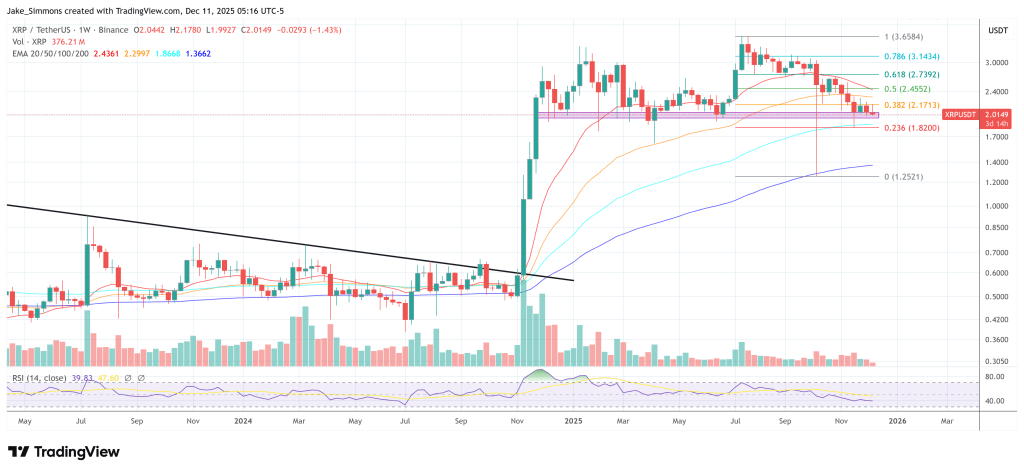
XRP holds above key support, 1-week chart | Source: XRPUSDT on TradingView.com

Related Reads

How Did Institutions Adjust Their Crypto Asset Holdings in Q1? Who Increased and Who Exited?

The Q1 2026 13F filings reveal a sharply divided picture of institutional activity in crypto assets. Sovereign wealth funds and bank capital increased exposure, while major endowment funds notably de-risked. The most significant buying came from the Abu Dhabi sovereign wealth fund Mubadala, which expanded its position in the iShares Bitcoin Trust (IBIT). JPMorgan Chase dramatically increased its IBIT exposure by 174%, with other global banks like RBC, Scotiabank, and Barclays also adding to Bitcoin ETF holdings, while using options for asymmetric protection. Conversely, the Harvard Management Company (Harvard University's endowment), once a major academic holder, cut its IBIT position by 43% and fully exited a BlackRock Ethereum ETF. The reallocated capital flowed into traditional assets like TSMC, Microsoft, and gold. Other Ivy League endowments showed varied strategies: Brown and Dartmouth maintained Bitcoin positions, with Dartmouth making a nuanced shift by moving Ethereum exposure to a staking ETF and adding a Solana staking ETF to capture yield. Hedge fund Jane Street significantly reduced Bitcoin ETF holdings, locking in profits, while Wells Fargo increased its Ethereum stake. Overall, institutions are deploying traditional capital market tactics—buying, selling, hedging, and rotating—within crypto via spot ETFs. The Q2 reports will be crucial to determine if Harvard's retreat is an outlier or the start of a broader trend among endowments.

marsbit22m ago

How Did Institutions Adjust Their Crypto Asset Holdings in Q1? Who Increased and Who Exited?

marsbit22m ago

Blockchain Capital Partner: Most People Have a Narrow Understanding of the On-Chain Economy

Author Spencer Bogart, a partner at Blockchain Capital, argues that most people have a narrow view of the on-chain economy, seeing it primarily as a faster, cheaper version of existing financial systems. While this represents a significant opportunity, he believes it's only a small part of the story. Bogart compares the current state of crypto to the early internet, where email was the obvious "faster mail" application. The truly transformative categories—like search, social media, and cloud computing—were entirely new and unimaginable beforehand. Similarly, the most profound innovations in crypto will not be incremental improvements but entirely new categories enabled by the core properties of public blockchains: atomic execution, shared global state, programmable custody, and composability. He cites the "flash loan" as a prime example of a "new verb"—a financial action structurally impossible before programmable assets and atomic settlement. It allows for uncollateralized, trustless borrowing of any size, provided repayment occurs within the same transaction, enabling novel strategies like arbitrage and collateral swaps. Bogart admits the difficulty in precisely predicting these future innovations, as human imagination tends to extrapolate from the past. He posits that the most exciting applications in ten years will be things that don't exist today and have no precedent—products only possible in a global, composable, always-on environment with programmable assets. While the exploration of this vast design space will involve many failures, the potential for transformative, category-defining breakthroughs is what makes the next decade so promising.

链捕手51m ago

Blockchain Capital Partner: Most People Have a Narrow Understanding of the On-Chain Economy

链捕手51m ago

Cloud PC Gets a Second Chance, Google/Alibaba/Microsoft Battle for Cloud AI Dominance

Google unexpectedly announced "Android Computer," a new high-end productivity-focused PC series, positioning cloud AI as its core rather than an add-on. This move signals a potential revival for the "cloud computer" concept in the AI era. The article argues that current "AI PCs" are essentially traditional Windows machines with AI features grafted on, heavily reliant on cloud AI for complex tasks due to limited local consumer-grade hardware capabilities. This reliance raises questions about the value of premium local AI hardware. Cloud computers, which struggled with latency-sensitive applications like cloud gaming, are seen as a natural fit for AI PCs due to AI's higher tolerance for response time. Google's Android Computer deeply integrates AI (powered by its Gemini model) into the OS interface, making it contextually available. Its hardware-agnostic approach (supporting both x86 and ARM chips) further underscores the shift towards cloud-centric AI. Other players are adapting: Cloud service providers like Alibaba are enhancing their AI cloud computer offerings; chipmakers (Intel, AMD) are focusing on data center AI chips; traditional PC brands are adding AI software layers; and Apple is leveraging its ecosystem and affordable hardware. Microsoft is defining AI PC standards, embedding Copilot (powered by GPT and Bing) into Windows, and also relying on cloud AI. In conclusion, Android Computer challenges the traditional PC form factor by proposing a "light local, heavy cloud" model. This approach appears promising amid rising hardware costs and local compute bottlenecks. The future PC market will involve a multifaceted competition around cloud integration, OS-level AI, and cross-device ecosystems, potentially redefining the PC as a screen and network conduit to cloud-based AI productivity.

marsbit1h ago

Cloud PC Gets a Second Chance, Google/Alibaba/Microsoft Battle for Cloud AI Dominance

marsbit1h ago

Encrypted ETF Weekly Report | Last Week, US Bitcoin Spot ETF Net Outflow $9.95 Billion; US Ethereum Spot ETF Net Outflow $255 Million

Last week, U.S. Bitcoin spot ETFs saw significant net outflows totaling $995 million over three days, with a major contribution of $317 million from BlackRock's IBIT. Their total net asset value (NAV) stands at $104.2 billion. U.S. Ethereum spot ETFs also experienced net outflows of $255 million over five days, largely from BlackRock's ETHA ($186 million out), bringing their total NAV to $12.93 billion. In Hong Kong, Bitcoin spot ETFs recorded a net outflow of 24.91 BTC, reducing their NAV to $323 million. Hong Kong's Ethereum spot ETFs saw no inflows, with an NAV of $68.13 million. U.S. Bitcoin spot ETF options showed increased activity, with a total nominal trading volume of $797 million and a put/call trading ratio of 1.63, indicating a bullish market sentiment. The total open interest reached $23.08 billion. Key developments include VanEck and Grayscale simultaneously filing amended proposals for BNB ETFs, signaling potential SEC review progress. Grayscale also filed for the first U.S. privacy coin ETF (Zcash). Avenir Group remains Asia's largest institutional holder of Bitcoin ETFs. 21Shares launched an actively managed crypto ETF (TKNS), and Bitwise's Hyperliquid ETF (BHYP) is set to list on the NYSE. Institutional activity varied: JPMorgan dramatically increased its Bitcoin ETF holdings (IBIT up 174%), while Jane Street significantly reduced its exposure (IBIT down 71%). Dartmouth College disclosed holdings of $7.7M in Bitcoin ETF and $3.4M in a Solana ETF.

链捕手1h ago

Encrypted ETF Weekly Report | Last Week, US Bitcoin Spot ETF Net Outflow $9.95 Billion; US Ethereum Spot ETF Net Outflow $255 Million

链捕手1h ago

Trading

Spot
Futures

Hot Articles

What is GENIUS

I. Project Introduction1. What Is Genius?Genius (GENIUS) is positioned as the “ultimate on-chain terminal,” a decentralized trading platform focused on privacy and speed. By integrating top-tier privacy technology, it aims to build a next-generation privacy trading infrastructure across networks such as BNB Chain, enabling users to interact on-chain with a seamless experience comparable to centralized exchanges.2. How Does Genius Work?Genius's core technical architecture is structured as follows:(1) Chain-invisible: Users do not need to manually handle multi-step approvals for cross-chain operations, asset wrapping, or complex gas management.(2) Signatureless Trading: Through integrations such as Turnkey, Genius enables instant trading without pop-up confirmations or per-transaction authorization.(3) Aggregator of Aggregators: Genius is powered by a best-in-class aggregation stack integrated with more than 150 DEXs, claiming superior quote efficiency compared with competing products.(4) Account Management: The platform adopts a non-custodial architecture and leverages Turnkey and Lit Protocol for key management, allowing users to securely access their accounts through passkeys.3. Who Created Genius?According to its official Terms of Service, Genius was developed by Shuttle Labs, Inc. Based on the project’s official X account, Ryan Myher is one of the key contributors driving product iteration, including developments such as the rollout of the Ghost protocol, as well as broader community engagement.Binance founder CZ has officially joined the project as an advisor, with the goal of helping the team build a faster and more privacy-preserving on-chain trading experience.In addition, the project has received strong backing from YZi Labs, which has invested in Genius and works alongside the Genius Foundation, responsible for maintaining the core Genius Bridge Protocol (GBP).4. Genius TokenomicsGENIUS is the native token of the Genius ecosystem. As of now, the project has not released a full tokenomics document.Based on the latest official disclosures, Genius incorporates a deflationary mechanism, and 4.6% of the total token supply had already been burned during the early launch phase.Genius Points (GP) System:(1) Trade-to-Earn: The platform has established a reward pool of 200 million Genius Points, and users earn GP for every trade executed through the terminal.(2) Tiering and Badges: Genius features a progression-based badge system ranging from Smart to God, with higher levels unlocking additional perks and benefits.(3) Native Yield: Users holding designated assets such as usdGG in the dashboard can earn native yield directly without going through complex staking.(4) Referral Incentives: Referrers can earn fee rebates of over 45% paid in USDC, along with additional GP.5. Timeline & Key MilestonesMarch 2020: The project’s official X account was created, marking the beginning of its early preparation phase.January 13, 2026: Genius announced a multi-million-dollar investment from YZi Labs and simultaneously confirmed CZ as an advisor to accelerate the buildout of its privacy trading infrastructure.April 18, 2026: The project announced that the Ghost privacy protocol would be launching soon.April 29, 2026: The Ghost protocol officially opened to its first 50 testers, marking the beginning of a new era for privacy trading on BNB Chain. At the same time, the team confirmed 4.6% of tokens have been burnt.​II. Token Information1) Basic InformationToken name: GENIUS (Genius)III. Related LinksWebsite:https://www.tradegenius.com/homeExplorers:https://bscscan.com/address/0x1f12b85aac097e43aa1555b2881e98a51090e9a6Socials:https://x.com/GeniusTerminalNote: The project introduction comes from the materials published or provided by the official project team, which is for reference only and does not constitute investment advice. HTX does not take responsibility for any resulting direct or indirect losses.

1.2k Total ViewsPublished 2026.04.29Updated 2026.05.11

What is GENIUS

How to Buy GENIUS

Welcome to HTX.com! We've made purchasing Genius (GENIUS) simple and convenient. Follow our step-by-step guide to embark on your crypto journey.Step 1: Create Your HTX AccountUse your email or phone number to sign up for a free account on HTX. Experience a hassle-free registration journey and unlock all features.Get My AccountStep 2: Go to Buy Crypto and Choose Your Payment MethodCredit/Debit Card: Use your Visa or Mastercard to buy Genius (GENIUS) instantly.Balance: Use funds from your HTX account balance to trade seamlessly.Third Parties: We've added popular payment methods such as Google Pay and Apple Pay to enhance convenience.P2P: Trade directly with other users on HTX.Over-the-Counter (OTC): We offer tailor-made services and competitive exchange rates for traders.Step 3: Store Your Genius (GENIUS)After purchasing your Genius (GENIUS), store it in your HTX account. Alternatively, you can send it elsewhere via blockchain transfer or use it to trade other cryptocurrencies.Step 4: Trade Genius (GENIUS)Easily trade Genius (GENIUS) on HTX's spot market. Simply access your account, select your trading pair, execute your trades, and monitor in real-time. We offer a user-friendly experience for both beginners and seasoned traders.

2.4k Total ViewsPublished 2026.04.29Updated 2026.05.11

How to Buy GENIUS

Discussions

Welcome to the HTX Community. Here, you can stay informed about the latest platform developments and gain access to professional market insights. Users' opinions on the price of A (A) are presented below.

活动图片