Bitcoin rallies fail at $94K despite Fed policy shift: Here’s why

cointelegraphPublished on 2025-12-11Last updated on 2025-12-11

Abstract

Bitcoin's price struggled to break above $94,000 despite a 0.25% interest rate cut by the Federal Reserve, remaining near $90,000 due to weak bullish momentum. Analysts attribute the stagnation to a significant decline in liquidity, particularly from stablecoins, with ERC-20 stablecoin inflows dropping nearly 50% since August. This reduction in buying power means recent rebounds are driven by reduced sell pressure rather than strong accumulation. Key resistance lies between $94,000 and $98,000, but repeated rejections at $93,000 signal exhaustion. A break below $88,000 could trigger a bearish structure, potentially pushing BTC toward $84,000 or even $80,600. Bulls need a weekly close above $90,000–$93,000 to regain momentum.

Bitcoin’s (BTC) price action remained underwhelming this week after another failed attempt to reclaim the monthly volume-weighted average price (VWAP), with BTC consolidating near $90,000 following the Federal Reserve’s 0.25% interest rate cut. The market continued to reject any meaningful push above $93,000, thereby limiting bullish momentum.

Key takeaways:

  • One Bitcoin analyst said that liquidity contraction is suppressing Bitcoin’s upside, reducing demand relative to sell pressure.

  • $94,000 to $98,000 remained the critical liquidity pocket, but BTC must avoid forming a bearish break of structure below $88,000.
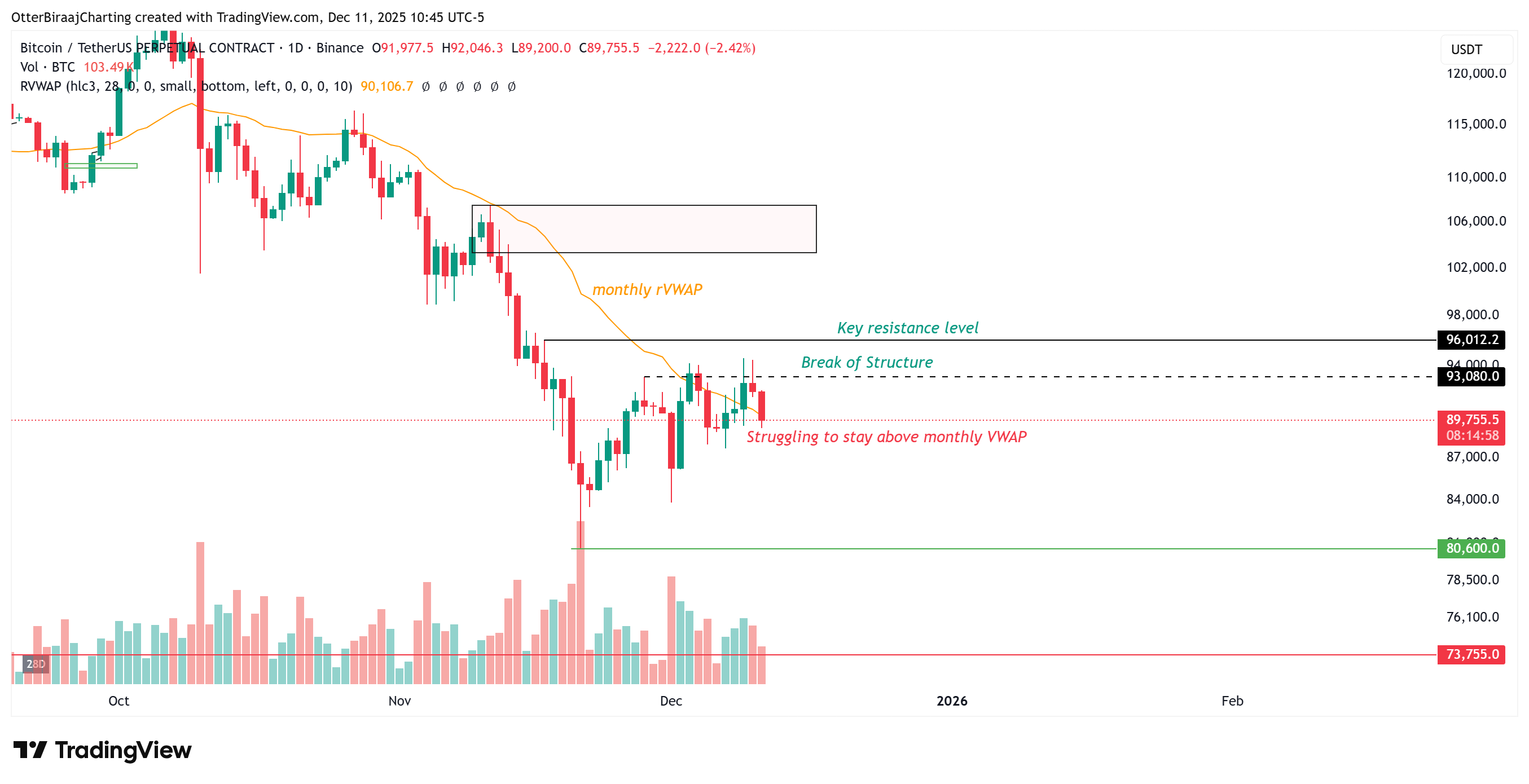
Bitcoin one-day chart. Source: Cointelegraph/TradingView

Liquidity compression dictates Bitcoin’s market behavior

According to crypto analyst Darkfost, Bitcoin’s struggle has little to do with sentiment swings and more to do with declining liquidity, specifically from stablecoins. Stablecoin inflows onto exchanges offer one of the most reliable signals of incoming capital, and right now that signal is flashing red.
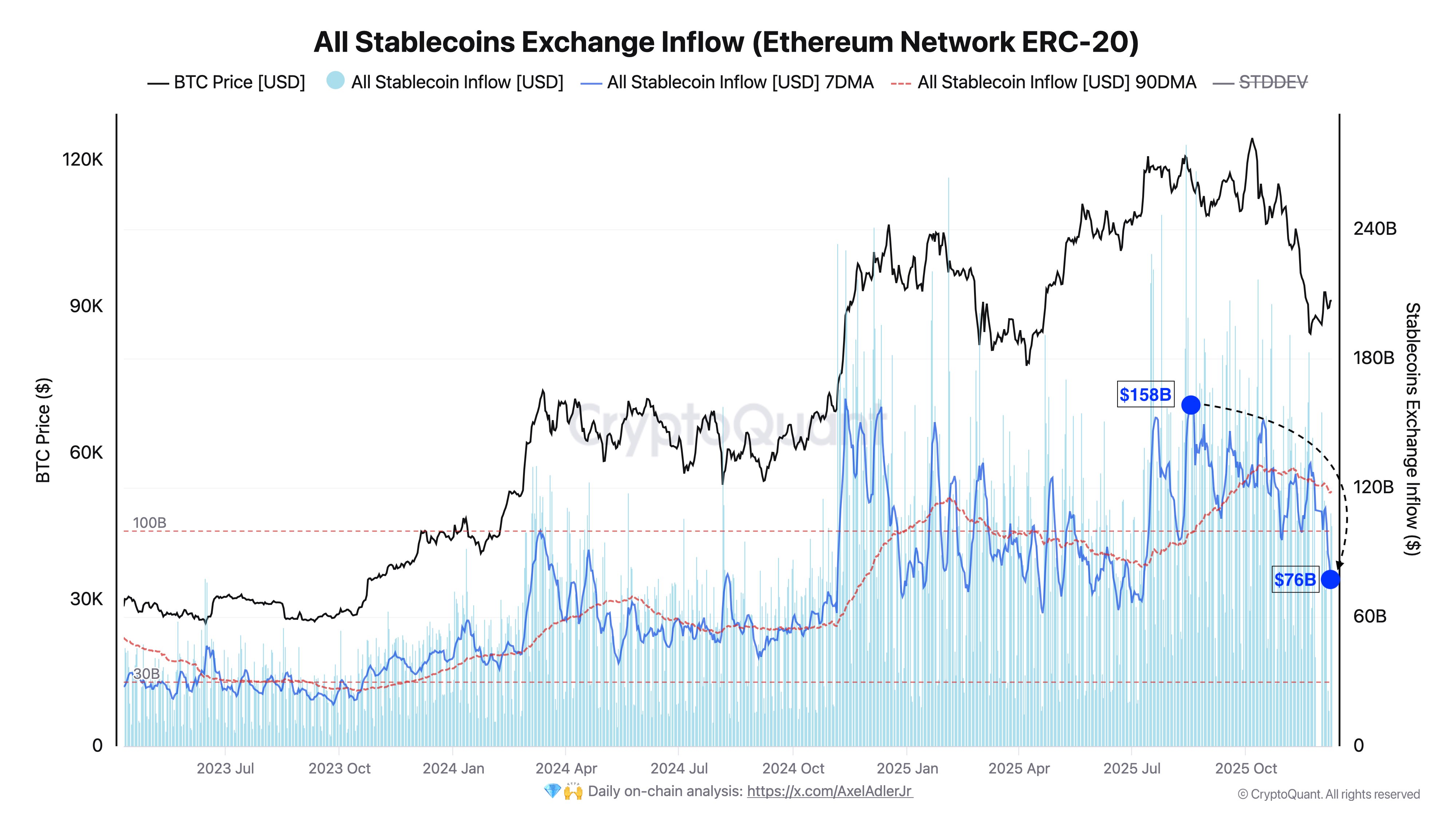
Stablecoin exchange inflows. Source: CryptoQuant

The data showed a significant liquidity contraction: ERC-20 stablecoin inflows have declined from $158 billion in August to approximately $76 billion this month, representing a nearly 50% drop. Even the longer-term 90-day average has slipped from $130 billion to $118 billion, confirming that the trend is not temporary but structurally deteriorating.

This decline translated directly into weaker buying power. Darkfost noted that recent rebounds are not driven by strong accumulation but by periods of reduced sell pressure, meaning the market lacks the inflows needed to sustain higher highs or defend key support levels. Until fresh liquidity returns, Bitcoin’s rallies are likely to remain shallow.

Meanwhile, trader DaanCrypto added that the broader liquidity map still indicated the $97,000–$98,000 region as the next significant magnet for price. But BTC has repeatedly failed to break $94,000, the first barrier that must be overtaken for volatility expansion.

Without that confirmation, the market remains vulnerable to sharp range reversions that continue to trap both longs and shorts.
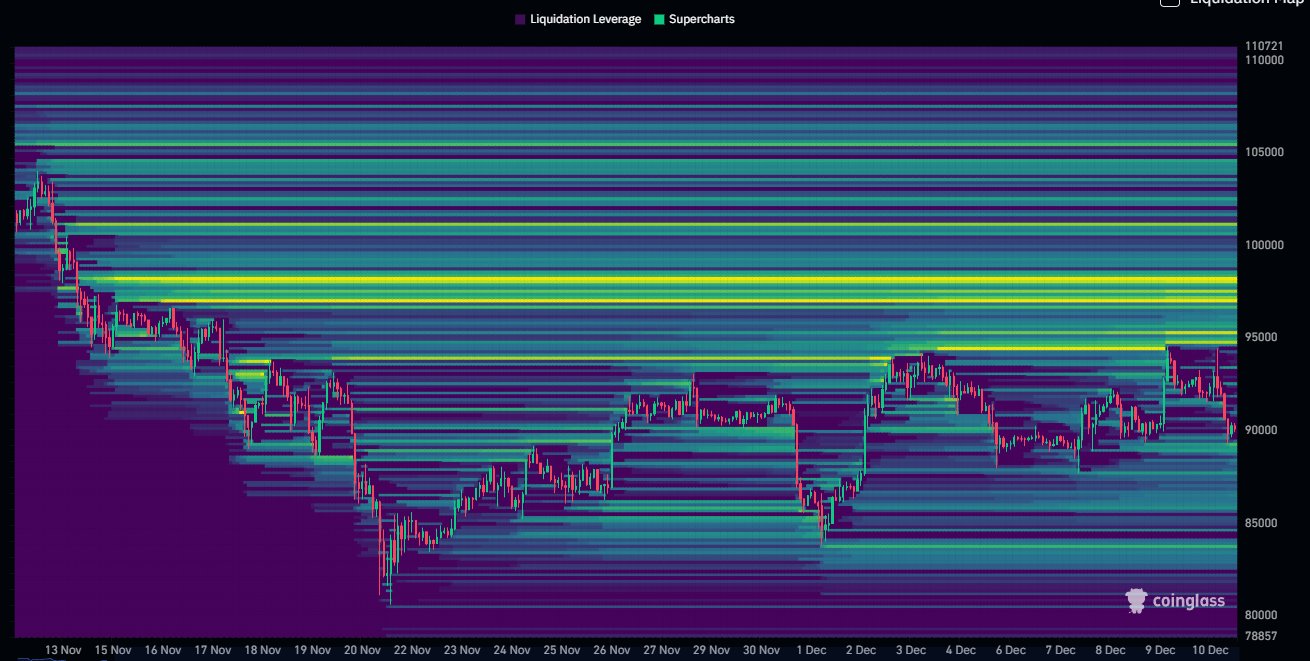
Bitcoin liquidation analysis by Daan. Source: X

Related: Prediction markets bet Bitcoin won’t reach $100K before year’s end

BTC nears key breakdown threshold near $90,000

From a structural standpoint, Bitcoin has now failed three consecutive attempts to break the $93,000 level. The latest rejection formed a clean swing failure pattern (SFP) after the FOMC meeting, signaling exhaustion and reinforcing the weakness in trend continuation.
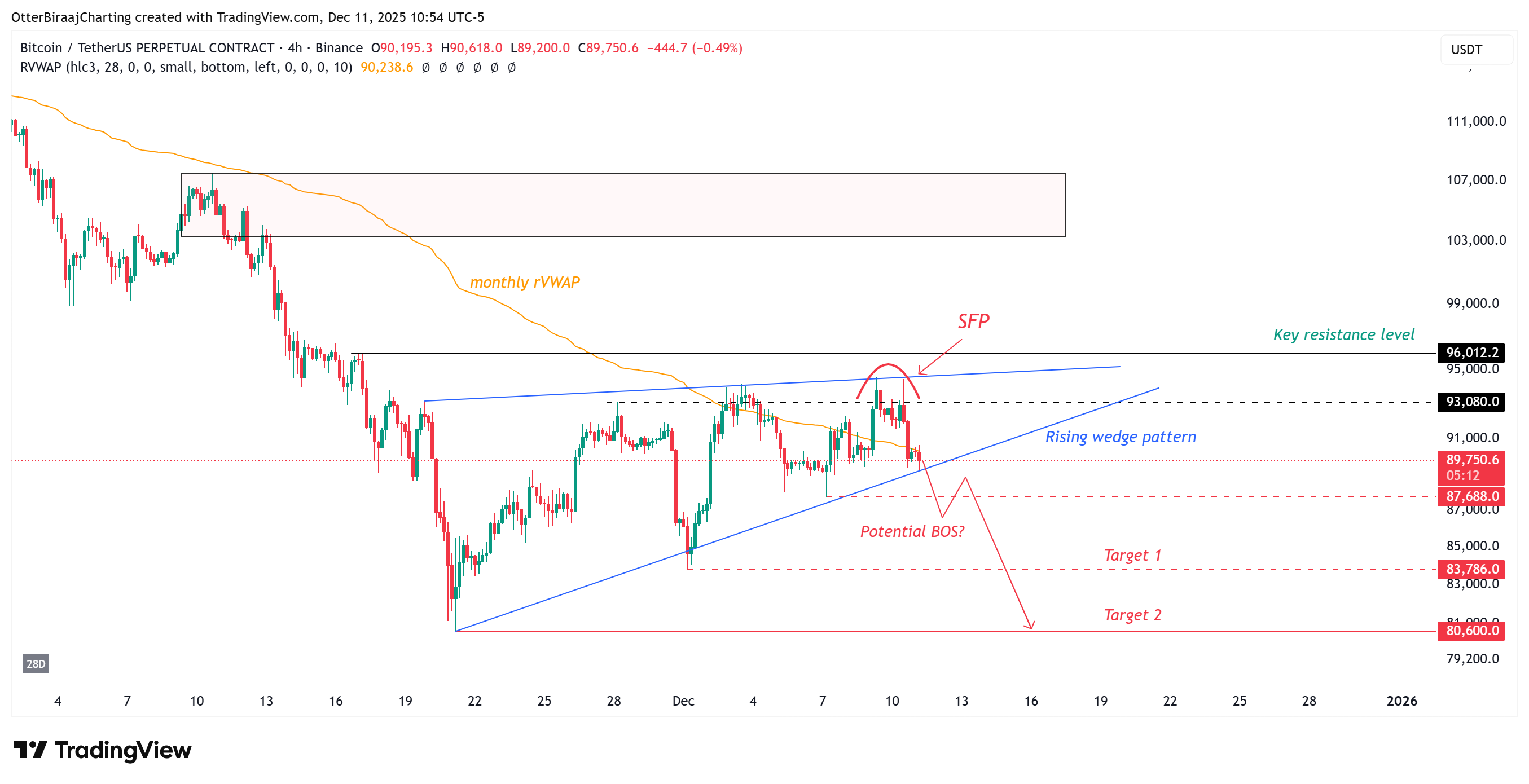
Bitcoin one-hour chart analysis. Source: Cointelegraph/TradingView

BTC is also nearing confirmation of a bearish rising wedge, which becomes active if the price falls below $88,000 and forms a bearish break of structure (BOS). A breakdown would expose an external liquidity sweep around $84,000, with deeper downside potential toward the $80,600 quarterly lows, a level that aligns with prior inefficiencies on higher-timeframe charts.

Still, bullish traders such as Captain Fabik maintained that BTC is undergoing deliberate shakeouts designed to remove weak hands. For a bullish reclaim, BTC must secure a weekly close above $90,000 and ideally near $93,000, giving bulls the structural foundation required to attack the $96,000 breakout zone, where a momentum expansion could finally unfold.
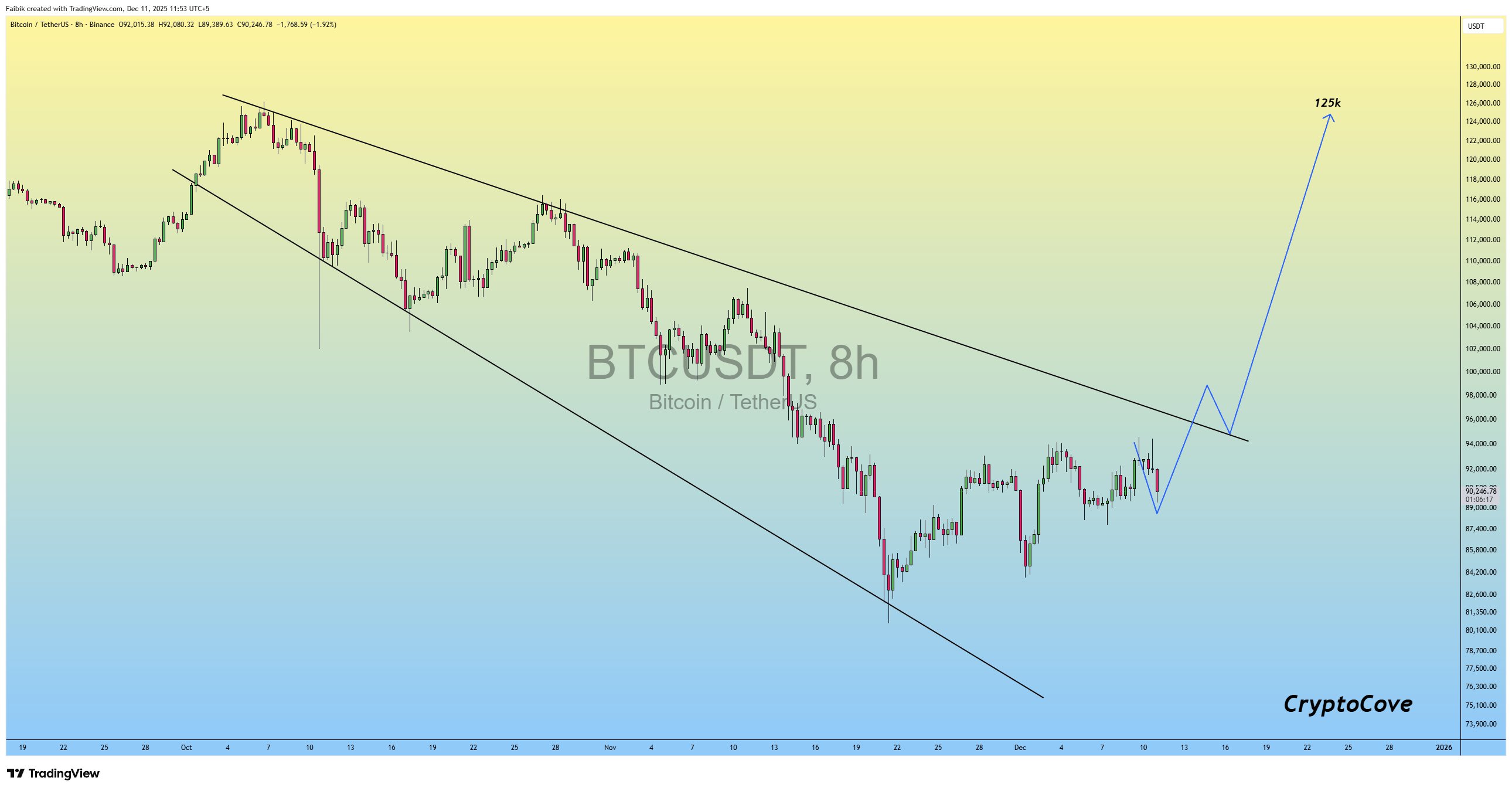
BTC 1-day analysis by Captain Fabik.

Related: Bitcoin due 2026 bottom as exchange volumes grind lower: Analysis

This article does not contain investment advice or recommendations. Every investment and trading move involves risk, and readers should conduct their own research when making a decision. While we strive to provide accurate and timely information, Cointelegraph does not guarantee the accuracy, completeness, or reliability of any information in this article. This article may contain forward-looking statements that are subject to risks and uncertainties. Cointelegraph will not be liable for any loss or damage arising from your reliance on this information.


Related Reads

Vitalik: We Need to Create Sanctuaries, Not Fight AI

In a recent interview, Vitalik Buterin, founder of Ethereum, addresses the central anxiety of the AI era. He argues the primary risk isn't AI's intelligence, but human passivity—ceding decisions, privacy, and agency to centralized systems or "super AIs" for a sense of "disempowering safety." His solution is not to fight AI, but to build "sanctuary technologies." These are optional, non-totalizing spaces that protect users while preserving their sovereignty and privacy. Ethereum is presented as a prime example, offering a parallel financial system one can freely choose, not a fix for the old one. Reflecting on his journey from a 19-year-old on "autopilot" to an active "pilot," Vitalik notes the world reinvents itself every 5-10 years. To keep up, individuals must actively pilot their lives, not be passive passengers. He stresses that active learning vastly outperforms passive learning, even with equal time invested. His practical advice for builders and individuals in the AI age includes: periodically forcing oneself to do tasks manually to keep the mind engaged; prioritizing active learning and verification over outsourcing answers; building tools that help retain human agency; not outsourcing all strategic thinking to AI; and preserving serendipity through real-world interactions. Ultimately, Buterin redefines Ethereum/crypto's role: not to win against or fix the old world, but to provide a free, optional alternative. The core message is that as AI grows more powerful, the truly scarce resource will be proactive humans who retain their sovereignty, privacy, and capacity for independent thought. The era demands not less tool use, but more intentional and active use of technology.

链捕手2h ago

Vitalik: We Need to Create Sanctuaries, Not Fight AI

链捕手2h ago

Conversation with Patagon Founder: Revealing the Inside Story of Anthropic's Secondary Market

**Summary: Inside Anthropic's Massive, Opaque Secondary Market** In a revealing interview, Patagon founder Dio Casares pulls back the curtain on the booming, high-risk secondary market for shares in companies like Anthropic. This private market, fueled by companies staying private longer and massive funding rounds, is estimated to involve hundreds of billions of dollars. Casares distinguishes between two types of "secondary" trading: 1. **Company-approved SPV (Special Purpose Vehicle) sales:** Where new capital flows into the company, often facilitated by select private equity firms. Anthropic supports this to manage liquidity and pre-IPO selling pressure. 2. **The "gray" market:** Platforms like Hive and Forge that match buyers and sellers, often creating pricing confusion and competing with official funding rounds. These intermediaries are widely disliked by companies. The market structure is complex and fragmented, relying heavily on personal connections. Brokers connect buyers and sellers, often layering multiple SPVs to pool capital, with single transaction fees as high as 10%. Strikingly, some finance professionals earn more from this trading than from their primary investment roles. **Key risks highlighted include:** * **High Fraud Rates:** An estimated 10-20% of transactions involve fake stock certificates or sellers who take payment without having the shares. * **Complex, Risky Structures:** Nested SPVs, "forward contracts" on employee equity, and tokenized private equity create layers of opacity. This is exemplified by a recent incident where an xAI employee's shares were revoked after an espionage allegation, leaving buyers empty-handed. * **Post-IPO "Settlement Hell":** After an IPO, delays in distributing shares through multiple SPV layers and decisions by fund managers to hold onto shares could trigger years of lawsuits as downstream investors are locked out. **For small investors** holding positions through tokenized vehicles or layered SPVs, it's often impossible to verify the underlying asset. Casares advises caution: if the investment feels wrong, consider exiting. As the private market now surpasses IPO fundraising, this "wild west" ecosystem faces a looming reckoning. While it will likely professionalize, the post-IPO period for a company like Anthropic could unleash a wave of disputes, exposing the vulnerabilities built into this frenzied, largely unregulated marketplace.

marsbit4h ago

Conversation with Patagon Founder: Revealing the Inside Story of Anthropic's Secondary Market

marsbit4h ago

Trading

Spot
Futures

Hot Articles

Discussions

Welcome to the HTX Community. Here, you can stay informed about the latest platform developments and gain access to professional market insights. Users' opinions on the price of S (S) are presented below.

活动图片