Web3 Teams, Stop Wasting Your Marketing Budget on Platform X

marsbitPublié le 2026-03-12Dernière mise à jour le 2026-03-12

Résumé

Web3 marketing teams are wasting budgets on ineffective X platform campaigns, as traditional promotion strategies have become obsolete. The classic model—announcement, followed by coordinated KOL posts, and then community discussion—no longer works due to X's new partnership disclosure rules, which make paid promotions obvious to users. This triggers ad avoidance instead of organic engagement. X rewards drama, memes, and debates, not formal announcements. Using Starknet's recent strkBTC campaign as a case study, the author notes that their promotional efforts resulted in low organic mentions and engagement. The solution is to flip the strategy: start by creating narrative tension through debates and comparisons (e.g., "Ethereum L2 vs. Bitcoin L2"), encourage community-generated content, and only then release the official announcement. The goal is to dominate conversations, not just broadcast messages. For developer outreach, building ecosystem prestige and showcasing success stories is more effective than announcement-led campaigns. The key takeaway: marketing must prioritize sparking discussion rather than controlling the message.

Original Author / Stacy Muur

Compiled by / Odaily Planet Daily Golem(@web 3_golem)

Every month, Green Dots conducts research on KOL promotional campaigns on Platform X to understand the strategies of other Web3 marketing teams and track which strategies and post styles are truly effective. However, due to the new paid partnership policy introduced by X, which has changed the marketing landscape on Platform X(Related reading: Musk casually overturns the rice bowl of crypto KOLs), most Web3 projects' promotional strategies are no longer suitable. Stacy Muur reveals in this article the common problems in many recent Web3 promotional activities, using Starknet as the case study for this analysis.

Author's statement: This is not targeting Starknet; their technical strength remains strong. Despite the many doubts and suspicions from the outside world after the airdrop and TGE, the team continues to release and develop products, which deserves respect. But this article focuses only on one aspect: marketing strategy. Starknet's recent new product promotion is just a typical example.

How did Starknet conduct its advertising promotion?

Starknet recently launched strkBTC [₿] and invited some content creators on Platform X to promote this event. They adopted a very classic promotion model:

  1. First, release an announcement with a promotional video;
  2. Within 12-48 hours of the announcement, KOLs will post collaborative promotional posts;
  3. Subsequently, publish articles to specifically explain the advantages of the product.

Even though this promotion was conducted in late February, to comply with Platform X's paid partnership policy, some creators included the paid partnership label when posting related content. But the focus of this article is not on the disclosure of payments, but on the effectiveness of this promotion strategy itself.

On February 10th, around another announcement released by Starknet, their marketing team conducted another KOL promotion. Exactly the same routine: first release a video announcement, then promote it through KOLs.

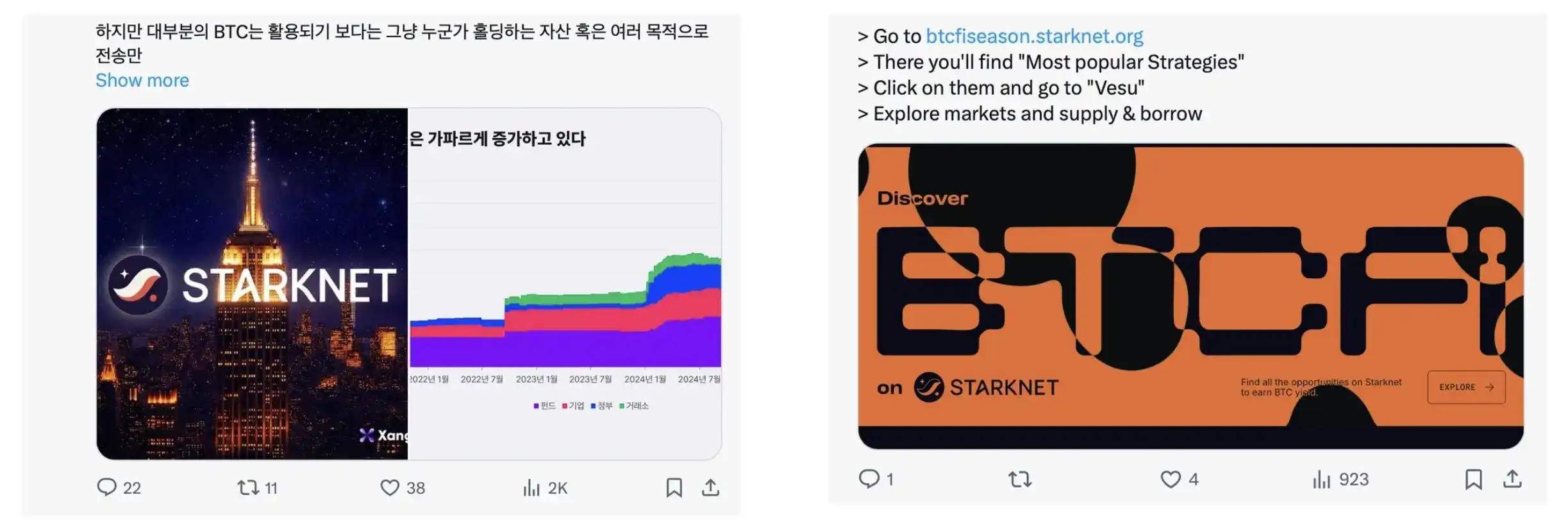
Of course, Starknet also has other promotional methods, such as publishing several long articles and conducting some promotional activities in the Korean language region.
For the record, I don't know who was responsible for managing this campaign, nor whether any agency was involved. I am merely providing some thoughts from an outsider's perspective, from a marketer's point of view.

One problem is obvious throughout the promotion: the screening of creators participating in the promotion is weak.

X is essentially a perception layer. Ideally, creator promotions on X should bring:

  • More discussion about the brand
  • Trigger more voluntary posts from independent creators
  • Drive the production of more community content
  • Stronger ecosystem activation

But is that what we see? Not really.

If you use simple filtering conditions on X to view popular posts mentioning Starknet in February, the results are obvious.
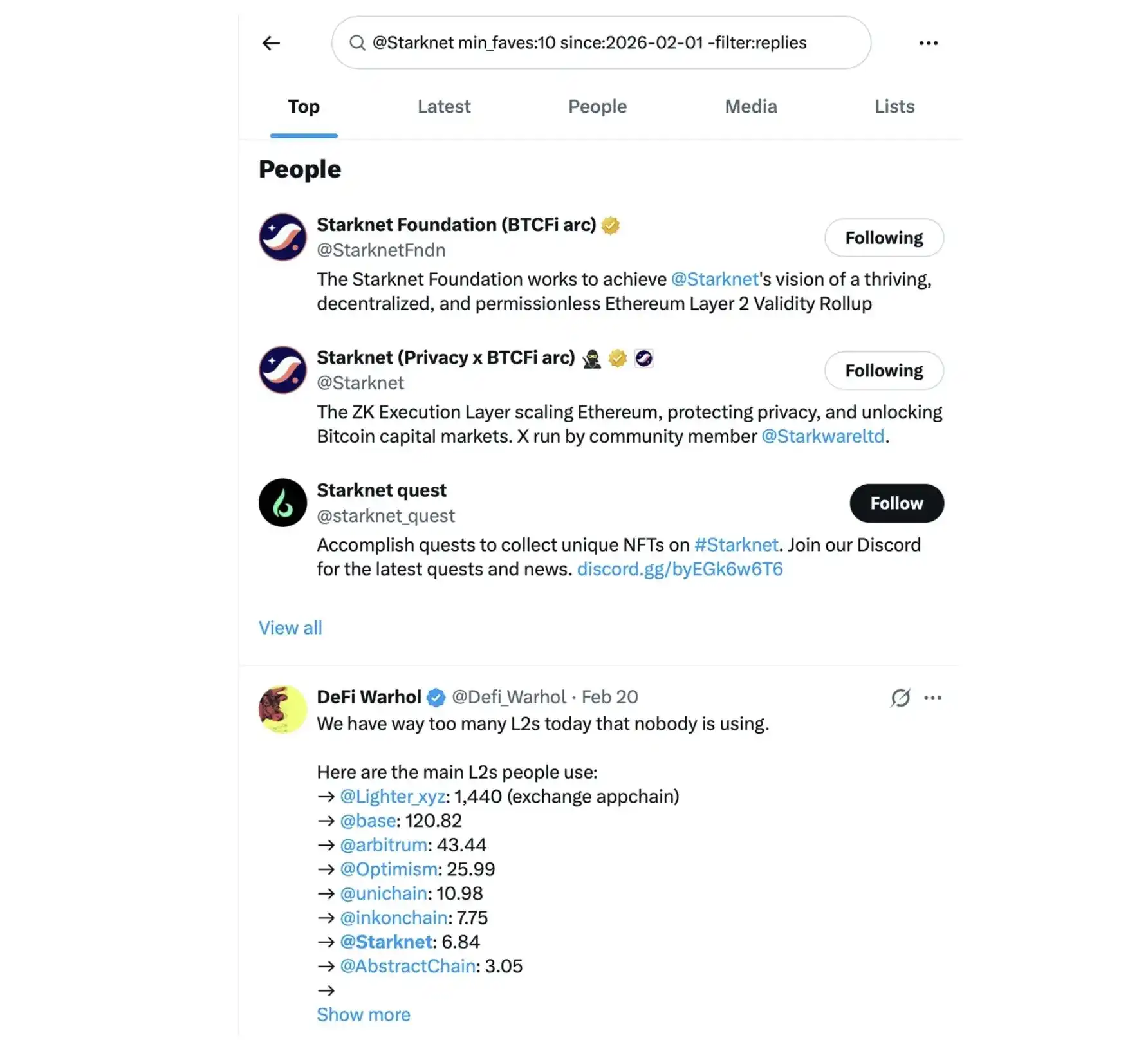
The most mentioned post was actually from Warhol. Overall, in February, only a little over 100 independent posts mentioning Starknet received more than 10 likes. For a well-known L2 ecosystem, this number is not high.

Some popular organic mentions of Starknet included:

  • Mookie's post about token unlocks (approx. 10k views)
  • Warhol's post about the best internship brands in the crypto industry (approx. 16k views)
  • Warhol's L2 rating list (approx. 30k views)
  • santiment's post ranking L2s by developer activity (approx. 50k views)
  • mztacat's post about the "Big Four companies" (approx. 82k views)

The above roughly constitutes Starknet's mention volume on Platform X in February. This leads to a more important question, not just concerning Starknet, but concerning the fact that the classic Web3 marketing strategy is gradually failing on Platform X.

Why is the classic Web3 advertising strategy failing?

For years, the default mode of Web3 marketing has been this: Announcement -> KOL promotion -> Community discussion.

This classic model worked when X's timeline was less crowded, narratives were strong, and most promotions were not easily identifiable as paid promotions. But it started failing after the following changes occurred.

Paid disclosure kills implicit virality

Once creators started adding paid disclosure information, this promotion model became obvious to followers.

First, users see an announcement, then within the next 24 hours, 5-10 similar promotional posts appear, all with largely identical content. Users can immediately recognize this structure. It doesn't trigger community discussion; instead, it sends a signal that "this is an ad campaign."

In the environment of Crypto Twitter, ads rarely spark community discussion; they are usually just scrolled past.

KOL behavior is now very easy to identify

Crypto Twitter has matured; people understand how KOL marketing works.

When the same group of creators quotes the same announcement with slightly different wording, it's easily interpreted as a coordinated promotion. And once KOL content is clearly identified as a promotion, user engagement drops because the audience switches from curiosity mode to ad-filtering mode.

X rewards buzz, not announcements

X is not a distribution channel; it's a narrative space. Unless a Web3 project's announcement can trigger the following, they rarely become trending topics:

  • Arguments and debates
  • Meme coins
  • Hot takes
  • Competition between KOLs

Without these dynamic factors, dissemination can only bring brief user reach but cannot truly win users' minds. Therefore, to truly gain buzz, Web3 projects should change the sequence of their marketing campaigns.

The old promotion flow was: Announcement -> KOL promotion -> Community discussion. The new promotion structure should be: First build the topic -> Spark creator debate -> Generate community content -> Finally announce, so the announcement becomes the final confirmation moment, not the starting point.

If the project skips the narrative stage, promotion has nothing to build on.

How to redesign a promotion campaign for Starknet

Let's get back to reality. Starknet carries heavy baggage. The previous airdrop phase triggered a lot of fear, uncertainty, and doubt. Explanations and promotional videos alone cannot solve this problem; the project needs to control the conversation to resolve it. Different goals also require different marketing strategies.

If the goal is to win mindshare

The strategy should be to actively engage in controversy. Don't try to suppress critics; design topics that can spark debate.

For example:

  • "Which L2 is better for developing BTCFi?"
  • "Ethereum L2 vs Bitcoin L2"
  • "Top 5 ecosystems for BTCFi developers"

Then sponsor posts related to ranking lists, posts comparing Starknet with other projects, and posts with debates. Maybe half the timeline will support Starknet, and the other half will attack Starknet, but both sides increase exposure. Creating drama is not bad marketing; marketing that goes unnoticed is bad.

If the goal is to dominate the narrative

Then stop publishing lengthy PR articles; few people read them. Instead, publish visual infographics, ecosystem maps, competitor comparisons, and short frameworks that KOLs can reuse. Giving creators space to remix content is far more powerful than content they can only quote.

The goal of dominating the narrative is not one good article, but dozens of derivative articles. This is how narratives spread.

If the goal is to attract developers

Then remember that developer acquisition is a B2B model. Posting announcements on X is not effective for developer onboarding. What projects should do is:

  • Build topic momentum
  • Build ecosystem prestige
  • Showcase developers who have already found success there

Once this trend forms, onboarding developers becomes much easier. Because developers also chase hotspots.

Conclusion

The traditional Web3 promotion model (Announcement -> KOL promotion) is dying on X. The new model is more like: Design the topic -> Spark creator interest -> Trigger discussion -> Let the community run with it.

The project's announcement is still important, but it should no longer be the beginning of the promotion campaign; it should be the end point.


Questions liées

QAccording to the article, why is the classic Web3 marketing strategy of 'announcement → KOL promotion' no longer effective on platform X?

AThe strategy is no longer effective due to several key changes: paid disclosure labels make the promotional nature obvious to users, the coordinated posting by KOLs is easily recognized as a campaign, and the X platform's algorithm rewards engaging topics and drama rather than simple announcements.

QWhat does the author suggest is the new, more effective structure for a marketing campaign on X?

AThe author suggests the new structure should be: design a debatable topic → spark creator debate → generate community content → and finally, publish the official announcement as the confirmation point, not the starting point.

QWhat was identified as a major problem with Starknet's recent promotional campaign on X?

AA major problem was the weak vetting of the creators involved in the promotion, which failed to generate significant independent discussion, community content, or ecosystem activation.

QWhat specific type of content does the author recommend creating to dominate public opinion, instead of long PR articles?

AThe author recommends creating visual infographics, ecosystem maps, competitor comparisons, and short, reusable frameworks that creators can easily remix and build upon, leading to dozens of derivative posts.

QFor the goal of attracting developers, what does the article say is more effective than making announcements on X?

AFor attracting developers, it is more effective to build topic momentum, create ecosystem prestige, and showcase developers who have already found success on the platform, as developer acquisition is a B2B process that follows trends.

Lectures associées

Claude Opus 4.8 trouve un bug de 4,5 milliards de dollars : l'ère de l'IA produit des pirates informatiques en masse

Un chercheur en sécurité a découvert une faille critique dans le protocole Orchard de Zcash, permettant une création illimitée de jetons, ce qui a entraîné une chute de 50% de sa valeur marchande. Cette vulnérabilité a été identifiée à l'aide de Claude Opus 4.8 d'Anthropic, un modèle d'IA récemment publié et accessible. Cet événement illustre un changement profond : l'IA rend la découverte de vulnérabilités accessible à tous, pas seulement aux experts. Des modèles comme Opus, ou le plus puissant mais restreint Claude Mythos Preview, démocratisent cette capacité. Cela génère un double problème : un flux massif de rapports de bugs, souvent faux ou de faible qualité, qui submergent les mainteneurs de logiciels libres souvent bénévoles, et la mise au jour plus rapide de vraies failles critiques auparavant cachées. La sécurité internet a longtemps reposé sur le coût élevé de la découverte des vulnérabilités. Des failles historiques comme Heartbleed ont pu persister des années. Désormais, l'IA abaisse radicalement ce coût, multipliant simultanément les découvertes et les menaces potentielles. Cependant, la capacité à *corriger* les vulnérabilités ne suit pas. Le secteur souffre déjà d'une pénurie critique de talents humains capables d'analyser, de prioriser et de réparer ces failles. La sécurité repose sur une longue chaîne de collaboration humaine, déjà sous tension. En somme, l'IA illumine l'état réel de notre infrastructure numérique, révélant les failles accumulées. Le défi n'est plus tant de les trouver, mais de trouver assez de personnes pour les réparer et maintenir la confiance dans les systèmes dont dépend notre vie quotidienne.

marsbitIl y a 20 mins

Claude Opus 4.8 trouve un bug de 4,5 milliards de dollars : l'ère de l'IA produit des pirates informatiques en masse

marsbitIl y a 20 mins

Prévision du Prix de l'Ethereum : L'ETH pourrait doubler tandis que Cardano (ADA) et ce nouveau token approchent d'une hausse de 500 %

Le marché des cryptomonnaies montre des signes de regain alors que les investisseurs se préparent pour le prochain cycle haussier majeur. Bien que les cryptos à grande capitalisation continuent de représenter une part importante des portefeuilles, une tendance émerge en faveur des projets offrant des rendements potentiellement plus élevés. L'article évoque le potentiel de trois actifs. Tout d'abord, Ethereum (ETH), actuellement à 2 014,7 $, pourrait voir son prix doubler pour dépasser les 4 000 $ en 2026 si le marché reste optimiste. Ensuite, Cardano (ADA), coté autour de 0,2329 $, est présenté comme un projet de couche 1 axé sur le développement durable, susceptible de bénéficier d'une reprise du marché. Enfin, l'accent est mis sur un nouveau token, Little Pepe (LILPEPE), en cours de prévente au stade 13 au prix de 0,0022 $. Ce projet, ayant déjà levé plus de 28 millions de dollars, vise à construire une blockchain de couche 2 compatible Ethereum, dédiée aux communautés de memes, promettant des coûts de transaction réduits et un écosystème d'applications. Certains investisseurs anticipent une hausse potentielle de 500% pour LILPEPE, misant sur la forte demande lors de la prévente, ses fonctionnalités écosystémiques (staking, lanceur de memes, gouvernance DAO) et sa communauté grandissante, attirée par des campagnes de giveaway. En conclusion, Ethereum et Cardano restent des investissements de long terme solides, tandis que Little Pepe attire l'attention des investisseurs en quête de croissance future, à l'approche d'un potentiel cycle haussier en 2026.

TheNewsCryptoIl y a 45 mins

Prévision du Prix de l'Ethereum : L'ETH pourrait doubler tandis que Cardano (ADA) et ce nouveau token approchent d'une hausse de 500 %

TheNewsCryptoIl y a 45 mins

Guide du mode Goal de Codex : comment inciter l'IA à poursuivre un objectif spécifique

**Titre : Guide de l'utilisation du mode Goal de Codex : Comment faire avancer l'IA vers un objectif concret** **Résumé en français :** Le mode Goal (/goal) de Codex transforme l'outil d'un assistant codant à requêtes ponctuelles en un agent exécutant capable de travailler de manière autonome sur un objectif à long terme, pendant des heures ou des jours. La clé du succès réside dans la définition d'un **critère de sortie clair et vérifiable** (ex : "réduire le temps de déploiement de 30%", "LCP sous 2.5 secondes"), permettant à Codex de savoir quand s'arrêter. Il est crucial de fournir des **orientations et des outils** pour guider ses efforts et mesurer les progrès dans un **environnement de test réaliste**, proche de la production. L'article met en garde contre les **objectifs visuels** purs ("reproduire un UI pixel-perfect"), qui peuvent mener à des impasses. Il recommande de les décomposer en spécifications fonctionnelles ou en checklist. Pour les tâches longues, un **suivi des progrès** via commits, PR brouillons, rapports ou notifications est essentiel. Enfin, une fois l'objectif atteint, une **phase de revue et de nettoyage** du code est nécessaire pour éliminer les tentatives infructueuses laissées en chemin. Le mode Goal représente ainsi un changement de paradigme : le développeur ne se contente plus de rédiger des prompts, mais **définit des objectifs, configure l'environnement et gère un agent d'exécution** pour des projets ambitieux.

marsbitIl y a 1 h

Guide du mode Goal de Codex : comment inciter l'IA à poursuivre un objectif spécifique

marsbitIl y a 1 h

De l’Ethereum à l’IA : que signifie le « CROPS » si souvent mentionné par Vitalik ?

Ces derniers temps, Vitalik Buterin a fréquemment mentionné le concept de « CROPS », un acronyme pour Censorship Resistance, Capture Resistance, Open Source, Privacy et Security (Résistance à la censure, Résistance à la capture, Open Source, Confidentialité et Sécurité). Au-delà d'une simple vision pour Ethereum, ce cadre définit des principes fondamentaux pour préserver la souveraineté des utilisateurs dans un environnement numérique de plus en plus centralisé, notamment avec l'avènement de l'IA. Initialement formalisé dans un mandat de l'Ethereum Foundation, CROPS guide les efforts pour garantir que les utilisateurs puissent interagir sans dépendre de plateformes uniques, sans perdre le contrôle final et sans être bloqués arbitrairement. Avec l'intégration croissante de l'IA dans la gestion des portefeuilles et l'exécution automatisée, ces principes deviennent cruciaux pour empêcher que les agents IA ne deviennent des "boîtes noires" centralisées ayant accès aux données sensibles et aux actifs des utilisateurs. Vitalik souligne ainsi la convergence entre une « couche d'accès Ethereum CROPS » et une « IA CROPS ». L'enjeu commun est de permettre aux utilisateurs d'accéder à des services (comme les appels à des modèles linguistiques distants ou la lecture de données blockchain via des RPC) sans divulguer leurs informations personnelles, leurs intentions ou leurs identités. Des technologies comme les preuves à connaissance nulle (ZK) pourraient y contribuer. En somme, CROPS n'est pas un slogan abstrait mais un filtre pratique pour le développement futur. Il positionne Ethereum et les écosystèmes Web3 comme des infrastructures essentielles pour un futur numérique où, malgré la puissance croissante de l'IA, les individus conservent le contrôle, la compréhension et la propriété de leur vie numérique. La confidentialité et la sécurité doivent être conçues dès l'origine, et non rajoutées après coup.

marsbitIl y a 1 h

De l’Ethereum à l’IA : que signifie le « CROPS » si souvent mentionné par Vitalik ?

marsbitIl y a 1 h

Trading

Spot
Futures
活动图片

