Wall Street Plunged into 'AI Phobia': An Indiscriminate Sell-off Is Spreading

marsbitPublié le 2026-02-11Dernière mise à jour le 2026-02-11

Résumé

Wall Street is experiencing a widespread "AI panic," triggering indiscriminate sell-offs across sectors perceived as vulnerable to AI disruption. The fear intensified recently when a tax-strategy tool from startup Altruist Corp. caused sharp declines in shares of major wealth managers like Charles Schwab, Raymond James, and LPL Financial. This reflects a broader market shift from focusing on AI winners to hastily dumping stocks of companies—from small software firms to large financial services—deemed at risk of being replaced by AI-driven products. Similar sell-offs occurred earlier in software, insurance, and asset management after AI companies like Anthropic and Insurify launched new tools. While some investors see this as an overreaction, citing the slow pace of technological adoption historically, others warn that AI’s rapid advancement is fueling legitimate anxiety. High market valuations have made stocks particularly sensitive to any negative signals, amplifying the volatility. The key uncertainty remains how quickly and deeply AI will reshape industries, leaving the market in a state of cautious speculation.

Source: Jinshi Data

On Wall Street, growing fears about artificial intelligence are hammering the stocks of companies that could become its targets of disruption, from small software firms to large wealth management companies, none have been spared.

The latest round of selling erupted on Tuesday when a tax strategy tool launched by a little-known startup, Altruist Corp., caused shares of Charles Schwab Corp., Raymond James Financial Inc., and LPL Financial Holdings Inc. to fall by 7% or more.

This marked the steepest decline for some of these stocks since the market crash triggered by the trade war last April. But it is just the latest example of the "sell first, ask questions later" mentality—a mindset that is rapidly taking hold as the hundreds of billions of dollars poured into AI begin to translate into commercial products, sparking anxiety that AI could disrupt entire industries.

"Companies with any potential disruption risk are being sold off indiscriminately," said John Belton, a fund manager at Gabelli Funds.

Over the past few years, advancements in AI technology have been at the forefront of Wall Street, with tech stocks leading the gains. As this rally pushed stock prices to record highs, questions have persisted about whether this is a bubble about to burst or whether it will trigger a productivity boom that reshapes the American corporate landscape.

But since the beginning of last week, a series of AI product launches has triggered a noticeable market shift. Instead of focusing on picking winners, investors are quickly trying to avoid holding any company facing even the slightest risk of being replaced.

"I don't know what's going to happen next," said Will Rhind, CEO of Graniteshares Advisors.

"Last year's story was that we all believed in AI—but we were looking for applications, and as we keep discovering applications that seem increasingly powerful and persuasive, it is now leading to disruption."

For some time, the software industry has been troubled by concerns about AI. Last week, when a new tool from Anthropic PBC triggered sharp declines in stocks across industries such as software, financial services, asset management, and legal services, these worries began to shift more broadly to other sectors.

The same fears hit U.S. insurance broker stocks hard on Monday after the online insurance marketplace Insurify launched a new app using ChatGPT to compare auto insurance rates. On Tuesday, wealth management stocks became the next victim, as the product Hazel launched by Altruist—which helps financial advisors create personalized strategies for clients—dragged these stocks down.
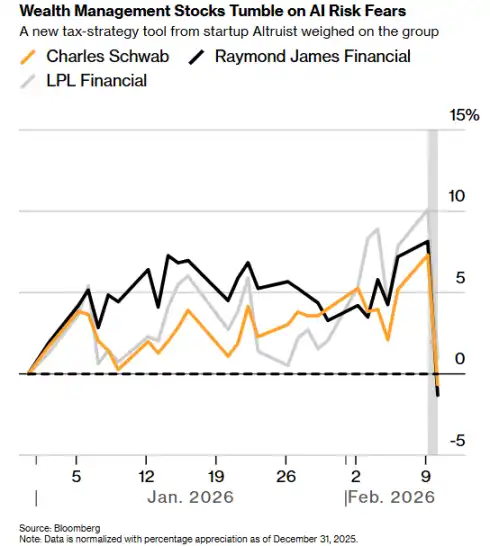
Wealth management stocks plunge on AI risk concerns

Altruist CEO Jason Wenk said he himself was surprised by the scale of the stock market reaction, which wiped tens of billions of dollars from the market value of several investment firms. But he said it sends a strong signal about the competitive threat his company poses.

"People are beginning to realize—the architecture we used to build Hazel, it can replace any job in wealth management," he said in an interview. "Usually these jobs are done by entire teams. And now, AI can effectively do these jobs for just $100 a month."

AI companies like OpenAI and Anthropic have already made solid progress in the field of software engineering with products that help developers simplify and debug code processes, and are now entering other industries.

However, many questions remain about how this technology will be adopted. Take banking, for example, which has periodically faced challenges from electronic services and other technologies, but these have ultimately failed to undermine its dominance.

Gabelli fund manager Belton is one of the skeptics about how Wall Street has shifted from worrying about an AI bubble to fearing its imminent disruption of large parts of the economy.

"There will be winners and losers in every industry," Belton said. But he added: "A rule of thumb is that technological disruption often takes longer to materialize than expected."

This pullback may also reflect widespread anxiety about the sharp rise in stock prices over the past few years, driven by the AI spending boom and an unusually resilient U.S. economy. This has already pushed valuations too high and made investors more sensitive to concerns about a reversal.

"As long as they emit a signal that the market perceives as somewhat negative, the stock will fall 10%, which would never happen in a market that hasn't reached current trading levels," said Graniteshares' Rhind.

For Ross Gerber, CEO of Gerber Kawasaki, the anxiety about AI losers that has been hitting parts of the market over the past week is premature. He said it is still too early to say exactly what the impact will be.

"We can try to extrapolate how AI will change the world in five years, but we just don't know," he said. "The market is trying to judge this while we are still at the beginning of this infancy."


Questions liées

QWhat is the main reason behind the recent sell-off in Wall Street stocks, particularly affecting companies like Charles Schwab and Raymond James?

AThe sell-off is primarily driven by growing fears that new AI products, such as Altruist Corp's tax strategy tool Hazel, could disrupt traditional business models in industries like wealth management, leading investors to indiscriminately dump stocks perceived as vulnerable to AI-driven disruption.

QHow did the launch of Altruist Corp's Hazel tool impact the stock prices of major financial firms?

AThe launch of Hazel caused significant stock price declines, with companies like Charles Schwab Corp., Raymond James Financial Inc., and LPL Financial Holdings Inc. falling by 7% or more, marking some of their worst drops since the market crash triggered by the trade war in April of last year.

QWhat shift in investor behavior is observed as AI products become commercially available?

AInvestors have shifted from focusing on picking AI winners to rapidly avoiding any companies that face even the slightest risk of being disrupted by AI, adopting a 'sell first, ask questions later' mentality.

QAccording to Jason Wenk, CEO of Altruist, why is AI seen as a threat to the wealth management industry?

AJason Wenk stated that AI tools like Hazel, built with advanced architectures, can replace various jobs in wealth management that are typically done by entire teams, performing these tasks effectively for as low as $100 per month.

QWhat skepticism do some experts, like John Belton of Gabelli Funds, express about the current AI-driven market disruption fears?

AJohn Belton expresses skepticism, noting that technological disruption often takes longer to materialize than expected, and while there will be winners and losers in every industry, the current panic may be premature given the early stage of AI adoption.

Lectures associées

Du prévente aux marchés publics, l'écart de prix d'Ozak AI représente un potentiel de multiplication par 100 rarement vu pour les nouveaux tokens d'IA

Ozak AI, un jeton prédictif alliant IA et blockchain, suscite un vif intérêt avant son lancement public. Pendant sa septième et dernière phase de prévente, il est actuellement vendu au prix de 0,014 $, ce qui représente une multiplication par 14 pour les premiers investisseurs par rapport à la phase initiale. Les fonds levés dépassent 7 millions de dollars, avec plus de 1,19 milliard de jetons vendus. Avec un prix de mise en bourse fixé à 1 $, les investisseurs de la prévente pourraient potentiellement réaliser un gain de 71x, et certains anticipent même une croissance pouvant atteindre 100x une fois le jeton listé. La plateforme Ozak AI vise à fournir des prévisions de marché précises grâce à son réseau de collecte de données et à ses agents prédictifs personnalisables fonctionnant 24h/24. Son écosystème sécurise les données et les stratégies dans des coffres numériques. Le jeton natif $OZ sert de droit d'accès aux fonctionnalités avancées, au staking et aux récompenses. Le projet renforce son écosystème grâce à des partenariats stratégiques, comme celui avec AImstrong, visant à optimiser les performances dans la finance décentralisée (DeFi). En résumé, la transition d'Ozak AI de la prévente aux marchés publics présente un écart de prix rare, porté par une forte demande, une technologie d'IA avancée et des collaborations croissantes, ce qui pourrait en faire un actif à fort potentiel de croissance dans le secteur des jetons d'IA.

TheNewsCryptoIl y a 1 h

Du prévente aux marchés publics, l'écart de prix d'Ozak AI représente un potentiel de multiplication par 100 rarement vu pour les nouveaux tokens d'IA

TheNewsCryptoIl y a 1 h

L'Ère des Agents IA Accélère, Questflow Définit un Nouveau Paradigme d'Intelligence Financière par les Courtiers IA en Ligne

L’agence de renseignements sur le marché technologique CB Insights a publié son classement annuel AI 100, mettant en lumière 100 startups d’IA les plus prometteuses au monde en 2026. Le thème central de cette année est passé de « l’IA peut-elle fonctionner » à « à quelle vitesse l’IA peut-elle être déployée, gouvernée et étendue à des workflows complexes ». Les agents d’IA, capables d’exécuter de manière autonome des tâches en plusieurs étapes, deviennent le moteur clé de cette nouvelle vague de transformation. Questflow, une startup basée à Singapour spécialisée dans le courtage financier sur chaîne (« chain AI brokerage »), incarne cette tendance. Alors que de nombreux outils financiers alimentés par l’IA se contentent de tableaux de bord, Questflow développe des agents d’IA capables d’agir comme des entités de trading autonomes. Ces agents, appelés « AI Clones », scannent en permanence les marchés (notamment sur Polymarket et Hyperliquid), forment leurs propres jugements et exécutent des transactions via une interface conversationnelle, sans nécessiter d’intervention humaine pour chaque décision. La proposition centrale de Questflow est de démocratiser l’intelligence financière. Si Robinhood a permis à tous de s’asseoir à la table de jeu, Questflow ambitionne de donner « un cerveau à chacun ». En combinant la technologie des clones d’IA et le copy trading, la plateforme abaisse la barrière d’entrée à 1 $, sans frais de gestion ni commission sur performance. Son modèle repose uniquement sur des frais d’exécution des transactions (1 %), alignant ses intérêts avec ceux des utilisateurs. Le timing semble idéal, selon l’analyse de CB Insights qui souligne trois signaux : la mise à l’échelle des agents d’IA, l’accélération de la pénétration de l’IA dans les services financiers et la maturation des infrastructures sur chaîne. Avec des liquidités suffisantes sur les marchés cibles et des capacités d’inférence d’IA renforcées, Questflow vise à fusionner à terme les rôles de courtier, de fonds et de bourse en une seule plateforme, permettant à des millions d’utilisateurs de gérer leur propre « fonds quantitatif ».

链捕手Il y a 1 h

L'Ère des Agents IA Accélère, Questflow Définit un Nouveau Paradigme d'Intelligence Financière par les Courtiers IA en Ligne

链捕手Il y a 1 h

Trading

Spot
Futures
活动图片