Wall Street Plunged into 'AI Phobia': An Indiscriminate Sell-off Is Spreading

marsbitPublié le 2026-02-11Dernière mise à jour le 2026-02-11

Résumé

Wall Street is experiencing a widespread "AI panic," triggering indiscriminate sell-offs across sectors perceived as vulnerable to AI disruption. The fear intensified recently when a tax-strategy tool from startup Altruist Corp. caused sharp declines in shares of major wealth managers like Charles Schwab, Raymond James, and LPL Financial. This reflects a broader market shift from focusing on AI winners to hastily dumping stocks of companies—from small software firms to large financial services—deemed at risk of being replaced by AI-driven products. Similar sell-offs occurred earlier in software, insurance, and asset management after AI companies like Anthropic and Insurify launched new tools. While some investors see this as an overreaction, citing the slow pace of technological adoption historically, others warn that AI’s rapid advancement is fueling legitimate anxiety. High market valuations have made stocks particularly sensitive to any negative signals, amplifying the volatility. The key uncertainty remains how quickly and deeply AI will reshape industries, leaving the market in a state of cautious speculation.

Source: Jinshi Data

On Wall Street, growing fears about artificial intelligence are hammering the stocks of companies that could become its targets of disruption, from small software firms to large wealth management companies, none have been spared.

The latest round of selling erupted on Tuesday when a tax strategy tool launched by a little-known startup, Altruist Corp., caused shares of Charles Schwab Corp., Raymond James Financial Inc., and LPL Financial Holdings Inc. to fall by 7% or more.

This marked the steepest decline for some of these stocks since the market crash triggered by the trade war last April. But it is just the latest example of the "sell first, ask questions later" mentality—a mindset that is rapidly taking hold as the hundreds of billions of dollars poured into AI begin to translate into commercial products, sparking anxiety that AI could disrupt entire industries.

"Companies with any potential disruption risk are being sold off indiscriminately," said John Belton, a fund manager at Gabelli Funds.

Over the past few years, advancements in AI technology have been at the forefront of Wall Street, with tech stocks leading the gains. As this rally pushed stock prices to record highs, questions have persisted about whether this is a bubble about to burst or whether it will trigger a productivity boom that reshapes the American corporate landscape.

But since the beginning of last week, a series of AI product launches has triggered a noticeable market shift. Instead of focusing on picking winners, investors are quickly trying to avoid holding any company facing even the slightest risk of being replaced.

"I don't know what's going to happen next," said Will Rhind, CEO of Graniteshares Advisors.

"Last year's story was that we all believed in AI—but we were looking for applications, and as we keep discovering applications that seem increasingly powerful and persuasive, it is now leading to disruption."

For some time, the software industry has been troubled by concerns about AI. Last week, when a new tool from Anthropic PBC triggered sharp declines in stocks across industries such as software, financial services, asset management, and legal services, these worries began to shift more broadly to other sectors.

The same fears hit U.S. insurance broker stocks hard on Monday after the online insurance marketplace Insurify launched a new app using ChatGPT to compare auto insurance rates. On Tuesday, wealth management stocks became the next victim, as the product Hazel launched by Altruist—which helps financial advisors create personalized strategies for clients—dragged these stocks down.
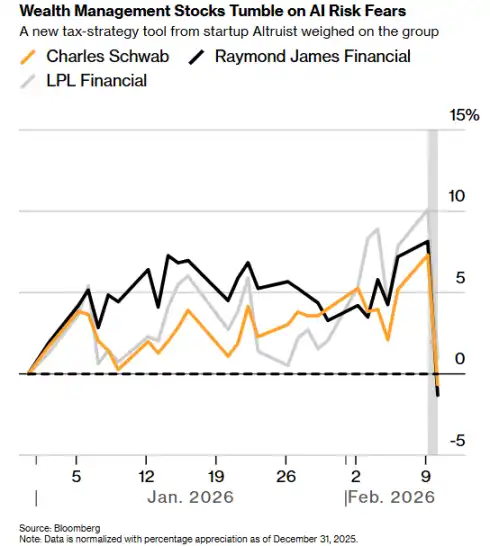
Wealth management stocks plunge on AI risk concerns

Altruist CEO Jason Wenk said he himself was surprised by the scale of the stock market reaction, which wiped tens of billions of dollars from the market value of several investment firms. But he said it sends a strong signal about the competitive threat his company poses.

"People are beginning to realize—the architecture we used to build Hazel, it can replace any job in wealth management," he said in an interview. "Usually these jobs are done by entire teams. And now, AI can effectively do these jobs for just $100 a month."

AI companies like OpenAI and Anthropic have already made solid progress in the field of software engineering with products that help developers simplify and debug code processes, and are now entering other industries.

However, many questions remain about how this technology will be adopted. Take banking, for example, which has periodically faced challenges from electronic services and other technologies, but these have ultimately failed to undermine its dominance.

Gabelli fund manager Belton is one of the skeptics about how Wall Street has shifted from worrying about an AI bubble to fearing its imminent disruption of large parts of the economy.

"There will be winners and losers in every industry," Belton said. But he added: "A rule of thumb is that technological disruption often takes longer to materialize than expected."

This pullback may also reflect widespread anxiety about the sharp rise in stock prices over the past few years, driven by the AI spending boom and an unusually resilient U.S. economy. This has already pushed valuations too high and made investors more sensitive to concerns about a reversal.

"As long as they emit a signal that the market perceives as somewhat negative, the stock will fall 10%, which would never happen in a market that hasn't reached current trading levels," said Graniteshares' Rhind.

For Ross Gerber, CEO of Gerber Kawasaki, the anxiety about AI losers that has been hitting parts of the market over the past week is premature. He said it is still too early to say exactly what the impact will be.

"We can try to extrapolate how AI will change the world in five years, but we just don't know," he said. "The market is trying to judge this while we are still at the beginning of this infancy."


Questions liées

QWhat is the main reason behind the recent sell-off in Wall Street stocks, particularly affecting companies like Charles Schwab and Raymond James?

AThe sell-off is primarily driven by growing fears that new AI products, such as Altruist Corp's tax strategy tool Hazel, could disrupt traditional business models in industries like wealth management, leading investors to indiscriminately dump stocks perceived as vulnerable to AI-driven disruption.

QHow did the launch of Altruist Corp's Hazel tool impact the stock prices of major financial firms?

AThe launch of Hazel caused significant stock price declines, with companies like Charles Schwab Corp., Raymond James Financial Inc., and LPL Financial Holdings Inc. falling by 7% or more, marking some of their worst drops since the market crash triggered by the trade war in April of last year.

QWhat shift in investor behavior is observed as AI products become commercially available?

AInvestors have shifted from focusing on picking AI winners to rapidly avoiding any companies that face even the slightest risk of being disrupted by AI, adopting a 'sell first, ask questions later' mentality.

QAccording to Jason Wenk, CEO of Altruist, why is AI seen as a threat to the wealth management industry?

AJason Wenk stated that AI tools like Hazel, built with advanced architectures, can replace various jobs in wealth management that are typically done by entire teams, performing these tasks effectively for as low as $100 per month.

QWhat skepticism do some experts, like John Belton of Gabelli Funds, express about the current AI-driven market disruption fears?

AJohn Belton expresses skepticism, noting that technological disruption often takes longer to materialize than expected, and while there will be winners and losers in every industry, the current panic may be premature given the early stage of AI adoption.

Lectures associées

Dialogue avec Ray Dalio : Nous sommes actuellement dans une bulle de l'IA, 1% de mon portefeuille est en Bitcoin

Ray Dalio, fondateur de Bridgewater Associates, met en garde contre la bulle actuelle de l'IA, présentant des signes classiques similaires aux précédents krachs financiers. Il explique qu'une combinaison de spéculation excessive, d'endettement et de changements de taux d'intérêt pourrait provoquer son éclatement, entraînant une récession économique. Dalio décrit également un « grand cycle » mondial d'environ 80 ans, caractérisé par des inégalités croissantes, des déficits publics élevés et des tensions géopolitiques. Nous serions actuellement dans une phase de déclin de ce cycle, avec un ordre mondial en transition. Pour protéger leur patrimoine, il conseille aux investisseurs de diversifier leurs actifs (actions, obligations, or, immobilier) plutôt que de détenir uniquement des liquidités. Il mentionne détenir environ 1% de Bitcoin, mais préfère l'or physique pour sa stabilité. Concernant l'IA, Dalio souligne qu'elle remplacera progressivement le travail intellectuel humain, creusant les inégalités. L'avenir appartiendra à ceux qui sauront allier intelligence humaine et collaboration avec l'IA. Enfin, il évoque un monde de plus en plus régionalisé, avec un affaiblissement de la puissance américaine, visible dans des conflits comme celui avec l'Iran, et la montée en puissance d'autres pôles, notamment la Chine.

marsbitIl y a 3 h

Dialogue avec Ray Dalio : Nous sommes actuellement dans une bulle de l'IA, 1% de mon portefeuille est en Bitcoin

marsbitIl y a 3 h

7,2 billions de KRW en une journée, les achats nets des investisseurs étrangers atteignent un record historique ce vendredi ! Wall Street : Les vents contraires sur les flux de capitaux sud-coréens se sont dissipés

Les marchés boursiers sud-coréens montrent des signes tangibles d'amélioration des flux de capitaux. Le 31 juillet, les investisseurs étrangers ont réalisé un achat net record de 7 200 milliards de wons sur une seule journée dans le KOSPI, marquant un renversement de la tendance de sorties massives observée ces derniers mois. En juillet, leurs ventes nettes mensuelles se sont fortement réduites à 9 800 milliards de wons, contre 48 400 et 44 500 milliards en juin et mai respectivement. Parallèlement, les institutions domestiques comme les fonds de pension ont inversé leur tendance, passant à un achat net de 1 000 milliards de wons en juillet. La Commission des services financiers a également resserré l'accès aux ETF à effet de levier sur actions individuelles pour les investisseurs de détail, réduisant ainsi la volatilité du marché. Citigroup Research maintient son objectif pour le KOSPI à 10 000 points, estimant que les vents contraires liés aux flux de capitaux s'atténuent. Des facteurs tels que les fondamentaux solides du secteur des puces mémoire, les faibles valorisations du marché, une économie robuste et un environnement politique favorable devraient soutenir le marché. La possibilité d'interventions des autorités pour stabiliser le marché offre également un filet de sécurité.

marsbitIl y a 3 h

7,2 billions de KRW en une journée, les achats nets des investisseurs étrangers atteignent un record historique ce vendredi ! Wall Street : Les vents contraires sur les flux de capitaux sud-coréens se sont dissipés

marsbitIl y a 3 h

Choc ! La prochaine IA d'OpenAI résout 10 problèmes du calibre de la Médaille Fields

**OpenAI provoque un séisme mathématique avec son nouveau modèle Astra** OpenAI a dévoilé des avancées mathématiques majeures réalisées par son modèle interne Astra, présenté par Sam Altman. L'IA aurait résolu ou fait progresser dix problèmes complexes dans des domaines variés comme la géométrie haute dimension, la théorie des groupes et la complexité quantique. Le résultat le plus marquant est la construction du premier groupe "non sofic" infini et finiment présenté, réfutant une conjecture de Mikhail Gromov vieille de 27 ans. Cette seule découverte est qualifiée de niveau "Prix Fields". Astra a également amélioré une borne fondamentale sur le problème de l'empilement des sphères en haute dimension, stagnant depuis 1978, et a réfuté la conjecture de rigidité d'Alain Connes en construisant une infinité de groupes non isomorphes partageant la même algèbre de von Neumann. Ces résultats, compilés dans un document de 249 pages, sont accompagnés de preuves formelles vérifiées par l'assistant Lean 4. OpenAI précise que le coût total de génération de ces démonstrations aurait été inférieur à 2000 dollars. La communauté mathématique réagit avec stupeur, certains experts y voyant un tournant historique où l'IA démontre une intuition et une capacité de raisonnement pouvant surpasser les meilleurs mathématiciens humains.

marsbitIl y a 5 h

Choc ! La prochaine IA d'OpenAI résout 10 problèmes du calibre de la Médaille Fields

marsbitIl y a 5 h

Grâce aux lancers de dés, les clés Bitcoin sont stockées hors ligne, mais tout le monde ne s'y mettra pas

Le titre « Les clés Bitcoin protégées par des dés, mais la méthode reste marginale » introduit un article sur la génération manuelle de graines de portefeuille Bitcoin à l'aide de dés. L'article explique le concept d'entropie, illustré par Claude Shannon, où un dé à six faces génère environ 2,585 bits d'incertitude. Il aborde le scandale récent de Coldcard, où une vulnérabilité du générateur de nombres aléatoires matériel a compromis des fonds. Les utilisateurs ayant généré leur phrase de récupération avec des dés (environ 99 lancers pour une haute sécurité) n'étaient pas affectés pour leur seed principal. Cependant, l'analyse du chercheur Kevin Loaec montre que d'autres fonctions du portefeuille (clés de copie, portefeuilles papier, mots de passe, etc.) utilisaient ce générateur défectueux et restaient vulnérables. L'article souligne les défis pratiques de la méthode des dés : elle est longue, sujette aux erreurs de saisie, et peu adaptée aux nouveaux utilisateurs qui pourraient mal l'exécuter. Il conclut que si cette méthode manuelle est robuste pour les experts, l'objectif à long terme est d'avoir un matériel et des logiciels générant une entropie fiable de manière simple et sécurisée. Il conseille aux propriétaires de Coldcard de vérifier leur firmware et les fonctions utilisées, et rappelle l'intérêt des solutions multi-signatures avec différents fabricants pour limiter les risques.

cryptonews.ruIl y a 8 h

Grâce aux lancers de dés, les clés Bitcoin sont stockées hors ligne, mais tout le monde ne s'y mettra pas

cryptonews.ruIl y a 8 h

Trading

Spot
活动图片




