Tiger Research: The Next Bull Market, Waiting for the Wind

比推Publié le 2026-02-04Dernière mise à jour le 2026-02-04

Résumé

Tiger Research analyzes whether the crypto market is currently in a "crypto winter" and outlines the conditions for the next bull run. Unlike previous bear markets triggered by internal crises (Mt. Gox hack, ICO crackdown, FTX collapse), the current downturn is driven by external factors like macro policies and tariffs, while internal fundamentals remain intact. The market has structurally split into three layers: a regulated sector (stable, institutional), an unregulated sector (speculative, experimental), and shared infrastructure (e.g., stablecoins, oracles). ETF inflows remain confined to Bitcoin and do not trickle down to altcoins. The next bull market requires: 1) a "killer app" emerging from the unregulated sector (e.g., AI agents, InfoFi), and 2) favorable macro conditions like liquidity injections. The era of broad-based rallies is over; growth will be segmented between regulated stability and unregulated volatility.

Source: Tiger Research

Author: Ryan Yoon

Original Title: Is This a Crypto Winter? Post-Regulation Market Shift

Compiled and Edited by: BitpushNew


As the market enters a downward cycle, skepticism towards the crypto market is growing. The core question at hand is: Have we entered a "crypto bear market"?

Core Views

  • The evolution path of a crypto winter: Major event → Collapse of trust → Brain drain.

  • The particularity of this cycle: Past winters were triggered by internal problems; the current surge and crash are both driven by external factors. It is neither a "winter" nor a "spring".

  • Three-tier market structure post-regulation: The market has split into a compliant zone, a non-compliant zone, and shared infrastructure; the past "Trickle-down effect" has disappeared.

  • Limitations of ETF funds: Funds remain within Bitcoin and do not flow outside the compliant zone.

  • Prerequisites for the next bull market: The birth of a "killer app," coupled with a favorable macroeconomic environment.

1. How Did Past Crypto Winters Evolve?
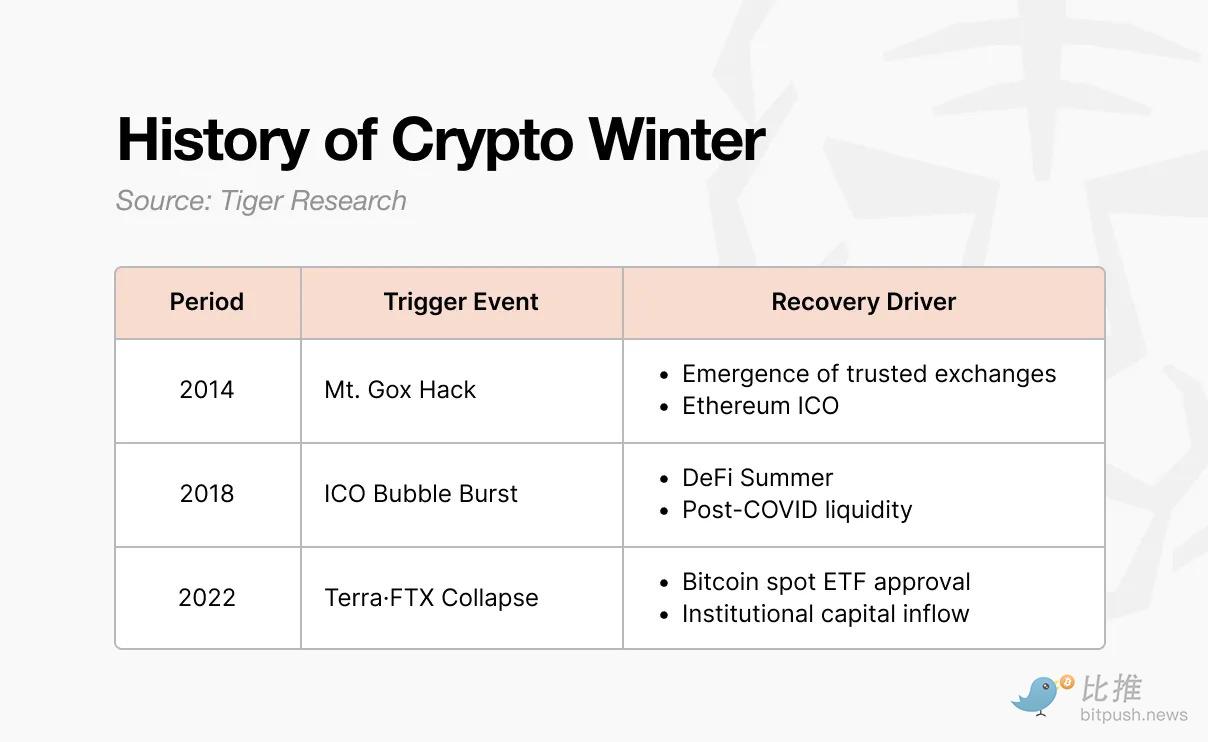
The first winter occurred in 2014. At that time, the Mt. Gox exchange handled 70% of global Bitcoin trading volume. Due to a hack, approximately 850,000 BTC vanished, leading to a complete collapse of market trust. Subsequently, various new exchanges with internal controls and audit functions emerged, and trust was slowly restored. Meanwhile, Ethereum was born through ICOs (Initial Coin Offerings), presenting a new vision and financing method for the industry.

This ICO model became the spark for the next bull market. When anyone could issue tokens and raise funds, the frenzy of 2017 was ignited. Projects raising billions with just a whitepaper were rampant, but most had no substance.

In 2018, South Korea, China, and the US successively introduced strict regulatory measures, the bubble burst, and the second winter arrived. This winter lasted until 2020. After the COVID-19 pandemic, liquidity began to pour in, and DeFi protocols like Uniswap, Compound, and Aave gained attention, leading to a return of funds.

The third winter was the most severe. The Terra-Luna collapse in 2022 triggered the successive failures of Celsius, Three Arrows Capital, and FTX. This was not just a simple price drop but a shake-up of the entire industry's structure. It wasn't until January 2024, when the U.S. Securities and Exchange Commission (SEC) approved the Bitcoin spot ETF, followed by the Bitcoin halving and Trump's pro-crypto policies, that funds began to flow in again.

2. The Pattern of Crypto Winters: Major Event → Collapse of Trust → Brain Drain

The first three winters all followed the same evolutionary logic: a major negative event triggered a collapse of the trust system, ultimately leading to a large-scale brain drain.

  • Starts with a major event: Whether it was the Mt.Gox hack, the ICO regulatory crackdown, or the Terra-Luna collapse and subsequent FTX bankruptcy, the scale and form varied, but the result was the same—the entire market was thrown into turmoil and panic.

  • Spreads to a collapse of trust: This shock quickly turned into a crisis of confidence. People who once discussed "what to build next" began to question whether crypto technology had real value. The collaborative atmosphere among builders disappeared, replaced by mutual blame.

  • Leads to brain drain: Doubts about the前景 led to an exodus of talent. The builders who had once created momentum in the blockchain space fell into pessimism. In 2014, they flowed into fintech and big tech companies; in 2018, they turned to traditional institutions and the AI field. They left here for places that seemed more certain.

3. Is This a Crypto Winter Now?

On the surface, some signs of past crypto winters are still clearly visible today:

  • Major events:

    • Trump memecoin: Its market cap once reached $27 billion in a single day, then plummeted by 90%.

    • The "10.10" liquidation event: The US announced 100% tariffs on China, triggering the largest liquidation wave in Binance's history ($19 billion).

  • Collapse of trust: Skepticism is spreading within the industry, and the focus of discussion has shifted from "building" to "blame-shifting."

  • Pressure of brain drain: The AI industry is growing rapidly, offering faster and more lucrative monetization paths than cryptocurrency.

However, it is difficult to define the current situation as a typical "crypto winter." Past winters erupted from within the industry—the Mt. Gox hack, ICOs going to zero, FTX blowing up—these were all cases of the industry destroying its own Great Wall.

The current situation is截然 different:

The approval of ETFs started the bull market, while tariff policies and interest rate changes drove the decline. External factors lifted the market, and external factors also dragged it down.
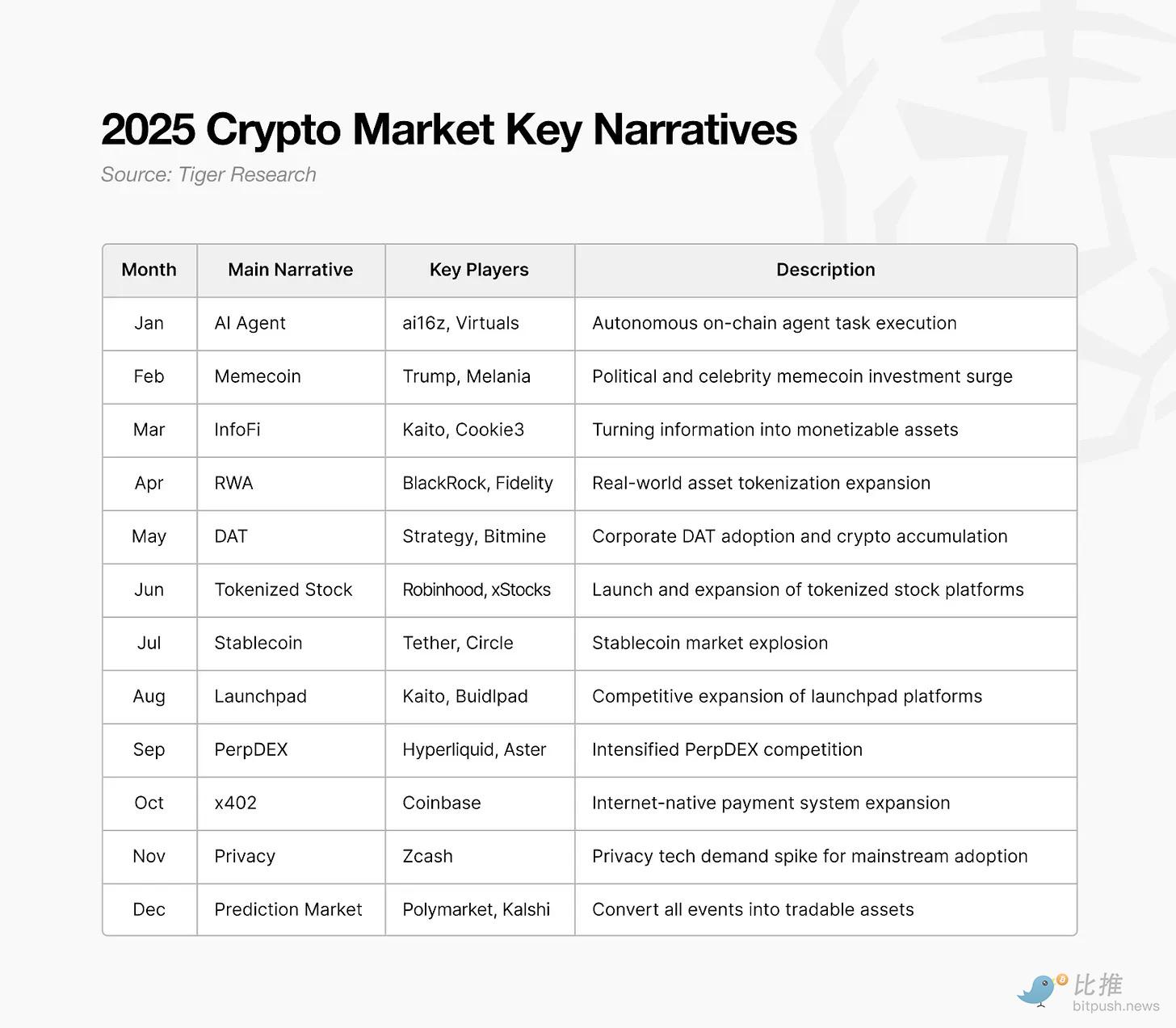
Builders have not left the field either:

New narratives such as RWA (Real World Assets), perpDEX (perpetual contract exchanges), prediction markets, InfoFi, and privacy protocols are emerging one after another and continue to iterate. Although they have not driven a full-market rally like DeFi did back then, they have not disappeared. The industry's fundamentals have not collapsed; only the external environment has changed.

Just as we did not personally create this "warm spring," there is currently no so-called "winter."

4. Fundamental Changes in Market Structure Post-Regulation

Behind this phenomenon lies the profound evolution of the market structure post-regulation. The market has now split into three levels: 1) The Compliant Zone, 2) The Non-Compliant Zone, and 3) Shared Infrastructure.
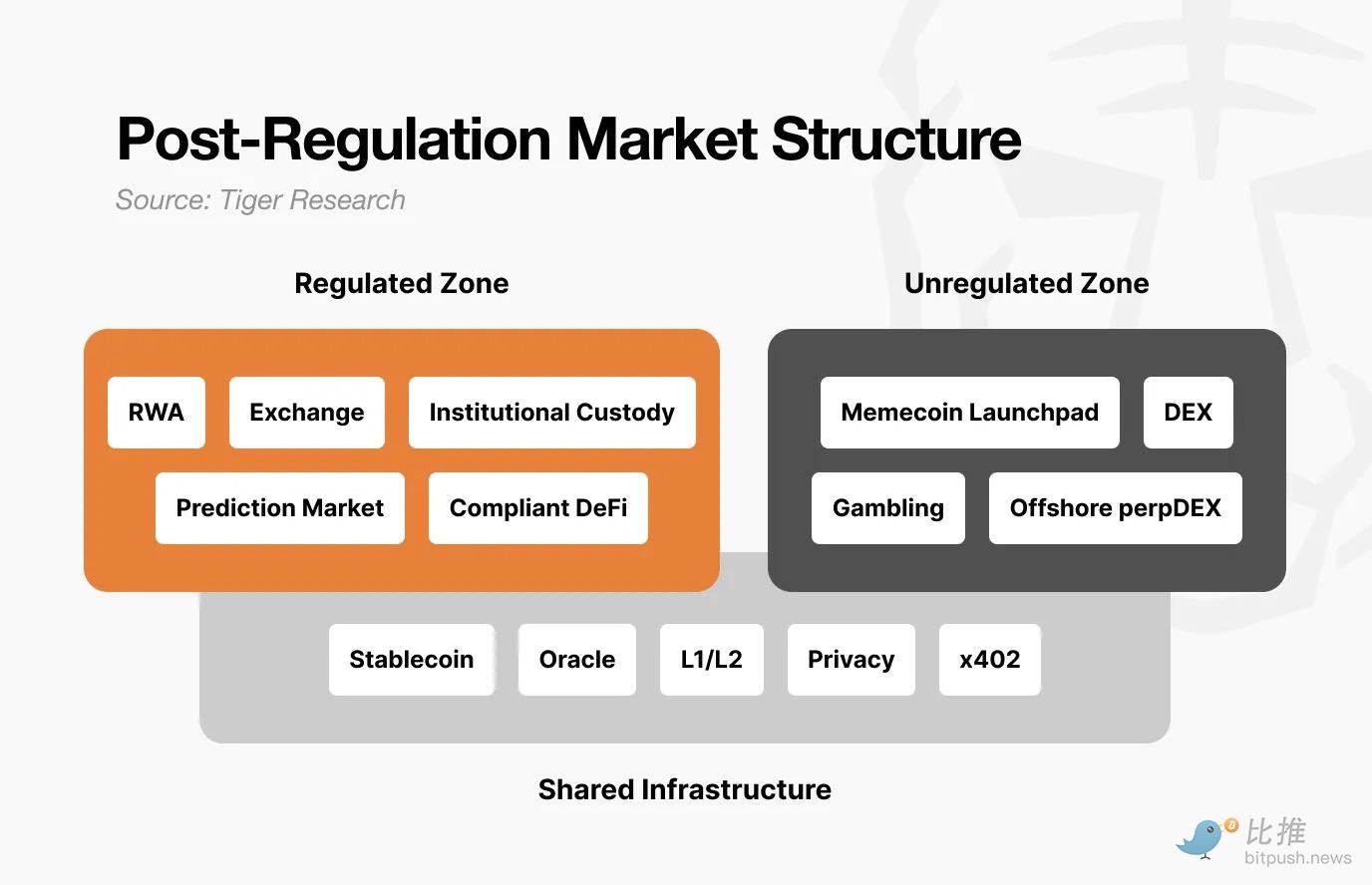
  • Compliant Zone: Includes RWA tokenization, licensed exchanges, institutional-grade custody, legal prediction markets, and compliant DeFi. These areas undergo audits, fulfill disclosure obligations, and are legally protected. Although growth is slower, the capital规模 is huge and stable.

    • Characteristics: After entering the compliant zone, it is difficult to expect the explosive 100x returns of the past. Volatility decreases, the上限 is limited, but the下限 is also guaranteed.

  • Non-Compliant Zone: This area will have an even stronger speculative色彩 in the future. Low barriers to entry, fast pace, surging 100x today and dropping 90% tomorrow will become the norm.

    • Significance: This space is not meaningless. The non-compliant zone is a cradle of creativity. Once a track is proven effective, it will migrate to the compliant zone (like DeFi back then and prediction markets now). It serves as an "experimental field," but itself will increasingly剥离 from compliant businesses.

  • Shared Infrastructure: Includes stablecoins and oracles. They serve both zones simultaneously. The same USDC can be used for institutional-grade RWA payments and for speculative trading on Pump.fun; oracles provide data verification for tokenized treasuries and support liquidations for anonymous DEXs.

This differentiation has changed the flow path of funds.

In the past, Bitcoin's rise would带动山寨币齐涨 through the "Trickle-down effect." Now it's different: institutional funds entering through ETFs stop dead within Bitcoin; funds in the compliant zone no longer flow to the non-compliant zone. Liquidity only stays where value is proven. Even Bitcoin itself, its属性 as a safe-haven asset has not yet been fully proven against risk assets.

5. Conditions for the Next Bull Market

The regulatory framework is being完善, and builders are still working hard. Two more conditions need to be met:

  1. A new "killer app" is born in the non-compliant zone: Something must emerge that can create全新 value, like the "DeFi Summer" of 2020. AI agents, InfoFi, and on-chain social are potential candidates, but they have not yet reached a scale that触动全局. The良性流动 of "non-compliant zone experiment → successful verification → migration to the compliant zone" must be formed again.

  2. Cooperation from the macroeconomic environment: Even if regulation is settled, builders are working hard, and infrastructure is perfect, if the macro environment is not supportive, the upside space is still limited. The 2020 DeFi boom erupted after the pandemic amid global massive liquidity injection; the post-ETF rise in 2024 also coincided with expectations of interest rate cuts. No matter how well the crypto industry does itself, it cannot control interest rates and liquidity. For the value built within the industry to gain widespread recognition, the macro environment must reverse.

A crypto season with "universal上涨" like in the past is unlikely to reappear. Because the market has彻底分裂. The compliant zone will grow steadily, while the non-compliant zone will continue to fluctuate剧烈.

The next bull market will eventually come, but it will not favor everyone.


Twitter:https://twitter.com/BitpushNewsCN

Bitpush TG Discussion Group:https://t.me/BitPushCommunity

Bitpush TG Subscription: https://t.me/bitpush

Original article link:https://www.bitpush.news/articles/7608772

Questions liées

QWhat are the three stages of evolution in a crypto winter according to the article?

AThe three stages are: 1) A significant negative event triggers the downturn, 2) This leads to a collapse of trust within the market, and 3) Ultimately results in a massive exodus of talent from the industry.

QHow does the current market downturn differ from previous crypto winters?

APrevious crypto winters were triggered by internal industry problems (e.g., Mt. Gox hack, ICO crackdown, FTX collapse). The current cycle is different because both the rally (driven by ETF approval) and the subsequent decline (driven by external factors like tariff policies and interest rates) were propelled by external factors, not internal industry failures.

QWhat are the three layers of the post-regulation market structure described in the article?

AThe market has split into three layers: 1) The Compliant Zone (e.g., tokenized RWA, licensed exchanges), 2) The Non-Compliant Zone (a space for speculation and experimentation), and 3) Shared Infrastructure (e.g., stablecoins, oracles that serve both zones).

QWhy has the 'trickle-down effect' of Bitcoin's price rally on altcoins disappeared?

AThe 'trickle-down effect' has disappeared because institutional capital entering through Bitcoin ETFs remains largely confined to Bitcoin itself within the Compliant Zone and does not flow into the Non-Compliant Zone where most altcoins reside. Liquidity now stays only in areas with proven value.

QWhat two conditions are necessary for the next crypto bull market to begin?

ATwo conditions are necessary: 1) A new 'killer app' must emerge from the Non-Compliant Zone, creating entirely new value (similar to DeFi Summer in 2020), and 2) There must be a favorable macroeconomic environment, such as lower interest rates and increased liquidity, which is outside the control of the crypto industry itself.

Lectures associées

Le « GENIUS Act » et le « CLARITY Act » adoptés : Quelle est la véritable architecture du rendement sur chaîne ?

L'article distingue trois types de crédit en chaîne (on-chain) : le prêt cryptographique surcollatéralisé, le prêt non garanti (historiquement défaillant), et le crédit adossé à des actifs (Asset-Backed Credit - ABC), présenté comme la catégorie à la croissance la plus rapide et la seule résolvant structurellement le problème de sélection adverse. L'ABC repose sur des garanties réelles identifiables, des droits légaux hors chaîne et des mécanismes de recouvrement. La croissance des actifs du monde réel (RWA) tokenisés est significative, tirée par une deuxième vague de crédit privé tokenisé (ex : Maple Finance, Centrifuge). La demande provient principalement des stablecoins (3230 milliards de dollars), cherchant un rendement conforme. Cependant, l'article souligne que le modèle actuel de "fonds tokenisés" ne résout pas le problème de sélection adverse au niveau du protocole ; il reporte simplement les risques et la structure du fonds sous-jacent. Le contexte réglementaire américain, avec les lois GENIUS (interdisant aux émetteurs de stablecoins de verser des rendements) et CLARITY (étendant cette interdiction aux plateformes), crée un tournant. Désormais, le rendement sur les dollars en chaîne doit être fourni via des produits d'investissement distincts et conformes. La "vault" (sorte de coffre-fort numérique ou contrat intelligent de type ERC-4626) devient donc l'architecture centrale incontournable. Elle n'est plus un simple outil de packaging, mais le lieu où s'encodent la conformité, la transparence, l'évaluation du crédit, la structure des paiements (waterfall) et les mécanismes de recouvrement. Sa conception est désormais une question architecturale de premier ordre pour délivrer un rendement conforme et résoudre la sélection adverse directement au niveau de la couche protocole, dans un paysage post-GENIUS/CLARITY.

Foresight NewsIl y a 20 mins

Le « GENIUS Act » et le « CLARITY Act » adoptés : Quelle est la véritable architecture du rendement sur chaîne ?

Foresight NewsIl y a 20 mins

Bureau de Renseignement TechFlow : Le Nouveau Modèle Fable d'Anthropic Limite la Recherche en Biosécurité et Fait Polémique, l'IPC Américain Grimpe à 4,2 %, un Sommet depuis Trois Ans

La controverse éclate autour des nouveaux modèles Fable et Mythos d'Anthropic, accusés d'entraver discrètement la recherche en biosécurité via des limitations et une rétention obligatoire des données. Le fondateur d'Anthropic révèle que son départ d'OpenAI fut dû à un manque d'honnêteté, et non à des divergences de sécurité. OpenAI envisage quant à lui une guerre des prix. Dans le secteur crypto, BlackRock poursuit ses démarches pour un ETF Bitcoin générateur de revenus, tandis que des avertissements concernent l'impact des stablecoins sur les dépôts bancaires. Malgré une inflation américaine en hausse à 4,2% et la fermeture du détroit d'Hormuz par l'Iran, le Bitcoin ne joue pas son rôle de valeur refuge. Sur le front technologique, Nvidia et AMD rivalisent d'innovations matérielles et logicielles pour l'IA. Un tribunal allemand établit un précédent en tenant Google responsable des réponses erronées de son IA, et Microsoft étend son assistant Copilot. Les marchés sont agités : l'or et les actions chutent, tandis que la Corée du Sud subit des turbulences boursières. Des avancées majeures sont signalées, comme l'utilisation d'interface cerveau-ordinateur pour la cécité, mais aussi une inquiétante première : un drone autonome ayant tué un soldat. Le fil rouge de ces événements souligne les tensions croissantes autour de la régulation de l'IA et son test dans un monde réel marqué par l'instabilité géopolitique et économique.

marsbitIl y a 35 mins

Bureau de Renseignement TechFlow : Le Nouveau Modèle Fable d'Anthropic Limite la Recherche en Biosécurité et Fait Polémique, l'IPC Américain Grimpe à 4,2 %, un Sommet depuis Trois Ans

marsbitIl y a 35 mins

Alibaba crée un nouveau département, quel signal ?

Le mois de juin a été marqué par un ajustement organisationnel majeur chez Alibaba dans le domaine de l'IA. Le groupe a fusionné ses deux principales entités dédiées à l'IA — le département du grand modèle Tongyi et le Future Life Lab — pour créer le nouveau "Token Foundry Business Unit", placé sous la direction directe du PDG Daniel Zhang. Cette réforme s'inscrit dans une série de réorganisations rapides. Il y a trois mois, Alibaba avait déjà créé le groupe d'affaires Alibaba Token Hub (ATH) pour consolider ses ressources en IA. La création de Token Foundry indique une transition de la phase d'intégration des ressources à celle d'accélération de la commercialisation. L'objectif est de devenir un fournisseur de base à l'ère de l'IA, en alignant la recherche fondamentale sur les modèles et l'exploration des scénarios d'application. Parallèlement, Jingren Zhou, architecte clé de la série de modèles Qwen, a été nommé scientifique en chef du groupe et dirigera le nouveau "Alibaba AI Future Research Institute". Cette nomination vise à le libérer de la gestion opérationnelle pour se concentrer sur la recherche de pointe à long terme. Ces changements reflètent une tendance globale parmi les géants technologiques (Google, Microsoft, Meta, Amazon) à unifier leurs forces en IA sous une direction centralisée pour améliorer l'efficacité et l'intégration avec les activités commerciales. La pression commerciale est un moteur important. Alibaba a annoncé que ses activités d'IA étaient entrées dans une phase de retour sur investissement commercial. Des produits comme la plateforme MaaS "Bailian" connaissent une demande élevée. Cependant, la concurrence sur le marché chinois des MaaS s'intensifie, avec des rivaux comme ByteDance et Tencent progressant rapidement. En résumé, la création de Token Foundry est une réponse stratégique d'Alibaba pour structurer ses capacités en IA, allier innovation à long terme et commercialisation à court terme, et rester compétitif dans une fenêtre d'opportunité qui se rétrécit rapidement.

marsbitIl y a 59 mins

Alibaba crée un nouveau département, quel signal ?

marsbitIl y a 59 mins

Du retour à la démission : Les 437 jours de Chen Hang à DingTalk

En mars 2025, Chen Hang (alias « Wuzhao ») est rappelé par Alibaba pour reprendre les rênes de DingTalk, l'application de productivité qu'il a fondée, après l'acquisition de sa start-up. Son mandat de 437 jours est marqué par une transformation radicale visant à faire de DingTalk la plateforme IA phare d'Alibaba pour les entreprises. Il impose immédiatement une discipline stricte (pointage, horaires étendus) et un « mouvement de terrain » pour identifier les vrais problèmes clients. Rapidement, il lance le projet « ONE », un nouvel interface IA, présenté en août lors du lancement de DingTalk IA 1.0. Cependant, ONE, développé à un rythme effréné, peine à fidéliser les utilisateurs et est démantelé début 2026. En mars 2026, Chen Hang présente « Wukong », une plateforme de travail native IA annoncée comme la refonte complète de DingTalk. L'objectif est de passer d'un outil utilisé par l'homme à un outil piloté par l'IA. Ce repositionnement place Wukong, et non plus DingTalk, comme la porte d'entrée B2B de la stratégie IA d'Alibaba. En juin 2026, la publication de deux longs articles critiques par d'anciens employés, dénonçant une culture de travail toxique et épuisante, déclenche une réaction sans précédent du comité des partenaires d'Alibaba. Celui-ci critique publiquement les méthodes de gestion au sein de DingTalk. Le lendemain, le 11 juin, Chen Hang quitte ses fonctions de PDG. Il est remplacé par Chen Yusen, né en 1992, un prodige de la technique connu pour ses startups innovantes dans le domaine de la cybersécurité et des agents IA. Ce changement semble incarner un virage vers une culture plus ouverte et axée sur l'innovation technologique, tout en maintenant Wukong au cœur de la stratégie IA B2B du groupe. L'héritage de Chen Hang est une base technique solide pour l'ère de l'IA, mais son style managérial a provoqué un coût humain et culturel élevé.

marsbitIl y a 1 h

Du retour à la démission : Les 437 jours de Chen Hang à DingTalk

marsbitIl y a 1 h

Trading

Spot
Futures
活动图片





