The World Cup has only been played for a few days, but some AI prediction models have already been crowned as oracles, while others have stumbled badly.

marsbitPublié le 2026-06-16Dernière mise à jour le 2026-06-16

Résumé

The 2026 FIFA World Cup has sparked significant interest not only on the pitch but also in AI-driven match prediction. Major models like Qwen, Copilot, and ChatGPT are being used to forecast outcomes, scores, upsets, red cards, and key player performances. Qwen gained early attention by accurately predicting Mexico's 2-0 win over South Africa (including a red card risk) and South Korea's 2-1 victory over the Czech Republic in the opening matches. Copilot's pre-tournament predictions had notable successes, such as correctly calling the Mexico 2-0 scoreline, South Korea's 2-1 win, and Brazil's 1-1 draw with Morocco. However, it also had clear misses, failing to predict upsets like Australia's 2-0 win over Turkey or Switzerland's draw with Qatar. ChatGPT provided detailed analytical reasoning, correctly predicting Mexico's 2-0 win, but its full-tournament predictions tended to favor favorites, missing several underdog results and draws. Tests pitting multiple models (ChatGPT, Gemini, Grok, Claude) against the same match, like Mexico vs. South Africa, showed varying predictions, with only some hitting the exact score. In summary, while AI models like Qwen have shown promising early results in specific match details, and others have had isolated successes, they collectively struggle to consistently identify upsets and underdog performances. AI is becoming an additional reference tool for prediction markets but is far from a definitive source.

The most exciting place at this World Cup isn't just on the pitch.

As interest in World Cup prediction events heats up, more and more users are participating in trading with real money. Who will win, what will the score be, will there be an upset, will there be a red card, which player will score—these topics, originally just casual pre-match chatter among fans, are now broken down into individual tradable prediction events.

When predictions become trades, users need more than just emotions and intuition: odds fluctuations, team form, injury news, head-to-head history, and market sentiment all become reference points before making a trade. In this process, AI models are being frequently brought into World Cup prediction scenarios.

Large models like Qwen, ChatGPT, Gemini, Claude, DeepSeek, Qwen, and Copilot can not only answer 'which team is more likely to win' but also provide score predictions, likelihood of upsets, red card risks, key player performances, and match flow analysis. For prediction market participants, AI's pre-match analysis is becoming another layer of reference beyond odds, news, team data, and market sentiment.

However, predictions ultimately have to be judged against the actual matches.

With the official start of the World Cup, the results of the first few matches have come in. Those AI analyses that users consulted to aid their judgments before the matches now have answers to compare against: Were the scores predicted correctly? Were upsets foreseen? How many details like red cards, last-minute winners, and match flow were actually captured by the models?

The first to go viral was, surprisingly, Qwen

The most entertaining performance on the opening day of the World Cup undoubtedly belonged to Qwen.

For the opening match between Mexico and South Africa, Qwen's pre-match prediction was Mexico 2:0 South Africa. After the match ended, the score was indeed 2:0. What's more interesting is that the match saw a total of three red cards, which also largely aligned with Qwen's pre-match risk assessment of 'South Africa's overly aggressive defending, potentially leading to playing with ten men early on.'
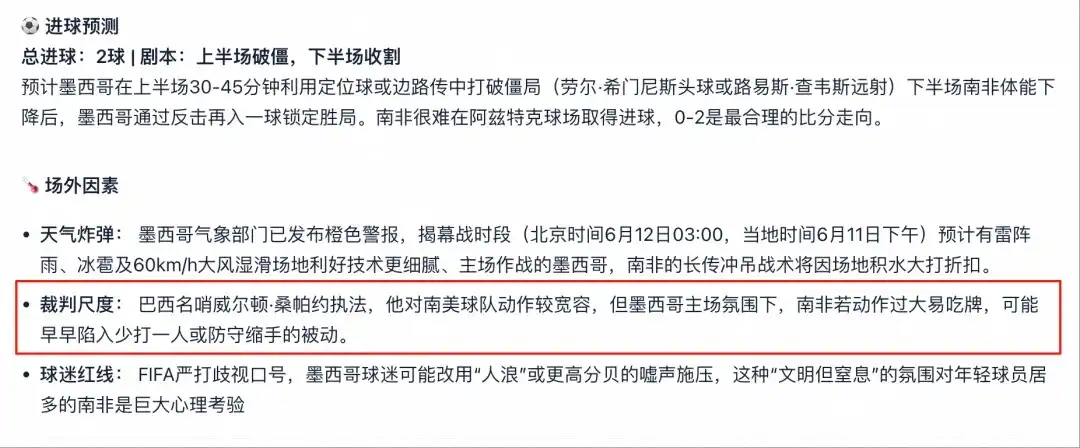
If it were just predicting a Mexico win, that wouldn't be too surprising. As one of the hosts, Mexico was favored anyway. But what Qwen nailed this time were the more specific match details: the 2:0 scoreline, South Africa's red card risk, and the pace of the game gradually opening up in the later stages.

Next, for the match between South Korea and the Czech Republic, Qwen gave a prediction of South Korea 2:1.

This match wasn't easy to call before kick-off. The Czech Republic had physicality, set-piece threats, and the usual big-tournament experience of European teams. The match process was indeed not one-sided; the Czechs took the lead first, South Korea equalized later, and the game was deadlocked at 1:1 for a long time. It wasn't until the final stages that South Korea scored the winning goal, with the final score becoming 2:1.

This gave Qwen's prediction an even stronger sense of 'scriptwriting.' Predicting the winner can rely on paper strength, score predictions can involve luck, but process details like red cards, comebacks, and last-minute winners are what truly make people think 'there's something to this.' After two matches on the opening day, Qwen first raised the profile of AI World Cup predictions.

Copilot: Moments of brilliance, but also obvious stumbles

Before the tournament, USA Today had Copilot predict all 104 matches of this World Cup. Judging from the completed matches so far, these predictions have both highlights and obvious misses.

Among them, three match predictions stood out.

For the opening match Mexico vs. South Africa, Copilot predicted Mexico 2:0, which matched the final score exactly. For South Korea vs. the Czech Republic, it predicted South Korea 2:1, again consistent with the result. For Brazil vs. Morocco, Copilot gave a 1:1 prediction, and Brazil was indeed held to a draw by Morocco.

Especially the Brazil 1:1 Morocco match, the prediction had significant merit. Brazil is, after all, a traditional powerhouse, with a squad and level of attention in the top tier.

Although Morocco reached the semi-finals in the last World Cup, predicting a draw against Brazil before the match was not a particularly safe choice. After the match, Brazil failed to get a winning start, and Morocco continued its resilience in major tournaments—Copilot's prediction for this match was indeed a 'stroke of genius.'

But Copilot's issues also became apparent quickly.

It predicted Canada would beat Bosnia and Herzegovina 2:1, but the match ended 1:1; it predicted Switzerland would edge Qatar 1:0, but Switzerland was also held to a draw; it predicted the USA would beat Paraguay 2:0—the direction was correct, but the actual score was 4:1, significantly underestimating the attacking intensity.

More obvious stumbles occurred in several matches involving upsets and strong teams being held back.

For Turkey vs. Australia, Copilot predicted Turkey would win 2:1, but Australia pulled off a 2:0 upset win. For Ecuador vs. Ivory Coast, it predicted Ecuador 2:1, but Ivory Coast won 1:0. For the Netherlands vs. Japan, it predicted the Netherlands 2:1, but Japan came back twice to level, ending in a 2:2 draw. For Sweden vs. Tunisia, it predicted 1:1, but Sweden thrashed them 5:1.

The fact that Copilot could nail the exact scores for Mexico, South Korea, and Brazil shows it doesn't just follow the favorites. But matches like Australia beating Turkey, Qatar drawing with Switzerland, and Japan drawing with the Netherlands also expose its judgments on upsets and draws as still being relatively conservative.

ChatGPT: Analysis is thorough, but not sharp enough on upsets

Compared to Copilot's full tournament predictions, ChatGPT is more like a 'pre-match analytical player.'

In its opening match prediction, ChatGPT predicted Mexico 2:0 South Africa, hitting the final score. The reasoning it provided was also quite thorough, including Mexico's home advantage, recent form, South Africa's lack of attacking threat, and factors like the high altitude of Mexico City and the home crowd atmosphere. In this prediction, ChatGPT didn't just give a result; the underlying logic also aligned with the match outcome.
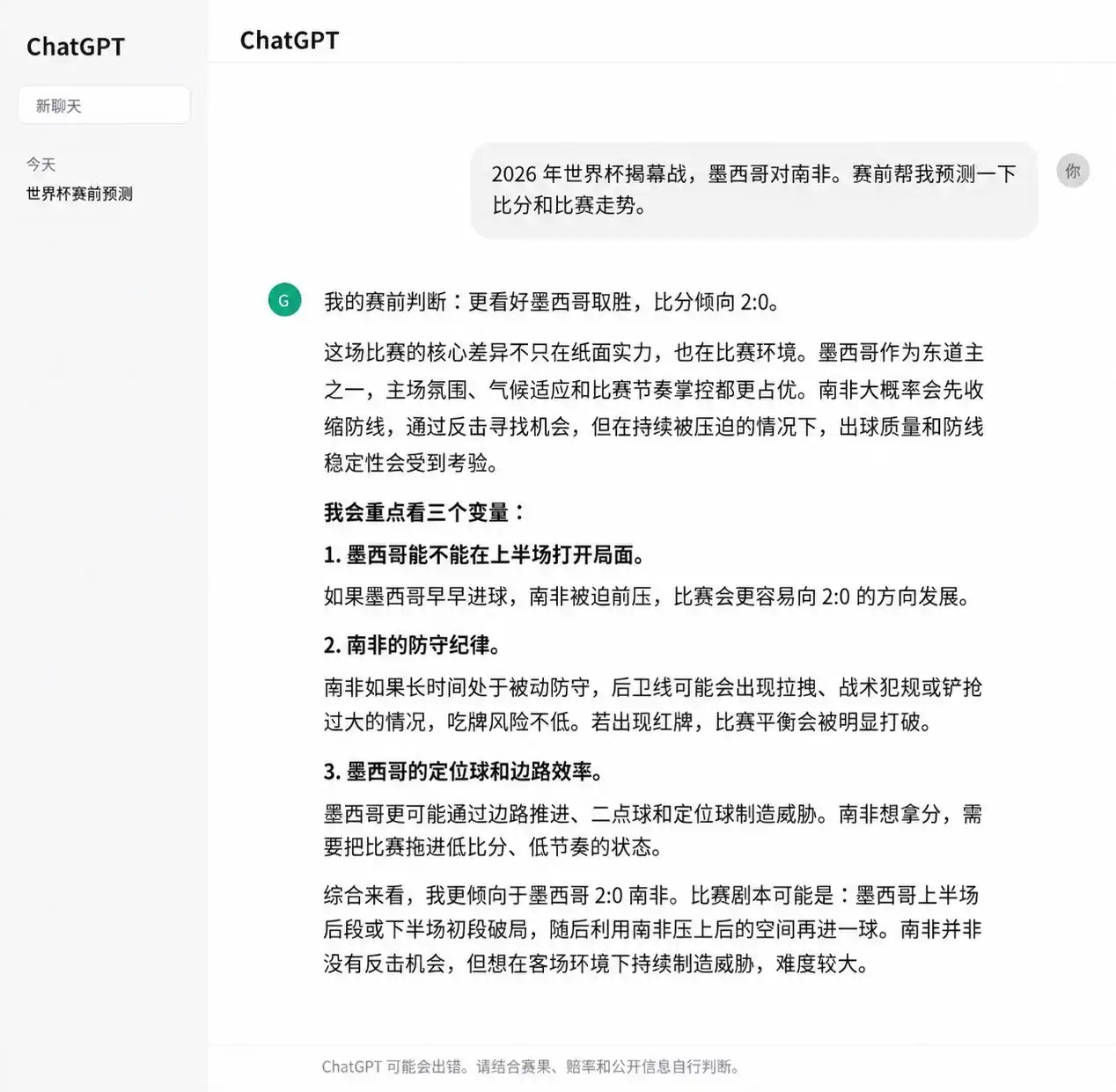
However, when it comes to full tournament predictions, ChatGPT's stability isn't as strong. While it correctly predicted Mexico 2:0 South Africa and Brazil 1:1 Morocco, and got the win/loss direction right for several matches like Scotland, Germany, and Sweden, for matches like South Korea 2:1 Czech Republic, Qatar 1:1 Switzerland, Australia 2:0 Turkey, and Japan 2:2 the Netherlands, ChatGPT's predictions favored the team with stronger paper strength. For example, it predicted Switzerland should beat Qatar, Turkey should beat Australia, and the Netherlands should edge Japan.

ChatGPT is not without predictive ability; it can break down team strength, home conditions, and recent form clearly, and can hit the score in some matches. But based on current results, it seems better at explaining 'why the favorite is more logical' rather than identifying in advance which matches might deviate from the favorite's script.

Gemini, Grok, Claude: Different models write different scripts for the same match

Besides Qwen, Copilot, and ChatGPT, some social media users have fed the same match to multiple models for pre-match predictions.

Taking the opening match Mexico vs. South Africa as an example, one blogger simultaneously tested four AI models—ChatGPT, Gemini, Grok, and Claude—for pre-match predictions. The results showed that both ChatGPT and Gemini predicted Mexico 2:0 South Africa, hitting the final score; Grok predicted Mexico 2:1, and Claude predicted Mexico 3:1. While both correctly predicted a Mexico win, they didn't nail the exact score.

For this opening match prediction, different models offered three different 'scripts.' ChatGPT Go and Gemini Pro were closer to the actual match: Mexico dominant, South Africa lacking in attack, ending with a clean sheet. Grok gave a more open scoreline, suggesting South Africa would get a goal back on the counter. Claude Sonnet set higher expectations for Mexico's attack, predicting a more open 3:1 result.

Summary

Since the number of AI prediction samples available for review is still limited at this stage, it's not yet possible to directly judge which model is the most 'football-savvy.'

But just looking at the few matches completed so far, differences are already starting to show. Qwen currently has the most memorable moments, hitting Mexico 2:0 South Africa and South Korea 2:1 Czech Republic on the opening day, and also catching red card risks and match flow, representing a standout performance in a small sample. However, whether it can sustain this accuracy requires verification from more matches.

Copilot and ChatGPT both have highlights of hitting exact scores, but they also share a common issue—their judgment remains insufficiently sensitive to matches that deviate from paper strength, like Australia beating Turkey, Qatar drawing with Switzerland, and Japan drawing with the Netherlands.

As for models like Gemini, Grok, and Claude, the publicly available samples are more focused on single matches or social media comparisons; they have reference value but are not yet suitable for direct rankings.

AI can already serve as one layer of reference for World Cup prediction market users, but it is far from being the standard answer.


Questions liées

QAccording to the article, which AI model had the most impressive start in predicting the World Cup matches?

AAccording to the article, the AI model Qwen (千问) had the most impressive start. It correctly predicted the exact scores (2:0 for Mexico vs. South Africa and 2:1 for South Korea vs. Czech Republic) for the first two matches it covered, and also accurately flagged the risk of a red card for South Africa.

QWhat are the major strengths and weaknesses identified for Copilot's predictions in the article?

AThe article states that Copilot's major strengths included accurately predicting exact scores for several matches, notably a 1:1 draw for Brazil vs. Morocco. Its major weakness was a tendency to be conservative in predicting upsets and draws, as it missed calls for matches like Australia beating Turkey, Qatar drawing with Switzerland, and Japan drawing with the Netherlands.

QHow does ChatGPT's approach to World Cup prediction differ from Copilot's, as described in the article?

AThe article describes ChatGPT as more of a 'pre-match analysis' tool that provides detailed reasoning for its predictions, such as considering home advantage and team form. In contrast, Copilot provided a complete forecast for all 104 tournament matches. However, both models shared a similar weakness in underestimating the likelihood of upsets.

QWhat was the key difference in the predictions for the Mexico vs. South Africa opener between models like ChatGPT/Gemini and Grok/Claude?

AFor the Mexico vs. South Africa opener, ChatGPT and Gemini correctly predicted the exact 2:0 scoreline. Grok predicted a 2:1 win for Mexico, and Claude predicted a 3:1 win. While all four models correctly predicted a Mexico victory, only ChatGPT and Gemini got the specific score and the fact that South Africa would be shut out.

QWhat is the article's overall conclusion about the current state of AI models in predicting World Cup outcomes?

AThe article concludes that while AI models can provide a useful additional reference for prediction market participants, they are far from being a definitive 'standard answer.' Their performance varies, and with a limited sample size of matches, it's too early to definitively judge which model is best. Models have shown they can predict specific scores and trends, but they still struggle with consistently identifying potential upsets or unexpected results.

Lectures associées

Projection 2029 : Lorsque la cryptomonnaie deviendra « invisible », qui survivra à cette transformation financière ?

**Résumé de l'article : "Prévisions pour 2029 : Quand la cryptomonnaie devient 'invisible', qui reste dans ce changement financier ?"** L'article propose un scénario pour l'industrie cryptographique jusqu'en 2029. Il identifie trois problèmes clés : la valeur des tokens, l'intégration de nouvelles technologies et la transformation en infrastructure financière traditionnelle. Sa thèse centrale est que la principale contrainte du secteur est juridique, et non technique. **Évolution principale :** * **2026 :** La valeur migre vers les actifs réels. Les contrats perpétuels synthétiques sur actions non cotées (ex: SpaceX, OpenAI) sur des plateformes comme Hyperliquid deviennent des références de prix cruciales, démontrant une demande pour des actifs de qualité, contrairement à la plupart des crypto-actifs. * **2026-2027 :** Le secteur se scinde en deux. D'un côté, un marché spéculatif bruyant (paris sur l'IA). De l'autre, un marché institutionnel silencieux où la tokenisation d'actifs (fonds monétaires, crédit privé) se développe dans un cadre réglementaire. Les blockchains généralistes s'orientent majoritairement vers les services institutionnels. * **2028 :** Un événement déclencheur. Une cascade de liquidations sur le marché des contrats perpétuels synthétiques, sans ancrage tangible, révèle ses failles. La réponse réglementaire serait d'autoriser la **publicité et la négociation légales de parts secondaires d'entreprises privées** pour les investisseurs accrédités, fournissant ainsi l'ancrage de prix manquant. * **2029 :** L'industrie atteint sa "fin". Le marché spéculatif se réduit. Une nouvelle forme de "bull market" émerge, alimentée par le trading direct et légal d'actions privées de sociétés technologiques (biotech, robotique, IA) par des investisseurs particuliers accrédités. La valeur des tokens dépendra désormais exclusivement des droits qu'ils confèrent sur des actifs réels. Les fonctions d'infrastructure de règlement (stablecoins, blockchains) deviennent "invisibles", intégrées et banales, comme tout autre service financier de base. L'auteur conclut que l'industrie ne sera plus définie par la spéculation sur des tokens, mais par le **marché qu'elle a construit pour échanger des actifs réels**. Le test décisif de sa prédiction sera l'émergence, ou non, d'un canal légal d'accès pour les investisseurs particuliers aux actifs privés d'ici fin 2028.

marsbitIl y a 19 mins

Projection 2029 : Lorsque la cryptomonnaie deviendra « invisible », qui survivra à cette transformation financière ?

marsbitIl y a 19 mins

Les actions de Zhipu ont bondi de 47 % après l'interdiction américaine de Fable 5

Le 15 juin, l'action de Zhipu AI a grimpé de 47,6% à la Bourse de Hong Kong, clôturant en hausse de 32,82%. Cette forte réaction suit deux annonces récentes. Le 12 juin, Anthropic a suspendu l'accès mondial à ses modèles phares Claude Fable 5 et Claude Mythos 5 suite à une injonction du gouvernement américain sur les contrôles à l'exportation. Le lendemain, Zhipu a annoncé l'ouverture de son dernier modèle open-source, GLM-5.2, à tous les utilisateurs de son Coding Plan, avec une sortie prévue de l'API et des poids du modèle sous licence MIT la semaine suivante. Cet événement met en lumière un changement dans l'industrie de l'IA : au-delà des performances pures, la stabilité, l'accessibilité durable et le contrôle des modèles deviennent des critères essentiels, surtout lorsque l'IA s'intègre dans les flux de travail critiques. La suspension soudaine de Claude a perturbé de nombreux développeurs et entreprises qui en dépendaient, soulignant les risques liés à l'accès à des modèles propriétaires soumis à des juridictions uniques. La réponse du marché valorise ce nouveau paradigme. GLM-5.2, présenté comme un modèle « véritablement utilisable » avec un contexte de 1M de tokens optimisé pour les tâches de codage longues et complexes, représente une alternative ouverte et contrôlable. Les analystes estiment que cet incident pourrait accélérer l'adoption de modèles de base locaux et open-source par les entreprises cherchant à sécuriser leurs capacités d'IA. La concurrence évolue ainsi de « qui est le plus performant » vers « qui est le plus accessible et fiable sur le long terme ».

marsbitIl y a 26 mins

Les actions de Zhipu ont bondi de 47 % après l'interdiction américaine de Fable 5

marsbitIl y a 26 mins

Guide d'inscription et de publication d'articles pour la colonne PANews

**Guide d'inscription et de publication pour les contributeurs de PANews** Cette page explique comment devenir contributeur (créer une colonne) et publier des articles sur PANews. L'accent est mis sur les contenus approfondis liés à la Crypto, au Web3, aux données et aux analyses. Les contenus principalement promotionnels ou générés massivement par IA ne seront pas approuvés. **Pour créer une colonne :** * **Sur le site web :** Allez en bas de la page d'accueil, cliquez sur "申请专栏" (Demander une colonne). Connectez-vous avec votre numéro de téléphone ou e-mail (code de vérification, pas de mot de passe). Remplissez le nom de la colonne, la description, téléchargez un avatar et fournissez des liens vers vos articles déjà publiés. * **Sur mobile :** Dans la section "我的" (Moi), accédez à "投稿与创作" (Soumettre et créer) et suivez les étapes. **Pour publier un article :** 1. Connectez-vous sur le site et allez sur votre page personnelle. 2. Accédez au "创作者中心" (Centre de création). 3. Utilisez l'éditeur pour rédiger et publier votre article. **Ajouter une vidéo :** Seul l'intégration via code embed (iframe) est supportée (ex. : Bilibili). Collez le code dans l'éditeur via le bouton "插入/编辑媒体" (Insérer/modifier un média). Ajustez la taille si nécessaire (largeur 100%, hauteur 560px recommandés). **PANews Skills (Agent IA) :** PANews propose un ensemble d'outils IA (PANews Skills) pour automatiser certaines tâches. L'outil `panews-creator` permet notamment de gérer votre colonne et de publier des articles directement via des agents IA compatibles (comme Cursor, Claude, etc.). Pour l'utiliser, vous devrez récupérer un jeton d'authentification (`sessionid`) depuis les outils de développement de votre navigateur après vous être connecté à votre compte PANews. **Rappel important :** Privilégiez les analyses de fond. Les contenus publicitaires (PR) doivent passer par la voie commerciale.

marsbitIl y a 36 mins

Guide d'inscription et de publication d'articles pour la colonne PANews

marsbitIl y a 36 mins

J'ai construit un poste de travail d'investissement personnel avec l'IA

Ces dernières semaines, j'ai exploré le « Vibe Coding », utilisant des modèles d'IA comme Codex, Claude et DeepSeek pour développer rapidement des outils personnalisés. Frustré par la nécessité de consulter plusieurs applications pour suivre mes actifs (actions, crypto, etc.), j'ai construit un tableau de bord unifié affichant l'ensemble de mon portefeuille et ses performances. Cet outil intègre désormais une surveillance des mouvements brusques, une cartographie des investissements (visualisant les écosystèmes complets) et un journal de réflexion. J'ai également créé un moniteur pour les marchés de prédiction (comme Polymarket), rassemblant les paris sur des événements futurs (valorisations d'entreprises, etc.) pour analyser leurs probabilités face à l'actualité. Un petit back-office pour gérer mes publications et un outil de mise en forme automatique pour différents plateformes complètent cet ensemble. L'essentiel n'est pas la sophistication des outils, mais la capacité nouvelle à matérialiser rapidement une idée. L'IA permet à tout investisseur de construire progressivement ses propres systèmes fondamentaux : observation d'actifs, surveillance de signaux, cartographie de secteurs et analyse rétrospective. Ce cycle rapide « idée → réalisation → utilisation → amélioration » change profondément la façon d'aborder la recherche et la gestion d'investissements pour les particuliers.

marsbitIl y a 52 mins

J'ai construit un poste de travail d'investissement personnel avec l'IA

marsbitIl y a 52 mins

Trading

Spot
Futures
活动图片




