The 'VVV' Concept Soars 9x in Half a Year, The New AI Narrative on Base Chain

marsbitPublié le 2026-05-12Dernière mise à jour le 2026-05-12

Résumé

"The article explores the 'VVV' concept as the new AI-focused narrative within the Base ecosystem, centered around the token $VVV of the privacy-focused, uncensored generative AI platform Venice, led by crypto veteran Erik Voorhees. Venice has seen significant growth in 2026, with its API users surging, partly attributed to exposure from OpenClaw. The platform now boasts over 2 million total users and 55,000 paid subscribers. Correspondingly, the $VVV token price has risen over 9x this year. Key to its performance are tokenomics designed for value accrual: reduced annual emissions, subscription revenue used for buyback-and-burn, and a unique staking mechanism. Staking $VVV yields $sVVV, which can be used to mint $DIEM tokens. Each staked $DIEM provides a daily $1 credit for using Venice's API services, creating tangible utility. The article also highlights other tokens associated with the 'VVV' narrative. $POD, the token of distributed AI network Dolphin (which co-developed Venice's default AI model), saw a massive price surge. $cyb3rwr3n, a project for a Venice credit auction market, gained attention due to perceived connections to Venice's team despite official denials. Finally, $SR of robotics platform STRIKEROBOT.AI rose after announcing a partnership with Venice for robot vision-language model development. Overall, the 'VVV' ecosystem combines AI platform growth, deflationary tokenomics, and innovative utility mechanisms, driving significant investor interest and pric...

Author: BlockBeats

Undoubtedly, the current main narrative within the Base ecosystem remains AI. To be more precise, it's "VVV."

Before introducing the tokens related to the "VVV" concept, let's first understand what "VVV" actually is.

What is the "VVV" Concept?

$VVV is the token of Venice, which is a privacy-first and censorship-resistant generative AI platform on the Base ecosystem, led by Erik Voorhees.

Erik is a seasoned OG in the crypto space since 2011, having played a pivotal role in early Bitcoin adoption. After the Mt.Gox collapse, he founded ShapeShift, one of the first platforms to emphasize non-custodial and privacy-first trading. His expertise in decentralized finance and user sovereignty makes him a strong advocate for permissionless AI.

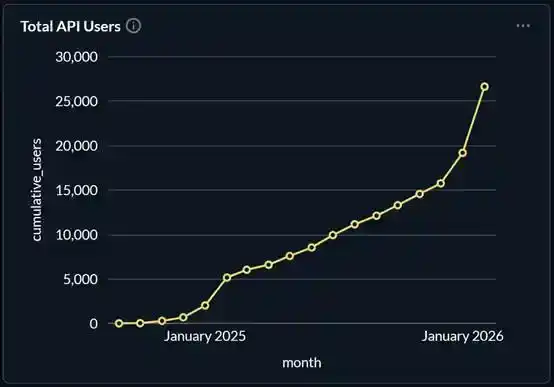
According to the Venice API user statistics chart disclosed by Erik Voorhees in March, Venice's API user count grew from near zero to 15,000 throughout 2025.
However, the corresponding price performance of $VVV has been lukewarm, with occasional rebounds reaching only about a $200 million market cap at most. It once fell below a $45 million market cap, far from its all-time high of nearly $1 billion when it first launched.

It's also noticeable that entering 2026, Venice's API user count experienced rapid growth. This has to be credited to the explosion of OpenClaw. Due to its privacy-focused positioning, Venice was prominently recommended in the model provider section of OpenClaw's official documentation.
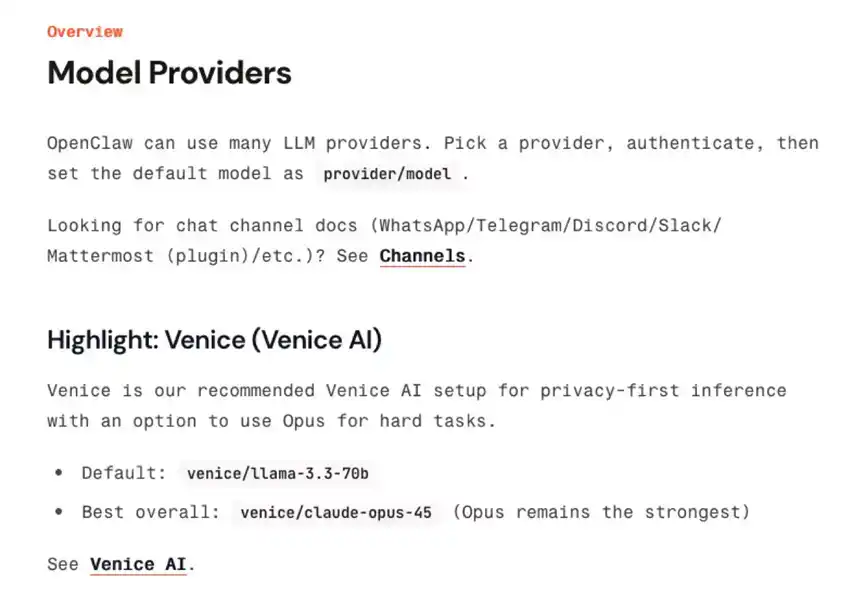
Although this prominent recommendation was later removed, 2026 has been a year of rapid growth for Venice. According to data disclosed by Erik Voorhees, by March this year, Venice's total user count exceeded 2 million, paid subscription users reached 55,000, monthly revenue hit $835,000, with a monthly growth rate of 15%.

Corresponding to this is the continuous rise of $VVV. Since entering 2026, $VVV has increased by over 9 times.

$VVV/$DIEM

Earlier, we covered Venice's growth in exposure and user numbers this year, which are the macro-narrative reasons for its rise. But as a crypto AI project with a token, its price increase is also closely tied to the token's mechanisms.

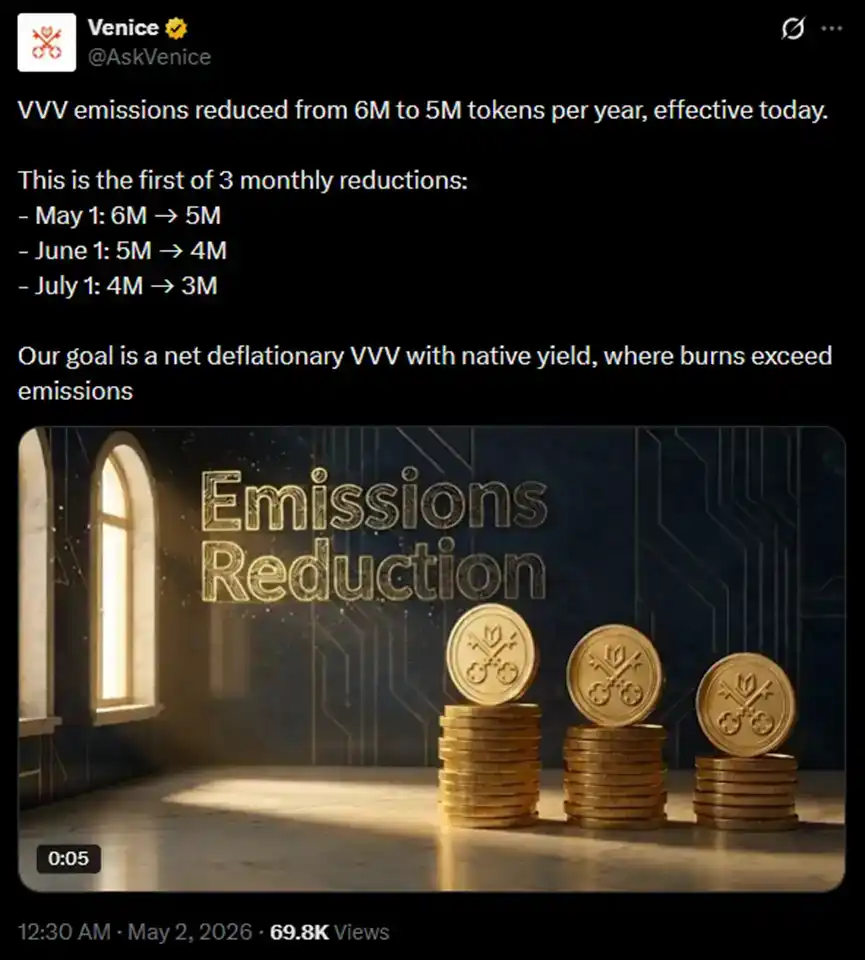
This year, the annual emission of $VVV has undergone multiple reductions and adjustments, dropping from 8 million tokens per year to 5 million. By July 1st, the annual emission will be further reduced to 3 million tokens. The official stated goal is to achieve net deflation for $VVV, ensuring the burn rate exceeds the emission rate to guarantee $VVV's native yield.
$VVV's initial total supply was 100 million tokens. The current total token supply is approximately 79.9 million, with 42.22% (about 33.73 million) of the current supply already burned.

The burn of $VVV is linked to Venice's subscription revenue. At the end of April, Venice allocated more subscription revenue towards token buybacks. For each new Pro plan subscription ($18), $2 will be allocated to buy back and burn $VVV. The Pro+ plan ($68) and Max plan ($200) correspond to $5 and $10 for buyback and burn, respectively.

The current circulating token count is approximately 46 million tokens. Additionally, about 8.85 million tokens remain locked, and around 32.47 million tokens are staked.

The token utility of $VVV is quite interesting. Compared to the awkward situation faced by past crypto projects where "token rights are useless compared to equity," $VVV offers a very compelling solution.

On the foundation of continuously controlling token supply, staking $VVV not only earns more $VVV (receiving more rewards from emission cuts) but also grants the right to mint $DIEM using the staked token $sVVV.
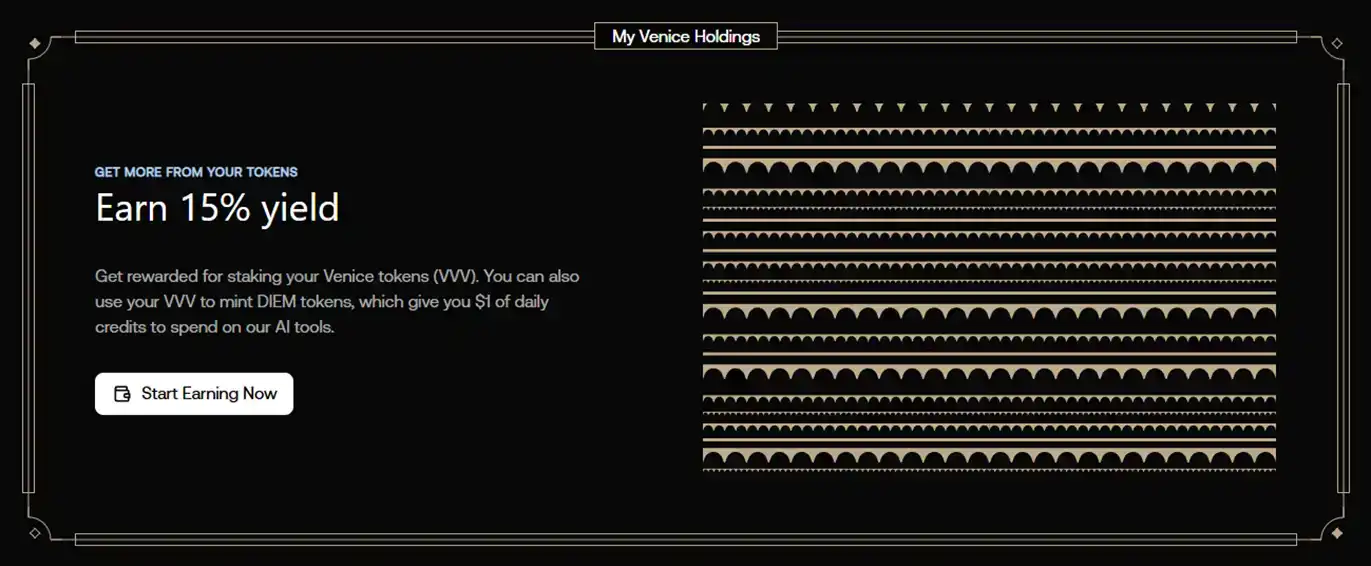
$DIEM can either be traded or staked. Staking 1 $DIEM corresponds to $1 worth of Venice API credit per day.

This credit refreshes daily; what's used today is replenished tomorrow, and it's permanent. What can you do with $1 of Venice API credit? Quite a lot, according to Venice itself:
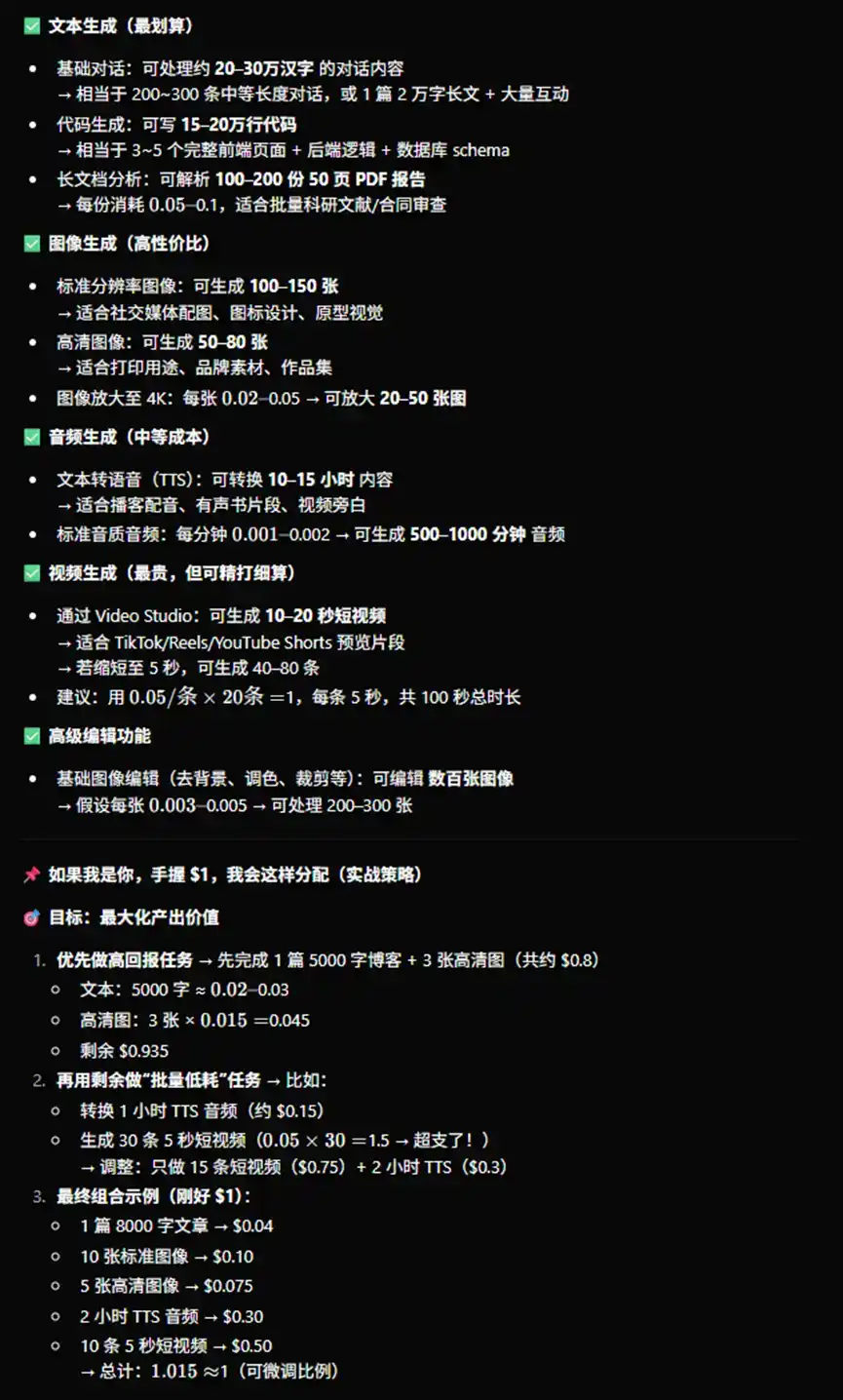
Stake 1 $DIEM, and get free daily processing of the above with Venice.

However, one must consider that the current price of one $DIEM has skyrocketed to around $1,500. To mint one $DIEM requires approximately 756 $sVVV, costing about $12,800. Is it worth it? Venice's own calculation looks like this:
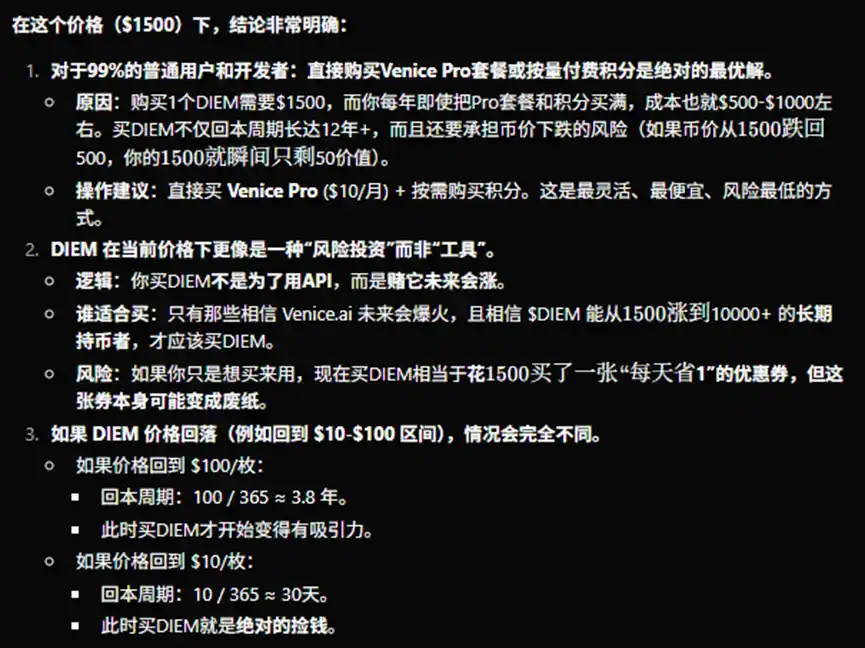
Overall, the $VVV/$DIEM economic structure, combined with Venice's regulatory mechanisms, gives $VVV a genuine "tech stock" flavor while retaining unique crypto characteristics:

- Supply-side emission reduction prevents excessive dilution of token value (and also protects the $VVV dividends for stakers from dilution).

- Subscription revenue is used for token buybacks.

- Staked $VVV can be used to mint $DIEM, allowing the token to serve a practical function within the product through $DIEM.

- However, this practical utility comes at a cost; $VVV used to mint $DIEM only receives 80% of the dividends ($VVV staking rewards).

- Enables on-chain DeFi operations, such as staking $VVV to obtain $DIEM, then selling $DIEM to buy more $VVV. There are even community projects like @cheaptokensAI that allow users to profit without selling $DIEM, by reselling the daily credit granted by $DIEM.

$POD

Since entering May, $POD has surged over 12 times at its peak, with its market cap rising from about $7.8 million to briefly surpass $100 million.

$POD is the token for Dolphin's distributed AI inference and training network. In simple terms, it involves "mining" with idle GPUs, providing computing power to those needing AI computation services, and earning $POD rewards.

However, the reason for $POD's speculative frenzy isn't the network itself, but another aspect of Dolphin's business—AI models. Venice's current default model, Venice Uncensored 1.2, is jointly developed by Dolphin and Venice and evolved from Dolphin Mistral 24B Venice Edition.

Therefore, although $POD is solely the token for Dolphin's distributed AI network, at this stage, it is being treated as the only investment vehicle for Dolphin and is being heavily speculated upon.

$cyb3rwr3n

This project claims to be building a USDC-based auction market for Venice usage credits. However, it is seen as part of the "VVV" related concepts largely because some players, after analyzing correlations between on-chain behavior and tweets, believe this project is highly associated with Venice founder Erik Voorhees.

The Venice official Twitter account has clarified these speculations, stating that cyb3rwr3n is not an official Venice project.

When this news broke last month, it caused about a 50% price drop, but a few days ago, the token hit a new all-time high. The official clarification hasn't completely erased market associations. According to some community discussions, Erik Voorhees was the first follower of the cyb3rwr3n official Twitter account, and Venice team members like co-founder @TeanaTaylor, CTO @jesseproudman, and product lead @willyogo also follow the account. They argue that even if Venice has no formal link, the supportive sentiment conveyed by such interactions is still a significant bullish signal.

This is also currently one of the cheaper tokens among "VVV" related concepts, with only a $4 million market cap. But being cheap comes with reasons—its product hasn't launched yet, and it currently functions more like a meme coin.

$SR

STRIKEROBOT.AI is a full-stack embodied intelligence platform building a humanoid robot framework for physical AI Business Process Outsourcing (BPO), focusing on safety in hazardous environments (nuclear plants, high-voltage facilities, radiation zones, etc.).

They have a robot training and simulation platform called SR Platform, and $SR is the token for this platform. The project's connection to Venice is the announcement on May 7th about jointly developing a VLM inference layer for robots with Venice and receiving funding sponsorship from Venice.
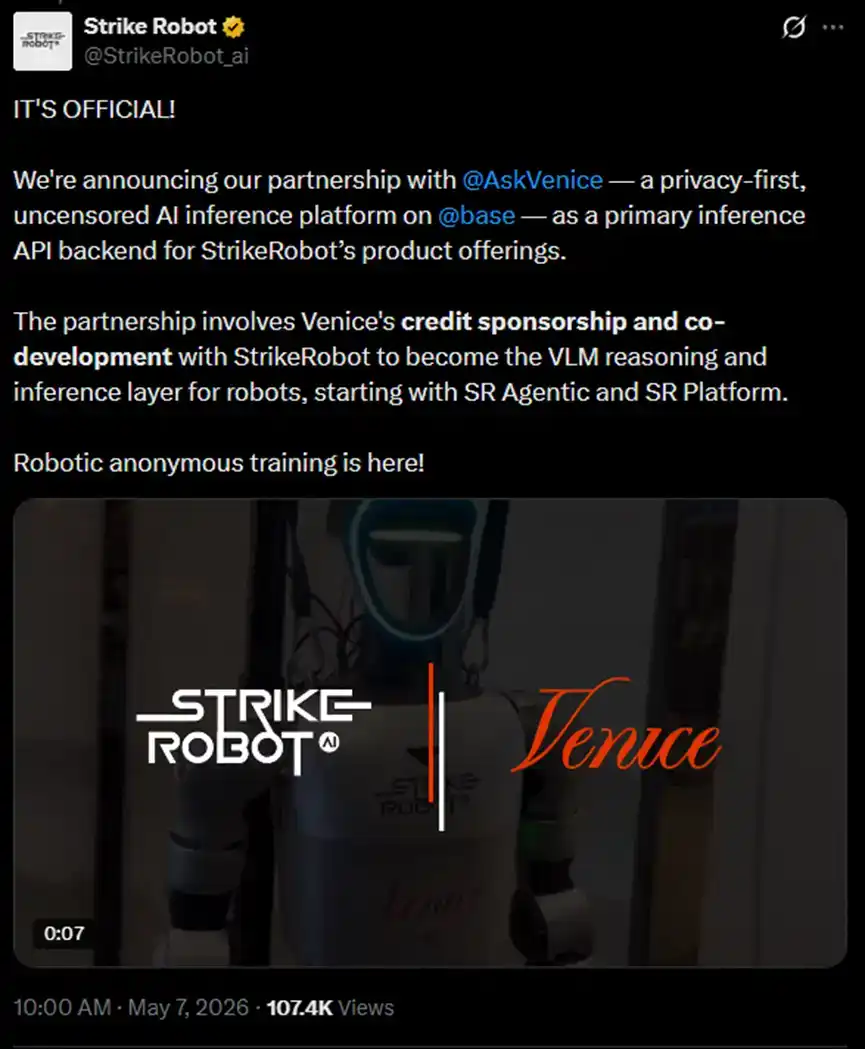
Since entering May, $SR has risen approximately 4 times, with a current market cap of around $9 million.

Questions liées

QWhat is the 'VVV' concept referred to in the article, and what is its primary platform?

AThe 'VVV' concept refers to the $VVV token associated with Venice, which is a privacy-focused, uncensored generative AI platform on the Base blockchain ecosystem, led by Erik Voorhees.

QAccording to the article, what was a significant driver for Venice's rapid growth in user numbers in 2026?

AThe significant driver for Venice's rapid growth in user numbers in 2026 was its high-profile recommendation in the official documentation of the popular project OpenClaw, thanks to its privacy-focused positioning.

QHow does the Venice platform's subscription model contribute to the $VVV token's economics?

AVenice uses a portion of its subscription revenue from Pro, Pro+, and Max packages to buy back and burn $VVV tokens. For example, each new $18 Pro subscription allocates $2 for this buyback and burn, creating deflationary pressure on the token's supply.

QWhat is the relationship between the $VVV token and the $DIEM token within the Venice ecosystem?

AStaking $VVV tokens yields staked $sVVV, which can be used to mint $DIEM tokens. Each staked $DIEM token provides a daily $1 credit for using the Venice API. While $DIEM can be traded, it also has this core utility within the Venice product.

QBesides $VVV itself, name two other tokens mentioned in the article that are considered part of the 'VVV' concept and briefly state their connection to Venice.

ATwo other tokens are $POD and $SR. $POD is the token for Dolphin, a distributed AI network, which co-developed the Venice Uncensored 1.2 model with Venice. $SR is the token for STRIKEROBOT.AI, which received funding from Venice and is collaborating with them to develop a VLM inference layer for robots.

Lectures associées

L'écart de prix du USDT en Inde dépasse 8,5 % alors que la pression réglementaire resserre l'offre

La prime de l'USDT en Inde a dépassé 8,5%, en raison d'une contraction de l'offre de stablecoins sur le marché local. Cette situation découle des pressions réglementaires qui découragent les entrées de capitaux via des actions coercitives et une surveillance accrue. En conséquence, le cours de l'USDT s'établit à ₹102,88 contre un taux officiel USD/INR de ₹94,65, élargissant considérablement l'écart par rapport à la fourchette habituelle de 3–4%. La pression réglementaire a ralenti les nouveaux afflux d'USDT, réduisant la liquidité sur les marchés de pair-à-pair, les bureaux de change de gré à gré et les bourses. Bien que le nombre de transactions et d'adresses de portefeuille actives reste solide, indiquant une demande soutenue pour les paiements transfrontaliers et la thésaurisation, l'offre est fortement contrainte. Les données de transactions P2P montrent un volume d'achat faible (1,2 million de dollars) par rapport au volume de vente (17,8 millions de dollars), révélant une capacité de tenue de marché limitée. Si l'incertitude réglementaire persiste, cette pénurie de liquidités pourrait maintenir des primes élevées et pousser les acteurs vers des canaux informels. À l'inverse, une clarification réglementaire et un meilleur accès au marché pourraient rétablir les opportunités d'arbitrage, augmenter la liquidité en dollars et réduire progressivement la prime sur l'USDT en Inde.

ambcryptoIl y a 17 mins

L'écart de prix du USDT en Inde dépasse 8,5 % alors que la pression réglementaire resserre l'offre

ambcryptoIl y a 17 mins

La CFTC américaine lance une enquête approfondie sur Polymarket : la saison des marchés prédictifs sur le point de s'éteindre ?

La Commodity Futures Trading Commission (CFTC) américaine a ouvert une enquête approfondie sur la plateforme de marchés prédictifs Polymarket, portant notamment sur ses activités de marketing sur les réseaux sociaux. Cette enquête fait suite à des accusations de sénateurs concernant des pratiques promotionnelles trompeuses, notamment via des influenceurs rémunérés. L'enquête intervient dans un contexte de croissance explosive du secteur des marchés prédictifs, stimulée par des événements comme la Coupe du Monde. Des plateformes comme Polymarket, Kalshi et celle de Robinhood voient leurs volumes de transaction et revenus annuels atteindre des records. Cette popularité attire également l'attention des géants de la tech comme Meta. La situation révèle un conflit croissant entre les régulateurs fédéraux, comme la CFTC qui revendique une juridiction exclusive sur ces "contrats d'événement", et les autorités étatiques qui y voient des paris sportifs illégaux menaçant leurs revenus fiscaux. Le litige porte sur la définition légale de ces marchés : produits dérivés ou jeux d'argent. Par ailleurs, des tensions existent aussi entre la CFTC et des bourses établies comme le CME, qui conteste des décisions réglementaires. En toile de fond, des intérêts politiques et financiers complexes émergent, avec l'implication d'investisseurs comme Donald Trump Jr. dans les principales plateformes. L'enquête sur Polymarket marque ainsi un tournant potentiel vers une régulation plus stricte, mettant fin à une période de croissance "sauvage" pour l'industrie, tout en dessinant les contours d'un futur cadre concurrentiel et légal plus structuré.

marsbitIl y a 1 h

La CFTC américaine lance une enquête approfondie sur Polymarket : la saison des marchés prédictifs sur le point de s'éteindre ?

marsbitIl y a 1 h

La CFTC américaine ouvre une enquête approfondie sur Polymarket, la saison de fête des marchés de prédiction est-elle sur le point de s'éteindre ?

La Commodity Futures Trading Commission (CFTC) américaine a ouvert une enquête approfondie sur la plateforme de marchés de prédiction Polymarket, suite à des accusations de marketing trompeur impliquant des influenceurs rémunérés. Cette action régulatoire intervient alors que le secteur connaît une croissance explosive, portée par la Coupe du Monde, avec des volumes d'échange hebdomadaires dépassant 144 milliards de dollars. L'enquête de la CFTC pourrait marquer la fin d'une période de croissance non régulée pour ces marchés. Elle s'accompagne d'un conflit de juridiction entre les régulateurs fédéraux, comme la CFTC qui revendique une compétence exclusive, et plusieurs États américains (dont le Kentucky) qui poursuivent Polymarket et sa concurrente Kalshi pour opérations de paris sportifs illégaux. Ce conflit oppose les intérêts fiscaux des États et la définition réglementaire de ces nouveaux produits. Parallèlement, l'industrie attire les géants de la tech, avec Meta envisageant des partenariats, et les investisseurs, comme Donald Trump Jr. qui a pris des participations stratégiques à la fois dans Kalshi et Polymarket. Malgré les défis réglementaires, les perspectives du secteur restent solides, Kalshi envisageant une introduction en bourse d'ici 2027-2028. L'enquête sur Polymarket apparaît ainsi comme une étape de normalisation pour un marché en passe de maturité.

Odaily星球日报Il y a 1 h

La CFTC américaine ouvre une enquête approfondie sur Polymarket, la saison de fête des marchés de prédiction est-elle sur le point de s'éteindre ?

Odaily星球日报Il y a 1 h

Les robots de Shenzhen vont bientôt sonner à la cloche

L'effervescence des robots à Shenzhen se concrétise par une vague d'introductions en bourse. La société de robotique Doogiang, basée à Nanshan, a vu sa demande d'introduction au ChiNext acceptée, après son IPO réussie à Hong Kong en 2024. Fondée en 2015 par Liu Peichao et son équipe dans un petit appartement, l'entreprise illustre le parcours typique de Shenzhen : partir d'une idée, prototyper rapidement grâce à un écosystème manufacturier dense, et se développer en s'appuyant sur une chaîne d'approvisionnement locale efficace. Doogiang s'est d'abord imposée dans les environnements industriels avant d'étendre ses robots collaboratifs aux espaces commerciaux. Cette dynamique s'inscrit dans un paysage robotique florissant à Shenzhen, surnommée "première ville des robots humanoïdes". Le "Nanshan Robot Valley", une ceinture industrielle de 28 km², regroupe des leaders comme Ubtech (valeur de près de 50 milliards de HKD) et des startups prometteuses telles que Zhipingfang et Ziliang. Des événements comme le "X-Day" au lac Xili servent de plateforme cruciale pour connecter les projets émergents aux capitaux et aux ressources industrielles, ayant déjà facilité des investissements et financements substantiels. La scène robotique de Shenzhen évolue ainsi des applications industrielles vers des domaines plus tournés vers l'expérience et le quotidien, solidifiant sa position de pôle d'innovation mondial.

marsbitIl y a 2 h

Les robots de Shenzhen vont bientôt sonner à la cloche

marsbitIl y a 2 h

Trading

Spot
活动图片