The Midlife Crisis of Crypto GPs: No PMF, No Next Check from LPs

marsbitPublié le 2026-06-01Dernière mise à jour le 2026-06-01

Résumé

The article "The Midlife Crisis of Crypto GPs: No PMF, No Next LP Check" analyzes the shifting crypto fundraising landscape. It argues the era of selling grand visions to LPs is over; GPs must now offer products with clear Product-Market Fit (PMF). The author categorizes crypto fundraising products into three types: Primary (VC funds), Liquid (trading strategies), and CeFi/DeFi Native Yield. This summary focuses on the Primary market. Key points include: * **Market Shift:** LPs are impatient, demand immediate returns, and are skeptical of future promises. The "easy money" narrative has faded. * **GP Value Erosion:** LP learning curves have shortened (aided by AI), reducing the value of a GP's basic "crypto knowledge." Superior judgment is now rare. * **Weakened LP Motivations:** Traditional reasons for LPs to invest in crypto VC funds (capturing industry beta, gaining access, leveraging GP judgment) have weakened due to new products like ETFs and increased LP sophistication. * **Surviving in Primary:** The primary market will likely persist for: 1) large funds in endowment mandates treating it as a lottery ticket, 2) family offices/HNWIs using proprietary capital, 3) a few funds with proven recent outperformance, and 4) funds with strong ecosystem "deal-making" capabilities. * **Conclusion:** For most GPs, rebuilding trust requires starting over in a niche, demonstrating alpha-generating ability, or providing concrete value/services to LPs.

Author: Yi.Pineapple

LPs are no longer buying dreams; GPs must sell products. This article will attempt to categorize current crypto fundraising products into three types: Primary, Liquid, and CeFi / DeFi Native Yield. The first part focuses on Primary: after VC blind pools have lost their appeal, who remains at this table, and who must prove themselves anew? The answer is at the end; you can scroll directly to the bottom.

Note: This article aims to provide a landscape overview of the entire crypto fundraising market. The first part mainly categorizes and explains the current market situation from a product perspective, while the second part will analyze more from the perspective of LPs. As the author is primarily based in the Asian market, this article may have a regional bias.

Market Status

Having lost the grand vision, most Crypto GPs who failed to earn excess returns this cycle must get down to earth and launch a product with PMF. They must either prove they still have the ability to generate excess returns for LPs through some niche market or help LPs/partners solve specific problems in order to survive.

  • For most GPs, this market has long moved from the stage of "buying a future vision" to the stage of "buying a specific product."
  • LPs have lost patience and no longer want to gaze at the stars and the sea; they want to see something that can make money immediately, right away, and with relative certainty.
  • Crypto LPs have lost trust in the market and are no longer willing to easily believe the "next cycle" narrative (this has been discussed too much and will not be elaborated here). Moreover, many did not make easy money this cycle. Once the way to make money becomes difficult, investment actions tend to become more cautious and conservative.
  • Most traditional LPs have also completed a round of learning and moved past the story-listening stage. The 2020/2021 bull market was the time of peak FOMO. Dollar funds were cheap (Treasury yield close to 0), LPs were still making money relatively easily (on the eve of the economic downturn), and Crypto was in an explosive period (there were many wealth creation myths, and there was still a dream to sell). Back then, many people, even with only a vague understanding of crypto, were willing to make impulsive purchases for the dream; or, for strategic reasons, paid to enter and learn.
  • AI and falling labor costs have also changed the positioning of GPs. The costs for LPs to learn, hire, analyze data, trade, and make small direct investments are all declining. The trend of LPs transforming into GPs is significant. If GPs only offer the vague capability of "I understand crypto," their value will become increasingly precarious.
  • As for the storytelling track, unless they are U.S.-based funds with strong brand power, who, based on their past track records, can still tell stories and visions in specific niches (e.g., a16z leveraging its advantage in the AI sector to talk about crypto * AI, Dragonfly leveraging its investments in Ethena/Polymarket to talk about internet capital markets), there is still an opportunity. In Asia, this positioning is already difficult. After all, to some extent, in both crypto projects and funds, the opportunity to tell stories often goes to those with a "white paper" (a play on words implying Western or native English speakers have an advantage).

Product Overview

This article categorizes crypto fundraising products into three major types for discussion: Primary, Liquid, and CeFi / DeFi Native Yield (Note: This categorization is not entirely precise; there are some blurred lines between the three). (*This time, only Primary is covered)

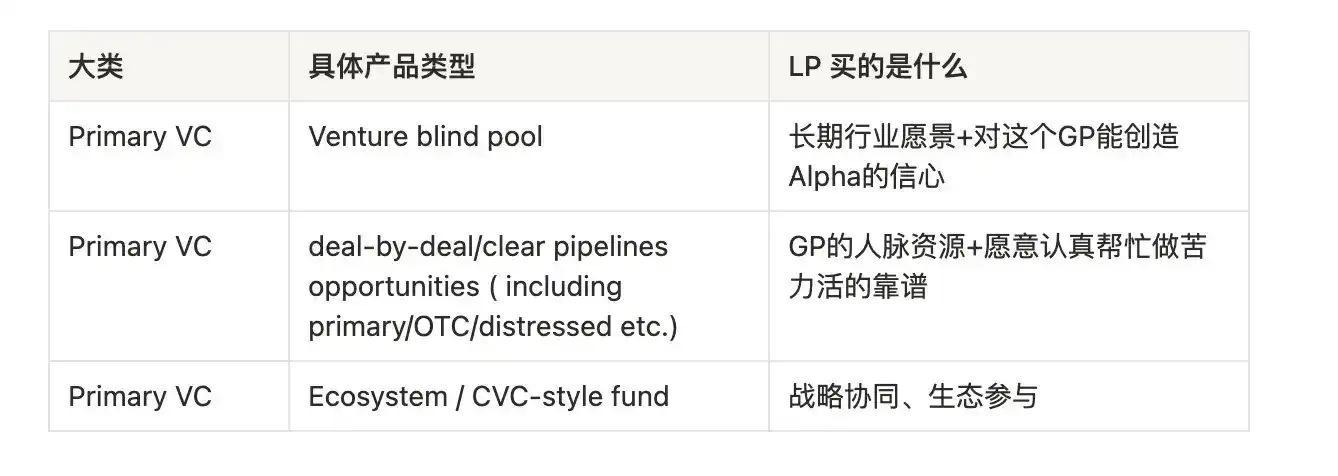
Primary VC:

In terms of transparency, they can be roughly divided into blind pools and those with clear pipelines.

In terms of liquidity, they can be roughly divided into primary and primary-secondary.
Liquid:

In terms of source of returns, roughly divided into alpha-focused (buying GP's personal ability) and beta-focused (buying industry trends).

In terms of directionality, roughly divided into directional (buying cycle judgments) and market neutral (buying market inefficiencies in immature markets).
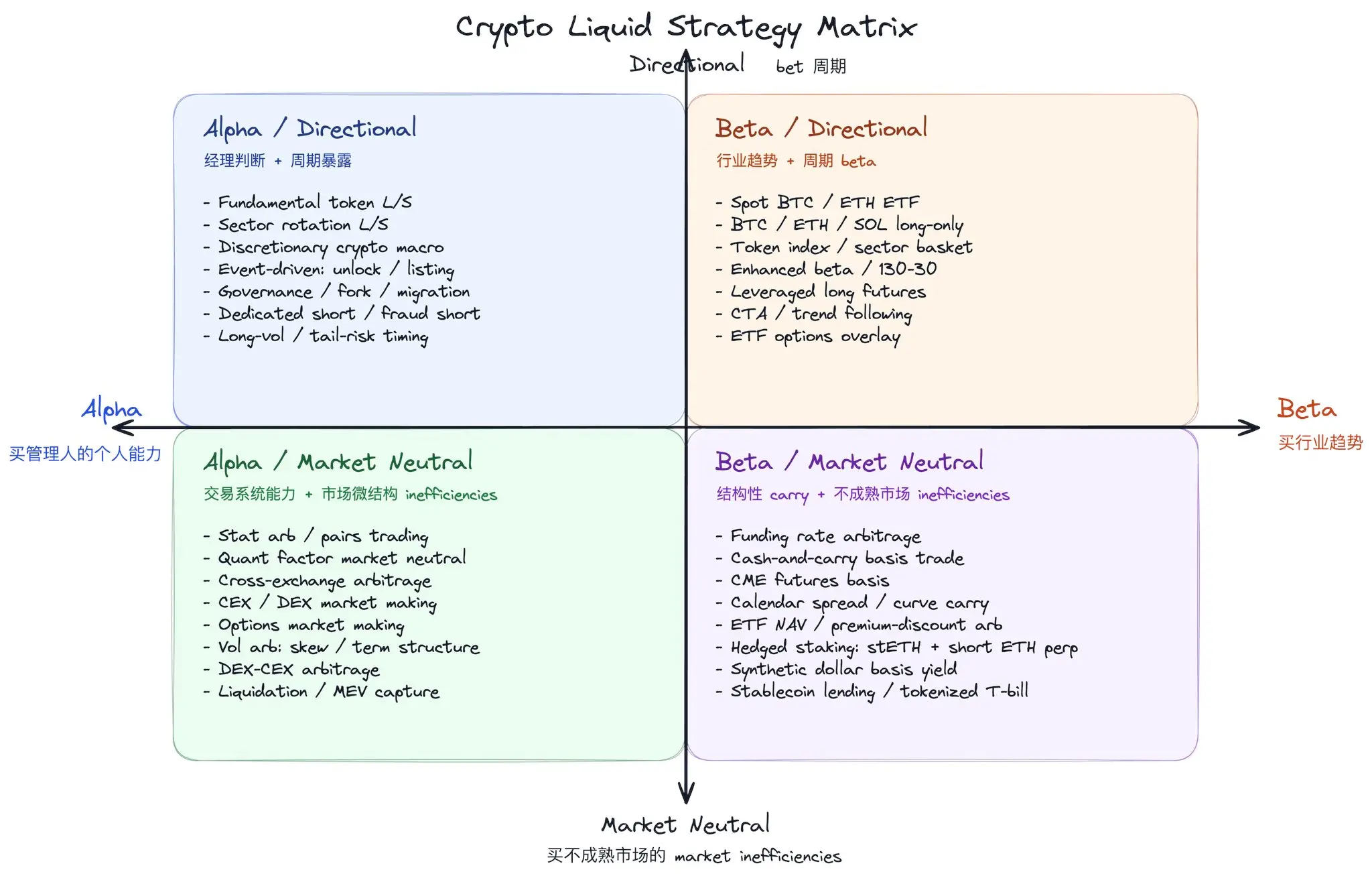
There are many ways to categorize; this is just to provide an idea

CeFi/DeFi Native Yield:

In theory, CeFi/DeFi Native Yield can be viewed as a type of return source within or spanning the crypto primary market and liquid market. The reason for listing it separately is mainly because, from the perspective of TradFi investors, they usually use the framework of traditional financial markets to understand crypto: for example, crypto VC can be understood as a sub-sector under the VC category, and staking/lending yield can be analogized to fixed income or cash management products.

However, crypto indeed contains some玩法 (play/mechanisms) and return mechanisms not entirely corresponding to traditional financial markets, such as mine-trade-sell, points/airdrop farming, protocol incentives, on-chain liquidity mining, etc. These are more like crypto-native issuance, user acquisition, and incentive mechanisms, warranting separate discussion.

Secondly, for many Crypto Native Investors, their earliest entry point and understanding of financial markets were not the traditional equity/bond market, but rather crypto-native scenarios like exchange wealth management products, staking, DeFi lending, LP, points/airdrop farming, basis trade, etc. Therefore, when they look at this part of the yield, they may not necessarily translate it into TradFi's fixed income, cash management, or alternative yield first. Instead, they more naturally understand it from the perspectives of protocol incentives, liquidity provision, token emission, on-chain risk, counterparty risk, and capital efficiency.

For Crypto Native LPs, accessing this part of the yield does not require a GP; at most, they might need a reliable key account manager.

For TradFi LPs, there are now some institutions packaging this part of the yield into fund forms to sell to TradFi LPs.

Primary Market

From the perspective of the entire primary market, crypto VC is just a sub-sector under the VC category. 2021 was a crazy year; whether crypto or non-crypto, the real returns of that vintage are not good. As a cruel fact, LPs have learnt their lessons, tired of any products with ultra-long lock-up periods (traditional VC typically 10 years, crypto VC also often 5-10 years). Because without a hard lock-up, they at least have the chance to withdraw part of their money if circumstances change.

In a sense, crypto is even worse off than traditional VC because the entire vision has collapsed. It is not a new industrial revolution; at most, it's a revolution in financial infrastructure. This judgment is not to disparage crypto—a revolution in financial infrastructure is still very important—but it's not as grand as many imagined in the last bull market. Worse, the market was too immature back then, and many projects were invested in without sufficient due diligence and legal protection. Many failed projects are a combination of investment failure and founders running away. There are already too many articles in the industry discussing the current dire situation; it will not be elaborated here.

Investing in VC is like VC investing in projects—a power-law business, a lottery-like business. As long as there are people willing to buy lottery tickets, this table will not disappear.

Why LPs invested in crypto VC back then, and why these reasons have weakened now

1. Invest to capture the beta of the industry

This reason was especially valid for tradfi LPs. It was true in the early days because market choices were few. For outsiders, on-ramping, buying tokens, going on-chain, using CEXs, and managing wallets were all difficult. They worried about losing private keys and CEXs running away. Investing in VC seemed like a more reliable access point then.

But today, when a traditional LP enters crypto, they have a whole set of choices before them: BTC ETF, ETH ETF, crypto ETP, DAT, custody accounts, SMAs, structured products. More importantly, these products do not require them to learn on-chain operations; they can trade just like they used to buy stocks.

According to CoinShares, the AUM of global digital asset investment products it covered reached about $156.9B in mid-May 2026. This number is not the total industry AUM, only the ETF/ETP/trust/closed-end funds and other listed or quotable products. But it's enough to show that gaining crypto exposure no longer requires investing in VC blind pools.

However, for long-term capital with clear mandates (e.g., endowment, etc.), this reason still applies. For them, to position in an industry often requires allocating to a basket of assets, so there is still likely a 1~2% allocation to Crypto VC.

2. Invest for accessibility

This usually happened to crypto LPs and some tradfi LPs with strategic positioning visions. At that time, many such LPs did not have the energy/time/ability to build their own investment teams, so they gave money to GPs, hoping to get good deal access.

But they later found this reason unstable too. When the market is good, GPs themselves don't have enough allocation, and it's hard for LPs to get truly good access. When the market is bad, competition is not fierce, and if you are willing to engage, getting allocation is not that difficult.

For traditional LPs, access had another meaning: they knew nothing at the time but hoped to enter the ecosystem and gain insider information by investing in crypto-native GPs. This was a strategic investment when there was no clear strategic target. Now the situation has changed. Many traditional LPs have either left for hotter industries like AI or have developed their own internal teams. AI and cheap researchers have narrowed the knowledge gap. New learners still exist, but their learning speed is accelerating, and their paths are multiplying; investing in the primary market with ultra-long lock-ups may not be the optimal choice for them.

3. Invest for judgment

This is the trickiest part. In a market developing extremely fast, unless GPs can continuously self-iterate, the judgment premium will disappear quickly. The rules of the game change every cycle, but it's not easy for people to change themselves (is this another version of "old habits die hard"?).

We must face a cruel reality: most GPs did not prove to LPs in the last cycle that they had superior judgment.

For traditional LPs, part of the purpose of investing in crypto-native GPs back then was to educate themselves and learn the industry through the GP's judgment. This typically happened to two types: one was companies hoping to strategically enter web3, such as large internet companies; the other was sophisticated tradfi investors, such as traditional GPs or family offices, who wanted to do their own web3 direct investment in the future. The learning period is now over, and only a small number of GPs who have truly proven they have superior judgment can remain on their investment lists.
For crypto LPs, they found that rather than betting on a GP's judgment, it's better to lose money themselves. Losing money themselves at least has emotional value, and they don't have to pay management fees.

4. Invest for deal-making ability

From an investment return perspective, deal-making ability mainly manifests as whether it can achieve a good exit for the project ultimately. Ideally, it would be best to help the project achieve healthy growth and ultimately obtain good returns in the secondary market. Otherwise, having the ability to organize the next round of financing is also important (essentially the difference between relying on retail investors or large investors to take over).

However, as a form of financial innovation, Crypto sometimes resembles a large-scale capital game. Sometimes, investment is just a way of exchanging interests, ensuring everyone has aligned interests and can make money together relatively assuredly.

5. Invest for reputation

For some large LPs, the money invested in a single VC is only about 1% of their overall portfolio, negligible. Sometimes they invest in a GP just to be cool (like investing in A16Z). However, most GPs are not in this category.

Who can still stay at the primary table

From a pure capital source perspective, the players most likely to continue staying at the primary table are:

Funds large enough to enter the mandates of endowments/other similar long-term patient capital. These institutions buy crypto VC as lottery tickets, without short-term funding pressure.

FOs, companies, HNW proprietary primary crypto investments using their own money. FOs/HNWs are more likely to do accelerator-like, very early funds; companies are more likely to do direct strategic investments/acquisitions.

The few funds that really made bets/accumulated BTC this cycle and actually generated excess returns for LPs. LPs believe they can win next time.

Funds with clear deal-making ability, possessing ecosystem resources that can be exchanged for interests with LPs.

For other players, if trust has been lost, it might be better to mentally start over and rebuild trust. Prove the ability to generate excess returns for investors again in a niche sector, or provide some specific service/value, and then scale up based on that.

Questions liées

QAccording to the article, what is the main reason why most crypto GPs are now forced to develop a product with Product-Market Fit (PMF)?

AThe main reason is that LPs have lost patience and are no longer willing to invest based on future visions or 'the next cycle' narrative. They now demand immediate, relatively certain profit opportunities or specific problem-solving capabilities. The market has shifted from 'buying a future vision' to 'buying a specific product.'

QInto which three broad categories does the article classify crypto fundraising products?

AThe article classifies crypto fundraising products into three categories: 1. Primary (like VC funds), 2. Liquid (trading-focused products), and 3. CeFi / DeFi Native Yield (products based on staking, lending, airdrop farming, etc.).

QWhat was a key reason for traditional LPs to invest in crypto native GPs in the past that has now significantly weakened?

AA key past reason was 'Invest for accessibility'—LPs lacked the knowledge, team, or operational ability to enter crypto directly and used GPs to access deals and insider information. This has weakened as learning resources improved, internal teams were built, and easier access products (like ETFs) emerged, reducing the necessity of a VC blind pool for exposure.

QWhat does the article identify as 'the most tricky part' regarding the 'Invest for judgement' reason for backing a GP?

AThe most tricky part is that the 'judgement premium' of a GP can disappear quickly in the fast-evolving crypto market unless the GP can continuously self-iterate. The article states the harsh reality that most GPs failed to prove they had superior judgement in the last cycle, eroding LP trust.

QBased on the article, which types of players are most likely to remain at the 'primary' investment table?

A1. Large funds that fit into the mandate of long-term, patient capital like endowments. 2. Family Offices, companies, and High-Net-Worth individuals investing their own money. 3. A few funds that delivered outsized returns in this cycle. 4. Funds with clear ecosystem resources and deal-making ('攒局') capabilities for利益置换 (interest exchange).

Lectures associées

« Pénurie d'eau », le point faible caché des infrastructures d'IA

En juin 2026, SpaceX a révisé son prospectus d’introduction en bourse pour inclure un nouvel avertissement : la pénurie d’eau constitue un risque majeur pouvant freiner l’expansion de ses centres de données dédiés à l’IA. Ce déplacement de l’eau, d’un simple coût opérationnel vers un facteur de risque stratégique, reflète une prise de conscience croissante dans l’industrie. Les centres de données consomment d’énormes quantités d’eau, principalement pour le refroidissement par évaporation. En 2023, les centres américains ont utilisé environ 64 milliards de litres d’eau directement, et plus de 2 110 milliards de litres indirectement via la production d’électricité. Des entreprises comme Google et Meta consomment chacune des centaines de millions de gallons annuellement. Cette demande entre en conflit avec les ressources locales. Dans des régions arides comme le Querétaro au Mexique ou l’Arizona aux États-Unis, les projets de centres de données géants font face à une opposition citoyenne croissante, motivée par les craintes de pénurie d’eau. Des projets représentant 640 milliards de dollars ont été retardés ou annulés aux États-Unis pour ces raisons. Les investisseurs commencent à exiger une plus grande transparence sur l’empreinte hydrique, transformant l’eau en un critère financier et de risque. Les tentatives pour réduire la consommation, comme le refroidissement liquide, impliquent souvent des compromis sur les coûts ou la consommation électrique. L’industrie de l’IA, qui ambitionne de devenir une utility aussi accessible que l’eau, se heurte donc à la réalité physique de sa dépendance à cette ressource. L’expansion future de l’infrastructure IA ne dépendra plus seulement de la technologie et du capital, mais aussi de l’accès à l’eau, une ressource de plus en plus disputée.

marsbitIl y a 1 h

« Pénurie d'eau », le point faible caché des infrastructures d'IA

marsbitIl y a 1 h

Zhou Hang : Combien vaut réellement SpaceX ?

**Résumé : SpaceX est-elle surévaluée avant son IPO ?** L’auteur Zhou Hang affirme que SpaceX, bien qu’étant probablement l’une des plus grandes entreprises industrielles des 50 dernières années (révolutionnant l’accès à l’espace, dominant le marché des lancements et créant Starlink), serait actuellement surévaluée d’environ 1 250 milliards de dollars par rapport à sa valorisation IPO potentielle de 1 750 milliards de dollars. Une projection réaliste (même optimiste) des revenus et des marges d’ici 2030 suggère une valorisation "fondamentale" entre 500 et 1 200 milliards de dollars. L’écart de 1 250 milliards correspond à trois facteurs spéculatifs ou non-financiers : 1. **Prime de vision à long terme** (Starship, données orbitales, AI). 2. **Prime d’actif souverain/stratégique** (contrats gouvernementaux, importance géopolitique de Starlink). 3. **Prime narrative et culte de la personnalité d’Elon Musk**, portée par les investisseurs particuliers. L’analyse présente trois scénarios post-IPO (A : valorisation justifiée, 25% ; B : stagnation, 50% ; C : correction vers des niveaux industriels, 25%). La valorisation probable pondérée serait de 1 300 à 1 500 milliards de dollars, inférieure au prix IPO, suggérant des rendements potentiellement négatifs à court terme pour les acheteurs au prix fort. **Conclusion :** La grandeur de l’entreprise (un fait) et le prix de l’action (une équation mathématique) sont deux choses distinctes. SpaceX peut être une société exceptionnelle tout en étant un titre surévalué à son entrée en bourse. Il est conseillé d’éviter l’achat impulsif au premier jour, d’attendre des étapes concrètes (Starship opérationnel, premiers gros contrats) et de distinguer l’investissement dans une entreprise solide de la "consommation" d’une histoire héroïque.

marsbitIl y a 1 h

Zhou Hang : Combien vaut réellement SpaceX ?

marsbitIl y a 1 h

Zhou Hang : SpaceX vaut réellement combien ?

SpaceX, considérée comme l'une des plus grandes entreprises industrielles des 50 dernières années, fait face à une évaluation potentiellement surévaluée de 1,25 billion de dollars à son introduction en bourse (IPO), avec une valorisation visée de 1,75 billion de dollars. L'analyse montre que même dans des scénarios optimistes pour 2030 (chiffre d'affaires de 50 à 80 milliards de dollars, EBITDA de 20 à 35 milliards de dollars), une valorisation raisonnable se situerait entre 500 milliards et 1,2 billion de dollars. L'écart de 1,25 billion de dollars s'explique par trois primes : la prime de vision à long terme (Starship, informatique spatiale), la prime d'actif souverain et stratégique (contrats gouvernementaux, Starlink comme infrastructure critique) et la prime narrative liée à Elon Musk et à l'enthousiasme des investisseurs particuliers. L'article esquisse trois scénarios post-IPO : la matérialisation de la valorisation (25% de probabilité), une stagnation (50%), ou une correction vers des niveaux plus raisonnables (25%). La valeur attendue pondérée se situe entre 1,3 et 1,5 billion de dollars, inférieure au prix d'IPO visé. La conclusion met en garde : une grande entreprise ne signifie pas nécessairement un bon investissement à n'importe quel prix. Il faut distinguer l'achat de l'entreprise sous-jacente, promise à long terme, de l'achat d'un récit spéculatif à court terme. Une approche prudente est recommandée pour les investisseurs potentiels.

链捕手Il y a 1 h

Zhou Hang : SpaceX vaut réellement combien ?

链捕手Il y a 1 h

L'émission de cartes mondiale entre dans l'ère de la conformité : WasabiCard construit l'infrastructure de paiement de nouvelle génération

Le secteur mondial de l'émission de cartes de paiement est entré dans une ère où la conformité réglementaire devient le principal moteur de développement. WasabiCard, une plateforme d'infrastructure de paiement par stablecoins, estime que l'industrie évolue d'une logique de croissance pure vers une focalisation sur l'exploitation stable et conforme sur le long terme, à mesure que les stablecoins pénètrent les paiements transfrontaliers et les transactions commerciales mondiales. Selon Ray, co-fondateur de WasabiCard, la prochaine étape de la compétition ne reposera plus uniquement sur l'efficacité produit ou la vitesse de croissance, mais sur la capacité des entreprises à opérer de manière conforme et à disposer d'une infrastructure mondiale robuste. La connexion des actifs numériques aux réseaux de paiement traditionnels (Visa, Mastercard) devient une infrastructure clé. Cependant, l'expansion rapide a exposé des vulnérabilités telles que l'émission transfrontalière de cartes, la gestion des ressources BIN, et des capacités insuffisantes en matière de lutte contre le blanchiment d'argent (AML) et de contrôle des risques. En réponse, WasabiCard déploie une stratégie d'infrastructure axée sur la collaboration avec des partenaires titulaires de licences, la mise en place de systèmes de KYC et d'AML, une gestion stricte des BINs, et le renforcement continu de ses capacités mondiales d'émission de cartes, de paiement et de transfert de fonds transfrontaliers. L'objectif est de construire une infrastructure de paiement stable et évolutive. À l'avenir, la logique concurrentielle passera de la "course à la taille" à une "compétition basée sur les capacités d'infrastructure". Les entreprises dotées de capacités d'exploitation mondiale, de conformité et d'intégration seront bien positionnées. WasabiCard continue de perfectionner ses capacités dans l'émission de cartes mondiales, les paiements par stablecoins, les flux transfrontaliers et les flux de travail financiers pilotés par API.

marsbitIl y a 1 h

L'émission de cartes mondiale entre dans l'ère de la conformité : WasabiCard construit l'infrastructure de paiement de nouvelle génération

marsbitIl y a 1 h

Trading

Spot
Futures

Articles tendance

Comment acheter CHECK

Bienvenue sur HTX.com ! Nous vous permettons d'acheter Checkmate (CHECK) de manière simple et pratique. Suivez notre guide étape par étape pour commencer votre parcours crypto.Étape 1 : Création de votre compte HTXUtilisez votre adresse e-mail ou votre numéro de téléphone pour ouvrir un compte sur HTX gratuitement. L'inscription se fait en toute simplicité et débloque toutes les fonctionnalités.Créer mon compteÉtape 2 : Choix du mode de paiement (rubrique Acheter des cryptosCarte de crédit/débit : utilisez votre carte Visa ou Mastercard pour acheter instantanément Checkmate (CHECK).Solde :utilisez les fonds du solde de votre compte HTX pour trader en toute simplicité.Prestataire tiers :pour accroître la commodité d'utilisation, nous avons ajouté des modes de paiement populaires tels que Google Pay et Apple Pay.P2P :tradez directement avec d'autres utilisateurs sur HTX.OTC (de gré à gré) : nous offrons des services personnalisés et des taux de change compétitifs aux traders.Étape 3 : stockage de vos Checkmate (CHECK)Après avoir acheté vos Checkmate (CHECK), stockez-les sur votre compte HTX. Vous pouvez également les envoyer ailleurs via un transfert sur la blockchain ou les utiliser pour trader d'autres cryptos.Étape 4 : tradez des Checkmate (CHECK)Tradez facilement Checkmate (CHECK) sur le marché Spot de HTX. Il vous suffit d'accéder à votre compte, de sélectionner la paire de trading, d'exécuter vos trades et de les suivre en temps réel. Nous offrons une expérience conviviale aux débutants comme aux traders chevronnés.

609 vues totalesPublié le 2026.01.19Mis à jour le 2026.06.02

Comment acheter CHECK

Discussions

Bienvenue dans la Communauté HTX. Ici, vous pouvez vous tenir informé(e) des derniers développements de la plateforme et accéder à des analyses de marché professionnelles. Les opinions des utilisateurs sur le prix de CHECK (CHECK) sont présentées ci-dessous.

活动图片