The 'Big Short' Burry: Now is an Excellent Time to Bottom-Fish in Hong Kong Stocks

marsbitPublié le 2026-07-17Dernière mise à jour le 2026-07-17

Résumé

The article discusses growing optimism towards Hong Kong stocks, led by prominent investor Michael Burry of "The Big Short" fame. Burry recently stated it is an "excellent time" to find cheap stocks in the Hong Kong market. His bullish view is based on the prediction that as the global AI chip stock frenzy cools, capital will flow out of markets like South Korea and Japan and seek undervalued opportunities, positioning Hong Kong as a potential beneficiary. Supporting this view, Goldman Sachs' Asia equity capital markets head, Wang Yajun, argues the Hong Kong market has already entered the AI era, but major indices have not yet reflected this reality. He points to active AI-related IPOs and transactions as evidence of underlying market vitality, contrasting with the weak performance of key indices like the Hang Seng. Data highlights Hong Kong's underperformance: the Hang Seng Index is down about 7% year-to-date, while markets in South Korea and Japan and semiconductor ETFs have seen significant gains. This disparity is seen by Burry and others as creating a valuation gap and a potential buying opportunity. The article notes Burry has acted on his view by increasing holdings in Chinese e-commerce firm JD.com. Morgan Stanley has also recently advocated buying Hong Kong stocks, citing positive corporate earnings expectations. However, challenges remain, including persistent concerns over Chinese consumer spending and e-commerce profitability, which continue to weigh on the ma...

Author: Zhao Ying

A battle between bulls and bears, epitomized by Michael Burry, is playing out in the Hong Kong stock market, with bullish sentiment steadily gathering.

Investor Michael Burry, who gained fame for accurately predicting the 2008 U.S. subprime mortgage crisis and served as the prototype for the film 'The Big Short,' recently stated publicly that now is an 'excellent time' to look for cheap stocks in the Hong Kong market. His bullish logic is based on the expectation that the global AI chip stock frenzy will cool down, leading capital to flow out of South Korea, Japan, and the semiconductor sector in search of undervalued opportunities.

Simultaneously, Wang Yajun, Head of Asia (ex-Japan) Equity Capital Markets at Goldman Sachs, also noted that the Hong Kong market has in fact entered the AI era, though this reality is not yet reflected in the major indices.

Both perspectives point to the same conclusion from different angles: there is a significant divergence between Hong Kong stocks' current weak performance and the underlying vitality within the market. This divergence itself may constitute an investment opportunity. For investors seeking value, the attractiveness of Hong Kong stocks is on the rise.

Burry Bullish on HK Stocks: A Value Play Post-AI Frenzy

Michael Burry, founder of Scion Asset Management, posted on X on July 17, stating, 'It is an excellent time to look for cheap stocks in Hong Kong. They should do well as the shine comes off Korea, Japan, and SOXX (a semiconductor ETF).'

Burry's statement has its market context. Global chip stocks have recently faced massive sell-offs, as doubts persist about whether AI companies can translate technological investments into actual profits. Coupled with high capital expenditure pressures, this has weighed on the semiconductor sector, which previously led global gains. In contrast, Hong Kong stocks' decline this year has made their valuations relatively more attractive.

Notably, Burry had already taken action earlier this month. According to Bloomberg, he increased his stake in Chinese e-commerce giant JD.com and opened new positions in DraftKings and Flutter, indicating his bullish stance on Hong Kong stocks and related Chinese tech stocks is not merely verbal.

Hong Kong Stocks Lag Far Behind Global Major Markets This Year

The relative weakness of Hong Kong stocks is clear from the data. The Hang Seng Index has fallen about 7% year-to-date, and the Hang Seng Tech Index has dropped even more deeply by 15.22%. Major drags include weak consumer spending and insufficient market confidence in the outlook for China's e-commerce industry.
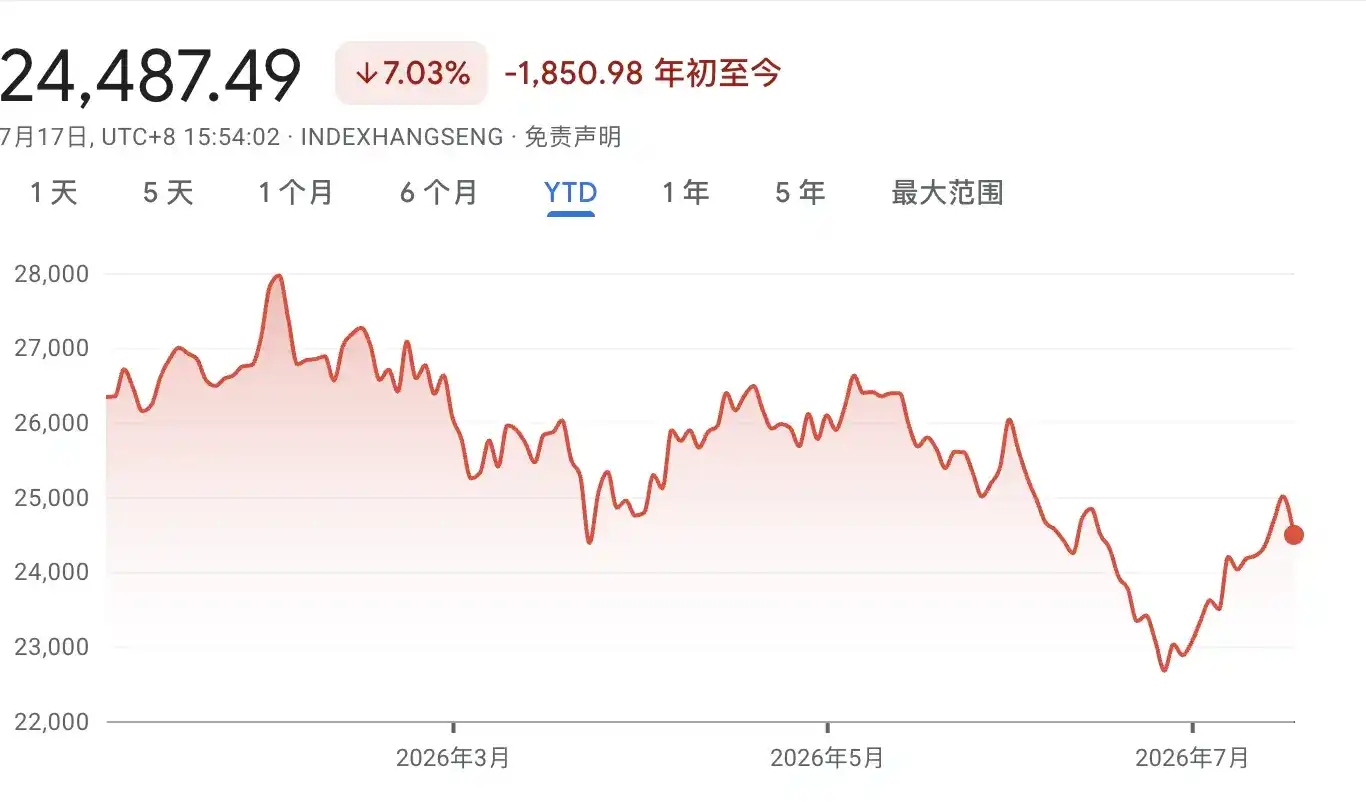
This stands in stark contrast to the strong performance of other major global markets. According to Bloomberg data, South Korea's benchmark index has surged 62% year-to-date, benefiting from the robust performance of two major chip giants; Japan's Nikkei 225 has risen 26%; and the iShares SOXX ETF tracking the semiconductor sector has skyrocketed 76%.

It is precisely this significant underperformance that leads Burry to believe Hong Kong stocks present a 'bargain-hunting' condition—when global capital begins to reassess the sustainability of the AI frenzy, previously overlooked Hong Kong stocks may usher in a catch-up opportunity.

Goldman Sachs: Index Distortion, HK Market Already in AI Era

Goldman Sachs' perspective offers another dimension of interpretation—the sluggishness of Hong Kong stocks is, to some extent, a 'false impression' caused by the structural lag of the indices.

Wang Yajun, Goldman Sachs' Head of Asia (ex-Japan) Equity Capital Markets, bluntly stated at a recent media briefing, the Hong Kong market has entered the AI era, but the major stock indices have not yet been able to reflect this reality. This is the fundamental reason for the 'hot IPO market vs. weak index performance' dichotomy.

Wang pointed out that the hottest topic in the Hong Kong stock market this year is AI. The most actively traded, best performing, and largest fundraising stocks are all AI-related. However, adjustments to index components take a relatively long time, leading to a mismatch between the indices and the true market landscape. He expects total equity financing volume in the Hong Kong market this year could hit a record high, with full-year IPO proceeds potentially surpassing the historical peak of 2021. More AI companies are also expected to list in Hong Kong in the second half of the year.

Regarding fundamental judgment, Wang believes that supported by end-demand growth, capital expenditure by AI companies will continue, providing a basis for the long-term performance of related sectors.

Multiple Bullish Voices Converge, Divergence Remains

Burry is not alone. According to Bloomberg, Morgan Stanley recently also urged investors to buy Hong Kong stocks, citing optimism about corporate earnings prospects and the belief that the impact of restricted share sales will be relatively limited.

However, the bullish logic for Hong Kong stocks is not without challenges. The Hang Seng Index's decline this year reflects persistent market concerns about the pace of China's consumption recovery and the profitability of the e-commerce sector. These structural pressures are difficult to dissipate completely in the short term. The 'index-market mismatch' described by Goldman's Wang also means that ordinary investors, referencing only the indices, may both underestimate the structural opportunities within Hong Kong stocks and overlook the pressures still facing traditional heavyweights.

For investors, Burry's bottom-fishing signal and Goldman's AI narrative together sketch a picture of opportunity for Hong Kong stocks. Yet, the core challenge facing the market remains how to precisely position between overall index pressure and structural bright spots.


Questions liées

QWhy does Michael Burry believe that now is a 'great time' to look for bargains in the Hong Kong stock market?

AMichael Burry believes it's a great time to look for bargains in Hong Kong stocks because he anticipates a cooling off of the global AI chip stock frenzy, which would cause capital to flow out of markets like South Korea and Japan and out of semiconductor sectors. This shift would make the currently underperforming and more attractively valued Hong Kong market a potential destination for that capital.

QWhat supporting action has Michael Burry taken regarding his bullish view on Hong Kong/Chinese stocks?

AAccording to Bloomberg, Michael Burry has taken action by increasing his holdings in the Chinese e-commerce company JD.com and establishing new positions in DraftKings and Flutter, indicating his view extends beyond just verbal statements.

QHow has the performance of the Hong Kong stock market compared to other major global markets in 2024, according to the article?

AThe Hong Kong stock market has significantly underperformed other major global markets in 2024. The Hang Seng Index is down about 7% and the Hang Seng Tech Index is down over 15%. In contrast, South Korea's benchmark index is up 62%, Japan's Nikkei 225 is up 26%, and the iShares Semiconductor ETF (SOXX) has surged 76%.

QWhat is Goldman Sachs' Wang Yajun's argument regarding the perceived disconnect between Hong Kong's market activity and its main stock indices?

AGoldman Sachs' Wang Yajun argues that while the Hong Kong market has already entered the AI era, its main stock indices have not yet reflected this reality. He states that AI-related stocks are the most active, best-performing, and largest in fundraising, but index composition lags, creating a mismatch between the index performance and the market's true dynamism.

QAccording to the article, what are some of the key challenges or risks that remain for the Hong Kong stock market despite the bullish views presented?

AKey challenges include persistent concerns about the pace of China's consumption recovery and the profitability of the e-commerce sector, which have weighed on the market. Additionally, the 'mismatch' between index performance and market reality means that while there are structural opportunities in AI, traditional heavyweights in the index may continue to face pressure.

Lectures associées

Manuel du Jeu pour la Coupe WEEX 2026 : Intelligence des données, aperçus prédictifs et 1 million de dollars en récompenses communautaires

WEEX, une plateforme mondiale de trading de crypto-monnaies, a marqué la Coupe du Monde 2026 en offrant à sa communauté une expérience unique alliant données, prédictions et récompenses. En partenariat avec ForeGate, un marché prédictif basé sur Solana, WEEX a publié un guide dynamique analysant les cotes de victoire et les parcours probables tout au long du tournoi, traitant le football comme un marché en évolution. Parallèlement, WEEX a lancé « WEEX Cup – Dice Rush », un événement interactif doté d'un prix global de 1 000 000 USDT. Les utilisateurs gagnaient des dés via diverses activités (dépôts, trading, invitations) pour débloquer des récompenses (BTC, ETH, coupons) et participer à des prédictions de matchs. La mécanique favorisait ceux qui pariaient sur des résultats moins attendus. Cette philosophie de valorisation de l'opinion minoritaire a été illustrée en amont du tournoi lors d'un entretien entre le COO de WEEX, Andrew Weiner, et la légende du football Michael Owen. Ce dernier a souligné que « là où vous êtes dans la minorité d'opinion, vous avez la plus grande chance de trouver la plus grande valeur ». Cette analyse a trouvé un écho retentissant avec la performance inattendue du Cap-Vert, qui a tenu en échec plusieurs anciens champions du monde. Ainsi, à travers un guide de données en temps réel, un jeu à récompenses massives et des insights d'expert, WEEX a fourni à ses utilisateurs les outils pour décrypter le tournoi, y participer activement et identifier la valeur là où peu la cherchaient.

TheNewsCryptoIl y a 47 mins

Manuel du Jeu pour la Coupe WEEX 2026 : Intelligence des données, aperçus prédictifs et 1 million de dollars en récompenses communautaires

TheNewsCryptoIl y a 47 mins

Stable Vaults est la dernière pièce du puzzle de la commercialisation d'Aave pour le grand public

Stable Vaults, la dernière pièce du puzzle pour la commercialisation de masse d'Aave Dans un contexte où les produits DeFi traditionnels offrent une multitude de choix complexes aux utilisateurs, Aave Labs a lancé Stable Vaults le 9 juillet. Cette solution vise à attirer le grand public en proposant des rendements fixes sur les dépôts en stablecoins, un concept rare dans la cryptosphère. **Fonctionnement** : Les entreprises (banques numériques, portefeuilles crypto, etc.) peuvent intégrer Stable Vaults pour offrir un service d'épargne. Elles définissent un taux d'intérêt fixe (ex : 4%) affiché aux utilisateurs. Le pool de prêt sous-jacent d'Aave génère un rendement variable. L'entreprise opératrice garde la différence si le rendement réel dépasse le taux fixe, mais doit combler l'écart si il est inférieur, assumant ainsi le risque de fluctuation. **Pour l'utilisateur** : L'avantage est la simplicité et la prévisibilité. Pas besoin de gérer un portefeuille autonome, de choisir des pools ou de suivre les taux variables. L'interface est familière, avec un support client. Le coût : un plafonnement des gains (ex : 4% même si le pool en génère 9%) et l'ajout d'un risque de contrepartie lié à l'entreprise opératrice et à ses scripts privés. **Pour l'opérateur** : C'est une source de profit potentielle via l'écart entre le rendement réel et le taux fixe promis. Cependant, il supporte le risque de devoir compléter les paiements si les marchés baissent. Un incident comme l'attaque du pont Kelp DAO en avril a exposé le risque de gel des retraits en cas de crise de liquidité, affectant à la fois les utilisateurs et les bénéfices des opérateurs. **Pour Aave** : Ce modèle permet d'attirer une liquidité plus stable et fidèle via des partenaires qui ont déjà une relation avec les utilisateurs, contrairement aux capitaux volatiles typiques du DeFi. Cela génère des revenus stables pour le protocole, cruciaux pour son modèle économique 3.0 incluant le rachat de jetons AAVE. Il évite également aux partenaires de devoir construire leur propre infrastructure DeFi. **Conclusion** : Stable Vaults répond à une préférence humaine fondamentale pour la simplicité, la sécurité perçue et la prévisibilité. Les utilisateurs sont prêts à payer une prime (rendement moindre) pour éliminer la complexité et le fardeau de la prise de décision. Pour Aave, c'est une étape stratégique vers l'adoption par le grand public, en s'intégrant discrètement dans les applications financières conventionnelles que les gens utilisent déjà.

marsbitIl y a 47 mins

Stable Vaults est la dernière pièce du puzzle de la commercialisation d'Aave pour le grand public

marsbitIl y a 47 mins

Avec un taux de soutien inférieur à 1%, le BIP-110 va-t-il quand même pousser Bitcoin vers un soft fork ?

Alors que la fenêtre d'activation forcée du BIP-110 approche en août, les débats reprennent autour de cette proposition controversée. Initiée par Dathon Ohm avec le soutien du développeur Luke Dashjr, elle vise à limiter temporairement les données non monétaires dans les transactions Bitcoin, ciblant notamment les inscriptions Ordinals et les NFT, pour réduire les "transactions indésirables" et recentrer le réseau sur sa fonction monétaire. Cependant, le BIP-110 manque cruellement de soutien, avec moins de 1% des mineurs et environ 15% des nœuds en sa faveur, loin du seuil d'activation de 55%. Sa particularité contestée est son mécanisme d'application forcée : si le seuil n'est pas atteint à une certaine hauteur de bloc, les nœuds le supportant rejetteront les blocs non conformes, créant potentiellement une scission de la chaîne entre une minorité pro-BIP-110 et la chaîne principale. Les partisans, menés par Luke Dashjr, défendent une vision "originaliste" du Bitcoin, considérant ces données comme une attaque nuisant au réseau. Les opposants, dont des figures comme Adam Back et Jameson Lopp, critiquent une approche inefficace et dangereuse. Ils soutiennent que le BIP-110 n'éliminerait pas les spams, étoufferait l'innovation, introduirait une censure contraire à l'esprit du Bitcoin, et risquerait de scinder l'écosystème. À l'activation, plusieurs scénarios sont possibles : l'échec rapide de la chaîne minoritaire par manque de puissance de calcul, une compétition prolongée si elle obtient un soutien minier significatif, ou sa persistance comme une fork indépendante mais marginale. La majorité des observateurs, se fiant aux faibles taux de support actuels et aux principes économiques des mineurs, anticipent un échec du BIP-110 à s'imposer comme la chaîne dominante de Bitcoin.

marsbitIl y a 51 mins

Avec un taux de soutien inférieur à 1%, le BIP-110 va-t-il quand même pousser Bitcoin vers un soft fork ?

marsbitIl y a 51 mins

Trading

Spot
活动图片