Stable TGE Tonight, Will the Market Still Buy into the Stablecoin Public Chain Narrative?

marsbitPublié le 2025-12-08Dernière mise à jour le 2025-12-08

Résumé

Stable, a Layer 1 blockchain supported by Bitfinex and Tether, is set for its mainnet launch on December 8th. It is designed with a focus on stablecoin infrastructure, using USDT as the native gas token to enable sub-second settlements and feeless peer-to-peer transfers. The native token, STABLE, has a fixed supply of 100 billion and is not used for gas fees but for governance, staking, and ecosystem incentives. Token allocation includes 10% for Genesis Distribution (fully unlocked at launch), 40% for ecosystem and community growth, and 25% each for the team and investors (with a 1-year cliff and linear release). The network uses a DPoS consensus model where users stake STABLE to participate in validation and governance. Prior to launch, Stable conducted two pre-deposit phases, which saw massive demand and technical issues, raising concerns over fairness and KYC delays. The project raised $28 million in seed funding at a $300 million valuation. Market expectations are mixed. Pre-launch perpetual trading suggests an FDV around $3 billion, while prediction markets indicate an 85% probability of FDV exceeding $2 billion post-launch. Pre-depositors may see returns between 7% to 16.9% based on current estimates. Exchanges like Bitget and Bybit have announced support, but major platforms like Binance and Coinbase have not.

At 21:00 Beijing time on December 8, the Stable mainnet will officially launch. Stable, a Layer 1 blockchain supported by Bitfinex and Tether, focuses on stablecoin infrastructure. Its core design involves using USDT as the native gas fee, achieving sub-second settlement and gas-free peer-to-peer transfers. As of the time of writing, including Bitget, Backpack, and Bybit have announced they will list STABLE spot trading. Additionally, Binance, Coinbase, and Korean exchanges have not yet announced listings for STABLE spot trading.

Total Supply of 100 Billion, Token Not Used for Gas Fees

The project team has released the whitepaper and tokenomics details before the mainnet launch. Its native token, STABLE, has a total fixed supply of 100 billion tokens. Transfers, payments, and transactions on the Stable network are settled in USDT. STABLE is not used for gas fees but is instead used to coordinate incentive mechanisms between developers and ecosystem participants. The STABLE token allocation is as follows: Genesis Distribution accounts for 10% of the total supply, supporting initial liquidity, community activation, ecosystem activities, and strategic distribution efforts at launch. The genesis distribution portion will be fully unlocked at the mainnet launch.

The Ecosystem & Community fund accounts for 40% of the total supply, allocated to developer grants, liquidity programs, partnerships, community initiatives, and ecosystem growth; the Team allocation accounts for 25% of the total supply, allocated to the founding team, engineers, researchers, and contributors; Investors & Advisors account for 25% of the total supply, allocated to strategic investors and advisors supporting network development, infrastructure construction, and promotion.
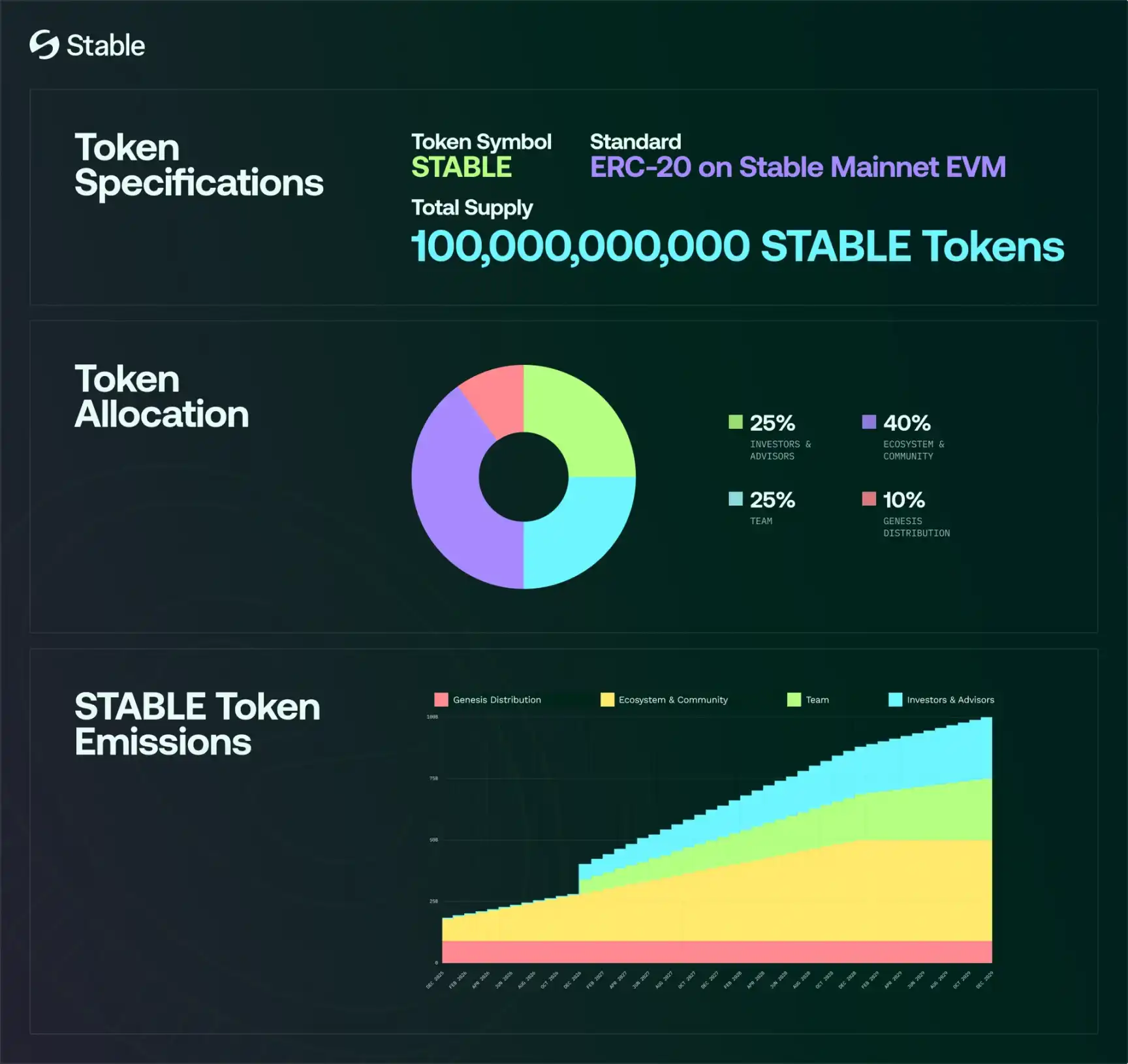
Team and investor allocations are subject to a one-year cliff, meaning zero unlocking for the first 12 months, followed by linear vesting. The Ecosystem & Community fund allocation is 8% unlocked at launch, with the remaining portion vested linearly to incentivize developers, partners, and user growth.

Stable utilizes a DPoS (Delegated Proof-of-Stake) model through its StableBFT consensus protocol. This design supports high-throughput settlement while maintaining the economic security required for a global payment network. Staking STABLE tokens is the mechanism for validators and delegators to participate in consensus and earn rewards. The primary roles of the STABLE token are governance and staking: holders can stake tokens to become validators, participate in network security maintenance, and vote in DAO governance to influence protocol upgrades, such as adjusting fee rates or introducing new stablecoin support.

Additionally, STABLE can be used for ecosystem incentives, such as liquidity mining or cross-chain bridging rewards. The project claims that this separated design can attract institutional capital because USDT's stability is much higher than that of volatile governance tokens.

Pre-deposit Controversy: Front-running, KYC Delays

Like Plasma, Stable also opened two deposit periods before the mainnet launch. The first phase of pre-deposits started in late October with an upper limit of $825 million, which was filled within minutes of the announcement. The community questioned potential front-running by some players. The top-ranked wallet deposited hundreds of millions of USDT 23 minutes before the deposit window opened.

The project team did not directly respond and opened a second pre-deposit event on November 6 with an upper limit of $500 million.

However, Stable underestimated the market's enthusiasm for deposits. The moment the second phase opened, massive traffic surge caused its website to slow down and become unresponsive. Consequently, Stable updated the rules, allowing users to deposit via the Hourglass frontend or directly on-chain; the deposit function was reopened for 24 hours, with a maximum of $1 million per wallet and a minimum deposit amount still set at $1,000.
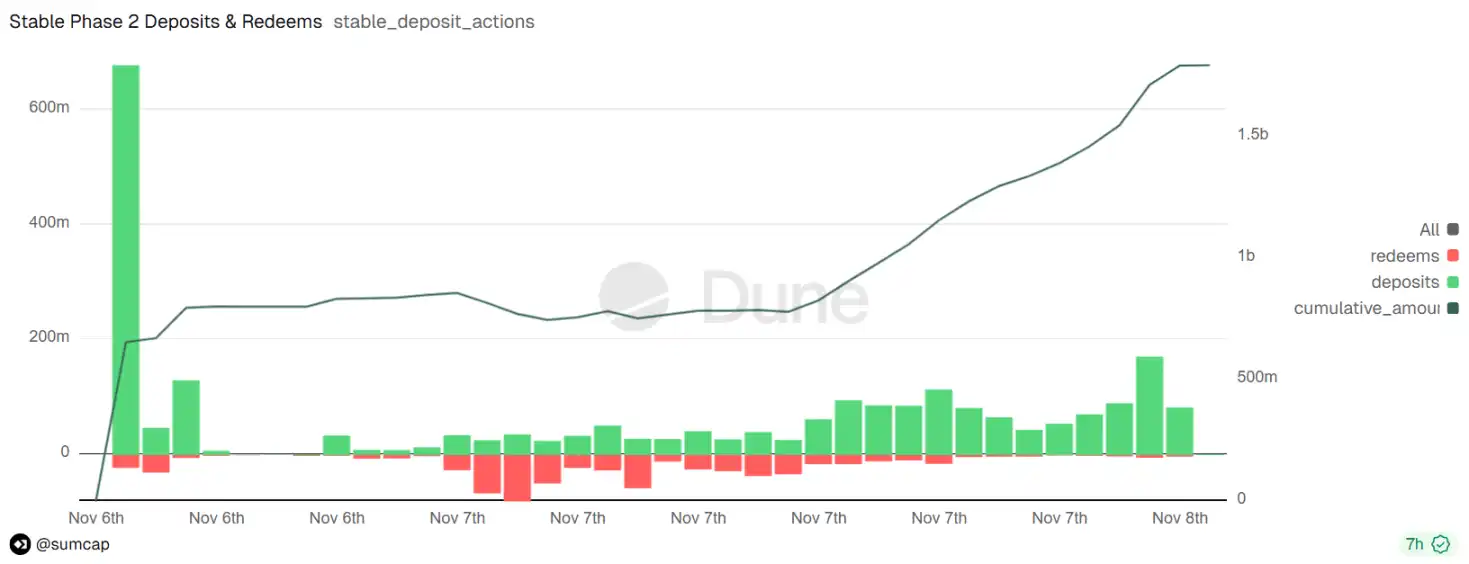
Ultimately, the total deposits in the second phase reached approximately $1.8 billion, with about 26,000 wallets participating.

The review time ranged from a few days to a week, with some users in the community complaining about system lag or repeated requests for additional materials.

Over 85% Probability of $2 Billion FDV

In late July this year, Stable announced the completion of a $28 million seed round led by Bitfinex and Hack VC, bringing its market valuation to around $300 million.

For comparison, Plasma's current market cap is $330 million, with an FDV of $1.675 billion.

Some optimists believe that the stablecoin narrative, Bitfinex's backing, and Plasma's initial price surge followed by a drop might indicate there is still some hype and potential for price appreciation in the near term. However, pessimistic voices are stronger: since gas is not paid in STABLE, its utility is limited, especially as the market has entered a bear cycle and liquidity has become tight, its token value may decline rapidly.

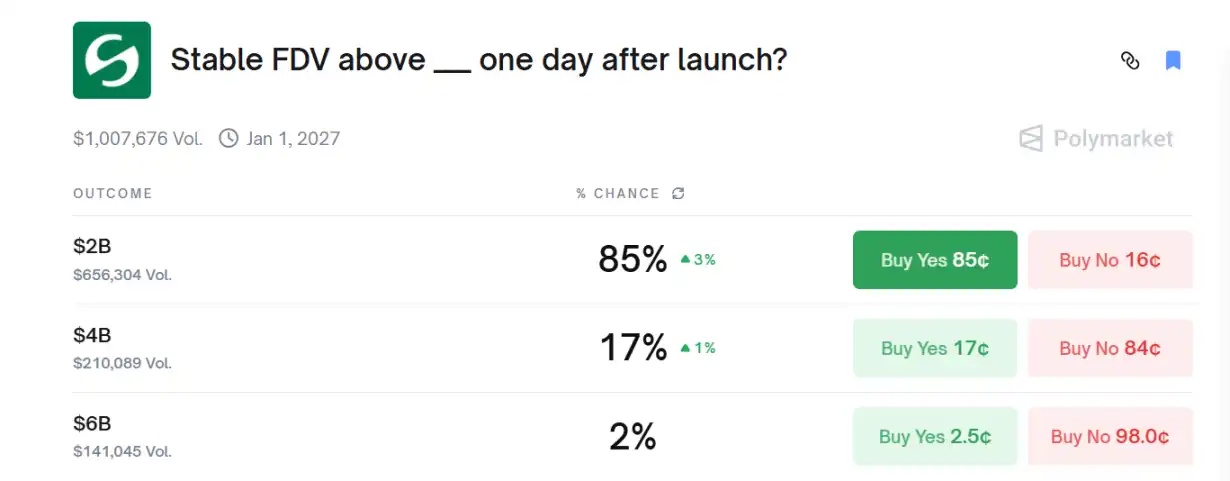
Current Polymarket data shows that the market is betting with an 85% probability that its FDV will exceed $2 billion the day after launch. Calculating conservatively at $2 billion, the STABLE token price would correspond to $0.02.
In the perpetual futures market, according to Bitget行情 data, STABLE/USDT is currently quoted at $0.032, implying an anticipated FDV rising to around $3 billion.

Stable's first pre-deposit phase reached $825 million, and the second phase actually contributed over $1.1 billion, but after proportional allocation, only $500 million was actually pooled. The total pre-deposit size is $1.325 billion. The tokenomics disclose an initial allocation of 10% (for pre-deposit incentive rewards, exchange campaigns, initial on-chain liquidity, etc.). Assuming Stable ultimately airdrops 3%-7% of the supply to pre-depositors, and based on the pre-listing price of $0.032, the corresponding returns would be approximately 7% to 16.9%, meaning every $10,000 deposit corresponds to $700 to $1,690.


Questions liées

QWhat is the core design feature of the Stable Layer 1 blockchain regarding transaction fees?

AThe core design feature is that it uses USDT as the native gas fee, enabling sub-second settlements and gas-free peer-to-peer transfers.

QWhat is the total supply of the STABLE token and what is its primary use, since it is not used for gas?

AThe total supply of the STABLE token is 100 billion. Its primary uses are for governance, staking to become a validator, and participating in ecosystem incentives, rather than paying for gas fees.

QWhat controversy surrounded the pre-deposit events for the mainnet launch?

AThe controversy involved allegations of 'rat trading' where a top wallet deposited hundreds of millions of USDT 23 minutes before the first pre-deposit phase officially opened. The second phase also experienced website slowdowns and crashes due to overwhelming traffic.

QAccording to the market data on Polymarket, what is the probability that Stable's FDV will exceed $2 billion after its first day of trading?

AAccording to Polymarket data, the probability that Stable's Fully Diluted Valuation (FDV) will exceed $2 billion after its first day of trading is 85%.

QWhich major cryptocurrency exchanges have announced plans to list the STABLE token for spot trading, and which have not as of the article's publication?

AAs of the article's publication, Bitget, Backpack, and Bybit have announced they will list STABLE spot trading. Binance, Coinbase, and Korean exchanges have not made such announcements.

Lectures associées

SpaceX entrée en bourse génère un trillionnaire, la fortune de Musk équivaut à la moitié du marché crypto

L'introduction en bourse de SpaceX a propulsé la fortune personnelle d'Elon Musk au-delà de 1 110 milliards de dollars, faisant de lui le premier trillionnaire en dollars de l'histoire moderne, selon l'indice Bloomberg. Cette somme dépasse la capitalisation boursière totale de l'ensemble du marché des crypto-monnaies, à l'exception du Bitcoin. L'IPO record de SpaceX, valorisant l'entreprise à 2 200 milliards de dollars, est la cause directe de cette augmentation. Le premier jour de négociation a généré un volume record de 85 milliards de dollars. Le contraste avec le marché des crypto-monnaies est frappant : la valeur totale de toutes les altcoins (hors stablecoins) est d'environ 880 milliards de dollars, soit moins que la fortune personnelle de Musk. Cela reflète une concentration massive de richesse et un transfert des capitaux institutionnels vers les actions technologiques. Malgré cela, Musk reste lié à l'écosystème crypto. Il détient personnellement du Bitcoin, de l'Ethereum et du Dogecoin. De plus, ses entreprises SpaceX et Tesla détiennent respectivement 18 712 et 11 509 Bitcoins dans leurs bilans, ce qui les placerait au 5e rang mondial des détentions corporatives si elles étaient combinées. Sa plateforme X (anciennement Twitter) intègre également des outils de suivi des prix des actifs numériques. Enfin, cette fortune historique, bien que phénoménale, reste principalement liée à la valorisation boursière de ses entreprises et soulève des questions sur l'extrême concentration de la richesse.

Foresight NewsIl y a 21 mins

SpaceX entrée en bourse génère un trillionnaire, la fortune de Musk équivaut à la moitié du marché crypto

Foresight NewsIl y a 21 mins

硬氪独家首发 | La société d'intelligence corporelle marine « Shihang Intelligent » obtient un financement record de 10 milliards de yuans, avec des investissements de Zhu Xiaohu et Temasek

La société d'intelligence incarnée océanique « Shihang Intelligent » a levé un financement record de plus de 10 milliards de yuans en série A, marquant la plus importante levée de fonds unique dans le domaine des robots océaniques mondial. Les investisseurs incluent des fonds de capital-investissement tels que Shanghe Momentum, Vertex Growth, ainsi que des actionnaires existants comme la société cotée en bourse Dayang Motor. Le fondateur et PDG, Chen Xiaobo, lauréat du premier prix national de progrès scientifique et technologique de la défense, dirige l'entreprise. Le financement sera principalement utilisé pour la R&D technologique, l'expansion mondiale et la construction de l'écosystème industriel. La société a développé des capacités fondamentales dans six systèmes clés pour les robots marins, permettant des opérations à pleine profondeur (0-10 000 mètres) et dans des scénarios comme le nettoyage de navires, la sécurité sous-marine, l'éolien offshore et l'inspection des fonds marins. Rien qu'au premier semestre 2026, le montant des commandes a dépassé 10 milliards de yuans. En avril de cette année, Shihang Intelligent a lancé le grand modèle d'intelligence incarnée océanique « Cangqiong CEORION ». Ce modèle intégré de bout en bout permet aux robots de réaliser de manière autonome 12 catégories de tâches sous-marines, avec un taux de réussite supérieur à 90 % dans les tests de simulation et une capacité d'adaptation à zéro échantillon dépassant 70 %. Il intègre un module de raisonnement physique pour réduire les risques de collision de 80 %. La société a également été sélectionnée comme partenaire clé pour le projet national singapourien d'inspection et de nettoyage des coques de navires.

marsbitIl y a 47 mins

硬氪独家首发 | La société d'intelligence corporelle marine « Shihang Intelligent » obtient un financement record de 10 milliards de yuans, avec des investissements de Zhu Xiaohu et Temasek

marsbitIl y a 47 mins

En trois mois, 35 milliards de yuans, les investisseurs se disputent l'"OpenAI du monde physique"

Une course effrénée des investisseurs s'engage vers l'AGI physique. La start-up chinoise Jijia Shijie (Excellent Vision) vient de boucler un financement de 3,5 milliards de yuans en seulement trois mois, portant sa valorisation à plus de 10 milliards. Dirigée par Huang Guan, un docteur de 30 ans de l'Université Tsinghua, l'entreprise attire un large éventail de fonds d'investissement nationaux et internationaux. La stratégie de Jijia Shijie repose sur un système en « double pyramide » combinant algorithmes et données, et centré sur un « modèle du monde » pour comprendre et interagir avec l'environnement physique. Ses modèles phares, GigaBrain et GigaWorld, ont obtenu des premières places dans des benchmarks mondiaux. La société vise le « moment GPT-3 » de l'AGI physique, où des capacités émergentes se manifesteront. Concrètement, Jijia Shijie déploie sa technologie sur deux fronts : grand public (robot domestique polyvalent « Shiguang S1 ») et industriel (robots « Maker » pour l'automatisation des usines et modèle de conduite autonome « DriveDreamer »). Ces déploiements génèrent des données et des revenus essentiels pour alimenter la boucle d'amélioration de ses modèles. L'objectif ultime est de dépasser l'AGI purement numérique pour créer une intelligence capable d'agir dans le monde physique, remodelant potentiellement les modes de production et la vie quotidienne. Les investisseurs parient que ce futur est proche.

marsbitIl y a 1 h

En trois mois, 35 milliards de yuans, les investisseurs se disputent l'"OpenAI du monde physique"

marsbitIl y a 1 h

Quel lien existe entre Huang Zheng, le fondateur de Pinduoduo, et la blockchain ?

L'auteur de l'article explore le lien entre Huang Zheng, fondateur de Pinduoduo, et la technologie blockchain, à travers une réflexion inspirée par l'essai de Huang « Inverser le capitalisme ». L'article explique que le modèle économique fondamental de Pinduoduo est une « affaire d'assurance » basée sur la gestion de l'« incertitude ». Huang Zheng observe que les capitaux tendent à s'accumuler chez les riches car ils peuvent absorber les incertitudes (comme les risques de maladie ou de perte d'emploi) que les plus pauvres paient pour éviter via des assurances ou des achats sécurisés. Le concept de Pinduoduo, le « group buying » (achat groupé), fonctionne comme une « assurance inversée ». Il agrège la demande préalable d'un grand nombre de consommateurs pour créer une commande certaine et massive, permettant aux usines de réduire le risque de surproduction. Cette certitude permet aux fabricants de baisser leurs prix, faisant ainsi refluer une partie de la valeur vers les consommateurs. Le lien avec la blockchain apparaît comme la pièce manquante pour perfectionner ce modèle. Le principal défi de « l'assurance inversée » est que l'engagement individuel d'un consommateur n'est pas crédible ou coûteux à faire respecter. La blockchain, via ses contrats intelligents (smart contracts), pourrait résoudre ce problème en rendant les engagements (comme une intention d'achat) contraignants, vérifiables et exécutables automatiquement, sans intermédiaire. Huang Zheng lui-même s'interroge : la blockchain n'est-elle pas idéalement conçue pour ce type d'« assurance inversée » ? En conclusion, l'article compare deux voies pour créer de la certitude : la voie « Pinduoduo », qui utilise la masse pour aplanir l'incertitude, et la voie « Bitcoin », qui verrouille les règles par un code inviolable, remplaçant la confiance en une institution par la confiance en un protocole.

链捕手Il y a 2 h

Quel lien existe entre Huang Zheng, le fondateur de Pinduoduo, et la blockchain ?

链捕手Il y a 2 h

Trading

Spot
Futures
活动图片




