Self-Directed Insider Trading: How He Manipulated Prediction Markets to Pay for His Bugatti?

比推Publié le 2026-03-11Dernière mise à jour le 2026-03-11

Résumé

A prominent X user, @Euanker, has accused former kickboxing champion Andrew Tate of orchestrating an elaborate insider trading scheme on the prediction market platform Polymarket. The allegations claim that Tate controlled at least seven accounts to profit from markets predicting his own weekly tweet activity, earning a total of $52,286. On-chain evidence reveals a consistent funding path: deposits from exchanges like Duelbits and Bybit were bridged via a specific address, then used to place bets on Polymarket. Profits were ultimately funneled to a Gnosis Safe wallet controlled by Tate, which holds over $1.3 million in assets. The betting patterns closely aligned with Tate’s actual tweet activity, indicating manipulation. Andrew Tate, a controversial influencer known for his luxury lifestyle and previous involvement in meme coin promotions, is alleged to have used this scheme to fund expenses like his rented Bugatti. The incident highlights significant regulatory gaps in prediction markets, where outcomes controlled by a single individual create inherent insider risks. Polymarket, which approves all markets on its platform, faces scrutiny over its lack of safeguards against such manipulation.

Author: Ma He, Foresight News

Original Title: Funding a Bugatti with Polymarket? Someone is Playing 'Self-Directed' Insider Trading


On March 10, X user @Euanker posted an exposé alleging that renowned combat sports champion Andrew Tate was involved in insider trading on Polymarket, profiting by manipulating markets related to the quantity of his personal tweets. Euanker pointed out that Tate created and controlled at least 7 Polymarket accounts, accumulating profits of $52,286 across six 'Weekly Tweet Count Prediction' markets. These markets essentially depend on Tate's own actions, with the exposé bluntly stating his aim was to 'raise funds for a rented Bugatti sports car.'
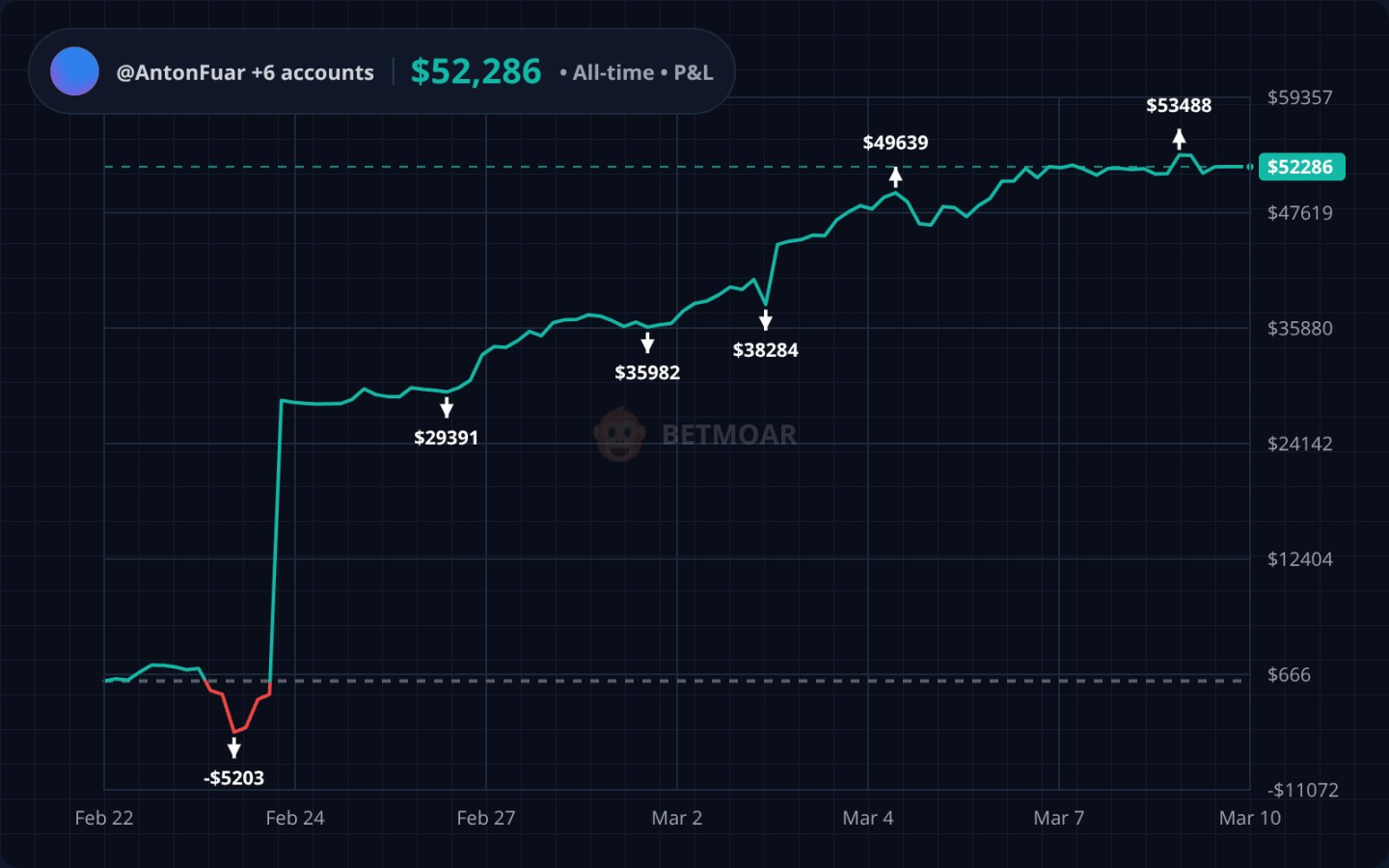
Interestingly, this exposé included detailed on-chain evidence and profit charts, allowing us a glimpse into the specifics of this insider trading.

Detailed Explanation of On-Chain Address Records: Identical Deposit Paths

The evidence provided by Euanker shows that the 7 Polymarket accounts (@Tornados, @eterboh5, @Mellisacars, @AntonFuar, @wondernot, @Lindayko, @Counteryeg) were highly consistent in their deposit exchanges, fund paths, and betting habits. The first 5 accounts have been fully linked through on-chain transactions, with the subsequent 2 also showing the same pattern.

The core tracking starts with the @Counteryeg account.
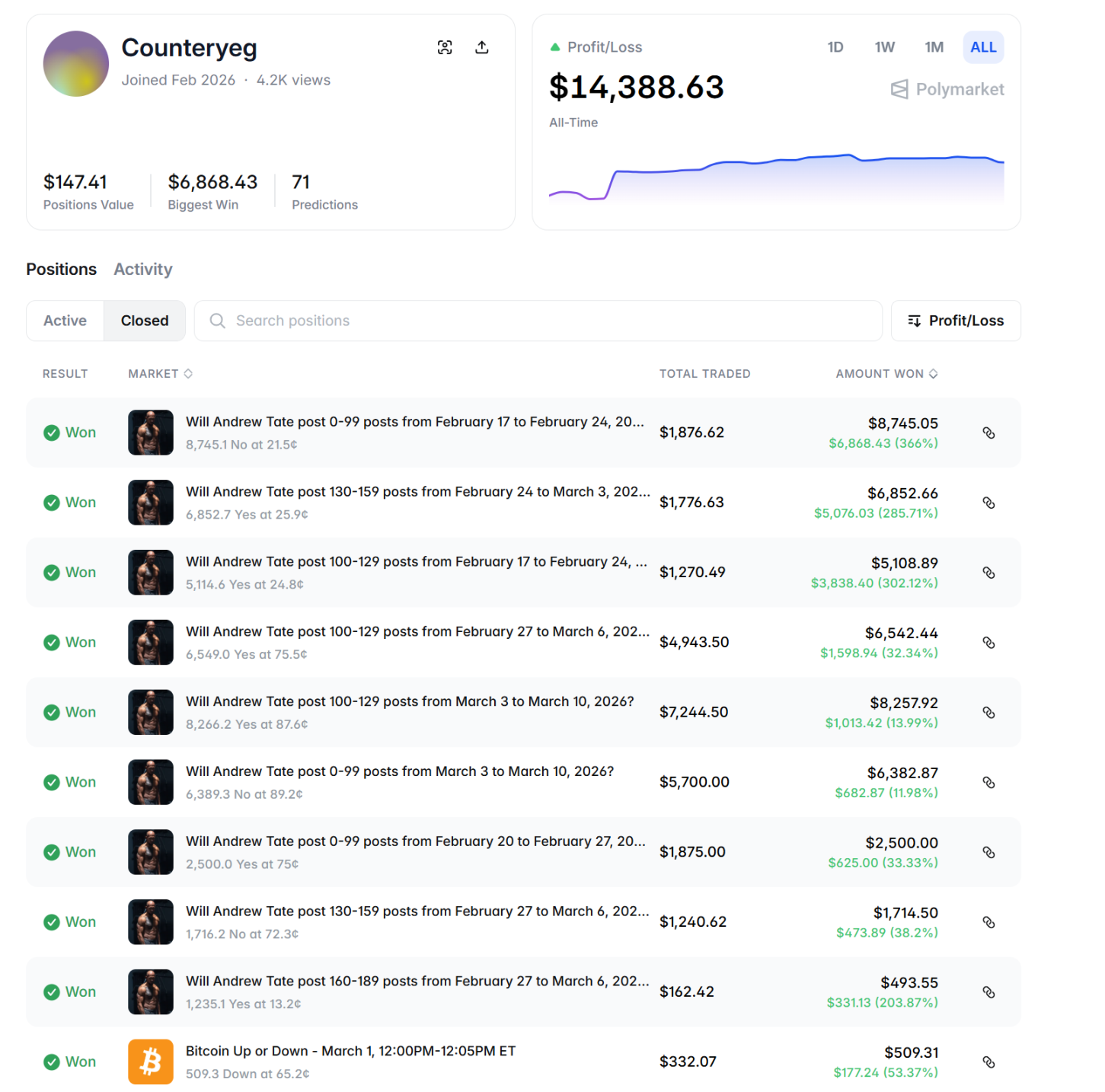

Its fund flow points to the bridging address 0xdae2844d5b3070aafb3638b80fa17e562d840dde. This address frequently conducted cross-chain transfers of USDC and USDC.e in the past week, primarily involving the Polygon and Ethereum networks. These funds were then transferred to the intermediary address 0x9D950Fb9D5F37a128bA0d4B82844DE96697fD83d.

Data from Arkham Intelligence for this address shows that in the past week, it received large USDC deposits from exchanges like Duelbits (a gambling platform), Changelly, and Bybit, accounting for 20%, 42%, and 26% respectively. Typical transactions include a 4000 USDC deposit from Duelbits, a 5700 USDC bridge withdrawal, and multiple transfers of 2500~6000 USDC to the upstream bridging address. The cumulative transaction volume of the address shows that the stablecoin flow rhythm highly coincides with Polymarket betting windows, presenting a unified pattern of 'large deposit first, precise betting second, profit aggregation after'.
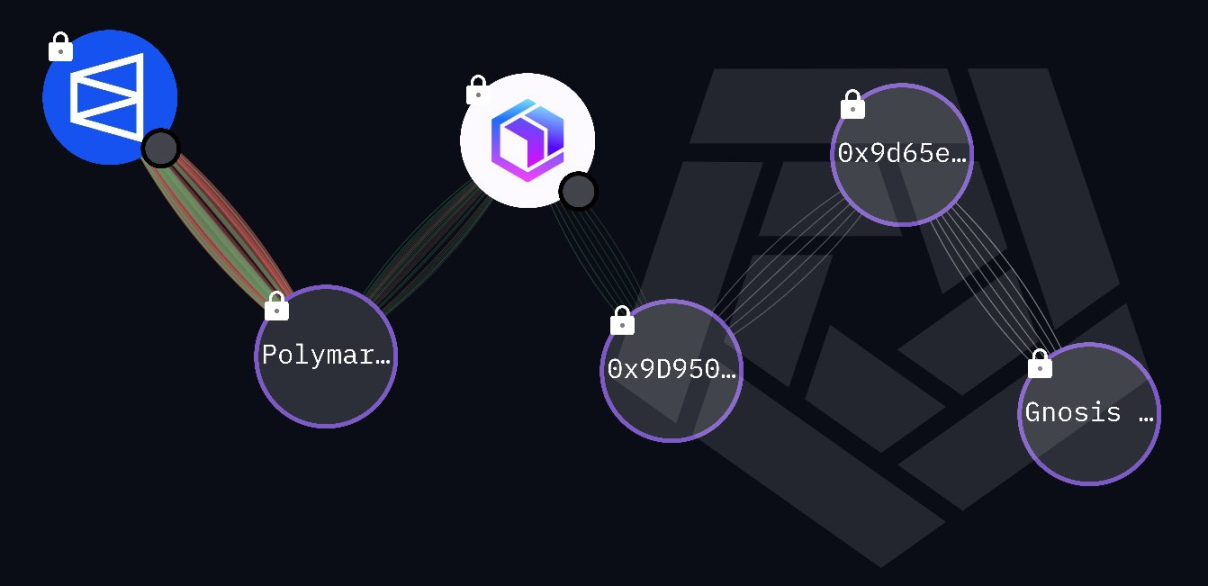
The final fund chain points to a Gnosis Safe multi-signature address (confirmed by the exposé and transaction graph as belonging to Tate). Arkham records show this Safe holds over $1.3 million in assets, with recent large USDT/USDC withdrawal operations.

The entire chain forms a closed loop: exchange deposit → bridging address transfer → Polymarket betting → profit aggregation to Tate's controlled Gnosis Safe.

The fund flow chart attached by Euanker clearly marks the Polymarket icon and the Gnosis Safe endpoint. A profit chart of the 7 accounts further corroborates, showing a rapid climb from an initial loss of $5,203 on February 22 to a cumulative peak of $52,286 on March 10, with multiple instances synchronized with Tate's public tweet timings. This level of consistency far exceeds coincidence. The identical combination of exchanges, same USDC bridging scale, and operational patterns precisely matching market settlement times constitute the core on-chain basis for the exposé's insider trading allegations.

From Luxury Cars and Mansions to Meme Coins, Fans Become Tools for Monetizing Influence

Andrew Tate (full name Emory Andrew Tate III), born in 1986, is a public figure, businessman, and former professional fighter with dual US and UK citizenship. Tate began his professional kickboxing career in 2005, winning multiple championships in the late 2000s to early 2010s, including the ISKA British Full-Contact Cruiserweight Championship (2009) and the ISKA World Championship (2011), claiming to be a four-time world champion. He is about 1.91 meters tall, with the nicknames 'Cobra Tate' or 'Top G'.

Andrew Tate has long presented a luxurious lifestyle; his名下 (owned) or rented multiple Bugatti sports cars and numerous mansions have long been the core of his personal brand. The term 'rented Bugatti' in the exposé恰好吻合 (perfectly matches) Tate's publicly flaunted pattern of luxury consumption.

He has repeatedly showcased high-end assets on social platforms, using this to reinforce his 'alpha male' persona and attract young male fans globally. After retiring, he shifted to online business and content creation, launching paid course platforms (like Hustler's University and War Room), teaching topics like wealth building, entrepreneurship, and mindset training, primarily attracting young male audiences.

Starting in 2022, he and his brother Tristan were arrested in Romania, facing charges of human trafficking, rape, and forming a criminal organization (related to recruiting women using the 'loverboy' method to produce adult content); the case is still ongoing. After the Romanian travel ban was lifted in late 2025, the two returned to the US. Currently, he also faces a UK civil lawsuit (four women alleging sexual violence and coercion), which has been moved up to Summer 2026. He denies all criminal and civil charges, calling them a political witch hunt against him.

Upon entering the crypto space, Tate further monetized his influence. He has issued multiple meme coins, the most representative being the DADDY series directly tied to his personal IP, achieving rapid monetization through fan-driven hype. Bubblemaps exposed that he had promoted over 10 shitcoins within 24 hours; after Bubblemaps revealed the insider information about DADDY token supply, Andrew subsequently blocked Bubblemaps.

These operations form a complete闭环 (closed loop) with this Polymarket incident: first, gather traffic with controversial statements and lifestyle, then directly extract funds from fans' wallets through prediction markets or meme coins. Whether it's luxury cars and mansions or meme coin issuance, the essence is the same monetization logic—converting personal fame into quantifiable cash flow.

This exposé once again reminds the crypto industry that prediction markets and the meme coin ecosystem under celebrity influence still have significant governance gaps. This incident points directly to structural deficiencies in Polymarket's market creation review process. For example, markets like 'Andrew Tate's Weekly Tweet Count' are created without effective门槛 (thresholds) to verify whether the market has objectivity or is susceptible to manipulation risk. The core value of prediction markets lies in aggregating分散 (dispersed) information for price discovery, but when the subject is entirely controlled by a single entity, information asymmetry is放大至极端 (amplified to an extreme). Tate could simply adjust his tweet frequency to influence market outcomes, while retail investors bet based on public information, unaware of the internal manipulation.
Previously, the author wrote an article titled 'He Made $300,000 Counting Musk's Tweets'. The prediction market tracked Elon Musk's tweet count; Musk himself is the world's richest man, a hard tech entrepreneur with no motive to profit from insider trading, while Andrew Tate might not be. Polymarket currently does not allow any individual user to directly create prediction markets. All markets are ultimately created by Polymarket's market team. If Polymarket does not strengthen market审查 (review), similar allegations are likely to continue to发酵 (ferment).


Twitter:https://twitter.com/BitpushNewsCN

Bitpush TG Discussion Group:https://t.me/BitPushCommunity

Bitpush TG Subscription: https://t.me/bitpush

Original article link:https://www.bitpush.news/articles/7618832

Questions liées

QWhat is Andrew Tate accused of doing on Polymarket according to the article?

AAndrew Tate is accused of engaging in insider trading on Polymarket by manipulating prediction markets related to the number of his own tweets. He allegedly controlled at least 7 Polymarket accounts to profit from these markets, earning a total of $52,286.

QHow did the exposé by user @Euanker provide evidence of Tate's alleged manipulation?

A@Euanker provided detailed on-chain evidence and profit charts showing that the 7 Polymarket accounts had identical deposit paths, funding sources from exchanges like Duelbits and Bybit, and a unified pattern of fund flow that ultimately led to a Gnosis Safe wallet controlled by Tate.

QWhat is the significance of the 'weekly tweet count prediction' markets in this case?

AThe 'weekly tweet count prediction' markets were significant because they were based entirely on Andrew Tate's own behavior, allowing him to manipulate the outcome by controlling the number of tweets he posted, thus creating an unfair advantage and profiting from insider knowledge.

QHow does this incident highlight a potential issue with Polymarket's governance?

AThe incident exposes a structural weakness in Polymarket's market creation and review process, as markets dependent on a single individual's actions lack objectivity and are susceptible to manipulation, undermining the platform's core purpose of price discovery through dispersed information.

QWhat other methods has Andrew Tate used to monetize his influence, as mentioned in the article?

AAndrew Tate has monetized his influence through luxury lifestyle branding, paid online courses like Hustler's University, and by promoting and issuing meme coins such as the DADDY series, leveraging his fan base for financial gain.

Lectures associées

De la prédiction à 150 $ à la liquidation de HYPE en trois jours : quelle crédibilité reste-t-il à Arthur Hayes ?

Arthur Hayes, co-fondateur de BitMEX, est vivement critiqué pour ses récentes pratiques de trading, remettant en cause sa crédibilité sur les marchés cryptographiques. Dès le début du mois de juin, il a procédé à une série de ventes soudaines, notamment des tokens HYPE, NEAR, ZEC et WLD. Ces opérations, souvent précédées de prises de position publiques très optimistes, ont permis à Hayes de réaliser des profits significatifs à des sommets du marché, tandis que les prix s'effondraient peu après ses ventes. L'exemple le plus frappant concerne WLD : après avoir prédit un objectif de 10 dollars le 3 juin, il a annoncé sa vente totale seulement trois jours plus tard, provoquant une chute brutale du prix. Dans un long article de blog intitulé "Reality Test", Hayes a tenté de justifier ses décisions en invoquant des risques macroéconomiques, tels que la hausse des coûts énergétiques et une éventuelle bulle de l'IA, expliquant que son family office, Maelstrom, ne conservait désormais que du BTC et de l'ETH. Cependant, les investisseurs notent que ce schéma se répète depuis 2025, avec des prises de parole publiques suivies de ventes précipitées sur des actifs comme HYPE, ETHFI ou ENA, lui permettant des sorties de marché quasi parfaites. La communauté a désormais adopté une stratégie de défiance : ignorer ses déclarations publiques, mais surveiller attentivement ses mouvements sur la blockchain. Si ce comportement persiste, comparé à une fable du "garçon qui criait au loup", la réputation et l'influence d'Arthur Hayes pourraient être durablement compromises. Comme il l'admet lui-même, il reste "un joueur invétéré", une attitude généralement peu récompensée à long terme sur les marchés.

Odaily星球日报Il y a 26 mins

De la prédiction à 150 $ à la liquidation de HYPE en trois jours : quelle crédibilité reste-t-il à Arthur Hayes ?

Odaily星球日报Il y a 26 mins

Le financement comme une danse étrange : l'absurdité de la levée de fonds selon les fondateurs de la Silicon Valley

Le financement en capital-risque est souvent présenté comme une danse rationnelle entre élites, mais une récente série de confessions de fondateurs de la Silicon Valley révèle une réalité plus absurde et déséquilibrée. L'étincelle a été allumée par Greg Isenberg, qui a partagé qu'un partenaire d'a16z s'est endormi 30 minutes pendant son pitch. Cette anecdote a ouvert les vannes : Jack Zhang d'Airwallex a pitché fiévreux face à un investisseur de SoftBank pieds nus et en mangeant des cacahuètes ; Travis Kalanick d'Uber a fait une présentation dans la Lexus d'un VC qui tentait de fuir. Au-delà du grotesque, ces histoires soulignent des rapports de pouvoir toxiques. Des fondateurs rapportent des propos sexistes, des tentatives de diviser les cofondateurs, ou des rencontres humiliantes où leur temps est dédaigné. Un fondateur décrit même une "arnaque de Sequoia" avec deux évaluations dans un même tour de table. Cependant, le tableau n'est pas entièrement sombre. Plusieurs entrepreneurs partagent des expériences positives avec des investisseurs respectueux, à l'écoute, et dont le soutien a parfois sauvé leur entreprise au bord du gouffre. Ces récits montrent que, malgré les travers, une relation fondée sur le respect mutuel et la confiance reste possible et constitue l'essence la plus durable de l'écosystème de la Silicon Valley. Cette vague de témoignages agit comme une collective purge, révélant le financement comme une interaction complexe bien au-delà d'une simple transaction financière.

marsbitIl y a 30 mins

Le financement comme une danse étrange : l'absurdité de la levée de fonds selon les fondateurs de la Silicon Valley

marsbitIl y a 30 mins

La prochaine évolution de la finance on-chain selon Vitalik : comment restructurer le DeFi avec une « pensée options » ?

Si vous êtes dans ce secteur depuis plus d’un cycle, vous avez probablement vu se répéter ce scénario : lors de conditions de marché extrêmes, les prix s’effondrent soudainement, les oracles fournissent des prix erronés, les robots de liquidation entrent en action et des positions sont liquidées en cascade en quelques minutes, aggravant la pression vendeuse. De l’événement « 312 » de 2020 aux krachs comme « 519 » ou « 1011 », les liquidations forcées restent un facteur déclencheur majeur. Face à ce problème, Vitalik Buterin a récemment proposé une idée de recherche : **et si la DeFi remplaçait le modèle traditionnel de CDP (Collateralized Debt Position) et de liquidation forcée par un mécanisme basé sur les options ?** L’idée centrale est d’utiliser des « oracles lents » plutôt qu’en temps réel, réduisant ainsi les risques de manipulation. L’exposition de l’utilisateur à l’indice dévierait progressivement (selon une courbe lisse) plutôt que de subir une liquidation instantanée. Le modèle CDP classique, utilisé par MakerDAO, Aave ou Compound, a permis de transformer des actifs comme l’ETH en actifs financiers réutilisables, mais il présente des faiblesses : dépendance à des oracles fiables en temps réel, amplification des pressités de marché en période extrême, et illusion de liquidité. La proposition de Vitalik change la logique sous-jacente : au lieu de fonder le système sur la dette, il suggère de le construire sur des options. Concrètement, 1 ETH pourrait être divisé en deux actifs complémentaires : l’un proche d’une exposition stable ou indicielle, l’autre assumant le risque inverse. Leur valeur combinée correspond toujours à celle de l’ETH sous-jacent. Ainsi, plus de liquidation brutale : l’utilisateur voit son exposition évoluer progressivement et peut rééquilibrer sa position au moment choisi. Les avantages seraient multiples : suppression des liquidations « dures », réduction de la dépendance aux oracles, résistance naturelle aux MEV, et surtout, plus de contrôle pour l’utilisateur face aux risques. Alors que des écosystèmes comme Hyperliquid offrent des expériences plus rapides et fluides, la DeFi sur Ethereum doit se réinventer. Sa force ne réside pas seulement dans la sécurité ou le TVL, mais dans sa capacité à concevoir des structures de risque plus transparentes, explicables et robustes – des innovations difficiles à réaliser en finance traditionnelle. En somme, l’évolution de la DeFi ne consiste pas seulement à reproduire des produits financiers existants, mais à exploiter la programmabilité et la composabilité des blockchains pour créer des modèles de risque nouveaux, où l’utilisateur garde le contrôle et comprend mieux ce qu’il risque. C’est peut-être là que réside l’avenir de la finance décentralisée sur Ethereum.

marsbitIl y a 1 h

La prochaine évolution de la finance on-chain selon Vitalik : comment restructurer le DeFi avec une « pensée options » ?

marsbitIl y a 1 h

Trading

Spot
Futures
活动图片