RWA, Meme, and Privacy: Who Will Be the True Source of Alpha in 2026?

marsbitPublié le 2026-01-21Dernière mise à jour le 2026-01-21

Résumé

The crypto market in 2026 is increasingly divided between two major investment camps: institutional-backed RWA (Real World Assets) and retail-driven Meme/Privacy coins. RWA, with its promise of tokenizing trillions in traditional assets like real estate, faces challenges such as low liquidity and regulatory delays despite strong institutional support. Meme coins have rebounded but remain a speculative, zero-sum game with inherent unlock selling pressures. Privacy coins, though seeing limited rebounds, struggle with regulatory scrutiny and a lack of mainstream adoption. The article argues that alpha is unlikely to come from any single sector. Instead, it may emerge from innovative intersections: Privacy-enhanced RWA, Meme IP tokenization, and compliant privacy layers that blend institutional patience with retail engagement. For retail investors, the optimal strategy may be to hold BTC/ETH and wait for clearer signals, avoiding the risks of chasing pumps and lacking conviction. The key is to avoid time horizon mismatches and capitalize on hybrid opportunities.

Author: Nikka / WolfDAO (X: @10xWolfdao)

By 2026, the crypto market is becoming increasingly polarized, with RWA, Meme, and privacy coins forming two major investment camps. Institutions are betting on the RWA revolution, anticipating a trillion-dollar market, but face risks of low liquidity and regulatory delays; Meme coins are rebounding but remain a game of existing players, with hidden risks of unlocking sell-offs; privacy coins have limited rebounds, caught in the dilemma of compliance and ideology. The article points out that a single sector is unlikely to yield Alpha, and opportunities lie in the intersection of these three areas. The best strategy for retail investors may be to hold BTC/ETH and wait for signals, avoiding the risks of chasing highs and failing to hold.

A Class Divide Unfolding

Are you all in on institutional narratives like RWA, or are you still chasing 100x quick gains in Meme/Privacy? This choice may determine whether you feast or starve in 2026.

Wall Street is betting on a "tokenization revolution." Bernstein predicts that 2026 will kick off a Tokenization supercycle, while Grayscale boldly claims that RWA (Real World Assets) will achieve a thousandfold growth by 2030. The institutional playbook is clear: tokenizing real estate, bonds, and treasury bonds on-chain to connect with trillion-dollar traditional markets.

But the story on the other end of the market is entirely different. Meme coins rose 23% at the beginning of the year, while privacy coin QUAI, once suppressed by regulation, surged 261%. Retail investors in Discord groups are still searching for the "next 100x coin," scoffing at the slow-money narratives of institutions.

This is not just an investment divergence; it is a collision of two worlds: suit-clad institutional investors calculating risk-reward ratios for RWA in boardrooms, and retail investors chasing Meme coin pumps at 3 a.m. while staring at K-line charts.
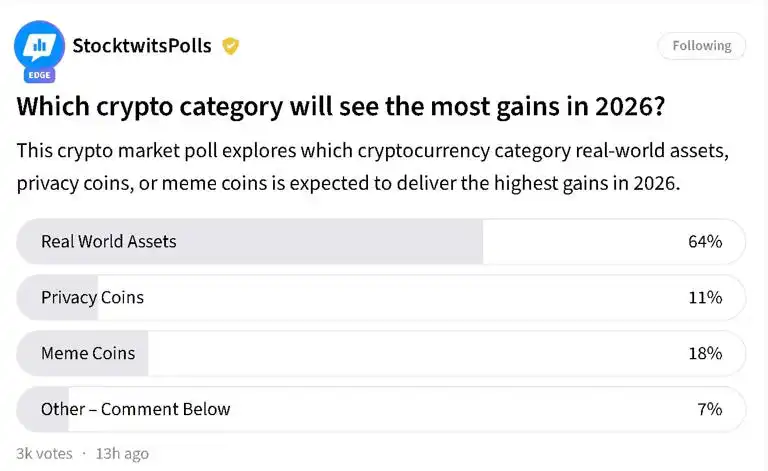
A recent Stocktwits poll shows: 64% of investors believe RWA will deliver the strongest returns in 2026, far exceeding Meme coins' 12% and privacy coins' 8%. But behind this number lies a question—when retail investors start clamoring to allocate to RWA, is it genuine cognitive upgrade, or just a PTSD response after the 2025 Meme crash?

RWA: The Promised Land for Institutions, or an Overcrowded Narrow Bridge?

Let’s first examine why Wall Street is so fascinated with RWA. The current total crypto market cap is approximately $3.2 trillion, with Bitcoin oscillating around $95,000. The market is searching for the next growth engine.

RWA’s logic seems flawless: Tokenizing traditional assets like real estate, bonds, and treasury bonds on-chain allows for both the efficiency advantages of blockchain and access to traditional finance’s trillion-dollar capital pool. This isn’t speculation; it’s "infrastructure building."

Grayscale, in its "2026 Digital Asset Outlook: Dawn of the Institutional Era" report, listed RWA as a core theme, predicting its scale will grow from the current $21 billion level to trillions by 2030. Behind this growth curve is a gradually clarifying regulatory environment—the potential passage of the U.S. CLARITY Act, and U.S. banks already allowing wealth advisors to allocate 1-4% of client assets to crypto.

Frontrunners have emerged. Ondo Finance focuses on RWA lending, with a current market cap of about $1.5 billion; Chainlink, as an oracle infrastructure, supports RWA data on-chain, with a market cap exceeding $20 billion. Bernstein explicitly expressed optimism about these projects and named Coinbase and MicroStrategy as indirect beneficiaries of the tokenization wave.

But here lies a paradox: When everyone knows RWA is the "correct answer," can it still deliver excess returns?
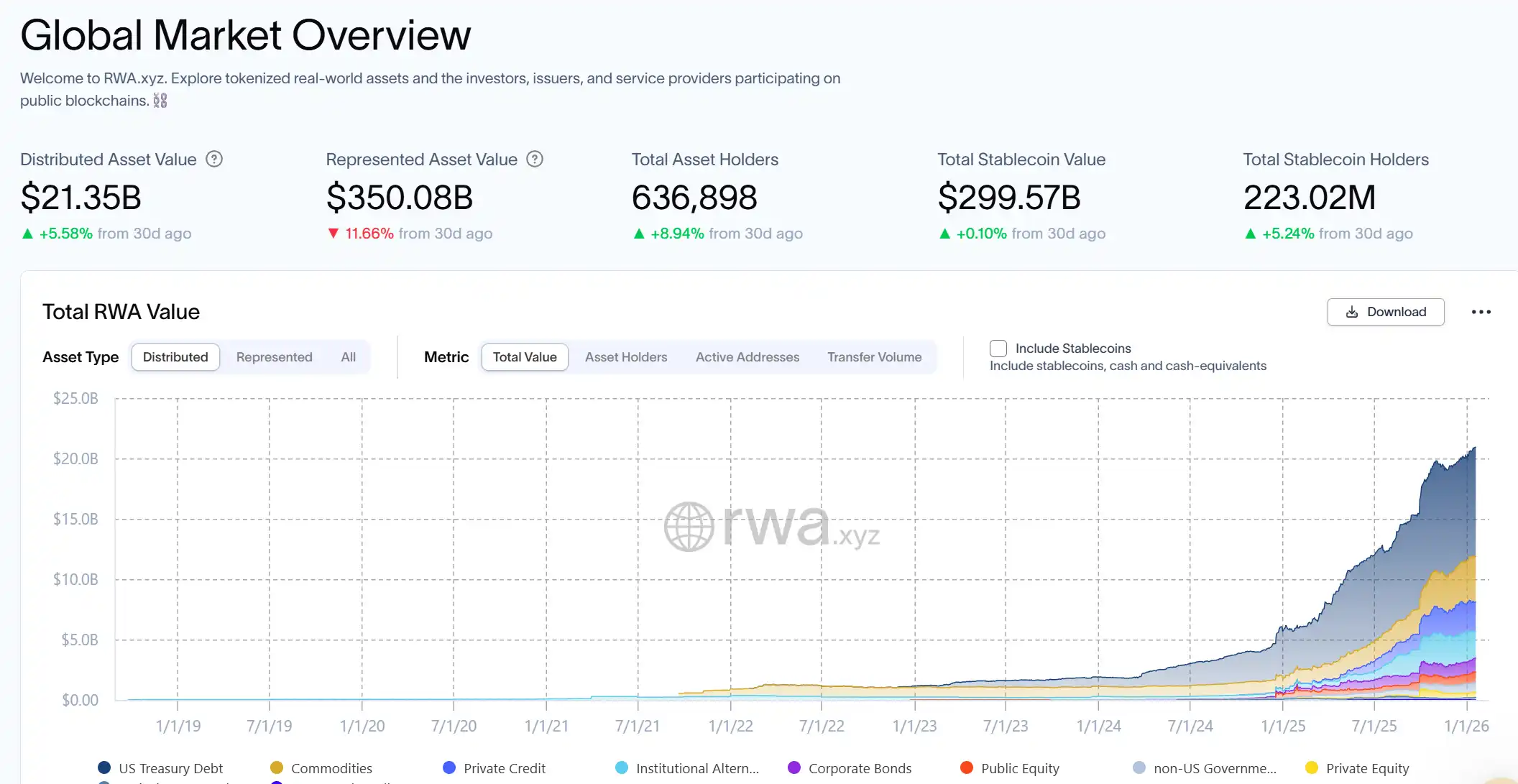
RWA’s current overall market cap is only around $20 billion, with extremely low liquidity. This means that once institutional funds pour in, prices could indeed surge; but the same logic applies to retreats—when the first batch of institutions starts taking profits, retail investors may find their RWA tokens unsellable.

A more realistic risk is regulatory delays: If the CLARITY Act is postponed, or if the Fed’s rate-cutting cycle lags behind expectations, the entire RWA narrative may need to wait another year or two amid volatility.

Institutions can endure this wait because they have advantages in funding costs and long-term allocation needs. But can retail investors? This is the most overlooked dimension of RWA investment—it requires not only correctly judging the direction but also having enough patience and liquidity to survive the vacuum period before the narrative materializes.

Meme: Cultural Renaissance or Final Carnival?

Compared to RWA’s rational narrative, Meme coins are more like the sentiment barometer of the crypto market. In early 2026, the total market cap of Meme coins rose from $150 billion at the end of 2025 to $185 billion, a 23% increase.

This number pales in comparison to the frenzy of 2021 or early 2025, but it still illustrates one fact: Meme is not dead.
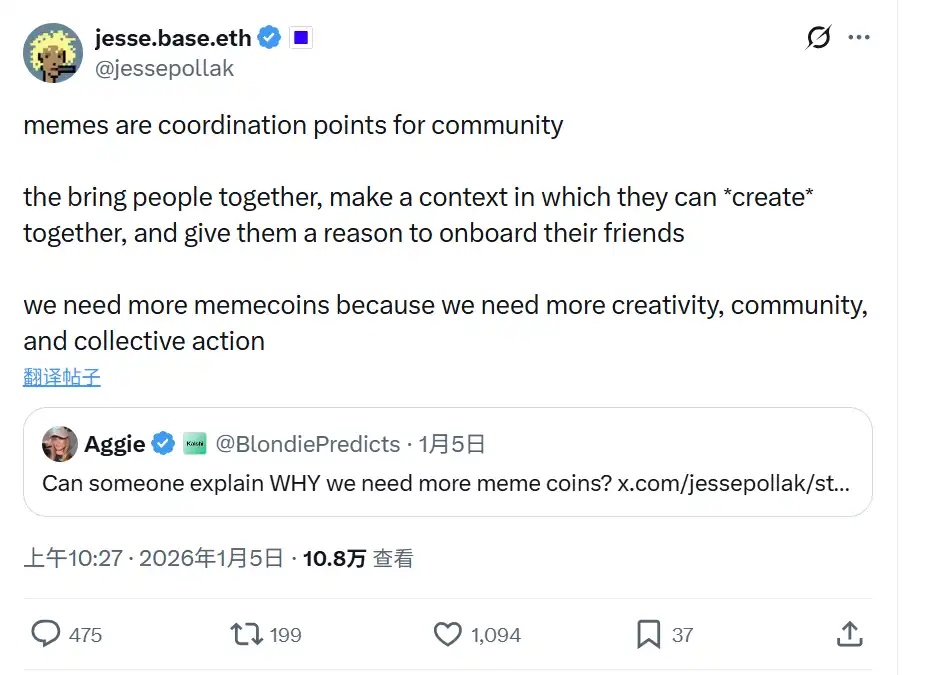
Base chain founder Jesse Pollak offers an interesting perspective. He repeatedly emphasizes that Meme is not just a speculative tool but the "core of on-chain culture." Through images, videos, music, and other content forms, Meme can attract millions of new users on-chain, becoming the entry point for Web3 mass adoption.

Meme projects on Base chain like TYBASEGOD, TOSHI, and BLOOFOSTERCOIN are validating this logic—they are not just tokens but更像是 vehicles for community culture.

But we must admit that this "cultural theory"更像是 justifications for platform ecosystems rather than genuine investment logic. The essence of Meme coins remains a zero-sum game: early participants profit through community consensus and viral spread, while later arrivals pay for liquidity.

The Stocktwits poll showing only 12% optimism for Meme reflects collective avoidance by institutions and rational retail investors. More critically, the 2025 Meme market crash left deep scars—many retail investors were deeply trapped buying at the top and have yet to break even.

So what does the 2026 Meme rebound mean? One interpretation is that Layer 2s like Base, with low costs and high throughput, have lowered the barriers to Meme creation and trading, allowing this sector to remain active with smaller capital flows.

But a more pessimistic interpretation is that this is just "existing player gambling"—old hands harvesting each other, with no new capital truly entering. If 2026 fails to birth new 100x myths (like Shiba Inu in 2021), Meme may gradually devolve into a niche game for enthusiasts.

More alarmingly, the密集 TGE (Token Generation Event) period in Q1 brings unlocking sell-off pressure. When large amounts of tokens unlock, market liquidity may be drained, and Meme, as the most fragile asset class, often bears the brunt first. This structural risk is rarely discussed in Meme communities but could be the main cause of retail losses in 2026.

Privacy: The Last Bastion of Idealism, or Regulation’s Next Target?

Privacy coins occupy the most awkward position in this discussion. On one hand, Quai Network surged 261% at the beginning of the year, rising from $0.03 to $0.11, with a market cap of about $86 million; Monero and Zcash also rebounded 10-50%.

On the other hand, the entire privacy coin category’s market cap is only around $5-10 billion, almost negligible in the $3.2 trillion total crypto market cap.

Privacy coin supporters will tell you this is because they represent crypto’s original intent—financial freedom and transaction privacy. Privacy coins uphold ideals of decentralization and censorship resistance. Quai’s surge partly stems from new mining hardware launches and DEX liquidity support, indicating that technical upgrades can still create short-term alpha for privacy coins.

But reality is harsher than ideals. The EU’s anti-money laundering laws are tightening regulations on privacy coins, and multiple exchanges have delisted coins like Monero. The Stocktwits poll showing only 8% optimism for privacy coins reflects not just regulatory concerns but also that privacy as an investment theme lacks sufficient market consensus.

A deeper issue: Can privacy and compliance coexist in the current regulatory environment? If not, privacy coins will either be marginalized as tools for geeks and dark web users or compromised into "pseudo-privacy" projects.

This dilemma makes it difficult for privacy coins to become mainstream investment targets. Of course, for true privacy believers, this恰恰 presents an opportunity for long-term contrarian accumulation—buying at historical lows after regulatory clarity may yield substantial returns. But this requires enduring 3-5 years of volatility and uncertainty, which is too long for most investors.

Polarization Is Inevitable, Where Is Alpha?

So, RWA, Meme, Privacy—who will be the true source of Alpha in 2026?

The answer may disappoint you: None of them, at least not in the way you imagine.

The essence of this polarization is a mismatch in time dimensions—RWA operates on a yearly scale, Meme on a weekly scale, Privacy on a quarterly scale. Institutions have the patience to lock up RWA, while retail seeks quick money but easily stops out repeatedly during volatility. The biggest risk isn’t "choosing the wrong sector" but "chasing highs + failing to hold."

True Alpha may lie in these two places:

1. The Intersection: Innovation Breaking Time Mismatch

True Alpha isn’t at the end of a single sector but in the intersection of narrative fusion:

  • Privacy-Enhanced RWA: Tokenized bonds, real estate on-chain, but with trading intent and holdings fully encrypted, disclosed only during audits. Transforming from "institution-exclusive" to playable by "institutions + high-net-worth retail."
  • Meme IP Tokenization: Viral Meme IP, once RWA-ized, generates cash flows from copyrights, merchandise, community shares. Evolving from "casino" to "cultural fund."
  • Compliant Privacy Layers: Default privacy + selective disclosure. Private stablecoins, private cross-chain bridges address institutional pain points (data leaks) and retail pain points (front-running).

The essence of these intersections: Using institutional patience to feed retail FOMO, and using retail viral spread to activate institutional liquidity. Pure sector players are easily washed out by time mismatch; intersection players find asymmetric opportunities.

2. Non-Participation: Retail’s Most Underrated Advantage

If you can’t understand this polarization, the best strategy may be non-participation. Hold BTC/ETH and wait for clearer market signals. FOMO will make you lose money in every sector; patience will let you go all-in at the right time. Retail’s biggest advantage is flexibility.


Questions liées

QAccording to the article, what are the two main investment camps in the 2026 crypto market, and what are their primary focuses?

AThe two main investment camps are institutions betting on the RWA (Real World Asset) tokenization revolution and retail investors speculating on Meme and Privacy coins. Institutions focus on the long-term infrastructure play of bringing trillions in traditional capital on-chain, while retail investors chase quick, high-multiple returns in more speculative assets.

QWhat major risk does the article identify for investors in the RWA sector, despite its promising growth narrative?

AThe article identifies low liquidity as a major risk for RWA investors. While prices could surge if institutional money floods in, they could also crash dramatically if those same institutions decide to take profits, leaving retail investors unable to sell their tokens. Additionally, the narrative is vulnerable to regulatory delays.

QHow does the article characterize the current state of the Meme coin market in 2026?

AThe article characterizes the 2026 Meme coin market as a potential 'culture revival' but also a possible 'last狂欢 (carnival)' or game of '存量博弈 (存量博弈 -存量 game)' where existing players are harvesting each other. It has seen a 23% rebound but lacks new, massive capital inflow and is vulnerable to sell-pressure from token unlocks.

QWhy do Privacy coins face a significant challenge in becoming a mainstream investment, as per the article?

APrivacy coins face a significant challenge due to a fundamental conflict between privacy and compliance in the current regulatory environment. Tightening anti-money laundering laws in regions like the EU and delistings from major exchanges have marginalized them. They lack broad market consensus as an investment theme, trapped between being tools for ideologues or compromising their core values.

QWhere does the article suggest the true 'Alpha' or outperforming investment opportunity lies for 2026?

AThe article suggests the true 'Alpha' is not in any single pure-play sector but in the cross-pollination and innovation between them, such as Privacy-Enhanced RWA, Meme IP tokenization, and compliant privacy layers. Alternatively, it states that for many retail investors, the best strategy might be to not participate directly and instead hold core assets like BTC/ETH patiently until clearer signals emerge.

Lectures associées

Trading

Spot
Futures

Articles tendance

Qu'est ce que MEME 2.0

Memecoin 2.0 : L'Ascension de $MEME 2.0 dans le Monde de la Cryptomonnaie Introduction Dans le paysage en constante évolution de la cryptomonnaie, un nouveau concurrent a émergé. Memecoin 2.0, symbolisé par $MEME 2.0, porte le concept des meme coins à un niveau excitant. En tant que produit dérivé du Memecoin original, ce projet a captivé l'attention de la communauté crypto en déplaçant l'accent des incitations financières typiques vers une expérience engageante et divertissante. Fonctionnant sur la blockchain Ethereum, Memecoin 2.0 redéfinit audacieusement l'engagement communautaire dans la sphère crypto. Qu'est-ce que Memecoin 2.0, $MEME 2.0 ? Au cœur de Memecoin 2.0 se trouve un projet de cryptomonnaie qui privilégie l'esprit communautaire et le plaisir associé à la culture des memes. Contrairement aux cryptomonnaies conventionnelles, qui se concentrent sur des cas d'utilisation pratiques et des avantages tangibles, Memecoin 2.0 se distingue en adoptant le côté léger de la monnaie numérique. Le projet existe sans promesses d'utilité, de feuille de route structurée ou de rendements financiers, se concentrant plutôt sur le développement d'une communauté dynamique centrée sur les memes et le plaisir partagé. Ce faisant, il s'inscrit dans la tendance croissante de la culture meme dans l'espace en ligne, en faisant un acteur unique dans le monde des actifs numériques. Créateur de Memecoin 2.0, $MEME 2.0 Malgré des recherches approfondies sur les origines de Memecoin 2.0, l'identité explicite de son créateur demeure inconnue. Cette anonymat n'est pas rare dans la communauté crypto, où de nombreux projets sont dirigés par des individus ou des groupes qui préfèrent rester dans l'ombre. Le manque d'informations accessibles au public sur le créateur pourrait être perçu comme un mouvement stratégique, mettant l'accent sur l'engagement communautaire plutôt que sur la notoriété individuelle dans l'espace. Investisseurs de Memecoin 2.0, $MEME 2.0 Les informations concernant les investisseurs ou le soutien financier de Memecoin 2.0 sont rares. Cette absence de détails peut suggérer que le projet est soit autofinancé, soit que son accent sur la communauté plutôt que sur les structures d'investissement traditionnelles a attiré un type de soutien différent. Étant donné que le monde des meme coins implique généralement un engagement plus de base plutôt que des investissements institutionnels, cette approche s'aligne sur l'éthique des projets dirigés par la communauté. Comment fonctionne Memecoin 2.0, $MEME 2.0 ? Memecoin 2.0 fonctionne entièrement sur la blockchain Ethereum, capitalisant sur ses caractéristiques de sécurité robustes et sa scalabilité. En tirant parti des forces d'Ethereum, Memecoin 2.0 peut offrir un environnement sécurisé pour les interactions des utilisateurs tout en garantissant que les transactions sont à la fois efficaces et rentables. Un des attributs uniques de Memecoin 2.0 réside dans sa structure axée sur la communauté. La valeur et la popularité du jeton $MEME 2.0 découlent de la participation active de ses utilisateurs, plutôt que d'une utilité inhérente. Ce design renforce l'accent mis par le projet sur l'aspect divertissant de la cryptomonnaie, impliquant que le rire et l'engagement communautaire sont les véritables devises qui guident son succès. De plus, le projet s'inscrit dans l'écosystème plus large des meme coins, où la valeur de chaque meme coin oscille en fonction de la culture, des tendances et de l'implication de la communauté plutôt que sur des principes économiques traditionnels. Chronologie de Memecoin 2.0, $MEME 2.0 Pour mieux comprendre l'évolution et les étapes marquantes de Memecoin 2.0, voici une chronologie mettant en évidence des événements significatifs de son histoire : 2024 : La création de Memecoin 2.0 est reconnue comme un découlement du Memecoin original, s'établissant dans le contexte florissant des meme coins tout en opérant sur la blockchain Ethereum. 13 Juillet 2024 : Memecoin 2.0 se positionne officiellement comme un meme coin centré sur la communauté sur le réseau Ethereum, soulignant son approche axée sur le divertissement qui invite les utilisateurs à s'engager et à participer à sa croissance. Points Clés sur Memecoin 2.0, $MEME 2.0 Plusieurs caractéristiques critiques définissent Memecoin 2.0 : Approche Axée sur la Communauté : La mission principale de Memecoin 2.0 est de créer une expérience communautaire amusante et engageante, capitalisant sur le plaisir collectif dérivé de la culture mémétique. Bâti sur Ethereum : Opérer sur la blockchain Ethereum procure au projet une infrastructure essentielle qui assure sécurité et scalabilité. Absence d'Utilité ou de Feuille de Route : Dans un départ frappant par rapport aux cryptomonnaies traditionnelles, Memecoin 2.0 ne promet aucune caractéristique utilitaire ou rendement financier, réaffirmant son engagement envers l'implication communautaire et l'engagement social. Accent sur la Culture Mémétique : En embrassant les aspects humoristiques et culturels du phénomène meme, Memecoin 2.0 fournit une plateforme permettant aux utilisateurs de s'engager avec la crypto hors ligne et en ligne. Contexte Supplémentaire : La Signification des Meme Coins Les meme coins ont émergé comme une classe distincte de cryptomonnaie, souvent motivée par l'humour et une approche légère du trading. Ces coins manquent généralement d'une utilité significative ou de feuilles de route de développement, attirant les utilisateurs avec la promesse de fun, d'interaction communautaire et de pertinence culturelle. Dans le paysage de l'écosystème crypto plus large, les meme coins ravivent l'importance de l'engagement communautaire, faisant barrage à des approches uniquement motivées par le profit. Des projets comme Memecoin 2.0 annoncent une ère où le divertissement peut s'harmoniser avec les aspirations financières, transformant la blockchain en un terrain de jeu créatif et d'interaction sociale. Conclusion Memecoin 2.0, ou $MEME 2.0, incarne une nouvelle vague de cryptomonnaie qui privilégie l'engagement communautaire au détriment de structures financières rigides. Avec un accent sur l'humour et l'interaction sociale, il capitalise sur la fascination entourant la culture meme. En opérant sur la blockchain Ethereum, Memecoin 2.0 exploite les capacités de la technologie tout en restant ferme dans son engagement envers la valeur de divertissement de la monnaie numérique. Alors que l'espace autour des cryptomonnaies continue d'évoluer, Memecoin 2.0 témoigne de l'idée que l'avenir des actifs numériques pourrait très bien dépendre d'expériences partagées, de rires et de liens communautaires solides. Dans le monde imprévisible des cryptos, peut-être que la joie peut être tout aussi précieuse que le gain financier traditionnel.

111 vues totalesPublié le 2024.04.04Mis à jour le 2024.12.03

Qu'est ce que MEME 2.0

Comment acheter MEME

Bienvenue sur HTX.com ! Nous vous permettons d'acheter Memeland (MEME) de manière simple et pratique. Suivez notre guide étape par étape pour commencer votre parcours crypto.Étape 1 : Création de votre compte HTXUtilisez votre adresse e-mail ou votre numéro de téléphone pour ouvrir un compte sur HTX gratuitement. L'inscription se fait en toute simplicité et débloque toutes les fonctionnalités.Créer mon compteÉtape 2 : Choix du mode de paiement (rubrique Acheter des cryptosCarte de crédit/débit : utilisez votre carte Visa ou Mastercard pour acheter instantanément Memeland (MEME).Solde :utilisez les fonds du solde de votre compte HTX pour trader en toute simplicité.Prestataire tiers :pour accroître la commodité d'utilisation, nous avons ajouté des modes de paiement populaires tels que Google Pay et Apple Pay.P2P :tradez directement avec d'autres utilisateurs sur HTX.OTC (de gré à gré) : nous offrons des services personnalisés et des taux de change compétitifs aux traders.Étape 3 : stockage de vos Memeland (MEME)Après avoir acheté vos Memeland (MEME), stockez-les sur votre compte HTX. Vous pouvez également les envoyer ailleurs via un transfert sur la blockchain ou les utiliser pour trader d'autres cryptos.Étape 4 : tradez des Memeland (MEME)Tradez facilement Memeland (MEME) sur le marché Spot de HTX. Il vous suffit d'accéder à votre compte, de sélectionner la paire de trading, d'exécuter vos trades et de les suivre en temps réel. Nous offrons une expérience conviviale aux débutants comme aux traders chevronnés.

402 vues totalesPublié le 2024.12.12Mis à jour le 2026.06.02

Comment acheter MEME

Discussions

Bienvenue dans la Communauté HTX. Ici, vous pouvez vous tenir informé(e) des derniers développements de la plateforme et accéder à des analyses de marché professionnelles. Les opinions des utilisateurs sur le prix de MEME (MEME) sont présentées ci-dessous.

活动图片













