The US fleet deployed to Iran is much larger than the one sent to Venezuela some time ago, which also means this asset plunge is more severe.
A few hours ago, Trump and the Iranian side began exchanging fierce rhetoric frequently. Meanwhile, rumors circulated in communities that the US aircraft carrier "Lincoln" and its strike group deployed in the Middle East had entered a "total blackout" communication shutdown, indicating that action against Iran might be imminent.
Every financial market investor is on edge.
First, look at US stocks. The Nasdaq 100 quickly widened its decline to 2%, the S&P 500 fell more than 1%, and the Dow Jones was not spared either, dropping 0.5%. The hardest hit were all assets highly tied to risk appetite; cryptocurrency-related stocks were practically crushed. MSTR once fell nearly 10%, COIN dropped over 4%, while HOOD, SBET, BMNR, and CRCL all saw significant pullbacks.
Even the so-called safe-haven assets, gold and silver, were also falling. Spot gold fell through three whole hundred thresholds in just half an hour, plummeting over $400 from the high, now trading near $5,155. Silver was even more dramatic, plunging 8% intraday, directly knocked down from $121 to just over $108.
The crypto market couldn't escape either. As US stocks opened, Bitcoin began to decline, sliding from $88,000 to around $83,000; Ethereum briefly fell below $2,800, SOL lost $118, and BNB also dropped below $865.
This means global capital has already priced in the worst-case scenario: war is about to begin.
What the US Prepared Before the Last "Strike"
Put the cards on the table first, then decide whether to flip it. This seems to be the consistent approach of the US government.
Looking back at the recent action against Venezuela, we can see the series of US signals before a formal attack: weeks before launching a series of attacks on Venezuelan vessels, the US had already amassed significant military assets in the Caribbean. The official statement at the time was that these ships were suspected of smuggling drugs to the US, but no clear evidence was ever provided.
The real outcome is known to all: on January 3rd, US forces directly intervened, taking Venezuelan President Maduro from Caracas.
It is said that the US aircraft carrier was already in position then; typically, 5 to 7 days before正式动手 (formal action begins), the US military's core strike forces are all in designated waters, waiting only for an "opportune moment."
Before Iran was attacked in June 2025, it was exactly the same rhythm. Days before the operation began, media caught abnormal movements of US military equipment. On June 21st, the US suddenly deployed 6 B-2 stealth bombers to Guam, later casually explaining it was a feint to maintain surprise advantage. But those familiar with US military operational logic understand that strategic assets of this level are never just for "drills." Meanwhile, two carrier strike groups led by the USS Carl Vinson and USS Lincoln had already been提前部署 (pre-deployed) in the Arabian Sea. The Arleigh Burke-class guided-missile destroyer USS Thomas Hudner was also moved to the eastern Mediterranean.
Thus, the deployment of carriers at sea, the mobilization of strategic bombers and heavy strike capabilities in the air, and the deployment of air defense systems are the three hallmark features of US military preparations before conflict.
And now, similar signals are gradually replaying.
Is a Second Aircraft Carrier on the Way?
"We have a massive fleet heading in that direction, maybe we won't need to use it." After Trump said this, US Central Command later confirmed on social platform X that a nuclear-powered aircraft carrier, the "Lincoln," had been sent to the Middle East.
This carrier left San Diego last November and had been performing missions in the South China Sea. Now, it has a new combat objective—Iran.
The Lincoln is one of the US Navy's core assets and one of the ten nuclear-powered aircraft carriers. It doesn't run on diesel but is driven by a nuclear reactor, theoretically capable of operating continuously for decades without refueling. It is equipped with highly advanced missile systems, radar, and sensors, essentially a floating combat command center at sea.
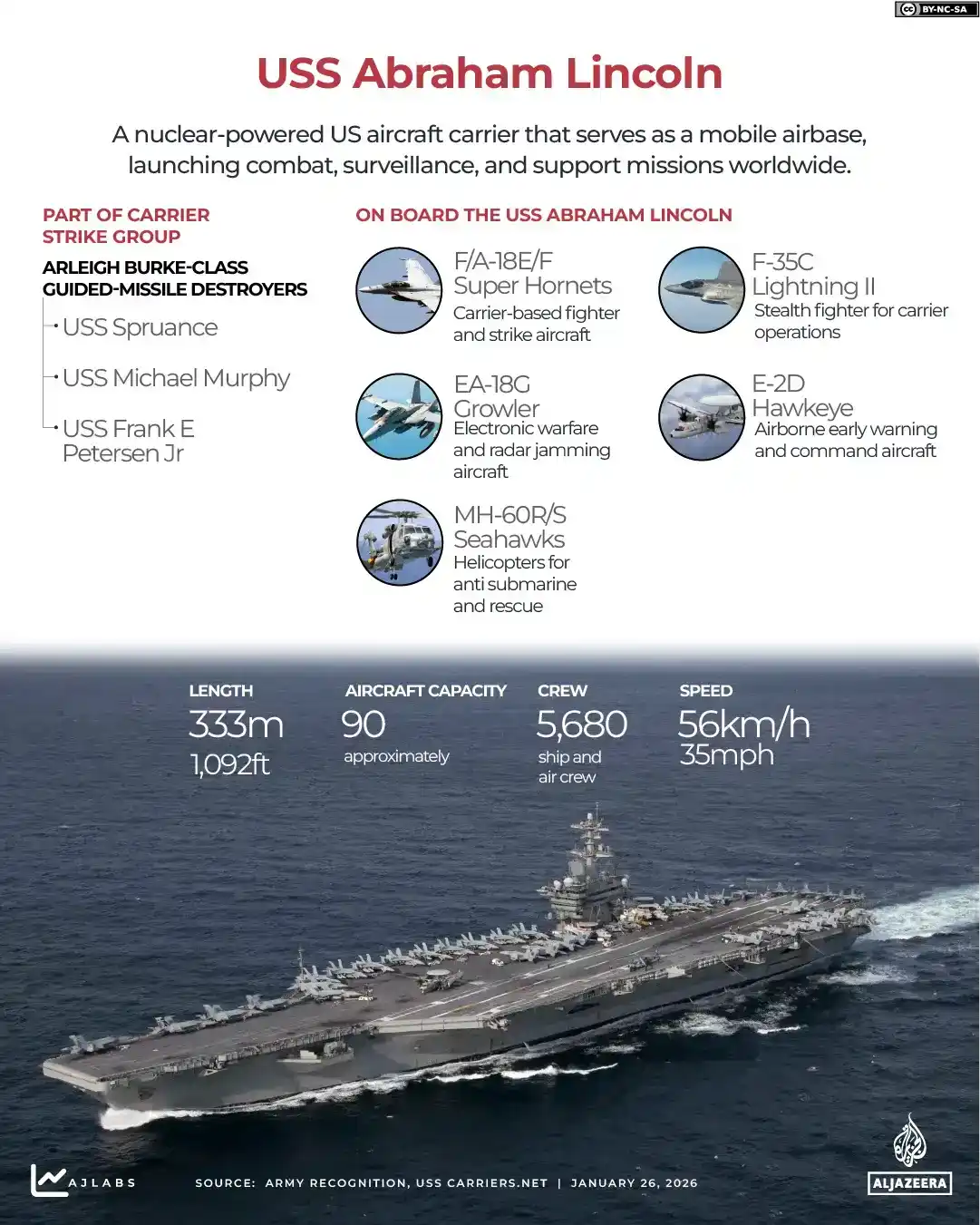
The Lincoln's whereabouts were originally highly classified, but because it had to pass through the Strait of Malacca, one of the world's busiest shipping lanes, it had to turn on its transponder to avoid collisions. It was this brief "lighting up" that allowed the outside world to confirm it had crossed the Indian Ocean on January 23rd. Subsequently, the transponder was turned off, and its location disappeared again. But based on speed calculations, it has now basically reached near the theater and entered a standby state.
After passing through the Strait of Malacca, the transponder was turned off again, and the carrier disappeared from radar. The rest can only be estimated by speed. But according to speed calculations, the Lincoln has now basically arrived near the theater and is in position.
At the same time, a second carrier seems to be on the way.
The "George Bush" set sail from the US East Coast on January 13th. It is widely believed that it will likely cross the Atlantic, enter the Mediterranean via the Strait of Gibraltar. Although it cannot be ruled out as just combat readiness training, at this point in time, few really believe it's a coincidence. Most military analyses speculate that the purpose of the George Bush's deployment is to "raise the stakes" in the Middle East situation.
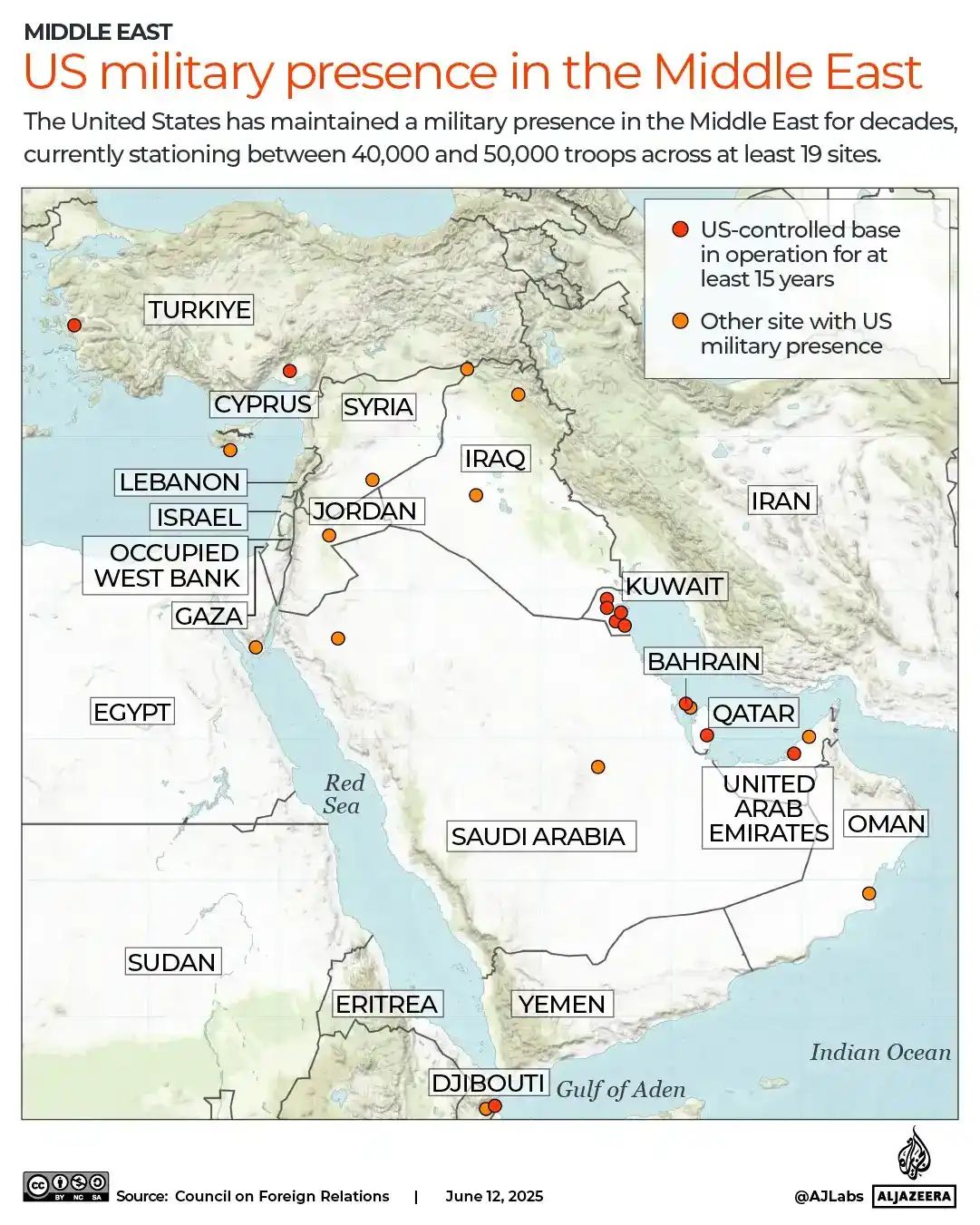
The judgment of many military analysts is also consistent: the truly "suitable" time to start fighting is likely after the second carrier strike group is in place. One carrier can certainly fight, but two mean air superiority, strike frequency, and fault tolerance are maximized. Since the best window for attack missed in early January when Iran protested, the difference between waiting a day and a week is not significant. Rather than acting hastily, it's better to wait for the second carrier strike group to arrive, pile up military strength in the Middle East to the highest level, and then strike decisively.
But as of now, the Bush has not been photographed passing through key straits. Based on speed estimates, it has not yet fully entered a combat-ready position.
After discussing carrier deployment, the air side is not idle either. US Air Force Central Command has announced multi-day combat readiness exercises in its area of responsibility, covering over 20 countries in the Middle East, Asia, and Africa. The term "exercise" itself is very flexible.
Of course, where there is offense, there must be defense.
Especially US protection of Israel. According to the Wall Street Journal, the US is also sending additional "Patriot" and "THAAD" anti-missile systems to the Middle East. After air defense systems are deployed, the real timeline for war often begins. But the specific timing is almost impossible for outsiders to know.
Some analyses even look further afield: Trump's obsession with Greenland is not just about resources. There are critically important US radar early warning facilities there, key nodes in preventing long-range ballistic missile surprise attacks. Controlling these places is essentially about creating defensive depth for larger-scale conflicts.
Israel has clearly entered the same timeline. On January 25th local time, Israeli Defense Forces Northern Command Chief Rafi Milo publicly stated that the IDF is preparing for the chain reaction after possible US military action against Iran. Earlier, Haaretz had cited defense sources saying the IDF had全面提高警戒级别 (raised alert levels across the board) in response to "a possible US attack within days."
Against this background, the US's real target appears increasingly clear. If it acts, the target is likely not just a limited strike but directly aimed at the Iranian regime itself. Precisely because of this, the US格外强调 (places great emphasis on) "everything being ready." A failed strike would mean long-term consumption, a political risk no US administration is willing to bear.
The Internal and External Troubles of the US Government's "Partial Shutdown"
Beyond military risks, domestic pressure is also building in the US simultaneously.
Lüdong's editors believe that the US government's "partial shutdown" before the end of the month is also an important reason for today's decline.
Each fiscal year, the US Congress must pass 12 appropriation bills. If no agreement is reached, the government shuts down. The current temporary funding bill expires on January 31st, and Congress has only two working days left. Informal vote counts in the Senate already show that the procedural vote to advance the appropriation bill failed. A partial or full government shutdown has almost become a high probability event.
And now, with only 2 working days left, a partial government shutdown is basically certain. The US Senate's informal vote count结果显示 (showed) that the procedural vote held that day failed to advance the government funding bill already passed by the House.
The budget disagreement between the two parties is mainly over the Department of Homeland Security. The main event is: Minnesota, a long-time Democratic stronghold, was recently exposed to one of the largest welfare fraud cases in US history, involving up to $9 billion. For more details, see related reading: "Is the US Government Shutting Down Again, Will Crypto Be Hit Again?" The editor will only briefly mention the points of disagreement here:
Many organizations involved are closely linked to the local Democratic political ecosystem. Evidence suggests that funds obtained by these welfare fraud organizations have flowed into Democratic campaign donations.
Minnesota itself is also a highly immigrant state, with large populations of Somali and other immigrant groups. The Minnesota Attorney General's office said that among the 92 defendants charged in this case, 82 are Somali Americans. This highly intertwines issues of immigration enforcement, welfare distribution, and public safety,恰好踩中了 (exactly stepping on) the core issues of long-standing opposition between the Democratic and Republican parties, and is also a policy promise repeatedly emphasized by Trump and the Republicans in the campaign.
Thus, Trump strengthened immigration enforcement in Minnesota. However, the sudden increase in enforcement intensity quickly led to serious consequences. Two incidents occurred where federal immigration enforcement officers accidentally shot and killed local residents, leading to large-scale protests and riots, even requiring the National Guard to maintain order. The Democrats quickly seized this opportunity, using the fatal shootings by ICE in Minnesota as ironclad evidence of the agency's out-of-control enforcement methods.
The Democrats' logic is clear: ICE caused two deaths in Minnesota, proving the agency's enforcement methods have serious problems. Without substantial reform of ICE and adding strict restrictions, why should we continue to fund it? Democrats demand reducing ICE's scale or at least attaching strict restrictions.
The Republican stance is diametrically opposed: The Minnesota welfare fraud case involves $9 billion, most defendants are Somali,恰恰说明 (precisely illustrating) the need to strengthen, not weaken, immigration enforcement. ICE is a key force in combating illegal immigration and welfare fraud; it must be fully funded.
Internal strife has no resolution, while external risks are simultaneously heating up. Whether war will truly happen, no one can give a definite answer. But Lüdong's editors hope for world peace.



















