Author: Jessica Klein, Wired
Translation: Saoirse, Foresight News
Joseph Edgar Foreman, better known by his stage name Afroman, is taking a long drag from a blunt. In a makeshift backstage lounge at The Venetian in Las Vegas, partitioned by curtains, the 51-year-old rapper is unhurried, even as thousands wait outside. The joint was rolled by his videographer, a woman in a tight evening minidress and clear sky-high heels. This grand venue is a world away from the dive bars he toured for over two decades.
Foreman is wearing his courtroom suit, an American flag-print outfit he now wears everywhere. In 2022, police, suspecting him of drug-related crimes and kidnapping, raided his Winchester, Ohio home. They found nothing incriminating except a jar of 'green herbal substance,' THC concentrate wax, paraphernalia, and over $5,000 in cash. After the raid, Foreman released songs mocking the officers involved, joking about receding hairlines and their wives, and humiliating them in various ways. Seven officers sued him for defamation and invasion of privacy, seeking $4 million. Foreman won the case, and clips from the trial went viral, earning him widespread public support.
After all, going viral is Foreman's specialty. He claims his 2000 college party anthem "Because I Got High" originally promoted free expression — a debatable point, but he is undeniably skilled at capturing attention. His calm demeanor during the trial and his emphasis on free speech drew millions to his music. Footage from his home security cameras, showing officers entering his house, was used in music videos, further boosting his popularity. The most viral, "Lemon Pound Cake," mocked an officer who seemed overly interested in a cake on the kitchen counter during the search. The video garnered nearly 10 million views on YouTube, and the so-called "Cake Cop" later reported receiving hundreds of lemon pound cakes as harassment.
The rapper's victory cast him as a "freedom fighter" in the public eye, which is why he traveled to Las Vegas to perform for a crowd of libertarian-leaning crypto enthusiasts. Craig Deutsch, the programming director for the Bitcoin conference, said Foreman's "fight for his right to create songs about police who illegally entered his home perfectly aligns with Bitcoin's core ethos." The annual Bitcoin conference attracts a diverse crowd: industry professionals, early Bitcoin adopters, and QAnon followers distrustful of government systems. It has also become a key campaign stop. Donald Trump delivered a keynote in 2024 during his presidential run; JD Vance spoke the following year. Now in its second year in Las Vegas, attendance is up despite Bitcoin's price being about $33,000 lower than last year.
Host Gregg Davis enters the smoky greenroom, finding Foreman surrounded by a small entourage: former pimp Bishop Don "Magic" Juan, an assistant in an emerald suit, men taking turns passing a blunt, and two young women in tight, shiny dresses.
"How should I introduce you?" Davis asks.
"Speak from the heart," Foreman replies. "Talk about the struggle, the hustle, the American Dream — if you remember that word — then just bring out Afroman."
The host jokingly thanks Foreman for "making the room smell so nice." Shortly after, his manager enters, politely informing him that hotel staff have smelled marijuana and are threatening to call the police.
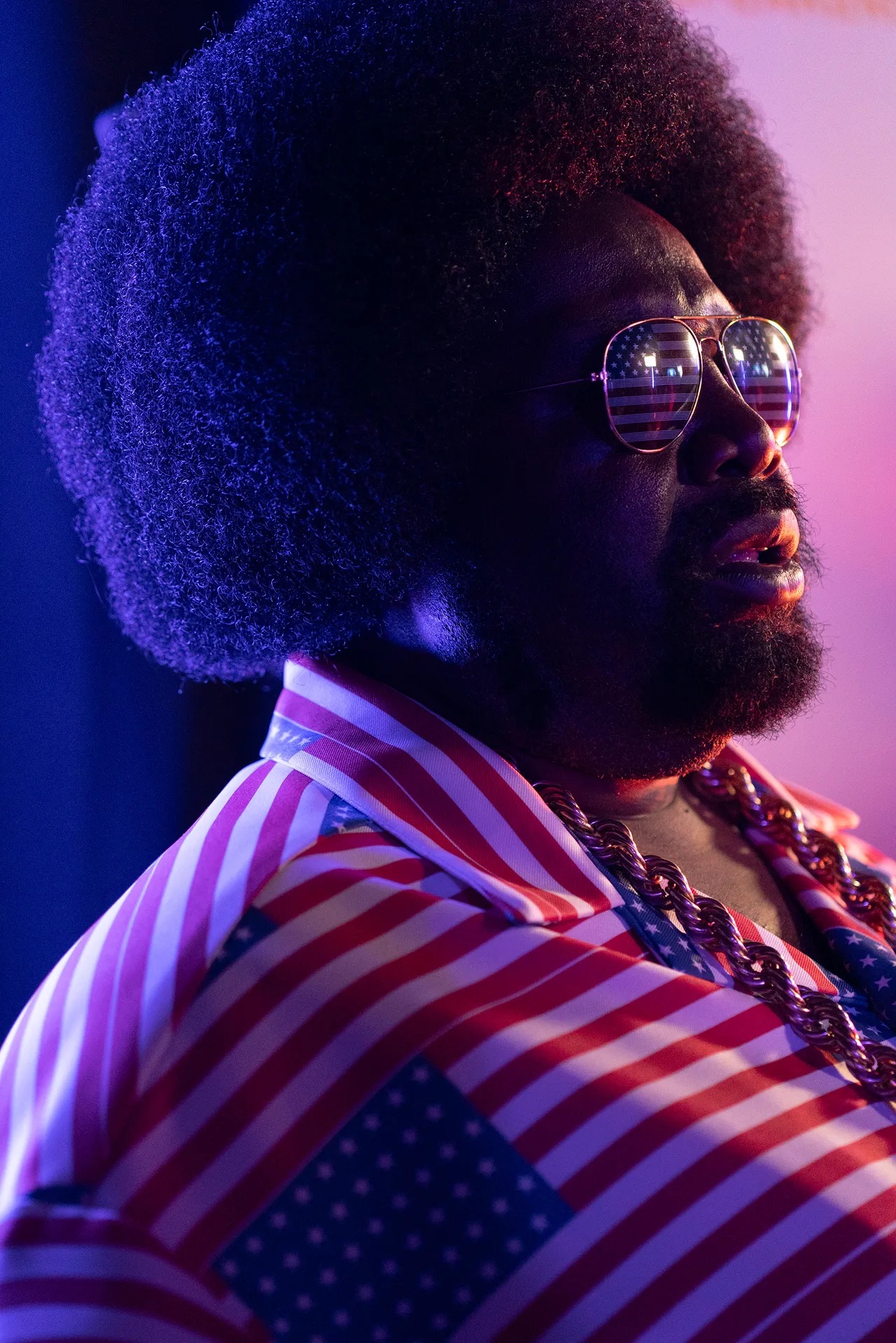
Joseph Edgar Foreman, widely known as rapper Afroman, rose to fame with "Because I Got High," a comedy song about the consequences of smoking marijuana. The song was nominated for a Grammy in 2002. Photo: Gabriella Angotti-Jones
"Okay, okay, I got it," Foreman says, turning to his crew. "They want us to put it out. Everybody, take a few last hits."
He has 20 minutes until he takes the Bitcoin conference's "Satoshi Main Stage," named after Bitcoin's pseudonymous creator. The rapper admits he knows nothing about cryptocurrency, doesn't own a single Bitcoin, and doesn't understand its logic. He pauses briefly, trying to think of something that will resonate with the crypto faithful, then lets it go. "I'm 51," he says. "I'll just wing it. It'll work out."
Foreman learned to sing in church and started writing raps at 12. His first song, he recalls, mocked a bully girl at his new school who had a mustache, with lyrics like, "Hairy Carrie ruins herself, so the hair on her lip gets no breeze." As an adult, back in Mississippi, he recorded "Because I Got High" shortly after quitting his job at a chicken processing plant, distributing 500 copies at a Mardi Gras party in New Orleans. Kids took it home and uploaded it to Napster; within days, Foreman says, it spread globally. In 2001, Universal Records flew to New York to sign him; the song earned a Grammy nomination the next year.
But Foreman's peak was fleeting. He never matched the success of his ode to marijuana-induced slacking. He parted ways with Universal and began self-releasing music online in 2004. For two decades, he's sustained a career performing his hit at college parties worldwide. He never intended to be an activist, but libertarian themes slowly seeped into his work. In an early interview with Time, he said, "I don't want to agitate anybody. I just thought, 'We're all potheads, let's just have some fun.'" In 2014, he partnered with the NORML legalization advocacy group for a positive spin on the song, highlighting medicinal benefits like glaucoma relief.
But these were often business opportunities, not deep convictions. Foreman tours relentlessly, taking gigs for the paycheck. He opened for Snoop Dogg on the 2018 Puff Puff Pass tour; he was paid $2,500 to perform three songs at a Pennsylvania frat party before police shut it down. He's had his own legal troubles: in 2015, he slapped a woman who rushed the stage, resulting in a $65,000 settlement and court-ordered anger management classes. After the Ohio raid but before his trial went viral, he even filed to run for U.S. President in 2024.
Earlier this year, millennials were surprised to see the party-rap icon from their youth re-emerge as a defender of the First Amendment. When a judge asked during the trial if the police entering his home gave him the right to mock them in song, Foreman responded, "They kicked my door down with guns, they searched my premises. Yes, I have freedom of speech. I could be in my backyard having fun, taking a bad situation and making it fun with my expression." He argued that since the officers chose to enter his home and appear on his security footage, using them in his video was fair game. The jury sided with him in just six hours. Foreman says he plans to write 50 to 100 songs about the officers who raided his home.
Overall, as he puts it, he's a "marijuana icon" first, with politics layered on top. This deeply appeals to the Bitcoin community. Rap is protest music, and Bitcoin is often called "the money of rebellion." Foreman fits into a lineage of conference speakers like former NSA whistleblower Edward Snowden and Silk Road founder Ross Ulbricht — the latter pardoned by Trump in 2025 after 11 years in prison for operating the dark web marketplace.
Conference organizer Deutsch says, "Whether Afroman is deep into crypto or not, in my mind, he is a Bitcoiner."
The morning before his performance, Foreman heads to Top Golf on the Las Vegas Strip. His companions include actor Christopher McDonald (who played Shooter McGavin in "Happy Gilmore"), a 19-year-old Amish boy on his Rumspringa (who had performed a cover of Weird Al Yankovic's "Amish Paradise" with Foreman the night before), two men from California, and Don Juan. It's all part of his paid appearance package for the Bitcoin conference. As a professional entertainer, he plays along: coaching the Amish boy on rapping, engaging with crypto fans, even as he's just beginning to grasp their zeal for digital currency.
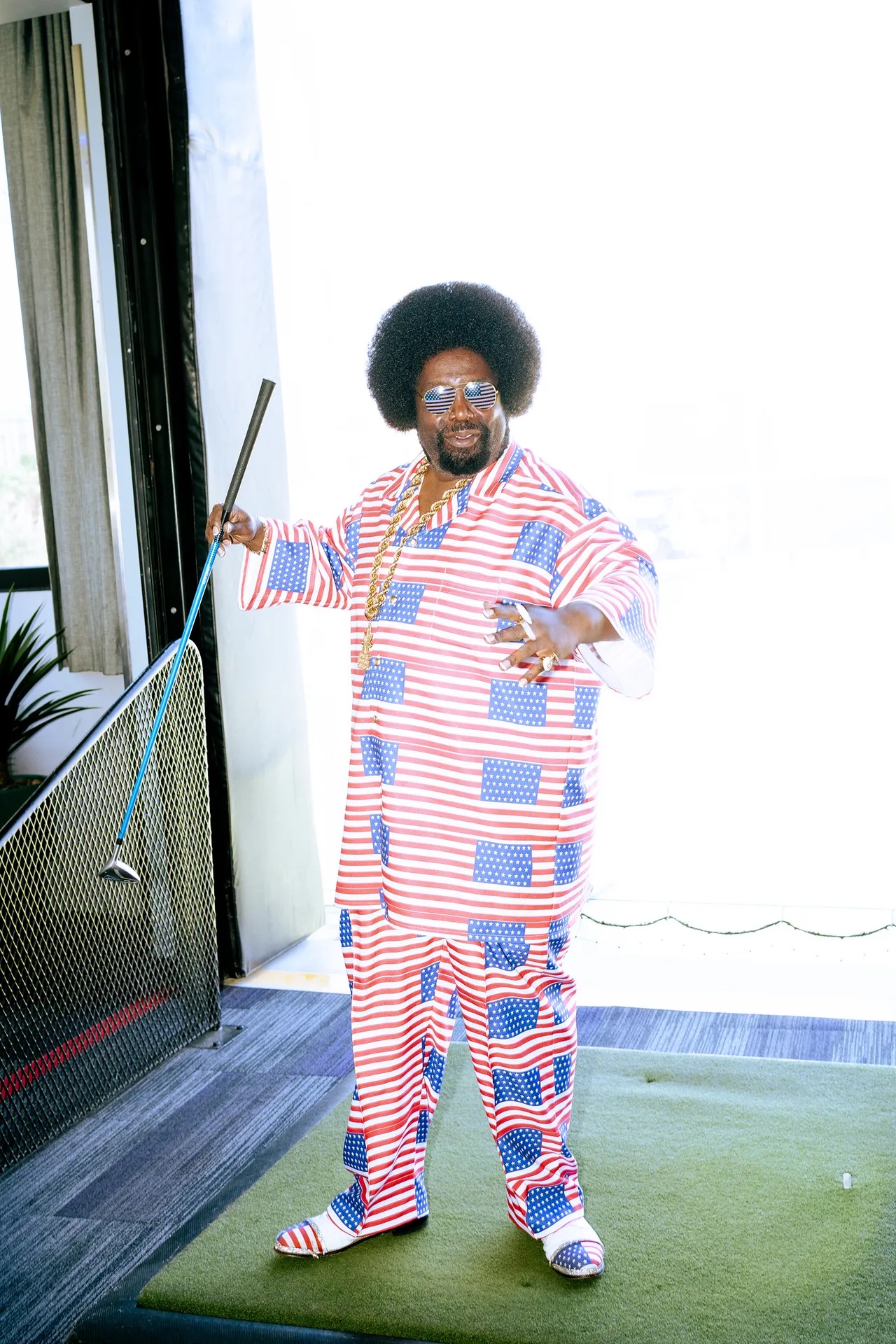
As part of his appearance at the Bitcoin conference, Foreman spent a morning at Top Golf on the Las Vegas Strip. Photo: Gabriella Angotti-Jones

Laken Schafer, 29, is Foreman's videographer. They met at a cannabis-themed wedding where she was filming and he was officiating. Foreman hired her because he "didn't want a sweaty male cameraman." Photo: Gabriella Angotti-Jones
Don Juan tends to Foreman throughout. They met through a mutual friend about 15 years ago and reconnect annually at the "Players' Ball," the pimp convention Don Juan started in 1974 for his birthday. He calls Foreman a "gentle giant," sitting beside him as his videographer tees off in heels. On the table is Don Juan's signature custom cup, featuring a diamond-encrusted silhouette of a woman.
Don Juan explains to Foreman, "Bitcoin keeps going up in value, and most regular people don't understand it." He once bought crypto but lost his private keys. He believes a figure like Afroman can introduce it to people outside the bubble.
Learning that one Bitcoin is worth about $77,000 and that someone once traded 10,000 Bitcoin for two pizzas in 2010 (worth about $41 at the time), Foreman remarks, "It's tough for the average person to get a whole Bitcoin."
He has a realization: "So it's like stocks? You buy it, hold it, and hope it goes up?"
The Bitcoin community, once a small group of cypherpunks wanting financial transactions free from government control, is now filled with political opportunists — many urging the U.S. government to hoard crypto to boost its price. In recent years, the conference has featured crypto-friendly Republican politicians, with MAGA merch everywhere, though political views aren't monolithic. This suits Afroman: he's not aligned with any party, focusing on issues that directly affect him. He supports jury trials in family court (he's divorced), federal marijuana legalization, civilian oversight boards for police (as a Black man, he feels this deeply); he's anti-war, against foreign aid, supports sex work legalization, and wants reparations for descendants of slaves.
Despite Trump's appearance at the conference, Foreman doesn't align with him. "The policy of qualified immunity for police is a deal-breaker for me," he says, also rejecting the glorification of Nazis and Confederate statues. "As a Black man, those are red lines."
Foreman has beliefs, but he advocates most fiercely when they intersect with his self-interest. During his 2024 presidential run, his two main platforms were: recreational marijuana legalization and mandatory body cameras for all police officers.
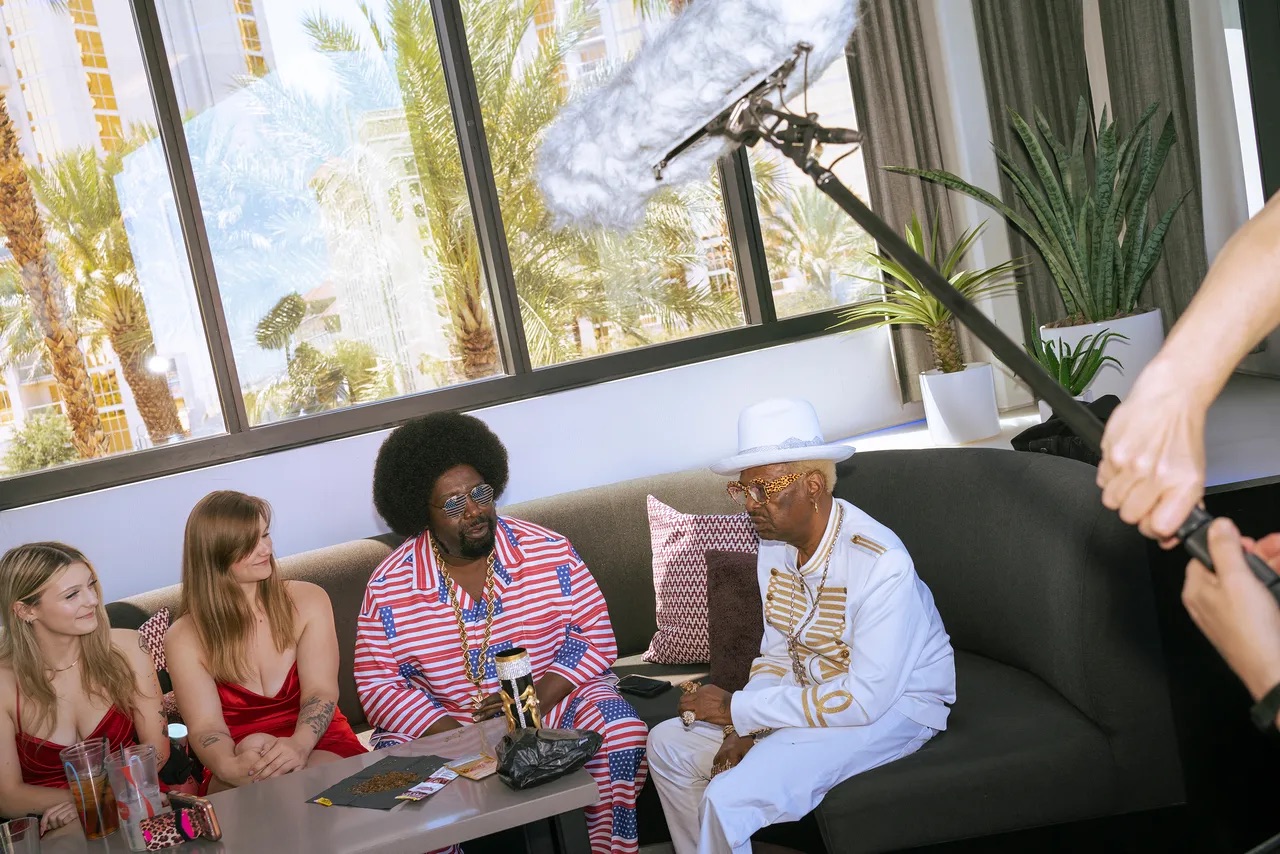
Afroman (from left) with his assistant Lilly Music, Laken Schafer, and Don Juan. Photo: Gabriella Angotti-Jones
Don Juan praises Foreman: "He's powerful now. People want something new. He's not just a rapper; he has a strong personality. Running Afroman for president isn't far-fetched."
Foreman declares, "I guarantee you, if I'm president, all these problems will be solved."
The three-day conference expo hall is filled with Bitcoin mining company booths. Suited professionals mingle with enthusiasts in sailor hats and Bitcoin logo face paint. In one corner, a mannequin sports Afroman's signature afro. A nearby glass case displays auction items: Afroman-signed rolling papers, a used ashtray, and commemorative bills with his portrait.
The items are listed by Scarce City, an auction house specializing in crypto memorabilia like old Bitcoin magazines and a harmonica set owned by crypto promoter and antivirus pioneer John McAfee. Last year, when Ross Ulbricht spoke, Scarce City auctioned three of his prison IDs and sneakers; one ID sold for 5.5 Bitcoin after bidding wars, worth about $371,000.
Scarce City's general manager, Sam Kimbrow, followed Foreman's trial and reached out in January to auction his items, hoping to help with legal fees, including the iconic American flag suit from court. The 40-year-old says assembling this collection fulfills "a millennial fantasy," hoping it shows a younger generation that artists can stand up for their rights.
"The core ethos of what we auction is freedom and personal sovereignty," she says. "Afroman is a living, modern-day freedom fighter."
After the auction, the flag suit sold for about $4,000 worth of Bitcoin, the ashtray for about $230 worth, but the signed rolling papers received no bids.
The auction didn't significantly benefit Foreman. He reveals he was paid a flat fee (undisclosed) to participate in Las Vegas events for three days. But he states his reason plainly: "They said one thing: 'Afroman, there's money involved!'"
On the conference's final day, an hour before his main stage performance, Foreman does an on-stage interview for elite attendees who bought the "Whale Pass" for $12,999 — an event closed to most media. The interviewer is Tracy Hoyos-Lopez, Kraken's head of strategic initiatives, known for influencing Trump's embrace of Bitcoin. All sixty seats fill quickly.
Asked about his mindset during the police raid, Foreman replies, "I'm used to police automatically thinking I'm a criminal. I'm patient. I wait for them to realize they're wrong."
"Through freedom of speech, we can call out corruption in the system," Foreman continues. "Once you see the problem, you can address it. Once it's addressed, you can fix it. I even hope this raid will make me enough money that I'll be glad the police came to my house."
According to Billboard, after winning the case, Foreman's music streams surged over 500%, helping cover the $20,000 in property damage from the raid.
The audience is fully on his side. Under a ceiling of colorful planet decorations, they sing along to "Because I Got High," even if they don't know all the words. They cheer when Foreman explains using footage of the actual officers who wronged him in his videos. Hoyos-Lopez concludes, "The greatest asset in America, in the Constitution, is freedom of speech. And Afroman, you have exercised that right to perfection."
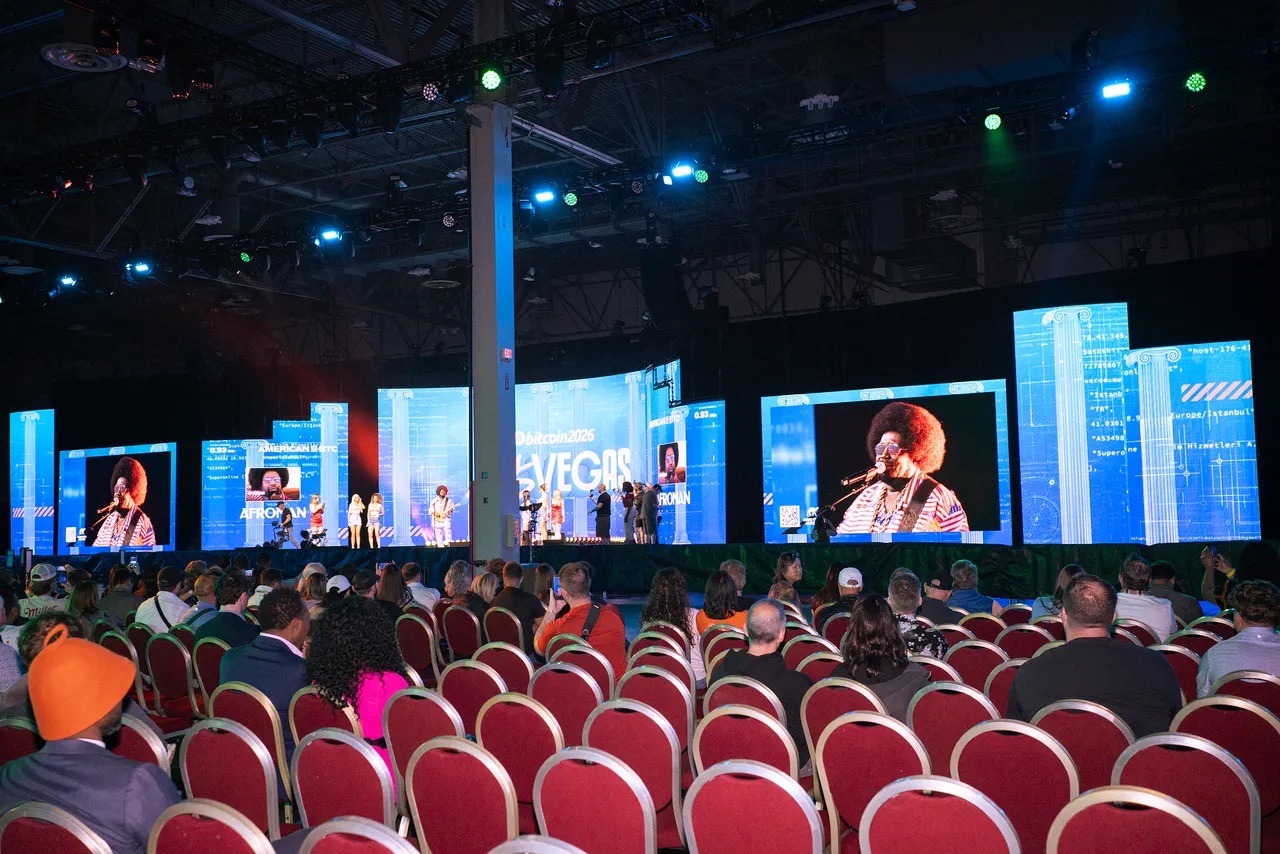
On the final night of the Bitcoin conference, Foreman took the Satoshi stage to perform his most famous song and make a special announcement. Photo: Gabriella Angotti-Jones
On the Bitcoin conference's closing night, Foreman takes the Satoshi stage, performs his hit, and makes a major announcement.
By the third day, the crowd has thinned, and The Venetian ballroom isn't packed. But the remaining audience nearly fills the 8,000 seats, there specifically for Afroman. As the only performer who's lived a protest story, the vibe isn't electric, but a middle-aged white woman in the front row gets up to dance.
Before starting, Foreman almost forgets his announcement. "Damn, I'm high," he says. "I almost forgot to tell y'all: I'm running for president in 2028."
The crowd erupts. Someone yells, "Afroman for president!"
Then, strumming a borrowed guitar shaped like the letter B, he launches into the song that made him famous.