Range Judgment Realized, Strategy Fully Executed | Guest Analysis

marsbitPublié le 2026-01-09Dernière mise à jour le 2026-01-09

Résumé

In his weekly analysis, Cody Feng, a quantitative trading expert, reviews Bitcoin's price action from January 5 to 11. BTC movement aligned closely with his initial forecast, trading within a range of $84,000 to $94,500. The price faced strong resistance at the $93,000–$94,500 zone and later pulled back toward the mid-to-lower part of the range. A short position was executed near $94,000 based on signals from momentum and spread trading models, and the trade was closed around $90,584, capturing a profit of approximately 3.4%. The strategy emphasized pre-planned execution and disciplined risk management. Currently, Bitcoin has found support around $86,500, with technical indicators suggesting oversold conditions and a potential bounce. However, the overall structure remains a broad consolidation. A rebound toward $92,000–$93,000 is anticipated, where renewed selling pressure may emerge. A break above $94,500 would require a reassessment of the market outlook. Feng concludes that in a ranging market, executing well-defined strategies with strict risk controls is more critical than predicting directional moves.

Odaily guest market analyst Cody Feng, Master of Financial Statistics from Columbia University, has focused on quantitative trading of US stocks since college and gradually expanded to digital assets such as Bitcoin. He has built a systematic quantitative trading model and risk control system through practical experience; possesses keen data insight into market fluctuations, and is committed to continuous growth in the professional trading field, pursuing stable returns. He will delve into BTC technical, macroeconomic, and capital flow changes weekly, review and showcase practical strategies, and preview noteworthy upcoming developments for reference.
Bitcoin Mid-Week Review(01.05~01.11)

Conclusion First:

This week, Bitcoin's overall price action largely operated within the 84,000~94,500 USD oscillation range we provided at the beginning of the week. The price precisely encountered resistance in the 93,000~94,500 USD pressure zone and subsequently fell back to the middle-lower part of the range. Our core level judgments were verified by actual market performance.

In this trade, we established short positions near 94,000 USD and exited all positions near 91,000 USD, capturing approximately 3.4% profit (spot) from the range, completing a high-probability, low-drawdown profit realization in a ranging market.

I. Validation of This Week's Core Range and Key Levels

At the beginning of the week, we clearly stated that this week required close attention to the battle between bulls and bears at the upper and lower boundaries of the 84,000~94,500 USD range.

The actual movement showed that Bitcoin clearly met resistance after rebounding to the 93,000~94,500 USD pressure zone, with multiple failed attempts to break higher, subsequently leading to a pullback under pressure, validating the effectiveness of this area as a阶段性 "ceiling".

Regarding support levels, the price showed clear signs of stopping declines and stabilizing after falling to the 86,000~86,500 USD area, where buying interest began to emerge. The more critical support level at 84,000 USD has not been touched yet, and the overall structure remains within the wide-range oscillation framework.

II. Execution of Plan A (From Entry to Exit)

Based on the range oscillation judgment, our Plan A formulated at the start of the week was effectively executed.

When the price rebounded to the 93,000~94,500 USD zone showing signs of upward exhaustion, and both the (momentum, spread trading) models simultaneously issued top signals, we immediately established short positions at 93,771 USD. The market subsequently declined as expected.

When the "Spread Trading" model issued a bottom signal, we finally exited all positions at 90,584 USD, completing a full, emotion-free short trade. The entire trading process was not "hindsight analysis" but involved pre-planning, in-execution, and post-verification.

III. Operational Thoughts for the Latter Half of the Week

Bitcoin 4-Hour Chart: (Momentum Quantitative Model + Spread Trading Model)
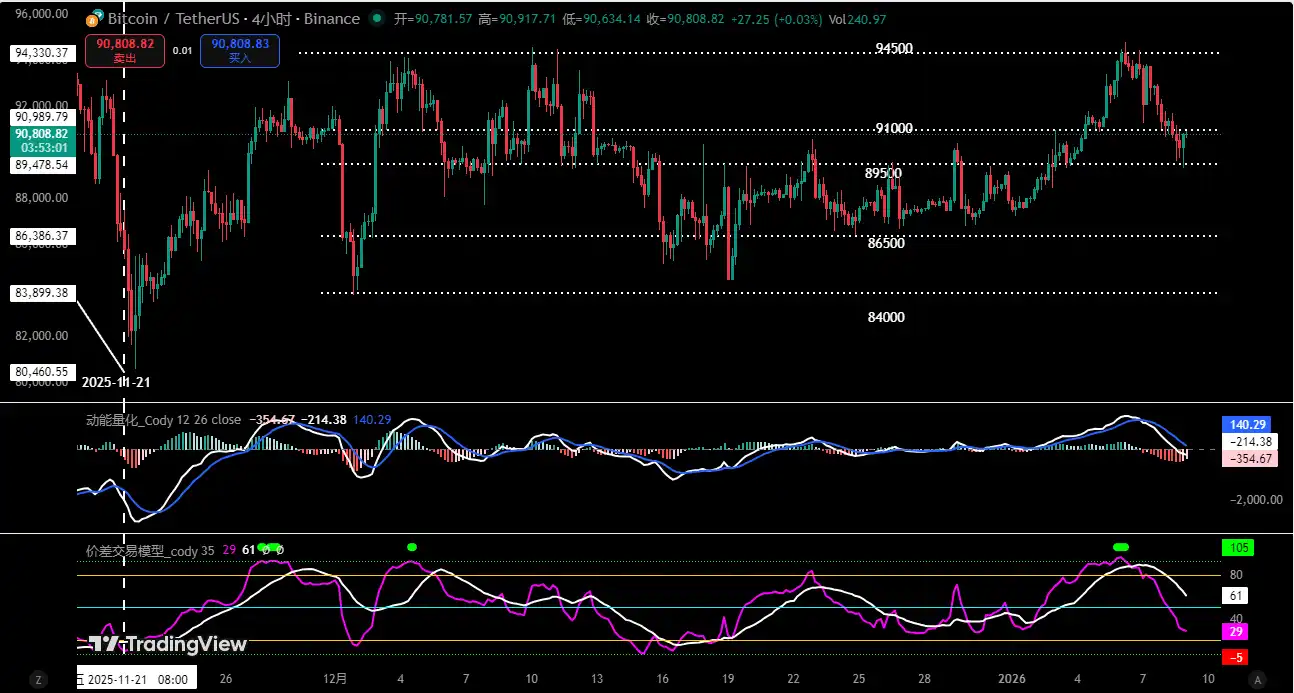
From the 4-hour technical structure (see chart above), Bitcoin has currently found effective support near 86,500 USD. Multiple technical indicators have entered oversold territory, indicating short-term selling pressure has been released. The market has a demand for a technical rebound correction (oscillatory rebound), but this is not yet sufficient to confirm a reversal of the downtrend.

Based on this, we anticipate the price may first rebound to test the 92,000~93,000 USD area. This level also coincides with the middle-upper part of the previous oscillation range and is expected to form resistance again.

For short-term operations, maintain a range-trading mindset: if the price reaches this zone and shows signs of momentum exhaustion or failed breakouts, consider building short positions on rallies; if it effectively breaks above 94,500 USD, stop loss decisively and reassess the market structure.

IV. Summary

Overall, Bitcoin continues to operate within the wide-range oscillation pattern defined at the beginning of the week: lower support provides room for rebounds, while upper resistance limits the upside. At present, rather than betting on a unilateral trend, it is more important to respect the range structure, focus on high-probability levels, and maintain strict risk control.

In ranging markets, formulating flexible response strategies and achieving stable profits is far more important than predicting direction.

Disclaimer: The above content is solely personal market opinion sharing and does not constitute any investment advice. Cryptocurrencies are highly volatile; please make independent judgments and strictly control risks.


Questions liées

QWhat was the price range for Bitcoin's consolidation as predicted by analyst Cody Feng at the beginning of the week?

AThe predicted consolidation range for Bitcoin was between $84,000 and $94,500.

QAt what price level did the analyst establish a short position and what was the profit from this trade?

AA short position was established near $94,000 and closed near $91,000, capturing a profit of approximately 3.4%.

QWhat are the two technical models mentioned that provided signals for the trade execution?

AThe two technical models mentioned are the Momentum Quant Model and the Spread Trading Model.

QAccording to the 4-hour chart analysis, what is the expected next move for Bitcoin's price and the key resistance area to watch?

AA technical rebound or震荡反弹 (oscillatory rebound) is expected to test the $92,000 to $93,000 area.

QWhat is the overarching trading philosophy emphasized for the current market conditions described in the article?

AThe philosophy is to focus on high-probability price points and strict risk control within the range-bound structure, rather than betting on a one-directional trend, as formulating flexible strategies for stable profits is more important than predicting direction.

Lectures associées

Le « GENIUS Act » et le « CLARITY Act » adoptés : Quelle est la véritable architecture du rendement sur chaîne ?

L'article distingue trois types de crédit en chaîne (on-chain) : le prêt cryptographique surcollatéralisé, le prêt non garanti (historiquement défaillant), et le crédit adossé à des actifs (Asset-Backed Credit - ABC), présenté comme la catégorie à la croissance la plus rapide et la seule résolvant structurellement le problème de sélection adverse. L'ABC repose sur des garanties réelles identifiables, des droits légaux hors chaîne et des mécanismes de recouvrement. La croissance des actifs du monde réel (RWA) tokenisés est significative, tirée par une deuxième vague de crédit privé tokenisé (ex : Maple Finance, Centrifuge). La demande provient principalement des stablecoins (3230 milliards de dollars), cherchant un rendement conforme. Cependant, l'article souligne que le modèle actuel de "fonds tokenisés" ne résout pas le problème de sélection adverse au niveau du protocole ; il reporte simplement les risques et la structure du fonds sous-jacent. Le contexte réglementaire américain, avec les lois GENIUS (interdisant aux émetteurs de stablecoins de verser des rendements) et CLARITY (étendant cette interdiction aux plateformes), crée un tournant. Désormais, le rendement sur les dollars en chaîne doit être fourni via des produits d'investissement distincts et conformes. La "vault" (sorte de coffre-fort numérique ou contrat intelligent de type ERC-4626) devient donc l'architecture centrale incontournable. Elle n'est plus un simple outil de packaging, mais le lieu où s'encodent la conformité, la transparence, l'évaluation du crédit, la structure des paiements (waterfall) et les mécanismes de recouvrement. Sa conception est désormais une question architecturale de premier ordre pour délivrer un rendement conforme et résoudre la sélection adverse directement au niveau de la couche protocole, dans un paysage post-GENIUS/CLARITY.

Foresight NewsIl y a 24 mins

Le « GENIUS Act » et le « CLARITY Act » adoptés : Quelle est la véritable architecture du rendement sur chaîne ?

Foresight NewsIl y a 24 mins

Bureau de Renseignement TechFlow : Le Nouveau Modèle Fable d'Anthropic Limite la Recherche en Biosécurité et Fait Polémique, l'IPC Américain Grimpe à 4,2 %, un Sommet depuis Trois Ans

La controverse éclate autour des nouveaux modèles Fable et Mythos d'Anthropic, accusés d'entraver discrètement la recherche en biosécurité via des limitations et une rétention obligatoire des données. Le fondateur d'Anthropic révèle que son départ d'OpenAI fut dû à un manque d'honnêteté, et non à des divergences de sécurité. OpenAI envisage quant à lui une guerre des prix. Dans le secteur crypto, BlackRock poursuit ses démarches pour un ETF Bitcoin générateur de revenus, tandis que des avertissements concernent l'impact des stablecoins sur les dépôts bancaires. Malgré une inflation américaine en hausse à 4,2% et la fermeture du détroit d'Hormuz par l'Iran, le Bitcoin ne joue pas son rôle de valeur refuge. Sur le front technologique, Nvidia et AMD rivalisent d'innovations matérielles et logicielles pour l'IA. Un tribunal allemand établit un précédent en tenant Google responsable des réponses erronées de son IA, et Microsoft étend son assistant Copilot. Les marchés sont agités : l'or et les actions chutent, tandis que la Corée du Sud subit des turbulences boursières. Des avancées majeures sont signalées, comme l'utilisation d'interface cerveau-ordinateur pour la cécité, mais aussi une inquiétante première : un drone autonome ayant tué un soldat. Le fil rouge de ces événements souligne les tensions croissantes autour de la régulation de l'IA et son test dans un monde réel marqué par l'instabilité géopolitique et économique.

marsbitIl y a 38 mins

Bureau de Renseignement TechFlow : Le Nouveau Modèle Fable d'Anthropic Limite la Recherche en Biosécurité et Fait Polémique, l'IPC Américain Grimpe à 4,2 %, un Sommet depuis Trois Ans

marsbitIl y a 38 mins

Alibaba crée un nouveau département, quel signal ?

Le mois de juin a été marqué par un ajustement organisationnel majeur chez Alibaba dans le domaine de l'IA. Le groupe a fusionné ses deux principales entités dédiées à l'IA — le département du grand modèle Tongyi et le Future Life Lab — pour créer le nouveau "Token Foundry Business Unit", placé sous la direction directe du PDG Daniel Zhang. Cette réforme s'inscrit dans une série de réorganisations rapides. Il y a trois mois, Alibaba avait déjà créé le groupe d'affaires Alibaba Token Hub (ATH) pour consolider ses ressources en IA. La création de Token Foundry indique une transition de la phase d'intégration des ressources à celle d'accélération de la commercialisation. L'objectif est de devenir un fournisseur de base à l'ère de l'IA, en alignant la recherche fondamentale sur les modèles et l'exploration des scénarios d'application. Parallèlement, Jingren Zhou, architecte clé de la série de modèles Qwen, a été nommé scientifique en chef du groupe et dirigera le nouveau "Alibaba AI Future Research Institute". Cette nomination vise à le libérer de la gestion opérationnelle pour se concentrer sur la recherche de pointe à long terme. Ces changements reflètent une tendance globale parmi les géants technologiques (Google, Microsoft, Meta, Amazon) à unifier leurs forces en IA sous une direction centralisée pour améliorer l'efficacité et l'intégration avec les activités commerciales. La pression commerciale est un moteur important. Alibaba a annoncé que ses activités d'IA étaient entrées dans une phase de retour sur investissement commercial. Des produits comme la plateforme MaaS "Bailian" connaissent une demande élevée. Cependant, la concurrence sur le marché chinois des MaaS s'intensifie, avec des rivaux comme ByteDance et Tencent progressant rapidement. En résumé, la création de Token Foundry est une réponse stratégique d'Alibaba pour structurer ses capacités en IA, allier innovation à long terme et commercialisation à court terme, et rester compétitif dans une fenêtre d'opportunité qui se rétrécit rapidement.

marsbitIl y a 1 h

Alibaba crée un nouveau département, quel signal ?

marsbitIl y a 1 h

Du retour à la démission : Les 437 jours de Chen Hang à DingTalk

En mars 2025, Chen Hang (alias « Wuzhao ») est rappelé par Alibaba pour reprendre les rênes de DingTalk, l'application de productivité qu'il a fondée, après l'acquisition de sa start-up. Son mandat de 437 jours est marqué par une transformation radicale visant à faire de DingTalk la plateforme IA phare d'Alibaba pour les entreprises. Il impose immédiatement une discipline stricte (pointage, horaires étendus) et un « mouvement de terrain » pour identifier les vrais problèmes clients. Rapidement, il lance le projet « ONE », un nouvel interface IA, présenté en août lors du lancement de DingTalk IA 1.0. Cependant, ONE, développé à un rythme effréné, peine à fidéliser les utilisateurs et est démantelé début 2026. En mars 2026, Chen Hang présente « Wukong », une plateforme de travail native IA annoncée comme la refonte complète de DingTalk. L'objectif est de passer d'un outil utilisé par l'homme à un outil piloté par l'IA. Ce repositionnement place Wukong, et non plus DingTalk, comme la porte d'entrée B2B de la stratégie IA d'Alibaba. En juin 2026, la publication de deux longs articles critiques par d'anciens employés, dénonçant une culture de travail toxique et épuisante, déclenche une réaction sans précédent du comité des partenaires d'Alibaba. Celui-ci critique publiquement les méthodes de gestion au sein de DingTalk. Le lendemain, le 11 juin, Chen Hang quitte ses fonctions de PDG. Il est remplacé par Chen Yusen, né en 1992, un prodige de la technique connu pour ses startups innovantes dans le domaine de la cybersécurité et des agents IA. Ce changement semble incarner un virage vers une culture plus ouverte et axée sur l'innovation technologique, tout en maintenant Wukong au cœur de la stratégie IA B2B du groupe. L'héritage de Chen Hang est une base technique solide pour l'ère de l'IA, mais son style managérial a provoqué un coût humain et culturel élevé.

marsbitIl y a 1 h

Du retour à la démission : Les 437 jours de Chen Hang à DingTalk

marsbitIl y a 1 h

Trading

Spot
Futures
活动图片




