New Year, New Momentum: Bitcoin Optimism Rises in Q1 as Fastest Layer-2 Pulls in $100K From Weekend Presale

bitcoinistPublié le 2026-01-06Dernière mise à jour le 2026-01-06

Résumé

Bitcoin (BTC) is on a five-day upward trend, supported by geopolitical events and renewed institutional inflows into ETFs. Amid this optimism, Bitcoin Hyper (HYPER), a high-speed Bitcoin Layer-2 solution, has raised over $30.1 million, including an additional $100,000 over the weekend. The project combines Solana-like speed with Bitcoin’s security via an SVM-based execution layer, enabling programmable applications and DeFi on Bitcoin. Early investors see HYPER as a catalyst to transition BTC from a store of value to an actively used asset, potentially driving the next bull run. The HYPER token, currently priced at $0.013535, serves as the network’s gas, staking, and governance asset. The presale window is closing soon, with the next price increase in 36 hours.

Monday, 5 January 2025 – Bitcoin (BTC) continues to build on its upward momentum and is on track for a fifth straight day of gains as the new year gets underway.

Alongside the rally, activity around Bitcoin Hyper (HYPER) is picking up. The project, positioned as the fastest Layer-2 solution built on the Bitcoin network, attracted an additional $100,000 in funding over the weekend, following its $30 million raise on Friday. The renewed inflow reflects a return of bullish sentiment across the market.

Early supporters see the expected 2026 launch of Bitcoin Hyper as a key catalyst. By introducing new utility and flexibility to the Bitcoin ecosystem, the protocol could help push BTC back toward and potentially above last year’s all-time highs.

By combining Solana-level speed with Bitcoin’s security, the Layer-2 aims to support a new wave of industry-shaping applications.

For a limited period, investors can still access the native HYPER token at presale prices. The token is currently priced at $0.013535, though this rate will change in 36 hours when the next funding round triggers a price increase.

Bitcoin’s Strong Start to 2026 and a Catalyst Still Ahead

After briefly dipping below $87,000, Bitcoin has logged four consecutive days of gains. As Monday’s session unfolds, the world’s largest cryptocurrency is eyeing a fifth green candle, signaling a strong start to the year.

A major driver behind the bullish narrative has been heightened geopolitical uncertainty following the U.S. capture of Venezuelan President Nicolas Maduro. The development has reignited global discussions around sovereignty and risk, further reinforcing Bitcoin’s role as a safe-haven asset.

This sentiment was echoed in the gold market, with prices climbing to $4,434 per ounce on Monday.

From a technical perspective, the move toward $91,000 was fueled by a sharp liquidation event. Around $180 million worth of short positions were erased within hours, forcing traders to buy back BTC to cover losses. This wave of forced buying created strong upward pressure, pushing prices even higher.

Looking further ahead, 2026 is increasingly being framed as a potential recovery year. Although Bitcoin hit record levels of $126,000 in 2025, momentum faded in the fourth quarter a period that typically supports rallies allowing bearish pressure to interrupt the uptrend. However, early indicators now suggest sentiment may be shifting.

On January 2 alone, Bitcoin ETFs recorded net inflows of $471 million. When combined with the $355 million inflow seen on December 30, these stand out as the only two positive net-inflow days across the past ten trading sessions, pointing to a renewed wave of institutional interest.
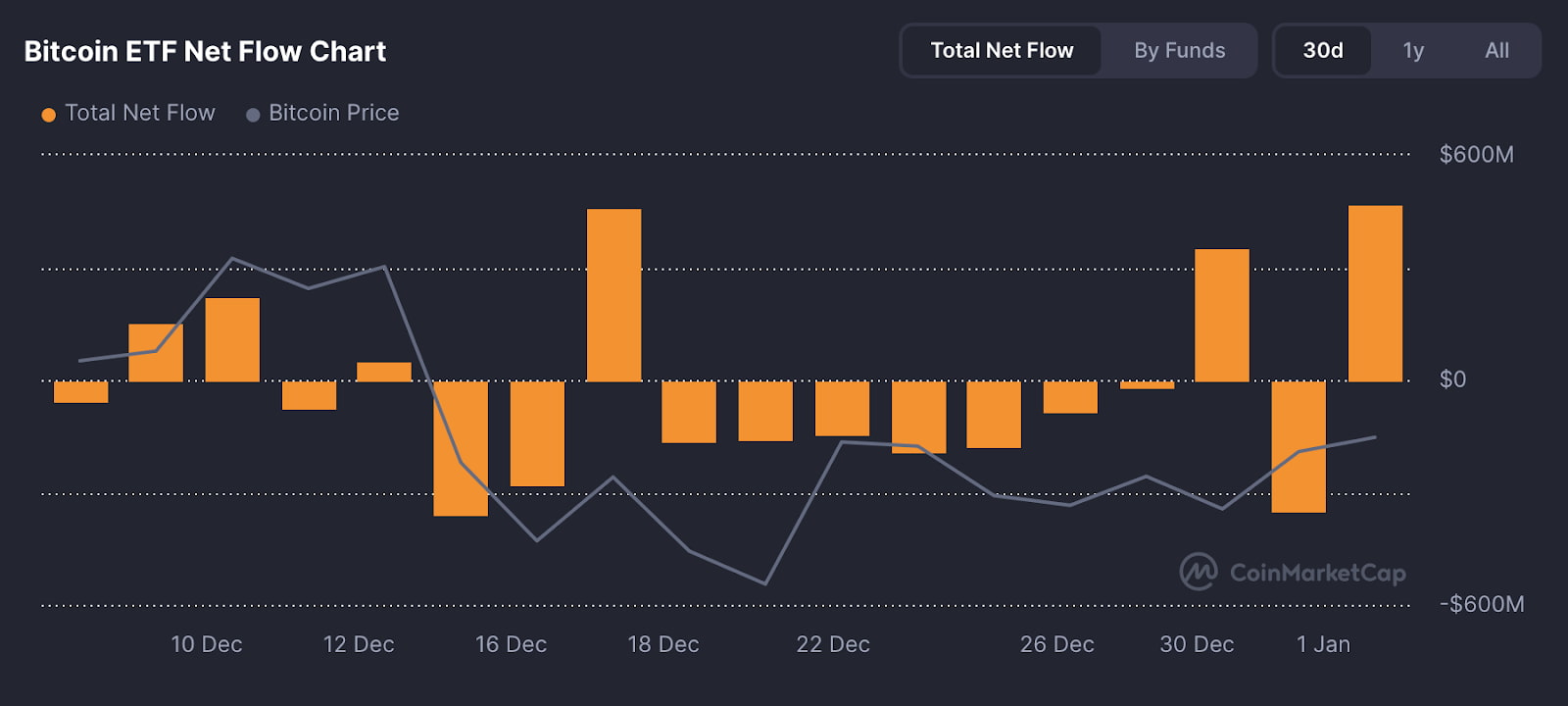
While broader macro conditions offer solid support, one key catalyst is still being largely overlooked: Bitcoin Hyper. As the project moves closer to launch, early backers are starting to assess how its ability to introduce Solana-like speed to the Bitcoin layer could unlock fresh demand, potentially serving as the missing trigger for Bitcoin’s next upward move.

Why Bitcoin Hyper Could Be the Trigger for the Next Bull Run

Bitcoin Hyper has already secured more than $30.1 million in total funding, driven by investor interest in a high-performance ecosystem built to remove Bitcoin’s long-standing structural constraints without weakening its underlying security.

At its core, Bitcoin’s strength comes from its extreme simplicity. Keeping block sizes in the 2MB to 4MB range helps ensure that running a node remains affordable for individuals. If block sizes were pushed to extremes such as 1GB or more, only large data centers could handle the hardware demands required to validate the network. That shift would exclude everyday users running nodes from home, effectively centralizing verification.

The Proof-of-Work (PoW) model is just as essential. Miners must expend real-world energy to solve cryptographic puzzles in order to earn BTC rewards. This tangible cost was highlighted by Elon Musk in an October post last year, where he described Bitcoin as being “based on energy,” noting that while digital information can be copied, energy cannot be faked.

This real-world constraint makes attacking the network economically irrational. Any actor attempting to compromise Bitcoin would need to outspend the combined energy and hardware of all existing miners a cost so high that it renders such an effort pointless.
While these traits make Bitcoin one of the strongest stores of value ever created, they also limit transaction speed and programmability.

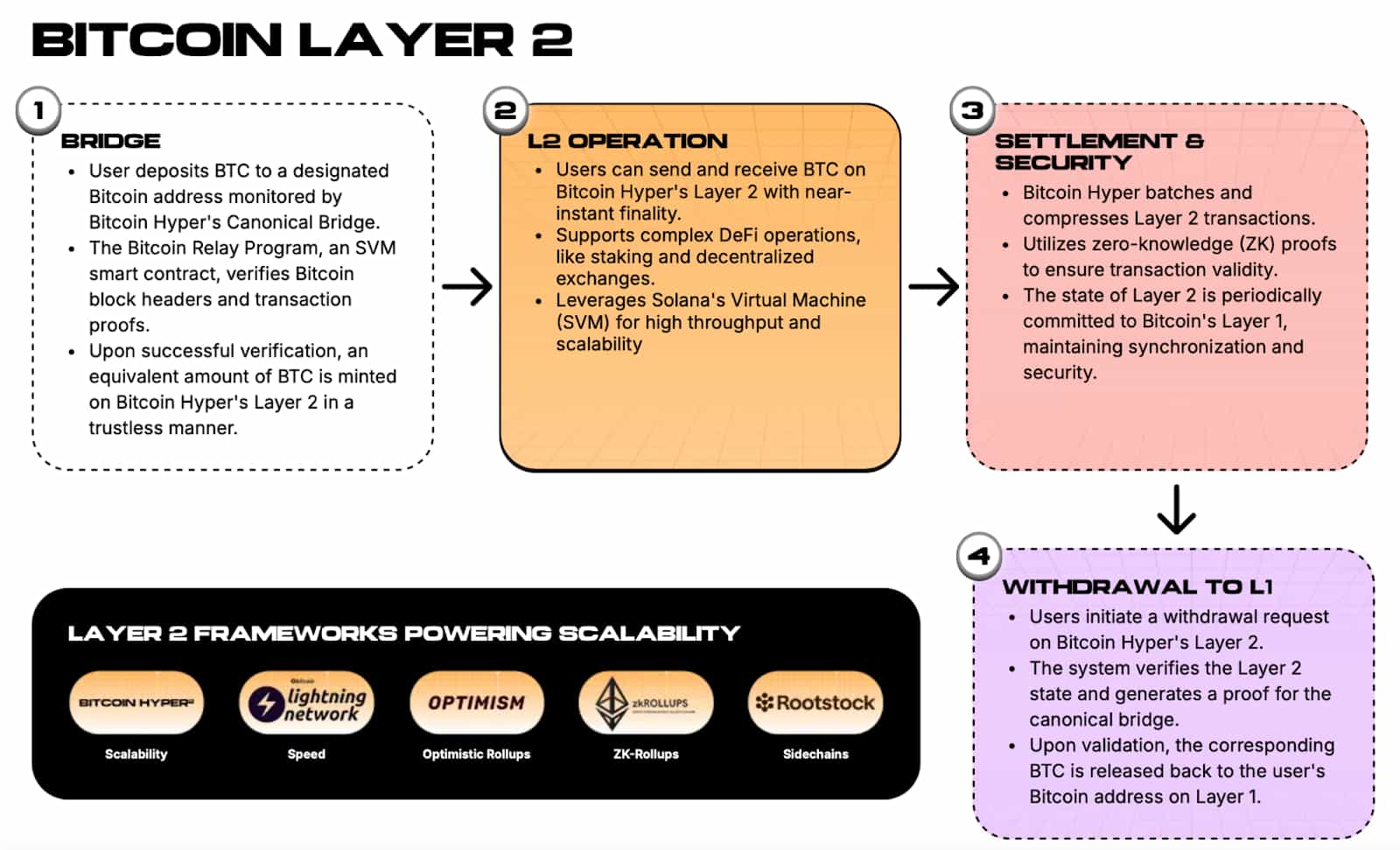
Bitcoin Hyper is designed to solve this trade-off. The project builds on Bitcoin’s security while introducing a high-speed execution layer. Using a canonical bridge, Bitcoin Hyper connects its SVM-based execution environment directly to the Bitcoin base layer.

Through a lock-and-mint mechanism, every Bitcoin secured within the bridge is matched 1:1 by an equivalent asset minted on Layer-2. This setup enables developers to create Rust-based decentralized applications that benefit from Bitcoin’s security while achieving near-instant finality via the Solana Virtual Machine.

The end result is a system where Bitcoin can operate as programmable money for the first time, delivering Solana-level performance without sacrificing the robustness of its base layer.

Powering Bitcoin’s Utility Through HYPER

As hybrid applications continue to expand, investors are increasingly expecting Bitcoin to transition from a passive store of value into a fast-moving utility asset. For early supporters, the core opportunity lies in building a clear “demand channel” where BTC is actively used as the main currency within a new wave of decentralized applications, rather than remaining idle.

The scale of this potential shift is substantial. If Bitcoin Hyper succeeds in drawing a meaningful share of BTC supply into its bridge, billions of dollars could move from passive holding into active circulation. Within this framework, Bitcoin would flow through DeFi protocols and consumer-focused apps, breaking away from its long-standing role of sitting unused in cold storage.

This evolution also sets up a strong alignment with the HYPER token. As the Layer-2 network attracts more Bitcoin liquidity and handles increasing transaction activity, demand for the native token is expected to grow alongside it. With HYPER serving as the gas token for the network, it becomes a critical component for processing and settling transactions.


This is why HYPER’s growth as an asset closely mirrors Bitcoin’s expansion within the ecosystem. Beyond simply settling transactions, the token also underpins staking and governance, giving it a layered utility model that extends across the network.

Given the scale and ambition behind Bitcoin Hyper, early participants increasingly view HYPER as a key gateway to unlocking Bitcoin’s next multi-billion-dollar utility phase. That belief is driving strong interest in the presale, with investors eager to secure exposure while the opportunity is still available.

How to Join the Race to Buy HYPER at Presale

With significant funding already secured, the window to purchase HYPER at presale prices is narrowing.

To secure HYPER during the presale, visit the Bitcoin Hyper website and buy the token using SOL, ETH, USDT, USDC, BNB, or a credit card.

Bitcoin Hyper recommends using Best Wallet, widely regarded as one of the leading crypto and Bitcoin wallets available today. HYPER is already listed in Best Wallet’s Upcoming Tokens section, allowing users to easily buy, track, and later claim their tokens once trading goes live.

Those looking to stay updated can also join the Bitcoin Hyper community on Telegram and X.

Visit Bitcoin Hyper.

Questions liées

QWhat is Bitcoin Hyper (HYPER) and how much funding did it attract over the weekend mentioned in the article?

ABitcoin Hyper (HYPER) is positioned as the fastest Layer-2 solution built on the Bitcoin network. It attracted an additional $100,000 in funding over the weekend, following its $30 million raise on Friday.

QWhat key technological combination does Bitcoin Hyper claim to achieve, and what problem does it aim to solve?

ABitcoin Hyper claims to combine Solana-level speed with Bitcoin's security. It aims to solve the trade-off between Bitcoin's strong security and its limitations in transaction speed and programmability, enabling Bitcoin to operate as programmable money for the first time.

QAccording to the article, what major geopolitical event is cited as a driver behind Bitcoin's bullish narrative and its role as a safe-haven asset?

AThe major geopolitical event cited is the U.S. capture of Venezuelan President Nicolas Maduro. This development reignited global discussions around sovereignty and risk, reinforcing Bitcoin's role as a safe-haven asset.

QWhat is the current price of the HYPER token in its presale, and how soon is the next price increase expected?

AThe HYPER token is currently priced at $0.013535 in its presale. The next price increase is expected in 36 hours when the next funding round triggers the change.

QWhat specific function does the native HYPER token serve within the Bitcoin Hyper ecosystem?

AThe native HYPER token serves as the gas token for the Bitcoin Hyper network, which is critical for processing and settling transactions. It also underpins staking and governance, giving it a layered utility model across the network.

Lectures associées

J'ai mis un an à comprendre la vérité déchirante sur les paiements des Agents

Pendant un an, j'ai travaillé sur l'infrastructure de l'économie des agents, échangeant avec des acteurs majeurs comme Stripe, Visa, Coinbase, et des dizaines de startups. La vérité est déconcertante : il n'existe pas encore de demande réelle, et les startups font face à des problèmes structurels. **Agent vs Commerce :** L'expérience utilisateur du shopping par IA est inférieure au e-commerce traditionnel pour la plupart des produits, qui reposent sur une navigation visuelle. Les agents excellent à comprendre les besoins, mais ne remplacent pas la comparaison côte à côte. La demande actuelle des marchands est défensive : ils veulent être "trouvables" par les agents (Agent Engine Optimization) par peur de rater une future tendance. Les niches potentielles (commande de nourriture, navigation dans des interfaces complexes) nécessitent une distribution de masse, domaine des géants. **Agent vs API :** Les développeurs ont déjà des relations de facturation établies pour les API qu'ils utilisent (calcul, données...). Le problème des micro-paiements est résolu par le prépaiement. L'obstacle profond est que les grands fournisseurs SaaS privilégient les contrats entreprises. Les protocoles pour un marché long tail (petits services, données de niche) existent, mais ciblent un segment intrinsèquement réduit et peu disposé à payer. **Agent vs Agent :** C'est une vision à long terme, purement théorique actuellement, sans volume significatif. Ce marché nécessiterait une infrastructure de règlement dédiée pour des transactions ultra-rapides, à très faible coût et potentiellement multipartites. C'est un pari réel mais lointain. **Agent vs Finance :** C'est la seule catégorie avec une demande actuelle et une volonté de payer. Intégrer l'IA dans les flux de travail financiers existants (gestion de portefeuille, DeFi) est une évolution naturelle et crée de nouvelles capacités. Cependant, la concurrence est rude face aux institutions établies, régulées et bien connectées. **Le véritable enjeu :** Les géants construisent par motif stratégique et marge financière. Pour les startups, la priorité n'est pas le simple transfert de fonds (paiement), mais la **coordination** entre agents et humains : organiser le travail, vérifier les résultats, puis régler. La coordination est le gâteau ; le paiement n'en est qu'une part. Ce sont les entreprises qui résoudront la coordination qui absorberont la fonction paiement, et non l'inverse.

链捕手Il y a 7 mins

J'ai mis un an à comprendre la vérité déchirante sur les paiements des Agents

链捕手Il y a 7 mins

Claude Opus 4.8 trouve un bug de 4,5 milliards de dollars : l'ère de l'IA produit des pirates informatiques en masse

Un chercheur en sécurité a découvert une faille critique dans le protocole Orchard de Zcash, permettant une création illimitée de jetons, ce qui a entraîné une chute de 50% de sa valeur marchande. Cette vulnérabilité a été identifiée à l'aide de Claude Opus 4.8 d'Anthropic, un modèle d'IA récemment publié et accessible. Cet événement illustre un changement profond : l'IA rend la découverte de vulnérabilités accessible à tous, pas seulement aux experts. Des modèles comme Opus, ou le plus puissant mais restreint Claude Mythos Preview, démocratisent cette capacité. Cela génère un double problème : un flux massif de rapports de bugs, souvent faux ou de faible qualité, qui submergent les mainteneurs de logiciels libres souvent bénévoles, et la mise au jour plus rapide de vraies failles critiques auparavant cachées. La sécurité internet a longtemps reposé sur le coût élevé de la découverte des vulnérabilités. Des failles historiques comme Heartbleed ont pu persister des années. Désormais, l'IA abaisse radicalement ce coût, multipliant simultanément les découvertes et les menaces potentielles. Cependant, la capacité à *corriger* les vulnérabilités ne suit pas. Le secteur souffre déjà d'une pénurie critique de talents humains capables d'analyser, de prioriser et de réparer ces failles. La sécurité repose sur une longue chaîne de collaboration humaine, déjà sous tension. En somme, l'IA illumine l'état réel de notre infrastructure numérique, révélant les failles accumulées. Le défi n'est plus tant de les trouver, mais de trouver assez de personnes pour les réparer et maintenir la confiance dans les systèmes dont dépend notre vie quotidienne.

marsbitIl y a 41 mins

Claude Opus 4.8 trouve un bug de 4,5 milliards de dollars : l'ère de l'IA produit des pirates informatiques en masse

marsbitIl y a 41 mins

Prévision du Prix de l'Ethereum : L'ETH pourrait doubler tandis que Cardano (ADA) et ce nouveau token approchent d'une hausse de 500 %

Le marché des cryptomonnaies montre des signes de regain alors que les investisseurs se préparent pour le prochain cycle haussier majeur. Bien que les cryptos à grande capitalisation continuent de représenter une part importante des portefeuilles, une tendance émerge en faveur des projets offrant des rendements potentiellement plus élevés. L'article évoque le potentiel de trois actifs. Tout d'abord, Ethereum (ETH), actuellement à 2 014,7 $, pourrait voir son prix doubler pour dépasser les 4 000 $ en 2026 si le marché reste optimiste. Ensuite, Cardano (ADA), coté autour de 0,2329 $, est présenté comme un projet de couche 1 axé sur le développement durable, susceptible de bénéficier d'une reprise du marché. Enfin, l'accent est mis sur un nouveau token, Little Pepe (LILPEPE), en cours de prévente au stade 13 au prix de 0,0022 $. Ce projet, ayant déjà levé plus de 28 millions de dollars, vise à construire une blockchain de couche 2 compatible Ethereum, dédiée aux communautés de memes, promettant des coûts de transaction réduits et un écosystème d'applications. Certains investisseurs anticipent une hausse potentielle de 500% pour LILPEPE, misant sur la forte demande lors de la prévente, ses fonctionnalités écosystémiques (staking, lanceur de memes, gouvernance DAO) et sa communauté grandissante, attirée par des campagnes de giveaway. En conclusion, Ethereum et Cardano restent des investissements de long terme solides, tandis que Little Pepe attire l'attention des investisseurs en quête de croissance future, à l'approche d'un potentiel cycle haussier en 2026.

TheNewsCryptoIl y a 1 h

Prévision du Prix de l'Ethereum : L'ETH pourrait doubler tandis que Cardano (ADA) et ce nouveau token approchent d'une hausse de 500 %

TheNewsCryptoIl y a 1 h

Guide du mode Goal de Codex : comment inciter l'IA à poursuivre un objectif spécifique

**Titre : Guide de l'utilisation du mode Goal de Codex : Comment faire avancer l'IA vers un objectif concret** **Résumé en français :** Le mode Goal (/goal) de Codex transforme l'outil d'un assistant codant à requêtes ponctuelles en un agent exécutant capable de travailler de manière autonome sur un objectif à long terme, pendant des heures ou des jours. La clé du succès réside dans la définition d'un **critère de sortie clair et vérifiable** (ex : "réduire le temps de déploiement de 30%", "LCP sous 2.5 secondes"), permettant à Codex de savoir quand s'arrêter. Il est crucial de fournir des **orientations et des outils** pour guider ses efforts et mesurer les progrès dans un **environnement de test réaliste**, proche de la production. L'article met en garde contre les **objectifs visuels** purs ("reproduire un UI pixel-perfect"), qui peuvent mener à des impasses. Il recommande de les décomposer en spécifications fonctionnelles ou en checklist. Pour les tâches longues, un **suivi des progrès** via commits, PR brouillons, rapports ou notifications est essentiel. Enfin, une fois l'objectif atteint, une **phase de revue et de nettoyage** du code est nécessaire pour éliminer les tentatives infructueuses laissées en chemin. Le mode Goal représente ainsi un changement de paradigme : le développeur ne se contente plus de rédiger des prompts, mais **définit des objectifs, configure l'environnement et gère un agent d'exécution** pour des projets ambitieux.

marsbitIl y a 1 h

Guide du mode Goal de Codex : comment inciter l'IA à poursuivre un objectif spécifique

marsbitIl y a 1 h

De l’Ethereum à l’IA : que signifie le « CROPS » si souvent mentionné par Vitalik ?

Ces derniers temps, Vitalik Buterin a fréquemment mentionné le concept de « CROPS », un acronyme pour Censorship Resistance, Capture Resistance, Open Source, Privacy et Security (Résistance à la censure, Résistance à la capture, Open Source, Confidentialité et Sécurité). Au-delà d'une simple vision pour Ethereum, ce cadre définit des principes fondamentaux pour préserver la souveraineté des utilisateurs dans un environnement numérique de plus en plus centralisé, notamment avec l'avènement de l'IA. Initialement formalisé dans un mandat de l'Ethereum Foundation, CROPS guide les efforts pour garantir que les utilisateurs puissent interagir sans dépendre de plateformes uniques, sans perdre le contrôle final et sans être bloqués arbitrairement. Avec l'intégration croissante de l'IA dans la gestion des portefeuilles et l'exécution automatisée, ces principes deviennent cruciaux pour empêcher que les agents IA ne deviennent des "boîtes noires" centralisées ayant accès aux données sensibles et aux actifs des utilisateurs. Vitalik souligne ainsi la convergence entre une « couche d'accès Ethereum CROPS » et une « IA CROPS ». L'enjeu commun est de permettre aux utilisateurs d'accéder à des services (comme les appels à des modèles linguistiques distants ou la lecture de données blockchain via des RPC) sans divulguer leurs informations personnelles, leurs intentions ou leurs identités. Des technologies comme les preuves à connaissance nulle (ZK) pourraient y contribuer. En somme, CROPS n'est pas un slogan abstrait mais un filtre pratique pour le développement futur. Il positionne Ethereum et les écosystèmes Web3 comme des infrastructures essentielles pour un futur numérique où, malgré la puissance croissante de l'IA, les individus conservent le contrôle, la compréhension et la propriété de leur vie numérique. La confidentialité et la sécurité doivent être conçues dès l'origine, et non rajoutées après coup.

marsbitIl y a 1 h

De l’Ethereum à l’IA : que signifie le « CROPS » si souvent mentionné par Vitalik ?

marsbitIl y a 1 h

Trading

Spot
Futures

Articles tendance

Comment acheter LAYER

Bienvenue sur HTX.com ! Nous vous permettons d'acheter Solayer (LAYER) de manière simple et pratique. Suivez notre guide étape par étape pour commencer votre parcours crypto.Étape 1 : Création de votre compte HTXUtilisez votre adresse e-mail ou votre numéro de téléphone pour ouvrir un compte sur HTX gratuitement. L'inscription se fait en toute simplicité et débloque toutes les fonctionnalités.Créer mon compteÉtape 2 : Choix du mode de paiement (rubrique Acheter des cryptosCarte de crédit/débit : utilisez votre carte Visa ou Mastercard pour acheter instantanément Solayer (LAYER).Solde :utilisez les fonds du solde de votre compte HTX pour trader en toute simplicité.Prestataire tiers :pour accroître la commodité d'utilisation, nous avons ajouté des modes de paiement populaires tels que Google Pay et Apple Pay.P2P :tradez directement avec d'autres utilisateurs sur HTX.OTC (de gré à gré) : nous offrons des services personnalisés et des taux de change compétitifs aux traders.Étape 3 : stockage de vos Solayer (LAYER)Après avoir acheté vos Solayer (LAYER), stockez-les sur votre compte HTX. Vous pouvez également les envoyer ailleurs via un transfert sur la blockchain ou les utiliser pour trader d'autres cryptos.Étape 4 : tradez des Solayer (LAYER)Tradez facilement Solayer (LAYER) sur le marché Spot de HTX. Il vous suffit d'accéder à votre compte, de sélectionner la paire de trading, d'exécuter vos trades et de les suivre en temps réel. Nous offrons une expérience conviviale aux débutants comme aux traders chevronnés.

346 vues totalesPublié le 2025.02.11Mis à jour le 2026.06.02

Comment acheter LAYER

Discussions

Bienvenue dans la Communauté HTX. Ici, vous pouvez vous tenir informé(e) des derniers développements de la plateforme et accéder à des analyses de marché professionnelles. Les opinions des utilisateurs sur le prix de LAYER (LAYER) sont présentées ci-dessous.

活动图片













