Just Spent 250 Million to Buy Companies, Then Laid Off 30%: Polygon Is Changing Its Way of Survival

marsbitPublié le 2026-01-16Dernière mise à jour le 2026-01-16

Résumé

Polygon, a major blockchain scaling solution, has laid off approximately 30% of its workforce while simultaneously spending $250 million to acquire two companies: Coinme, a licensed crypto-fiat exchange with an extensive US ATM network, and Sequence, a wallet infrastructure and cross-chain routing provider. This strategic pivot signals a shift away from its core Layer-2 (L2) business, where it faces intense competition from dominant players like Base, and toward building a comprehensive stablecoin payment infrastructure called the "Open Money Stack." The acquisitions provide critical pieces for this new direction: Coinme offers regulatory licenses and on-ramps/off-ramps, while Sequence provides the technical backend for seamless cross-chain transactions. The goal is to target B2B clients like banks and payment providers. This move is seen as a necessary "blood change." Polygon's previous strategy, focused on enterprise adoption and NFTs, yielded limited long-term results. In the crowded L2 space, it struggled against competitors with superior user distribution, such as Base, which is integrated with Coinbase's massive user base. The new focus on stablecoin payments is a promising but highly competitive market, with giants like Stripe, PayPal also making significant investments. While Polygon CEO claims this puts them in competition with Stripe, the company is betting on an open infrastructure model versus Stripe's more closed ecosystem. The strategy carries risks. Coinme ...

Author: David, Deep Tide TechFlow

Today, I saw a piece of news: Polygon has laid off about 30% of its employees.

Although Polygon has not officially announced or responded, CEO Marc Boiron admitted to the layoffs in an interview, while stating that the total headcount would remain stable due to the addition of newly acquired teams.

On social media, some laid-off employees also posted, indirectly confirming the fact.

But just this same week, Polygon announced it spent $250 million to acquire two companies. Laying off people while spending big money—doesn't that seem a bit strange?

If it were purely a contraction, they wouldn't simultaneously spend $250 million on acquisitions. If it were an expansion, they wouldn't cut 30% of the staff. Looking at both events together, it seems more like a blood change.

They laid off people from the original business lines, freeing up positions for the teams brought in through acquisitions.

The $250 Million Purchase Was for Licenses and Payment Channels

The two acquired companies are Coinme and Sequence.

Coinme is an old company founded in 2014, providing channels for converting between fiat and cryptocurrencies, operating crypto ATMs at over 50,000 retail points in the U.S. Its most valuable asset is its licenses—it holds money transmitter licenses in 48 states. These are very hard to obtain in the U.S.; companies like PayPal and Stripe spent many years to gather them.

Sequence builds wallet infrastructure and cross-chain routing. Simply put, it allows users to avoid handling bridging, gas swapping, and other hassles themselves, enabling one-click cross-chain transfers. Its clients include Polygon, Immutable, Arbitrum, and it has a distribution partnership with Google Cloud.
The two acquisitions total $250 million. Polygon has named this suite the "Open Money Stack," positioning it as middleware for stablecoin payments, aiming to sell to B2B clients like banks, payment companies, and remittance providers.

My understanding of the logic is this:

Coinme provides compliant fiat on- and off-ramps, Sequence provides user-friendly wallets and cross-chain capabilities, and Polygon's own chain provides the settlement layer. Put together, these three pieces create a complete stablecoin payment infrastructure.

The question is, why is Polygon doing this?

On the L2 Path, Polygon Is Already Struggling

The situation in 2025 is clear: Base has won.

Coinbase's L2 grew from $3.1 billion TVL at the beginning of last year to $5.6 billion, capturing 50% of the entire L2赛道 (L2 track/race). Arbitrum held onto 30% but basically saw no growth. The remaining dozens of L2s mostly became unused after their airdrops ended.
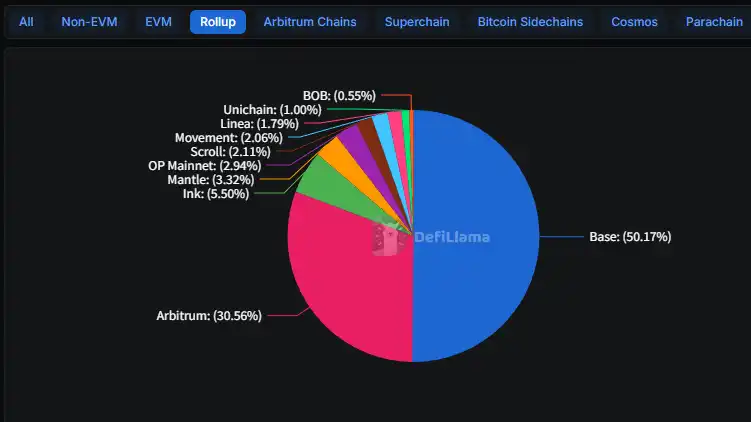
Where did Base win? Coinbase has hundreds of millions of registered users; any product feature launched naturally attracts users.

For example, deposits in the lending protocol Morpho on Base grew from $354 million at the beginning of last year to $2 billion now, primarily because it was integrated into Coinbase's App. Users can use it just by opening the App, without needing to know what an L2 or Morpho is.

Polygon doesn't have that kind of entry point. It also had layoffs in 2024, cutting 20% at that time, which was a bear market contraction—everyone was cutting staff.

This time is different; they have money on the books but still choose to lay off, indicating an active choice to change direction.

Remember before, Polygon's story was about enterprise adoption, like the Disney accelerator program, the Starbucks NFT membership plan, Meta's Instagram minting, Reddit avatars, etc.

Four years later, most of those collaborations have gone quiet. Starbucks' Odyssey program also shut down last year.

Continuing to fight Base head-on in the L2赛道 (L2 track/race), Polygon has almost no chance of winning. The technology gap can be closed, but the user entry point cannot. Rather than lingering on an unwinnable battlefield, it's better to seek new opportunities.

Stablecoin Payments Is a Good Direction, But It's Crowded

Stablecoin payments is indeed a growing market.

In 2025, the total market cap of stablecoins passed $300 billion, up 45% from the previous year. Their use is also changing, expanding from mainly moving funds between exchanges to cross-border payments, corporate treasury, payroll, and other scenarios.

But this market is already very crowded.

Stripe spent $1.1 billion last year to buy the stablecoin infrastructure company Bridge, and recently secured the issuance rights for the USDH stablecoin on Hyperliquid. PayPal's PYUSD already accounts for 7% of the stablecoin share on Solana.

Circle itself is pushing its Payments Network. JPMorgan, Wells Fargo, Bank of America, and other major banks are forming alliances to issue their own stablecoins.

Polygon founder Sandeep Nailwal said in an interview with Fortune that these acquisitions put Polygon in competition with Stripe.

Frankly, that's a bit of an overstatement.

Stripe's acquisition cost $1.1 billion; Polygon spent $250 million. Stripe has millions of merchants; Polygon's clients are mainly developers. Most importantly, Stripe has over a decade of accumulated payment licenses and banking relationships.

In a head-to-head fight, they are not opponents of the same caliber.

But Polygon might be betting on a different approach. Stripe wants to incorporate stablecoins into its closed loop, letting merchants still use Stripe, but with the settlement layer switched to stablecoins for faster and cheaper transactions.

Polygon wants to build open infrastructure, allowing any bank or payment company to build their own business on top of it.

One is vertical integration, the other is a horizontal切入 (cut-in/approach). These two models may not directly clash, but they are competing for the attention of the same group of customers.

Changing Its Way of Survival, the Road Ahead Is Uncertain

Finally, coming back to the point, layoffs in the crypto industry these past two years are not unusual.

OpenSea cut 50%, Yuga Labs, Chainalysis are all contracting. ConsenSys laid off 20% last year and again this year. Most are passive contractions; they are out of money and just trying to survive.

Polygon is different. They have money on the books, can still拿出 (take out/spend) $250 million for acquisitions, but still choose to lay off 30% of their people.

Changing blood to change its way of survival, but there are risks.

The core business of the acquired Coinme is crypto ATMs, with machines deployed at over 50,000 retail points across the U.S., allowing users to buy crypto with cash and cash out crypto.

The trouble is, this business ran into trouble last year.

California regulators fined Coinme $300,000 because its ATMs allowed users to withdraw over the limit, violating the $1,000 daily cap. Washington State was harsher, issuing a direct ban that was only lifted last December.

Polygon's CEO said Coinme's compliance situation "exceeds requirements." But regulatory penalties are black and white; pretty words don't change that.

Mapping these events back to the token, the narrative for the $POL token has also changed.

Previously, the more the chain was used, the more valuable POL became. After the acquisition, Coinme takes a commission on each transaction—this is real revenue, not token narrative. The official said they expect to achieve over $100 million annually.

If they can truly achieve this, Polygon could transform from a "protocol" into a "company," with revenue, profits, and a valuation anchor. This is a rare species in the crypto industry.

However, the speed at which traditional finance is entering is clearly accelerating, and the window for crypto-native companies is narrowing.

There's a saying in the industry: build in the bear market, harvest in the bull market.

Polygon's problem now is that it's still building, but the harvester in the bull market might no longer be it.


Questions liées

QWhy did Polygon lay off 30% of its employees while simultaneously spending $250 million on acquisitions?

APolygon is restructuring its workforce by cutting employees from its existing business lines to make room for new teams from the acquired companies, Coinme and Sequence, indicating a strategic shift rather than simple expansion or contraction.

QWhat are the key assets and roles of the two companies, Coinme and Sequence, that Polygon acquired?

ACoinme provides a fiat-to-crypto exchange channel with valuable money transmitter licenses in 48 U.S. states, while Sequence offers wallet infrastructure and cross-chain routing capabilities, together forming a complete stablecoin payment infrastructure for Polygon's new 'Open Money Stack'.

QWhat challenges is Polygon facing in the L2 (Layer 2) space that prompted this strategic shift?

APolygon is struggling to compete with dominant players like Base, which benefits from Coinbase's massive user base and integrated app features, making it difficult for Polygon to gain traction in the L2 market despite previous enterprise partnerships.

QHow does Polygon's approach to stablecoin payments differ from competitors like Stripe?

APolygon aims to provide open infrastructure for banks and payment companies to build their own services, whereas Stripe focuses on vertical integration by incorporating stablecoins into its existing closed-loop system for merchants.

QWhat risks does Polygon face with its acquisition of Coinme, and how might this affect its business model?

ACoinme has faced regulatory issues, including fines and bans for violating transaction limits, which could pose compliance risks. However, if successful, the acquisition could transition Polygon from a protocol to a company with real revenue streams, such as transaction fees from Coinme's operations.

Lectures associées

Venus Protocol Intègre des Actions Tokenisées comme Collatéral de Prêt sur BNB Chain

Venus Protocol intègre désormais des actions tokenisées comme garantie pour les prêts sur la BNB Chain, élargissant ainsi les cas d'utilisation des actifs du monde réel (RWA) dans le marché du crédit DeFi. **Points clés :** * Des actions tokenisées d'entreprises comme Apple, Tesla et Microsoft sont acceptées comme collatéral dans des pools de prêt isolés. * Ces actifs seraient adossés à 1:1 à des actions réelles détenues par des dépositaires régulés. * Les déposants peuvent emprunter des stablecoins ou du BNB contre ces garanties. Cette initiative permet aux détenteurs d'accéder à des liquidités sans vendre leurs positions sous-jacentes, rapprochant le crédit DeFi du financement sur marge traditionnel. Elle représente également une étape dans la compétition des blockchains pour attirer l'activité RWA. Cependant, ce collatéral introduit un profil de risque différent des actifs crypto-natifs, dépendant d'entités régulées hors-chaîne, de garde d'actifs et de processus de rachat. La gestion de l'évaluation des garanties, notamment avec des horaires de marché traditionnels, constitue un autre défi. Dans le contexte actuel du marché, cette intégration s'inscrit dans les tendances majeures que sont la tokenisation des actifs réels et la recherche d'une liquidité moins spéculative. Son succès dépendra de l'adoption réelle, de la fiabilité des custodians et des oracles de prix, ainsi que de la clarté des règles opérationnelles.

bitcoinistIl y a 1 h

Venus Protocol Intègre des Actions Tokenisées comme Collatéral de Prêt sur BNB Chain

bitcoinistIl y a 1 h

Le Triangle impossible est en réalité un faux problème

L'auteur conteste la pertinence du "trilemme" classique (décentralisation, scalabilité, sécurité) pour les blockchains. Il propose que les vrais freins à l'adoption massive sont la légitimité (environnement réglementaire) et le manque de confidentialité par défaut. La blockchain est définie comme un ordinateur partagé, lent et cher, dont la seule valeur unique est de fonctionner sans propriétaire ni permission. Seul l'argent natif (comme les stablecoins) est un actif adapté, car sa simple inscription au registre constitue sa valeur. Le marché actuel ne sert qu'une niche ("les gens assez aisés"). Les gros capitaux institutionnels restent à l'écart, principalement à cause des risques opérationnels et de deux défauts structurels : 1. **Légitimité** : L'absence de permission, essentielle, crée des zones grises réglementaires. Des progrès législatifs récents (ex: loi GENIUS) commencent à combler ce fossé. 2. **Transparence** : Celle-ci est présentée comme une vertu, mais constitue en réalité une taxe. Elle expose chaque transaction, position et paiement, permettant le MEV (extraction de valeur maximale) et décourageant toute entité sérieuse de révéler sa trésorerie au monde. L'auteur souligne l'ironie d'un système fondé sur la cryptographie qui ne protège pas la vie financière des utilisateurs. La solution réside dans une **confidentialité par défaut avec des preuves de conformité** (via des preuves à connaissance nulle - ZK). Cela permet de prouver un fait (solvabilité, respect des limites, KYC) sans révéler les données sous-jacentes, combinant ainsi protection individuelle et vérifiabilité pour les auditeurs et régulateurs. Cette évolution, purement améliorative, pourrait enfin attirer les milliers de milliards de capitaux institutionnels et faire de la blockchain l'infrastructure financière qu'elle était censée être.

marsbitIl y a 11 h

Le Triangle impossible est en réalité un faux problème

marsbitIl y a 11 h

L'impossible trilemme est un faux problème

L'industrie de la cryptographie a construit le système de cryptographie le plus puissant de l'histoire, mais son principal échec est l'absence de confidentialité financière par défaut. Chaque transaction, paiement et portefeuille est diffusé publiquement. La blockchain est essentiellement un ordinateur partagé, lent et coûteux, dont la seule valeur réside dans son absence de propriétaire unique et sa résistance à la censure. Pendant des années, le débat s'est concentré sur le "trilemme" (décentralisation, évolutivité, sécurité), qui est aujourd'hui largement résolu. Le vrai frein à l'adoption massive n'est pas là. La véritable contrainte est double : la légitimité juridique et le manque de confidentialité. Les fonds sont l'actif natif de la blockchain, mais les grands capitaux institutionnels restent à l'écart car l'environnement est perçu comme trop risqué et non conforme. La transparence totale de la chaîne n'est pas une vertu, mais une taxe. Elle expose les utilisateurs au MEV (Maximum Extractable Value), où les transactions sont espionnées et exploitées avant leur règlement, drainant des milliards de dollars de valeur. La plus grande ironie est que ce système, bâti sur la cryptographie, n'applique pas le chiffrement aux activités financières des utilisateurs, contrairement à la communication qui l'a adopté il y a des décennies. La solution n'est pas un anonymat total, mais une confidentialité prouvable et conforme. Les technologies cryptographiques modernes (comme les preuves à connaissance nulle) permettent de vérifier la solvabilité, la conformité KYC ou les limites de risque sans révéler les données sous-jacentes. Cela préserve les avantages de l'auditabilité tout en éliminant l'exposition permanente. En combinant un cadre réglementaire émergent (comme le GENIUS Act) et une confidentialité par défaut avec des mécanismes de divulgation vérifiable, la blockchain peut effectuer une mise à niveau pure. Elle cesse d'être un "tableur public coûteux" pour devenir une machine partagée qui confirme la véracité des transactions sans en divulguer le contenu. C'est le pont qui permettra aux capitaux institutionnels et à la finance traditionnelle de rejoindre la chaîne, débloquant ainsi les milliers de milliards de dollars qui attendent. Le système cryptographique le plus puissant apprend enfin à garder un secret, et cela change tout.

链捕手Il y a 12 h

L'impossible trilemme est un faux problème

链捕手Il y a 12 h

Des puces optiques en pleine expansion de production collective

La demande de puces photoniques connaît une croissance exponentielle, stimulée par les besoins en interconnexion optique des centres de données d'IA. Une course mondiale aux capacités de production est engagée. Aux États-Unis, Coherent étend sa ligne de production de semi-conducteurs InP de 6 pouces au Texas, soutenue par un financement et un investissement stratégique de Nvidia. Nokia développe ses capacités de test et d'emballage avancés en Pennsylvanie. Le japonais JX Advanced Metals prévoit d'augmenter sa production de substrats InP par 7 à 10 fois. En Europe, IQE et Tower Semiconductor ont conclu un accord d'approvisionnement à long terme pour les plaquettes InP, illustrant la tendance à l'intégration hétérogène des composants InP performants dans les plateformes silicium-optique matures. En Chine, l'expansion est rapide. Suzhou TFC Optical Communication (Solstice) investit 12 milliards de dollars dans un projet d'expansion. San'an Photonics possède une capacité de production mensuelle de 2 750 plaquettes pour les puces InP. Yunnan Germanium a lancé un projet pour augmenter la production de tranches de monocristal InP. La chaîne d'approvisionnement chinoise se consolide de la matière première au module. Malgré les débats sur les délais de déploiement du CPO (Co-Packaged Optics), l'augmentation globale de la consommation de contenu optique (moteurs photoniques, lasers) est incontestable, tirée par la demande croissante de bande passante dans l'IA. Le paysage futur impliquera probablement plusieurs architectures (silicium-optique, VCSEL, MicroLED) coexistant pour différentes distances et besoins. Cette frénésie d'expansion mondiale, des États-Unis et du Japon à l'Europe et la Chine, représente un pari collectif de l'industrie des semi-conducteurs sur l'avenir photonique de l'informatique à haute performance.

marsbitIl y a 14 h

Des puces optiques en pleine expansion de production collective

marsbitIl y a 14 h

Trading

Spot
Futures
活动图片