How to Capture the Potential Opportunities of the pump.fun Hackathon?

marsbitPublié le 2026-01-28Dernière mise à jour le 2026-01-28

Résumé

Pump.fun has announced a $3 million hackathon and the launch of its ecosystem venture fund, Pump Fund. Unlike traditional hackathons, this event has no judges or set themes. Instead, 12 winners will each receive $250,000 in funding based on market performance. Key rules require teams to hold at least 10% of their token supply and actively engage with the community via live streams on pump.fun. The hackathon is seen as an evolution of Pump.fun’s earlier GFF initiative, aiming to identify and support high-potential tokens with market caps targeting at least $10 million. It emphasizes stronger tokenomics, broader narratives beyond memes (such as AI, prediction markets, and privacy), and increased use of platform features like live streaming. Notable projects highlighted include $MIA (AI companion), $RAIN (AI prediction market), and $MONEROCHAN (privacy DeFi). Other participants like $LUMEN (evolving AI robot), $GOLD (AI-powered game token), and $PUMPCADE (real-time prediction market) are also in the running. The event reflects Pump.fun’s strategy to diversify content, boost engagement, and foster ecosystem growth through market-driven validation.

On January 20, pump.fun officially announced a hackathon with a prize pool of $3 million, and simultaneously launched the ecosystem venture fund Pump Fund.
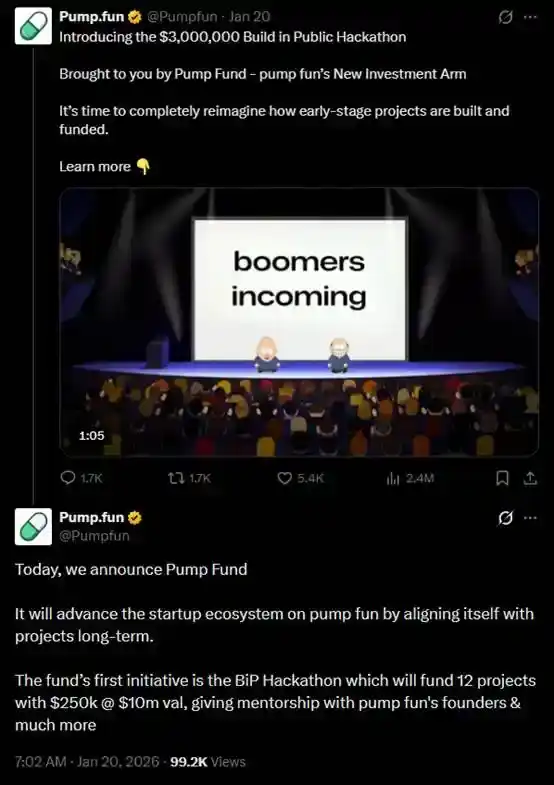
This is a very different hackathon. There are no judges, no theme, and there will be 12 winners, each taking away $250,000. Because of these special rules, before observing the projects, we need to first understand the logic behind this hackathon.

Called a Hackathon, Actually GFF 2.0

According to pump.fun's official statement, this hackathon abandons the traditional model of pleasing judges or investors to win funding, making the market the judge.

In short, it encourages everyone to launch tokens, and then it's up to their own abilities; whoever performs better in the market is more likely to win.

Apart from the requirement that the token must be deployed before the hackathon application deadline, the entire hackathon has almost only two restrictions. First, the team must own at least 10% of the token supply, and priority will be given to teams owning 20% - 50% of the supply. Second, the team must build "publicly," actively sharing their latest progress with the community, and priority will be given to teams that stream live on pump.fun at least 5 times a week.

For the最终 winning tokens, pump.fun will purchase $250,000 worth of tokens at a valuation of $10 million and provide ongoing consulting and incubation support.

This is hard not to remind people of last August, when pump.fun was challenged by the aggressive bonk.fun, they launched GFF (Glass Full Foundation), spending about $1.7 million to buy some well-performing meme coins in their ecosystem.

This hackathon, pump.fun is essentially still "buying coins," but in a more transparent and rule-based way, and the themes are no longer limited to pure meme coins. Based on the above interpretation of the rules, we can speculate on pump.fun's purpose and their understanding of the current market:

- Want to create 12 targets with at least a $10 million market cap

- Without good "control," there won't be new "golden dogs." If it's good control, it's called supply control adapted for long-term development. If it's bad control, it's called bundling.

- Still want to promote their own live streaming feature

- The theme of pure meme coins is too narrow; more narratives are needed for more revenue

At the same time, they have learned from the previous GFF lesson. GFF's promotion was just an announcement, with only a vague goal of "giving back to the ecosystem," and the theme was also limited to pure meme coins. Looking back now, it very much resembles a "wartime product" hastily created to deal with the bonk.fun challenge and the negative public opinion environment.

If following GFF's investments, the coin with the highest return was $neet, which rose over 200% at its peak two months after GFF's purchase, but more GFF holdings spiked instantly and then fell back.

Will this time be different? We cannot predict the future, only learn from history. A cautious strategy might be:

- Focus more on new coins, as new coins can bring more revenue to pump.fun

- Focus more on themes beyond pure meme coins, such as AI, Vibe Coding, or pump.fun live streaming coins

- Focus more on team background and influence, as this is a competition judged by market performance. If the founder is initially unknown, it's not easy to launch in the current market environment.

- Don't be too ambitious and long-term; don't expect pump.fun to do the work of helping those in need.

All of the above tells us that it is not easy to directly bet on "who will be the winner." If a token performs very strongly in the market, it actually doesn't need the official recognition from pump.fun to break through a $10 million market cap. Conversely, if a token needs official recognition from pump.fun as a driving force for its rise, then the token itself might not be that excellent.

Here, we can only look at some projects worth observing based on some available information and personal opinions that do not constitute investment advice.

3 "Case Studies" from the Official

First are the 3 coins that appeared as "case studies" in the official hackathon announcement: $MIA, $RAIN, and $MONEROCHAN.
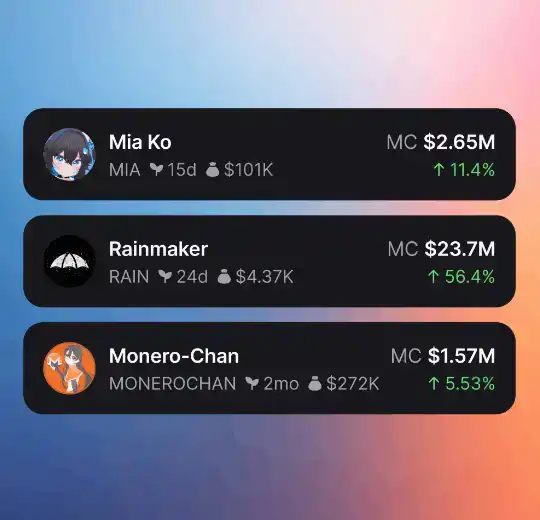
$MIA is building an interactive, multi-platform AI companion with real emotions. $RAIN is building an AI automated prediction market betting platform. $MONEROCHAN is building privacy DeFi on Solana.

$RAIN has a market cap of about $17 million, while $MIA and $MONEROCHAN are both around $1 million. However, none of these 3 tokens have publicly mentioned on their official Twitter whether they have applied to participate in this pump.fun hackathon, and for $MIA and $MONEROCHAN, it is unclear if the teams meet the hackathon's requirement of "the team holding at least 10% of the token supply."

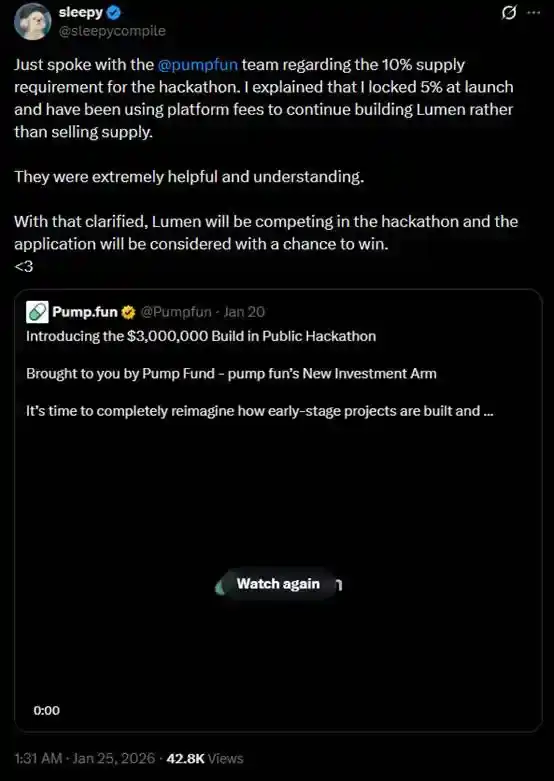
However, according to a tweet from the dev of the $LUMEN token, the requirement of "the team holding at least 10% of the token supply" can be leniently treated with a reasonable explanation.
From the 3 "case studies" given by pump.fun, we can also see that pump.fun might prefer the three sectors of AI, prediction markets, and privacy.

Observations on New Projects That Have Clearly Applied

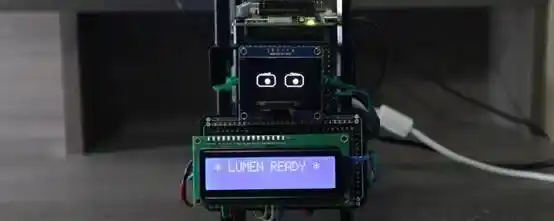
Lumen Frankenstein($LUMEN)

$LUMEN is building a robot that carries a continuously learning and evolving LLM with real emotions. The final product will be delivered to holders, and all delivered products will be connected to a backend cloud server, allowing all robots in the hands of holders to grow synchronously. The current market cap of this token is approximately $1.5 million.
Hyperscape($GOLD)

Under the AI theme, another competitor worth watching is $GOLD. The dev of this token is Shaw, the former founder of elizaOS and ai16z. Although, from TreasureDAO to ai16z, Shaw has issued too many assets and has a poor reputation among players.

$GOLD is the in-game token for the new game Hyperscape being developed by Shaw and his team, where 1 $GOLD = 1 in-game token. As the name suggests, this is a retro-style MMORPG like Runescape, built using AI and incorporating AI Agents powered by elizaOS. The game will be open source.
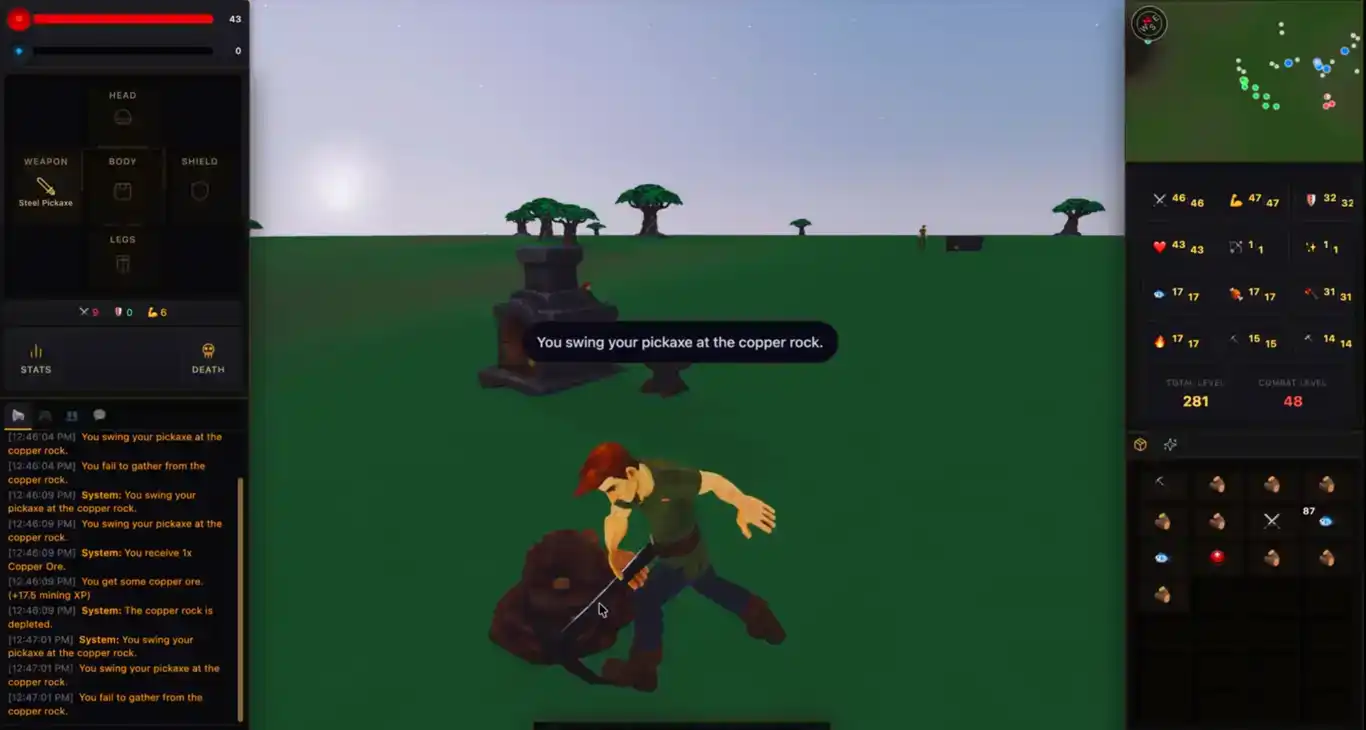
After briefly surging to nearly a $3 million market cap, $GOLD's current market cap is only about $360,000. Many players mock Shaw, but the final outcome is still hard to say.

PUMPCADE($PUMPCADE)

In the prediction market theme, a relatively outstanding competitor worth seeing is $PUMPCADE. This prediction market focuses on real-time betting on short-term volatility. Compared to prediction markets more friendly to medium-to-long-term beliefs, Pumpcade targets users seeking short-term entries and exits. For example, users might bet on the odds change for "Will Trump buy Greenland?" in the next hour, or they have developed a data source plugin for Runescape, allowing users to bet on the real-time收益 situation after killing a Boss, and so on.
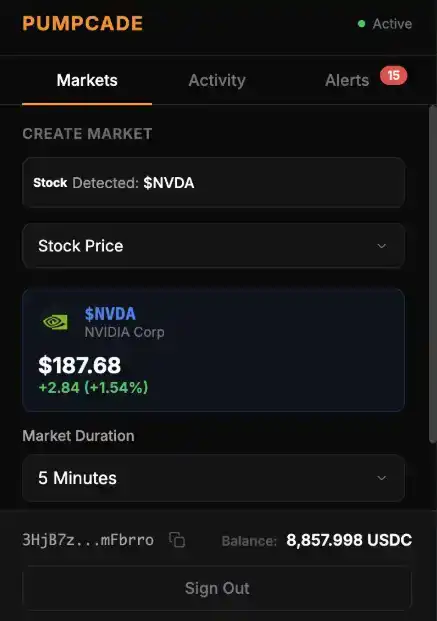
The current market cap of this token is approximately $3 million, having peaked at nearly $15 million.

The 3 non-"case study" projects mentioned above have clearly stated their participation in the pump.fun hackathon, but this is only for market observation and does not constitute investment advice.


Questions liées

QWhat is the total prize pool for the pump.fun hackathon and how many winners will be selected?

AThe total prize pool for the pump.fun hackathon is $3 million, and there will be 12 winners.

QWhat are the two main restrictions for teams participating in the pump.fun hackathon?

ATeams must own at least 10% of the token supply, and they must build publicly by actively sharing progress with the community, with a preference for teams that stream at least 5 times a week on pump.fun.

QWhat does the pump.fun hackathon's winning mechanism suggest about its purpose compared to the previous GFF initiative?

AThe hackathon, acting as GFF 2.0, uses a market-driven approach to select winners by acquiring their tokens at a $10 million valuation, aiming to create successful projects and diversify beyond pure meme coins, unlike the more reactive and meme-focused GFF.

QAccording to the article, what are some of the potential strategies for identifying promising projects in this hackathon?

AStrategies include focusing on new tokens that generate more revenue for pump.fun, prioritizing non-meme coin narratives like AI or prediction markets, evaluating team background and influence for better market performance, and avoiding overly long-term holds.

QName three example projects provided by pump.fun as 'case studies' for the hackathon and their respective focuses.

AThe three example projects are $MIA (an interactive, multi-platform AI companion with real emotions), $RAIN (AI-powered automated prediction market betting), and $MONEROCHAN (privacy-focused DeFi on Solana).

Lectures associées

Dialogue avec Ray Dalio : Nous sommes actuellement dans une bulle de l'IA, 1% de mon portefeuille est en Bitcoin

Ray Dalio, fondateur de Bridgewater Associates, met en garde contre la bulle actuelle de l'IA, présentant des signes classiques similaires aux précédents krachs financiers. Il explique qu'une combinaison de spéculation excessive, d'endettement et de changements de taux d'intérêt pourrait provoquer son éclatement, entraînant une récession économique. Dalio décrit également un « grand cycle » mondial d'environ 80 ans, caractérisé par des inégalités croissantes, des déficits publics élevés et des tensions géopolitiques. Nous serions actuellement dans une phase de déclin de ce cycle, avec un ordre mondial en transition. Pour protéger leur patrimoine, il conseille aux investisseurs de diversifier leurs actifs (actions, obligations, or, immobilier) plutôt que de détenir uniquement des liquidités. Il mentionne détenir environ 1% de Bitcoin, mais préfère l'or physique pour sa stabilité. Concernant l'IA, Dalio souligne qu'elle remplacera progressivement le travail intellectuel humain, creusant les inégalités. L'avenir appartiendra à ceux qui sauront allier intelligence humaine et collaboration avec l'IA. Enfin, il évoque un monde de plus en plus régionalisé, avec un affaiblissement de la puissance américaine, visible dans des conflits comme celui avec l'Iran, et la montée en puissance d'autres pôles, notamment la Chine.

marsbitIl y a 3 h

Dialogue avec Ray Dalio : Nous sommes actuellement dans une bulle de l'IA, 1% de mon portefeuille est en Bitcoin

marsbitIl y a 3 h

7,2 billions de KRW en une journée, les achats nets des investisseurs étrangers atteignent un record historique ce vendredi ! Wall Street : Les vents contraires sur les flux de capitaux sud-coréens se sont dissipés

Les marchés boursiers sud-coréens montrent des signes tangibles d'amélioration des flux de capitaux. Le 31 juillet, les investisseurs étrangers ont réalisé un achat net record de 7 200 milliards de wons sur une seule journée dans le KOSPI, marquant un renversement de la tendance de sorties massives observée ces derniers mois. En juillet, leurs ventes nettes mensuelles se sont fortement réduites à 9 800 milliards de wons, contre 48 400 et 44 500 milliards en juin et mai respectivement. Parallèlement, les institutions domestiques comme les fonds de pension ont inversé leur tendance, passant à un achat net de 1 000 milliards de wons en juillet. La Commission des services financiers a également resserré l'accès aux ETF à effet de levier sur actions individuelles pour les investisseurs de détail, réduisant ainsi la volatilité du marché. Citigroup Research maintient son objectif pour le KOSPI à 10 000 points, estimant que les vents contraires liés aux flux de capitaux s'atténuent. Des facteurs tels que les fondamentaux solides du secteur des puces mémoire, les faibles valorisations du marché, une économie robuste et un environnement politique favorable devraient soutenir le marché. La possibilité d'interventions des autorités pour stabiliser le marché offre également un filet de sécurité.

marsbitIl y a 3 h

7,2 billions de KRW en une journée, les achats nets des investisseurs étrangers atteignent un record historique ce vendredi ! Wall Street : Les vents contraires sur les flux de capitaux sud-coréens se sont dissipés

marsbitIl y a 3 h

Choc ! La prochaine IA d'OpenAI résout 10 problèmes du calibre de la Médaille Fields

**OpenAI provoque un séisme mathématique avec son nouveau modèle Astra** OpenAI a dévoilé des avancées mathématiques majeures réalisées par son modèle interne Astra, présenté par Sam Altman. L'IA aurait résolu ou fait progresser dix problèmes complexes dans des domaines variés comme la géométrie haute dimension, la théorie des groupes et la complexité quantique. Le résultat le plus marquant est la construction du premier groupe "non sofic" infini et finiment présenté, réfutant une conjecture de Mikhail Gromov vieille de 27 ans. Cette seule découverte est qualifiée de niveau "Prix Fields". Astra a également amélioré une borne fondamentale sur le problème de l'empilement des sphères en haute dimension, stagnant depuis 1978, et a réfuté la conjecture de rigidité d'Alain Connes en construisant une infinité de groupes non isomorphes partageant la même algèbre de von Neumann. Ces résultats, compilés dans un document de 249 pages, sont accompagnés de preuves formelles vérifiées par l'assistant Lean 4. OpenAI précise que le coût total de génération de ces démonstrations aurait été inférieur à 2000 dollars. La communauté mathématique réagit avec stupeur, certains experts y voyant un tournant historique où l'IA démontre une intuition et une capacité de raisonnement pouvant surpasser les meilleurs mathématiciens humains.

marsbitIl y a 4 h

Choc ! La prochaine IA d'OpenAI résout 10 problèmes du calibre de la Médaille Fields

marsbitIl y a 4 h

Grâce aux lancers de dés, les clés Bitcoin sont stockées hors ligne, mais tout le monde ne s'y mettra pas

Le titre « Les clés Bitcoin protégées par des dés, mais la méthode reste marginale » introduit un article sur la génération manuelle de graines de portefeuille Bitcoin à l'aide de dés. L'article explique le concept d'entropie, illustré par Claude Shannon, où un dé à six faces génère environ 2,585 bits d'incertitude. Il aborde le scandale récent de Coldcard, où une vulnérabilité du générateur de nombres aléatoires matériel a compromis des fonds. Les utilisateurs ayant généré leur phrase de récupération avec des dés (environ 99 lancers pour une haute sécurité) n'étaient pas affectés pour leur seed principal. Cependant, l'analyse du chercheur Kevin Loaec montre que d'autres fonctions du portefeuille (clés de copie, portefeuilles papier, mots de passe, etc.) utilisaient ce générateur défectueux et restaient vulnérables. L'article souligne les défis pratiques de la méthode des dés : elle est longue, sujette aux erreurs de saisie, et peu adaptée aux nouveaux utilisateurs qui pourraient mal l'exécuter. Il conclut que si cette méthode manuelle est robuste pour les experts, l'objectif à long terme est d'avoir un matériel et des logiciels générant une entropie fiable de manière simple et sécurisée. Il conseille aux propriétaires de Coldcard de vérifier leur firmware et les fonctions utilisées, et rappelle l'intérêt des solutions multi-signatures avec différents fabricants pour limiter les risques.

cryptonews.ruIl y a 8 h

Grâce aux lancers de dés, les clés Bitcoin sont stockées hors ligne, mais tout le monde ne s'y mettra pas

cryptonews.ruIl y a 8 h

Trading

Spot
活动图片




