FOLD Second Round Auction Now Live, Interfold Mainnet Launches Network Alpha, Building a New Paradigm for Confidential Coordination

marsbitPublié le 2026-08-18Dernière mise à jour le 2026-08-18

Résumé

Interfold announces two key developments: the launch of the second FOLD token auction and the mainnet deployment of Network Alpha, alongside enabling general FOLD transfers. The second auction, distributing 2% of total FOLD supply via Uniswap's mechanism, runs from August 17 to 19 UTC. Proceeds are allocated to liquidity and protocol development. This event marks the final limited distribution before full token transferability. Interfold's core mission is "confidential coordination"—enabling multiple parties to compute shared, verifiable results from private inputs without exposing underlying data. Network Alpha realizes this vision on mainnet. It utilizes encrypted execution environments (E3s) where inputs remain encrypted, computation occurs on-chain, and results are released via a distributed threshold decryption process. No single node holds full control. FOLD is integral to the network, as node operators stake it to secure the distributed cryptographic processes. The network is already being used for confidential on-chain governance in partnership with Aragon, showcasing practical applications like coercion-resistant voting. With Network Alpha live, Interfold transitions from protocol development to network operation, fostering an ecosystem for privacy-preserving, verifiable collaboration.

Interfold today announced two major milestones: the FOLD second round auction is now live, Network Alpha is officially running on mainnet, and FOLD's general transfer functionality has also been enabled.
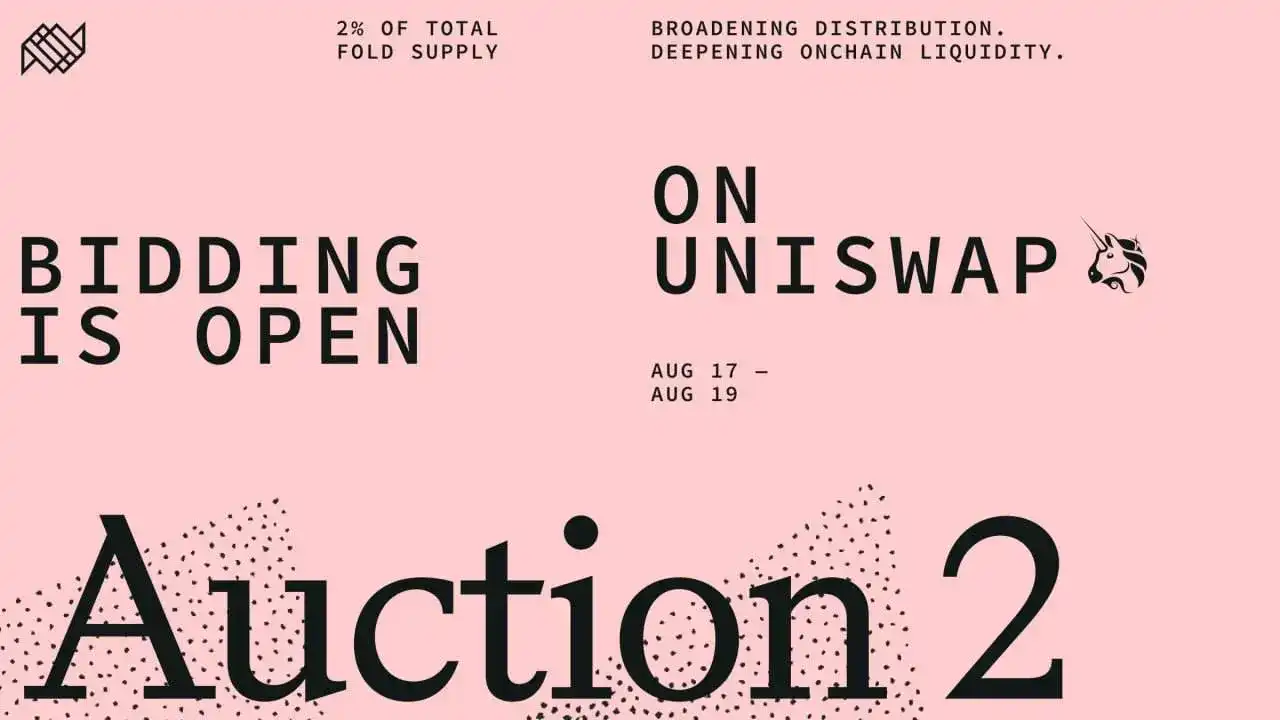
The second round auction, utilizing Uniswap's continuous clearing auction mechanism, offers a limited allocation of 2% of the total FOLD supply. The auction began on August 17th at 14:06 UTC and will run until August 19th at 13:06 UTC, with a starting price of 0.02154816 USDC per FOLD, matching the clearing price from the first auction.

This auction is positioned as the final limited distribution before FOLD's full transferability, aiming to broaden access to the token and enhance market infrastructure around the network. 50% of the auction proceeds will be dedicated to supporting long-term on-chain liquidity.

The Larger Vision: Confidential Coordination

The launch of FOLD serves a larger purpose.

As more global collaboration moves digital and computational, various organizations need to work together while preventing exposure of sensitive information to each other. Markets need to process private information, institutions need to analyze sensitive data, and communities need to hold verifiable elections without revealing individual voting preferences.
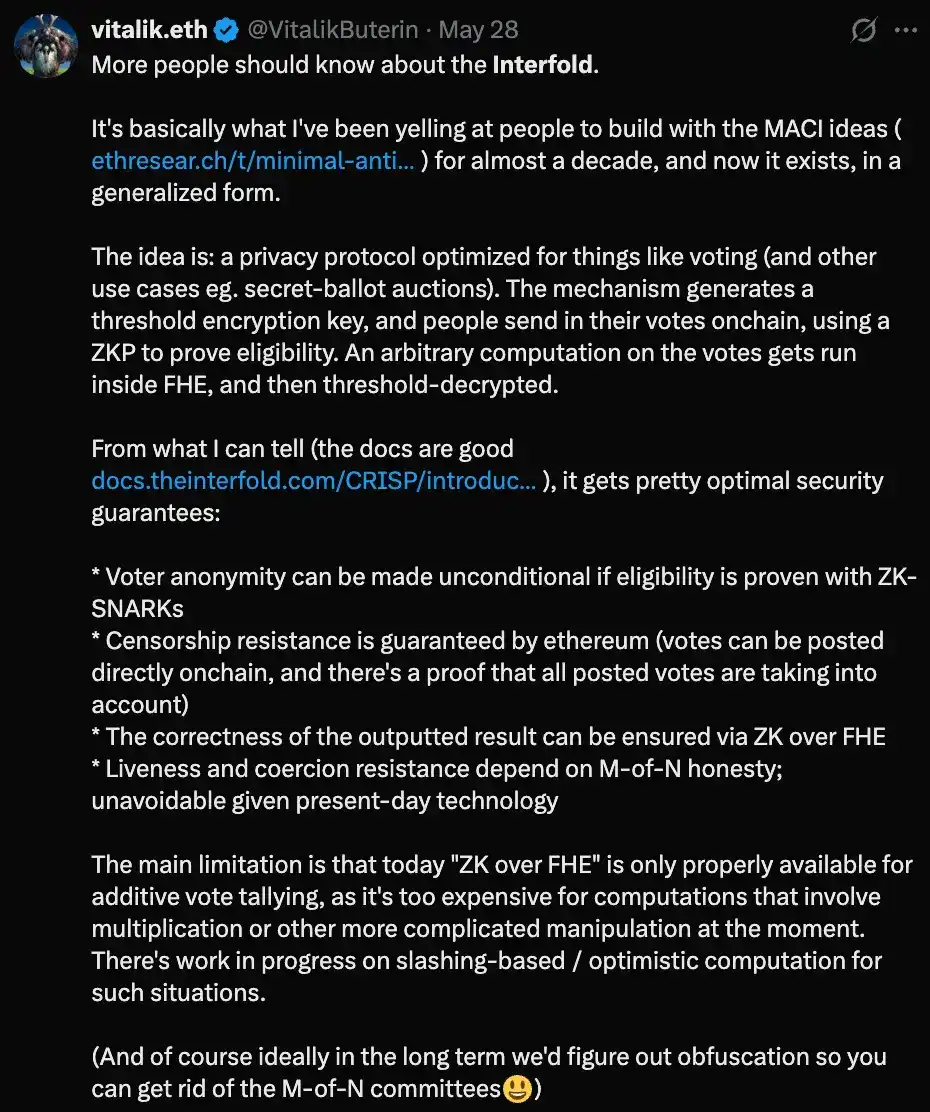
Today, such processes often require participants to hand over sensitive information, computational power, or control to centralized intermediaries. Interfold aims to change that.

Interfold is a decentralized network for confidential coordination: enabling independent parties to generate shared, verifiable outcomes from information they cannot directly reveal to each other.

The goal is simple: to collaboratively achieve a shared outcome without requiring anyone to reveal their underlying information.

Network Alpha Brings the Vision to Mainnet

Network Alpha is the first production version of this vision. On mainnet, encrypted execution environments (E3s) can complete their full lifecycle from deployment to operation. Participants can submit encrypted inputs, computation can proceed on those inputs, and authorized results are released through a distributed threshold process.

No single cryptographic node holds the complete decryption key or can independently control result release. Instead, cryptographic authority is distributed among multiple independent operators.

Through distributed key generation (DKG) and threshold decryption, the network collectively establishes the conditions under which private computation occurs and when authorized results can become public.

This constitutes a novel model for confidential computation: inputs are private, computation is shared, results are publicly verifiable, and the entire process is not controlled by any single machine. Network Alpha is now running this architecture on mainnet.

FOLD Becomes Part of the Network

With the opening of FOLD's general transfer functionality, FOLD enters a new phase. It is more than a transferable asset—cryptographic node operators can stake FOLD to participate in network duties, providing security for the distributed cryptographic processes that E3s rely on.

This directly ties the token to the network's underlying infrastructure. As Interfold grows, FOLD will play roles in distribution, liquidity, and network participation, linking economic incentives closely to the node operators responsible for confidential coordination.

A Network Designed for Real Use Cases

Network Alpha is already in practical use through its integration with Aragon for confidential governance. Votes remain encrypted throughout, while the network can generate end-to-end verifiable results. The system also features 'receipt-freeness,' meaning participants cannot prove their vote choice to others, effectively mitigating risks like coercion and vote-buying.

This is an early example of the broader problem Interfold solves: enabling multiple parties to feed private information into a shared process, while ensuring the original information remains confidential and the final outcome is verifiable.

The same architecture can readily extend to other collaborative scenarios requiring both privacy and verifiability.

Second Round Auction: Limited in Scale, Significant in Meaning

The second auction deliberately limits its size to 2% of the total FOLD supply. Its purpose is not to replicate the first auction, nor is it another large-scale funding round; it's a transitional step connecting initial token distribution to full network operation.

Starting at the clearing price of 0.02154816 USDC per FOLD established in the first round maintains launch continuity. Proceeds are allocated as follows: 25% is directly injected into a Uniswap liquidity pool, 25% is reserved for supplementary liquidity, and 50% goes to the Interfold Foundation treasury for continued protocol development.

This structure clearly points to Interfold's next phase: broader distribution, easier participation, robust liquidity, and a live network where FOLD can truly be used to solve significant privacy problems.

From Token Launch to Network Building

The significance at this moment extends far beyond the auction itself—Interfold is moving from 'building the protocol' into a new phase of 'operating the network.'

This means independent operators are starting to run infrastructure, developers are building confidential applications, participants are contributing to network processes, and organizations are using encrypted computation to collaborate around information that cannot be publicly disclosed.

Network Alpha intentionally starts at a manageable scale, allowing the ecosystem of node operators, supporting tooling, system performance, and use cases to evolve gradually in a live mainnet environment.

A protocol can be deployed at a moment, but a network grows through sustained participation.

The FOLD second round auction and the launch of Network Alpha are the starting points for this journey.

The FOLD second round auction is now open. Network Alpha is live on mainnet. Interfold is building the infrastructure for a world where information can stay private, yet collaboration remains verifiable.

Official Notice

Users should only participate in auctions, claims, transfers, and obtain contract and release information through official Interfold channels. Any unofficial links claiming to offer access to FOLD tokens, registration, verification, or auction participation may be fraudulent. Please exercise extreme caution.

About Interfold

Interfold is a decentralized network for confidential coordination. It enables independent parties to generate shared, verifiable outcomes from private inputs, without third-party custody, data exposure, or reliance on trusted hardware.

Interfold can support secret voting, sealed-bid auctions, and other coordination systems that require private inputs to produce verifiable results without relying on trusted operators.


Cryptos en tendance

Questions liées

QWhat are the two major announcements made by Interfold, and what is the significance of FOLD's general transfer functionality being enabled?

AInterfold announced the launch of the second FOLD auction and the mainnet launch of Network Alpha. The enabling of FOLD's general transfer functionality signifies that FOLD is entering a new phase where it is not just a transferable asset, but also a token that node operators can stake to participate in network duties and secure the distributed cryptographic processes for Encrypted Execution Environments (E3s).

QWhat is the core purpose or vision of the Interfold network?

AThe core vision of Interfold is to enable confidential coordination. It is a distributed network that allows independent parties to generate shared, verifiable results from private inputs that cannot be directly revealed to each other. The goal is to achieve coordination around a shared outcome without requiring anyone to disclose their underlying private information.

QHow does Network Alpha realize the vision of confidential coordination on the mainnet?

ANetwork Alpha, the first production version, realizes this vision by allowing Encrypted Execution Environments (E3s) to complete their full lifecycle on the mainnet. Participants can submit encrypted inputs, computations can be performed, and authorized results are released through a distributed threshold process. No single cryptographic node holds the full decryption key or controls the release unilaterally, as cryptographic authority is distributed among independent operators using Distributed Key Generation (DKG) and threshold decryption.

QWhat is a practical use case mentioned for Network Alpha, and what specific problem does it address?

AA practical use case is its integration with Aragon for confidential governance. It allows voting to remain encrypted throughout the process while the network generates end-to-end verifiable results. The system is also 'receipt-free,' meaning participants cannot prove their vote choice to others, thereby mitigating risks like coercion and vote buying.

QWhat are the key details and purpose of the second FOLD auction?

AThe second FOLD auction offers a limited share of 2% of FOLD's total supply via Uniswap's continuous liquidity auction mechanism. It runs from August 17, 14:06 UTC to August 19, 13:06 UTC, starting at 0.02154816 USDC per FOLD. Its purpose is to serve as a transitional step between the initial token distribution and the network's full operation, aiming to broaden token accessibility and enhance market infrastructure. 50% of the proceeds are dedicated to long-term on-chain liquidity support, with 25% directly added to a Uniswap pool and 25% for supplemental liquidity.

Lectures associées

Après CXMT, le temps d'Unitree : La valeur et le poids de la première action de robot humanoïde

**Résumé : La montée en puissance d'Unitree, la première société cotée en bourse spécialisée dans les robots humanoïdes** Le 19 août, Unitree Technology (688836.SH) a fait son entrée sur le STAR Market de la Bourse de Shanghai, devenant ainsi la « première action de robot humanoïde » du marché A. Son cours d'ouverture a bondi à 1100 yuans, soit une hausse de 629,44 % par rapport au prix d'introduction de 150,80 yuans, portant sa valorisation boursière à un sommet de 4450 milliards de yuans. Cette introduction, caractérisée par un processus d'approbation rapide et une demande d'investissement massive, a généré des profits substantiels pour les souscripteurs. Se présentant comme le « seul fabricant de robots humanoïdes rentable », Unitree a captivé le marché. Sa valorisation, initialement estimée entre 2000 et 2500 milliards de yuans, s'est rapidement ajustée à une fourchette de 3500 à 4500 milliards. Cette performance s'explique en partie par une faible liquidité initiale des actions et un fort soutien des investisseurs institutionnels stratégiques, dont DeepSeek, Tencent et des fonds souverains. Le fondateur, Wang Xingxing, est devenu la nouvelle personne la plus riche née dans les années 1990 en Chine, avec une participation valant plus de 110 milliards de yuans. Des investisseurs prestigieux comme Meituan (plus de 333 milliards de yuans de plus-value), le fondateur de DeepSeek Liang Wenfeng et le fondateur de Xiaomi Lei Jun (via Shunwei Capital) ont également réalisé des gains considérables. Sur la scène mondiale, Unitree, avec une production annuelle de plus de 5500 unités en 2025, rivalise avec des acteurs comme Figure AI (évalué autour de 2800 milliards de yuans) et devance Boston Dynamics. En Chine, il surpasse largement des concurrents comme Zhiyuan Robot ou Ubtech. Cependant, des défis persistent : un PER élevé, une commercialisation encore largement centrée sur la R&D et l'éducation (plus de 70 % des revenus), une pénétration industrielle limitée, des risques géopolitiques (régulations FCC américaines) et une concurrence croissante. Le marché attendra désormais qu'Unitree valide son potentiel par une croissance soutenue des bénéfices et une expansion réussie dans les applications industrielles. L'IPO d'Unitree s'inscrit dans la tendance des investissements en bourse chinois, qui privilégient désormais les entreprises de haute technologie ayant des revenus et profits tangibles, dans des secteurs comme l'IA, les semi-conducteurs et l'intelligence incarnée.

Odaily星球日报Il y a 8 mins

Après CXMT, le temps d'Unitree : La valeur et le poids de la première action de robot humanoïde

Odaily星球日报Il y a 8 mins

La réglementation centenaire des administrateurs en chaîne redémarre, a16z sous enquête antitrust

Le ministère américain de la Justice aurait ouvert une enquête antitrust sur le fonds de capital-risque Andreessen Horowitz (a16z). L'enquête, restée discrète pendant près d'un an, porte sur la question de savoir si des associés d'a16z occupent indûment des sièges aux conseils d'administration d'entreprises d'intelligence artificielle concurrentes. Plus précisément, le cofondateur Ben Horowitz siège au conseil de Databricks Inc., tandis que le partenaire Martin Casado siège à celui de Fivetran Inc., deux sociétés dont les activités principales – la collecte, l'organisation et l'analyse de données à grande échelle – se font directement concurrence. Cette enquête s'inscrit dans la continuité des efforts de l'ère Biden pour appliquer une loi de 1914 contre les "directorates imbriqués", où une même personne ou entité siège au sein de conseils d'entreprises rivales. Généralement, la solution dans ces cas est la démission de l'un des postes. L'affaire présente toutefois une particularité, car les mandats contestés sont exercés par différents associés d'a16z, et non par une seule personne physique, ce qui pourrait constituer une base de défense. L'enquête revêt une dimension politique notable, a16z ayant établi des liens avec l'administration Trump et étant un acteur influent dans l'élaboration des politiques d'IA. Le fonds, qui gère 90 milliards de dollars d'actifs et vient de lever un fonds historique de 15 milliards, a investi des milliards dans de nombreuses startups d'IA. L'issue de l'enquête reste incertaine et pourrait ne déboucher sur aucune mesure.

marsbitIl y a 42 mins

La réglementation centenaire des administrateurs en chaîne redémarre, a16z sous enquête antitrust

marsbitIl y a 42 mins

Token : une course folle qui laisse-t-elle une part du gâteau aux citoyens ordinaires ?

L'économie des Tokens, unités de base des modèles linguistiques d'IA, connaît une croissance explosive en Chine, avec une consommation quotidienne dépassant 140 000 milliards. Cependant, cet article questionne si cette métrique, souvent célébrée comme un indicateur de progrès, profite réellement à l'économie réelle et aux citoyens ordinaires. L'argument central est que la croissance des Tokens est largement pilotée par l'offre (investissements, infrastructures, subventions publiques, achats par les entreprises et l'État) et confondue avec la demande finale. Des politiques, comme à Beijing Yizhuang, subventionnent la consommation de Tokens par les entreprises, mais cela reste une dépense intermédiaire. Peu de preuves montrent que ces gains de productivité se traduisent par de meilleurs salaires, plus de temps libre, des services publics améliorés ou un pouvoir d'achat accru pour les ménages. L'article déconstruit le récit linéaire selon lequel plus de Tokens mène nécessairement à plus de prospérité partagée. Il souligne les écarts entre l'utilisation, l'accomplissement des tâches, la rentabilité des entreprises et le bien-être social. Le cas du modèle *Doubao* de ByteDance, responsable de la majorité de la consommation nationale principalement pour la génération vidéo, illustre une concentration plutôt qu'une pénétration large. Enfin, l'analogie avec Henry Ford et le fordisme est utilisée pour souligner un angle mort : la focalisation actuelle sur l'efficacité productive (la "moitié" de Ford) omet la nécessité de construire les institutions sociales – salaires stables, protection sociale, consommation de masse – qui permettent de redistribuer les gains de la productivité. Le risque est que la puissance réelle de l'IA soit capturée par un système excellant dans l'expansion de l'offre, sans créer automatiquement les acheteurs ou les bénéficiaires de cette nouvelle abondance.

marsbitIl y a 55 mins

Token : une course folle qui laisse-t-elle une part du gâteau aux citoyens ordinaires ?

marsbitIl y a 55 mins

Portefeuilles cryptographiques des institutions de Wall Street au T2 : La majorité des institutions ont augmenté leurs positions contre la tendance, l'exposition à l'ETH surpasse systématiquement celle au BTC

En raison de la déclaration obligatoire du formulaire 13F pour le Q2, les positions cryptographiques des institutions de Wall Street ont été révélées, montrant une tendance contraire à la performance des prix. Alors que le Bitcoin a chuté d'environ 14,2%, les positions institutionnelles déclarées en BTC ont augmenté de 7,5% pour atteindre environ 536 000 unités. Dans le même temps, les ETF américains sur le Bitcoin ont subi des rachats nets importants, avec un record de sorties en juin. De manière significative, l'exposition des banques à l'Ethereum a surpassé celle du Bitcoin. Morgan Stanley a vu sa position ETH augmenter de 18,6% (contre +3,7% pour le BTC), et JPMorgan a enregistré une hausse de 67,3% pour l'ETH (contre +12,2% pour le BTC). Des institutions comme Bank of America ont multiplié leur position dans l'ETHA par environ 29. Ceci survient malgré des sorties nettes globales des ETF spot Ethereum au Q2. Jane Street, qui avait réduit sa position dans l'IBIT au Q1, l'a fortement reconstituée avec une augmentation d'environ 324%. Plusieurs hedge funds ont réduit leurs positions spot mais ont utilisé des options pour maintenir leur exposition. Les institutions ont affiché des opinions divergentes sur les actions liées à la cryptomonnaie comme MicroStrategy, certaines réduisant leurs positions tandis que d'autres achetaient. De nouveaux entrants comme la Banco Santander ont divulgué pour la première fois des positions dans des ETF Bitcoin et Ethereum. D'autres, comme Morgan Stanley, ont initié des positions dans des produits Solana et XRP. Dans l'ensemble, les flux des ETF et les actions institutionnelles semblent se découpler, l'institutionnalisation des actifs cryptographiques s'approfondissant, avec un intérêt croissant pour l'Ethereum. Les flux dans les ETF Ethereum sont devenus positifs au Q3, accompagnant une hausse des prix.

marsbitIl y a 1 h

Portefeuilles cryptographiques des institutions de Wall Street au T2 : La majorité des institutions ont augmenté leurs positions contre la tendance, l'exposition à l'ETH surpasse systématiquement celle au BTC

marsbitIl y a 1 h

Trading

Spot

Articles tendance

Comment acheter AUCTION

Bienvenue sur HTX.com ! Nous vous permettons d'acheter Auction (AUCTION) de manière simple et pratique. Suivez notre guide étape par étape pour commencer votre parcours crypto.Étape 1 : Création de votre compte HTXUtilisez votre adresse e-mail ou votre numéro de téléphone pour ouvrir un compte sur HTX gratuitement. L'inscription se fait en toute simplicité et débloque toutes les fonctionnalités.Créer mon compteÉtape 2 : Choix du mode de paiement (rubrique Acheter des cryptosCarte de crédit/débit : utilisez votre carte Visa ou Mastercard pour acheter instantanément Auction (AUCTION).Solde :utilisez les fonds du solde de votre compte HTX pour trader en toute simplicité.Prestataire tiers :pour accroître la commodité d'utilisation, nous avons ajouté des modes de paiement populaires tels que Google Pay et Apple Pay.P2P :tradez directement avec d'autres utilisateurs sur HTX.OTC (de gré à gré) : nous offrons des services personnalisés et des taux de change compétitifs aux traders.Étape 3 : stockage de vos Auction (AUCTION)Après avoir acheté vos Auction (AUCTION), stockez-les sur votre compte HTX. Vous pouvez également les envoyer ailleurs via un transfert sur la blockchain ou les utiliser pour trader d'autres cryptos.Étape 4 : tradez des Auction (AUCTION)Tradez facilement Auction (AUCTION) sur le marché Spot de HTX. Il vous suffit d'accéder à votre compte, de sélectionner la paire de trading, d'exécuter vos trades et de les suivre en temps réel. Nous offrons une expérience conviviale aux débutants comme aux traders chevronnés.

331 vues totalesPublié le 2024.12.12Mis à jour le 2026.06.02

Comment acheter AUCTION

Discussions

Bienvenue dans la Communauté HTX. Ici, vous pouvez vous tenir informé(e) des derniers développements de la plateforme et accéder à des analyses de marché professionnelles. Les opinions des utilisateurs sur le prix de AUCTION (AUCTION) sont présentées ci-dessous.

活动图片