Crypto traders alert! Why Trump’s weekend post could trigger liquidations on Monday

ambcryptoPublié le 2026-04-04Dernière mise à jour le 2026-04-04

Résumé

Crypto traders are on high alert as former President Trump's weekend social media post regarding a potential escalation with Iran could trigger significant market liquidations on Monday. The crypto market, already vulnerable, closed Q1 with a nearly 21% loss, extending a severe downturn. This decline has moved in lockstep with soaring oil prices, which surged nearly 70% in Q1 due to Middle East tensions. Trump's post, warning of a severe attack on Iran's infrastructure, adds a critical layer of uncertainty. With U.S. stock markets closed over the weekend, the full market reaction has been delayed. Analysts now anticipate a highly volatile session when markets reopen, with oil potentially surging toward $200 per barrel. This could spark a sharp sell-off in equities, which would severely impact the crypto market. Bitcoin's positioning index has already turned negative, indicating traders are betting on further downside. The market is trapped in a liquidity crunch, making it extremely sensitive to any catalyst. A major, liquidation-driven downturn is now likely as Monday's session begins.

Is the worst still yet to come for crypto?

From a technical standpoint, the market is officially rolling into Q2. However, to see where it’s headed, we need to check where it’s been. Q1 closed with the total crypto market cap down nearly 21%, extending losses from Q4 2025 when it fell by about 24%.

In just six months, crypto has technically lost over $1.5 trillion. Bitcoin [BTC] hasn’t been spared either, making up 60% of those outflows – A sign that it’s lagging compared to other volatile assets. Backing this, the XAU/BTC ratio closed Q1 up almost 40%, underlining BTC’s relative weakness versus gold.
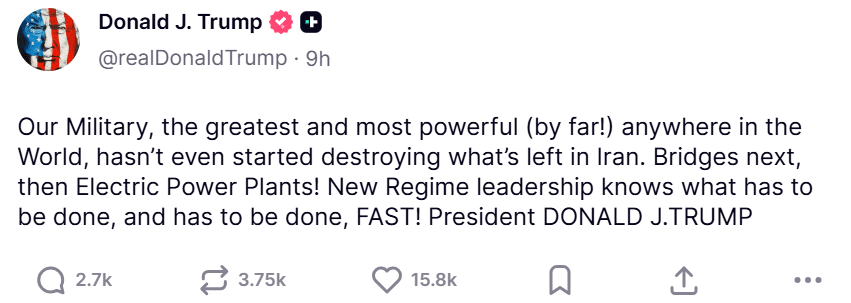
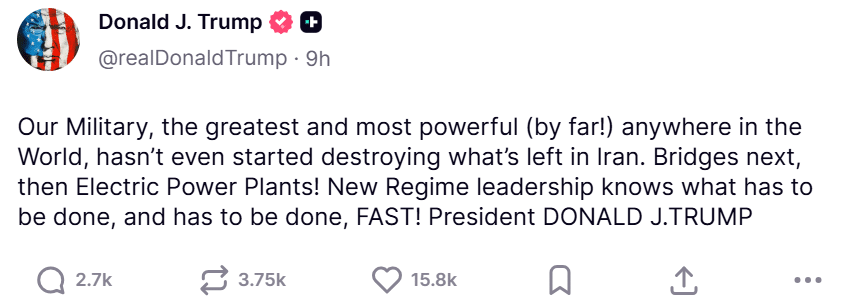
Source: TruthSocial

In short, despite recent optimism around Bitcoin’s “relative” resilience, Q1 revealed crypto was still the weakest performer across asset classes. Against this backdrop, a recent post by U.S President Donald Trump couldn’t have come at a more critical time.

In it, President Trump sounded a warning about a potentially severe attack on Iran’s infrastructure, putting ceasefire expectations on hold. However, more than the content, it’s the “timing” of the post that’s sparked a full-blown market frenzy. Notably, the U.S stock market will remain closed over the weekend, which means the post has temporarily prevented a liquidation cascade.

The real momentum shift, however, is in oil prices. Even before the post, oil had been rattling global markets. Now, the added geopolitical risk layers in more uncertainty. Traders and investors are likely to react as soon as the market reopens, making Monday a highly volatile session for equities. The spotlight, however, falls on crypto – Is a massive bloodbath looming?

Crypto locked in a liquidity trap as weekend market risk spikes

The crypto market’s nearly 21% drop in Q1 has moved almost in lockstep with oil prices.

Notably, this trend is set to shape Monday’s market, especially with equities likely to react. Take the NASDAQ (NDX), for example – It closed Q1 down nearly 6%, marking its worst quarterly performance since Q1 2025.

Here, the culprit is the ongoing Middle East conflict, which has created a massive oil supply squeeze. The Strait of Hormuz, responsible for roughly 20% of global oil exports, remains under serious threat. The impact is clear – Oil closed Q1 up nearly 70%, sending ripples across risk assets, including crypto.
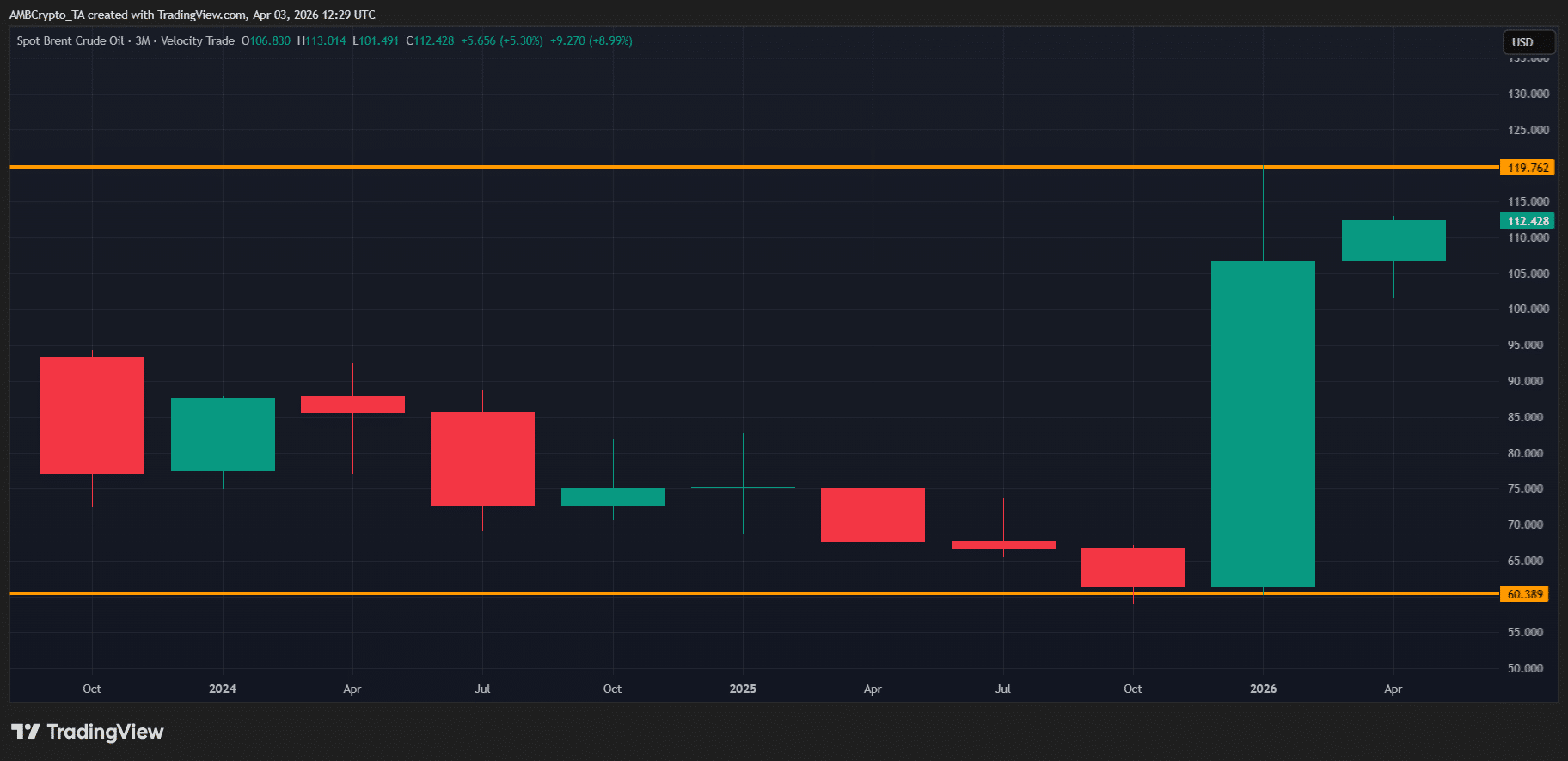
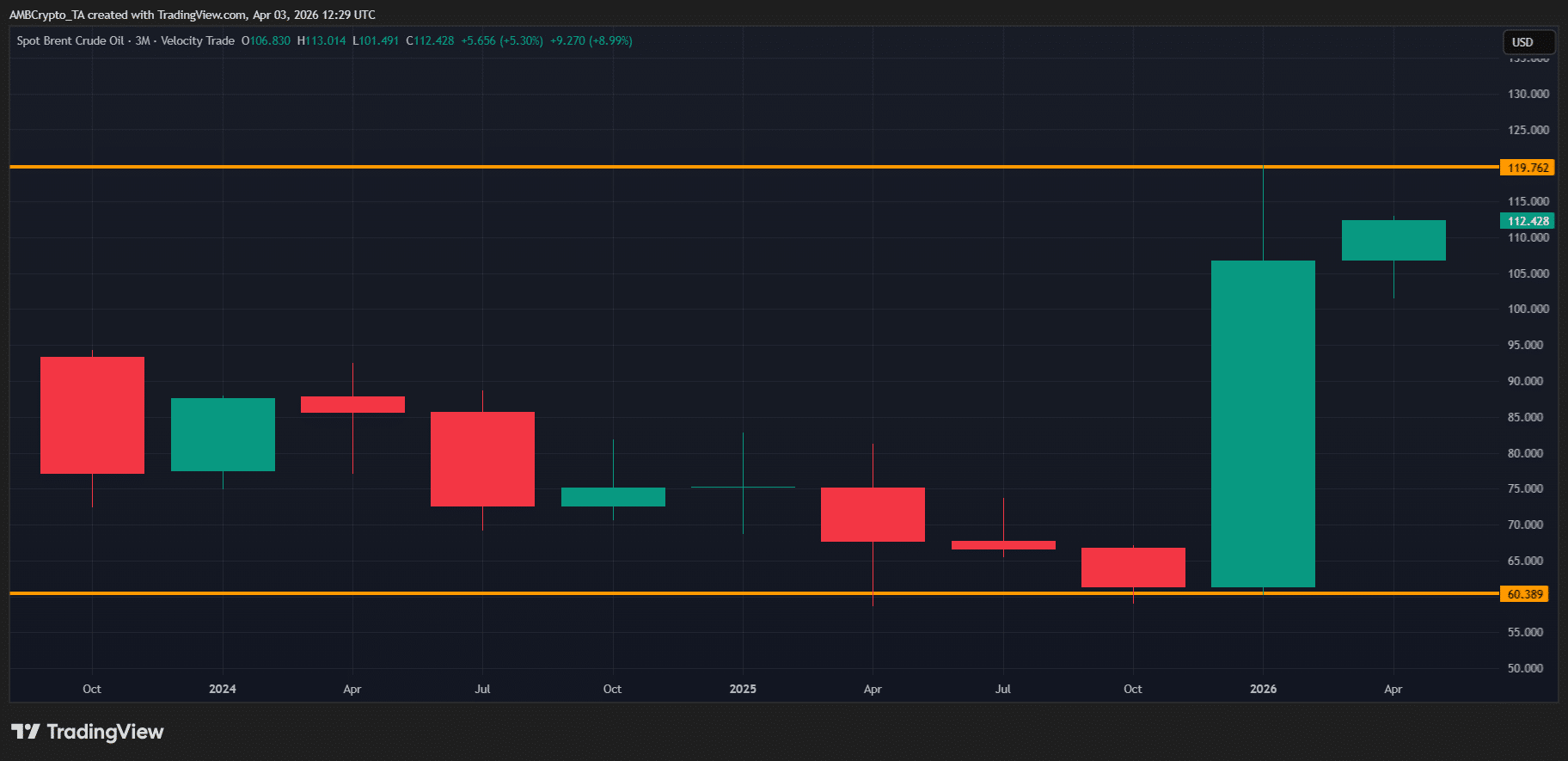
Source: TradingView (BRENT/USD)

According to AMBCrypto, that’s where President Trump’s recent post comes into play. With the escalation now official, analysts are expecting oil prices to surge towards $200 per barrel. In this context, Monday’s market reaction could be critical, with the odds of a sharp sell-off looking high.

Meanwhile, Bitcoin’s positioning index flipped negative, signaling that shorts are returning. This isn’t random. Instead, it’s a strategic move by traders, positioning for a potential downside in crypto once Monday’s session kicks off. With crypto heavily locked in a liquidity trap, even a small move could trigger sharp price swings, making the market extra sensitive to any catalyst.

Against this backdrop, President Trump’s post is now a key bearish trigger. Once Monday’s session begins, equities are set to react, putting crypto at high risk of a liquidation-driven bloodbath.


Final Summary

  • Q1 losses, negative positioning, and a liquidity trap are setting the stage for sharp downside moves.
  • President Trump’s post and surging oil prices could trigger a major market reaction on Monday.

Questions liées

QWhat was the overall performance of the crypto market in Q1, and how does it compare to Q4 2025?

AThe total crypto market cap was down nearly 21% in Q1, which extended the losses from Q4 2025 when it fell by about 24%.

QAccording to the article, what is the significance of the XAU/BTC ratio closing Q1 up almost 40%?

AThe XAU/BTC ratio's significant increase underlines Bitcoin's relative weakness as an asset compared to gold.

QWhy is the timing of President Trump's post considered so critical for the markets?

AThe timing is critical because the U.S. stock market was closed over the weekend, temporarily preventing an immediate liquidation cascade. The post is expected to trigger a major market reaction when trading resumes on Monday.

QWhat key factor, besides Trump's post, is identified as a major driver of risk asset performance and a threat to crypto?

ASurging oil prices, driven by the ongoing Middle East conflict and a potential supply squeeze from the Strait of Hormuz, are a major driver putting pressure on risk assets like crypto.

QWhat does the shift in Bitcoin's positioning index to negative signal, according to the analysis?

AThe shift to a negative positioning index signals that traders are opening short positions, strategically preparing for a potential downside move in the crypto market once Monday's trading session begins.

Lectures associées

Dylan Patel : le fondateur de SemiAnalysis, loué par Jensen Huang, est un "apiculteur" et un "gogo" des forums

Dylan Patel, le fondateur de l'organisation de recherche indépendante SemiAnalysis, est une figure singulière dans le secteur technologique. Cet ancien apiculteur du Minnesota est avant tout un autodidacte passionné, ayant appris les subtilités des semi-conducteurs en échangeant anonymement sur des forums en ligne dès son plus jeune âge. En 2020, il a lancé son blog, SemiAnalysis, qui s'est rapidement transformé en une entreprise de référence, générant des revenus substantiels grâce à ses abonnements, ses modèles et ses services de conseil. Avec une équipe d'environ 60 personnes et un laboratoire de démontage de puces, SemiAnalysis produit des rapports techniques approfondis sur l'industrie des semi-conducteurs et de l'IA. L'influence de Patel est considérable. Son analyse critique du logiciel ROCm d'AMD a conduit à un échange direct de 90 minutes avec la PDG Lisa Su, qui a publiquement remercié ses « retours constructifs ». Le fondateur de Nvidia, Jensen Huang, a également cité et loué les travaux de SemiAnalysis lors d'événements majeurs. Ses rapports, axés sur les contraintes pratiques comme les chaînes d'approvisionnement, peuvent avoir un impact immédiat sur les marchés boursiers, comme ce fut le cas avec certains fabricants de mémoire. SemiAnalysis est désormais perçu comme un guide essentiel et indépendant pour les décisions d'investissement et les stratégies industrielles dans le domaine des semi-conducteurs et de l'IA.

marsbitIl y a 46 mins

Dylan Patel : le fondateur de SemiAnalysis, loué par Jensen Huang, est un "apiculteur" et un "gogo" des forums

marsbitIl y a 46 mins

Rapport Q1 d’Ethereum : Activité on-chain à un niveau record, l’actif tokenisé en tête de l’industrie

Rapport sur le premier trimestre 2026 : l'activité sur la chaîne d'Ethereum atteint un niveau record, les actifs tokenisés en tête de l'industrie. Le rapport met en évidence une divergence claire au T1 2026 : les mesures d'utilisation (utilisateurs actifs mensuels à 13,2 millions, transactions à 200,4 millions) ont atteint des sommets historiques, tandis que les valeurs monétaires (TVL à 316,2 Mds$, capitalisation boursière totale d'ETH à 290 Mds$) ont baissé. Cela résulte des bénéfices de l'élargissement de l'espace de stockage Blob, réduisant drastiquement les frais de transaction de base de 47,9% malgré une activité accrue. Ethereum domine largement le paysage des actifs tokenisés, avec une capitalisation totale de 2 034 Mds$. Il détient des parts de marché écrasantes dans les stablecoins (61,8% parmi 5 chaînes), les fonds tokenisés (73%) et les matières premières tokenisées (84%). Les indicateurs DeFi (prêts actifs, frais des applications) restent également leaders. La vision à long terme est que l'espace de bloc moins cher stimulera la demande, reproduisant le "paradoxe de Jevons". Le rapport compare cette phase à Internet en 1996, prédisant une adoption massive alors que les institutions financières traditionnelles (BlackRock, JPMorgan) accélèrent leurs déploiements sur Ethereum, attirées par sa liquidité, sa neutralité et son écosystème mature. L'objectif est de consolider la position d'Ethereum en tant que couche de règlement fondamentale pour la finance mondiale.

marsbitIl y a 49 mins

Rapport Q1 d’Ethereum : Activité on-chain à un niveau record, l’actif tokenisé en tête de l’industrie

marsbitIl y a 49 mins

Un indicateur CryptoQuant signale une accumulation par les baleines près du support des 64 000 $ pour le Bitcoin

Une analyse de CryptoQuant indique une hausse significative de la taille moyenne des ordres sur le marché spot du Bitcoin autour du niveau de support clé de 64 000 $. Cette métrique, calculée en divisant le volume échangé par le nombre de transactions, suggère une possible accumulation par les "baleines" (gros investisseurs) lors du repli des prix. Un tel signal, observé près d'une zone de support, peut indiquer que des acheteurs importants absorbent l'offre vendue plutôt que d'attendre une cassure haussière. Bien que cela ne garantisse pas un plancher de marché, cela constitue un indice à surveiller quant à la solidité de ce support. Il est important de noter que cette métrique doit être interprétée avec prudence. Une taille moyenne d'ordre élevée peut parfois refléter des mouvements internes aux plateformes d'échange et non uniquement un achat directionnel convaincu. Sa fiabilité est renforcée lorsqu'elle s'accompagne d'autres signaux, comme une stabilisation des prix ou une diminution de la pression vendeuse. En conclusion, ce signal de CryptoQuant apporte un élément nuance au contexte actuel, indiquant une possible accumulation par les grands capitaux malgré la correction. Cependant, cela ne constitue pas une garantie de renversement haussier. La suite de l'évolution du prix autour du niveau de 64 000 $, ainsi que les facteurs macroéconomiques et les flux des ETF, restent déterminants pour la tendance future.

bitcoinistIl y a 1 h

Un indicateur CryptoQuant signale une accumulation par les baleines près du support des 64 000 $ pour le Bitcoin

bitcoinistIl y a 1 h

Trading

Spot
Futures
活动图片