Crypto Stablecoin Liquidity Shifts As Bear Market Deepens – What The Data Reveal

bitcoinistPublié le 2026-02-18Dernière mise à jour le 2026-02-18

Résumé

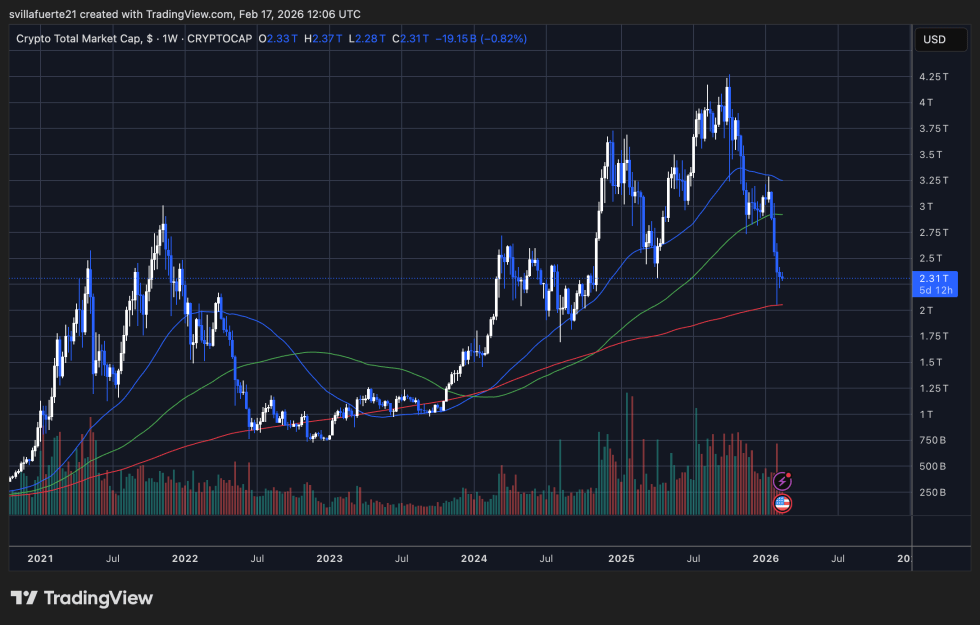
The crypto market faces intense selling pressure as Bitcoin and Ethereum struggle to reclaim key levels, with on-chain data revealing significant shifts in stablecoin liquidity. Stablecoin reserves grew by $11.4 billion in the 30 days before November 5, 2025, but fell $8.4 billion by December 23 as bearish conditions intensified. Outflows have recently slowed to about $2 billion, suggesting potential stabilization, though recovery remains uncertain. Binance dominates stablecoin liquidity, holding $47.5 billion in USDT and USDC—a 31% annual increase—accounting for 65% of all exchange reserves. USDT represents $42.3 billion of Binance’s holdings, while USDC reserves remain flat at $5.2 billion. Other exchanges like OKX ($9.5 billion) and Coinbase ($5.9 billion) lag significantly. The total crypto market cap has retraced from late-2025 peaks near $4 trillion, testing support around $2.3 trillion. Trend indicators show a shift from expansion to consolidation, with subdued buying pressure and elevated selling volume indicating ongoing distribution. The broader uptrend depends on holding long-term support, with a breakdown risking a deeper correction.

Trusted Editorial content, reviewed by leading industry experts and seasoned editors. Ad Disclosure

The crypto market continues to face intense selling pressure as both Bitcoin and Ethereum struggle to reclaim key psychological levels. Repeated rejection near resistance zones has reinforced cautious sentiment across the sector, with investors increasingly defensive after months of declining liquidity and volatile price action. While corrective phases are typical following strong bull market advances, the persistence of downside pressure suggests a more prolonged adjustment period may be unfolding.

On-chain data provides additional context for this shift in market dynamics. According to recent analysis, stablecoin reserve growth peaked shortly before the late-2025 price decline. In the 30 days leading up to November 5, reserves expanded by approximately $11.4 billion, reflecting strong liquidity availability and risk appetite at the time. However, this trend reversed quickly as market conditions deteriorated, with reserves falling roughly $8.4 billion by December 23 as the bear phase began to take shape.

More recently, the pace of outflows has moderated, with reserves declining by about $2 billion over the past month. This slowdown may indicate stabilization in liquidity conditions, though it does not yet confirm a sustained recovery. For now, the market remains sensitive to macro conditions, capital flows, and investor confidence.
Stablecoin Liquidity Concentration Highlights Binance’s Dominant Market Role

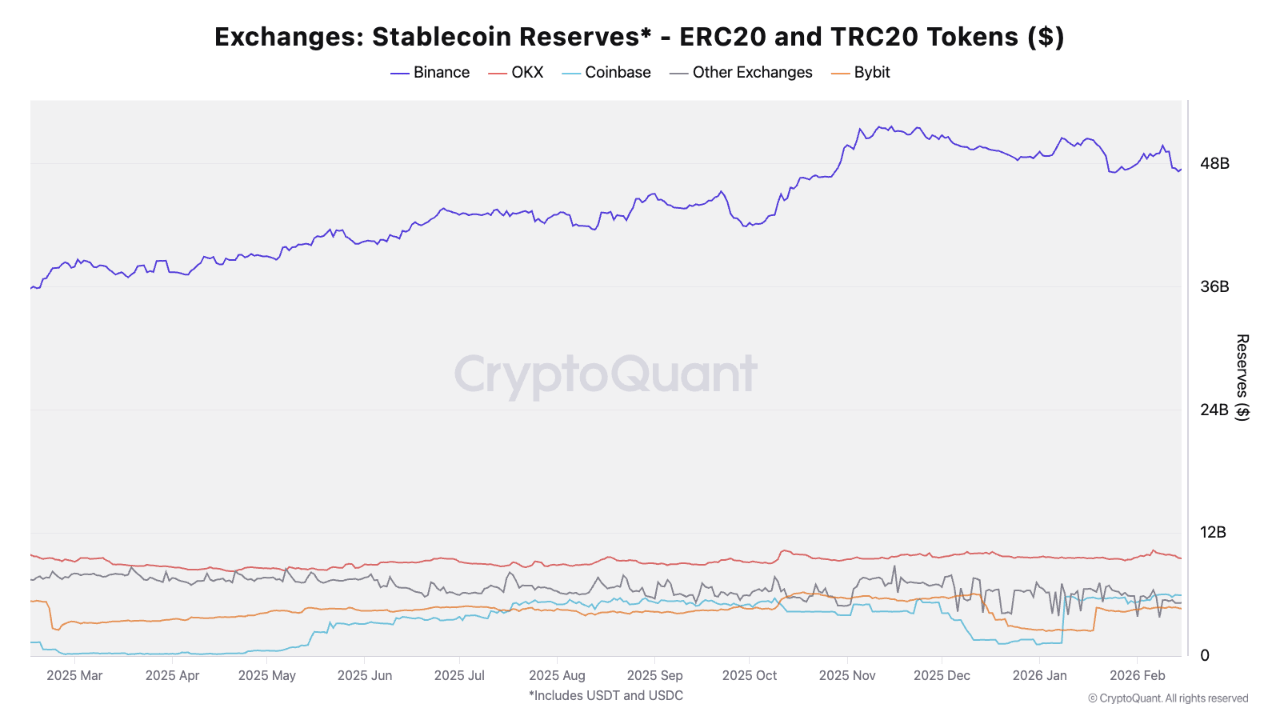
The data further shows that stablecoin liquidity remains heavily concentrated on Binance, reinforcing its role as the primary hub for crypto market liquidity. Current figures indicate the exchange holds roughly $47.5 billion in combined USDT and USDC reserves, marking a 31% year-over-year increase from about $35.9 billion. This concentration is significant, as Binance alone accounts for approximately 65% of all USDT and USDC held across centralized exchanges, highlighting its dominant position in facilitating trading flows and liquidity provisioning.
Crypto Exchanges Stablecoin Reserves | Source: CryptoQuant

Other major exchanges lag considerably behind in stablecoin reserves. OKX holds around $9.5 billion, representing roughly a 13% share, while Coinbase maintains approximately $5.9 billion, or about 8%. Bybit follows with close to $4 billion, equivalent to roughly 6% of exchange stablecoin liquidity. These balances are distributed mainly across Ethereum and TRON networks, which continue to serve as the primary infrastructure layers for stablecoin settlement.

Within Binance itself, liquidity remains overwhelmingly USDT-driven. About $42.3 billion of its reserves are held in USDT, reflecting a 36% year-over-year increase from approximately $31 billion. In contrast, USDC reserves stand near $5.2 billion and have remained broadly flat over the same period, suggesting stable but limited growth compared with USDT dominance.

Editorial Process for bitcoinist is centered on delivering thoroughly researched, accurate, and unbiased content. We uphold strict sourcing standards, and each page undergoes diligent review by our team of top technology experts and seasoned editors. This process ensures the integrity, relevance, and value of our content for our readers.

Sebastian Villafuerte

Follow

Sebastian's journey into the world of crypto began four years ago, driven by a fascination with the potential of blockchain technology to revolutionize financial systems. His initial exploration focused on understanding the intricacies of various crypto projects, particularly those focused on building innovative financial solutions. Through countless hours of research and learning, Sebastian developed a deep understanding of the underlying technologies, market dynamics, and potential applications of cryptocurrencies. As his knowledge grew, Sebastian felt compelled to share his insights with others. He began actively contributing to online discussions on platforms like X and LinkedIn, focusing on fintech and crypto-related content. His goal was to expose valuable trends and insights to a wider audience, fostering a deeper understanding of the rapidly evolving crypto landscape. Sebastian's contributions quickly gained recognition, and he became a trusted voice in the online crypto community. To further enhance his expertise, Sebastian pursued a UC Berkeley Fintech: Frameworks, Applications, and Strategies certification. This rigorous program equipped him with valuable skills and knowledge regarding Financial Technology, bridging the gap between traditional finance (TradFi) and decentralized finance (DeFi). The certification deepened his understanding of the broader financial landscape and its intersection with blockchain technology. Sebastian's passion for finance and writing is evident in his work. He enjoys delving into financial research, analyzing market trends, and exploring the latest developments in the crypto space. In his spare time, Sebastian can often be found immersed in charts, studying 10-K forms, or engaging in thought-provoking discussions about the future of finance. Sebastian's journey as a crypto analyst and investor has been marked by a relentless pursuit of knowledge and a dedication to sharing his insights. His ability to navigate the complex world of crypto, combined with his passion for financial research and communication, makes him a valuable asset to the industry. As the crypto landscape continues to evolve, Sebastian remains at the forefront, providing valuable insights and contributing to the growth of this revolutionary technology.

Full Profile

Related Posts

CFTC Chair Says Crypto Market Structure Bill Nears Final Approval

Why Kraken Is Backing Wyoming ‘Trump Accounts’, A Crypto Policy Gamble?

Polygon supera a Ethereum en tarifas diarias: la señal definitiva del auge de las L2

Zashi Becomes Zodl: Zcash Wallet Rebrands Following Internal Split

Kraken Backs Trump Accounts, Points To Shared Crypto Vision

Crypto And The 2026 Elections: By The Numbers And What Lies Ahead

Questions liées

QWhat does the data reveal about the shift in stablecoin reserves leading up to and during the crypto bear market?

AThe data shows that stablecoin reserve growth peaked shortly before the late-2025 price decline, expanding by approximately $11.4 billion in the 30 days leading up to November 5. However, this trend reversed as the bear market took hold, with reserves falling roughly $8.4 billion by December 23. More recently, the pace of outflows has moderated, declining by about $2 billion over the past month, which may indicate a stabilization in liquidity conditions.

QWhich exchange holds the dominant share of stablecoin liquidity, and what are the specific figures?

ABinance holds the dominant share of stablecoin liquidity, with approximately $47.5 billion in combined USDT and USDC reserves. This represents a 31% year-over-year increase and accounts for roughly 65% of all USDT and USDC held across centralized exchanges.

QHow does the distribution of stablecoin reserves on Binance compare between USDT and USDC?

AOn Binance, liquidity is overwhelmingly dominated by USDT. About $42.3 billion of its reserves are held in USDT, reflecting a 36% year-over-year increase. In contrast, USDC reserves stand near $5.2 billion and have remained broadly flat over the same period.

QWhat is the current state of the total crypto market capitalization and its key support level?

AThe total crypto market capitalization has retraced significantly from its late-2025 peak near $4 trillion and has recently stabilized around the $2.3 trillion level. This area is functioning as an interim key support zone, though price action remains fragile with reduced upside momentum.

QWhat do the volume dynamics during the market decline indicate about investor behavior?

AThe volume dynamics indicate that elevated selling volume accompanied the most recent decline, which suggests active distribution by sellers rather than a passive price drift. However, the subsequent moderation in volume hints that panic selling may be easing, even though conviction buying has not yet returned decisively.

Lectures associées

SpaceX entrée en bourse génère un trillionnaire, la fortune de Musk équivaut à la moitié du marché crypto

L'introduction en bourse de SpaceX a propulsé la fortune personnelle d'Elon Musk au-delà de 1 110 milliards de dollars, faisant de lui le premier trillionnaire en dollars de l'histoire moderne, selon l'indice Bloomberg. Cette somme dépasse la capitalisation boursière totale de l'ensemble du marché des crypto-monnaies, à l'exception du Bitcoin. L'IPO record de SpaceX, valorisant l'entreprise à 2 200 milliards de dollars, est la cause directe de cette augmentation. Le premier jour de négociation a généré un volume record de 85 milliards de dollars. Le contraste avec le marché des crypto-monnaies est frappant : la valeur totale de toutes les altcoins (hors stablecoins) est d'environ 880 milliards de dollars, soit moins que la fortune personnelle de Musk. Cela reflète une concentration massive de richesse et un transfert des capitaux institutionnels vers les actions technologiques. Malgré cela, Musk reste lié à l'écosystème crypto. Il détient personnellement du Bitcoin, de l'Ethereum et du Dogecoin. De plus, ses entreprises SpaceX et Tesla détiennent respectivement 18 712 et 11 509 Bitcoins dans leurs bilans, ce qui les placerait au 5e rang mondial des détentions corporatives si elles étaient combinées. Sa plateforme X (anciennement Twitter) intègre également des outils de suivi des prix des actifs numériques. Enfin, cette fortune historique, bien que phénoménale, reste principalement liée à la valorisation boursière de ses entreprises et soulève des questions sur l'extrême concentration de la richesse.

Foresight NewsIl y a 22 mins

SpaceX entrée en bourse génère un trillionnaire, la fortune de Musk équivaut à la moitié du marché crypto

Foresight NewsIl y a 22 mins

硬氪独家首发 | La société d'intelligence corporelle marine « Shihang Intelligent » obtient un financement record de 10 milliards de yuans, avec des investissements de Zhu Xiaohu et Temasek

La société d'intelligence incarnée océanique « Shihang Intelligent » a levé un financement record de plus de 10 milliards de yuans en série A, marquant la plus importante levée de fonds unique dans le domaine des robots océaniques mondial. Les investisseurs incluent des fonds de capital-investissement tels que Shanghe Momentum, Vertex Growth, ainsi que des actionnaires existants comme la société cotée en bourse Dayang Motor. Le fondateur et PDG, Chen Xiaobo, lauréat du premier prix national de progrès scientifique et technologique de la défense, dirige l'entreprise. Le financement sera principalement utilisé pour la R&D technologique, l'expansion mondiale et la construction de l'écosystème industriel. La société a développé des capacités fondamentales dans six systèmes clés pour les robots marins, permettant des opérations à pleine profondeur (0-10 000 mètres) et dans des scénarios comme le nettoyage de navires, la sécurité sous-marine, l'éolien offshore et l'inspection des fonds marins. Rien qu'au premier semestre 2026, le montant des commandes a dépassé 10 milliards de yuans. En avril de cette année, Shihang Intelligent a lancé le grand modèle d'intelligence incarnée océanique « Cangqiong CEORION ». Ce modèle intégré de bout en bout permet aux robots de réaliser de manière autonome 12 catégories de tâches sous-marines, avec un taux de réussite supérieur à 90 % dans les tests de simulation et une capacité d'adaptation à zéro échantillon dépassant 70 %. Il intègre un module de raisonnement physique pour réduire les risques de collision de 80 %. La société a également été sélectionnée comme partenaire clé pour le projet national singapourien d'inspection et de nettoyage des coques de navires.

marsbitIl y a 47 mins

硬氪独家首发 | La société d'intelligence corporelle marine « Shihang Intelligent » obtient un financement record de 10 milliards de yuans, avec des investissements de Zhu Xiaohu et Temasek

marsbitIl y a 47 mins

En trois mois, 35 milliards de yuans, les investisseurs se disputent l'"OpenAI du monde physique"

Une course effrénée des investisseurs s'engage vers l'AGI physique. La start-up chinoise Jijia Shijie (Excellent Vision) vient de boucler un financement de 3,5 milliards de yuans en seulement trois mois, portant sa valorisation à plus de 10 milliards. Dirigée par Huang Guan, un docteur de 30 ans de l'Université Tsinghua, l'entreprise attire un large éventail de fonds d'investissement nationaux et internationaux. La stratégie de Jijia Shijie repose sur un système en « double pyramide » combinant algorithmes et données, et centré sur un « modèle du monde » pour comprendre et interagir avec l'environnement physique. Ses modèles phares, GigaBrain et GigaWorld, ont obtenu des premières places dans des benchmarks mondiaux. La société vise le « moment GPT-3 » de l'AGI physique, où des capacités émergentes se manifesteront. Concrètement, Jijia Shijie déploie sa technologie sur deux fronts : grand public (robot domestique polyvalent « Shiguang S1 ») et industriel (robots « Maker » pour l'automatisation des usines et modèle de conduite autonome « DriveDreamer »). Ces déploiements génèrent des données et des revenus essentiels pour alimenter la boucle d'amélioration de ses modèles. L'objectif ultime est de dépasser l'AGI purement numérique pour créer une intelligence capable d'agir dans le monde physique, remodelant potentiellement les modes de production et la vie quotidienne. Les investisseurs parient que ce futur est proche.

marsbitIl y a 1 h

En trois mois, 35 milliards de yuans, les investisseurs se disputent l'"OpenAI du monde physique"

marsbitIl y a 1 h

Quel lien existe entre Huang Zheng, le fondateur de Pinduoduo, et la blockchain ?

L'auteur de l'article explore le lien entre Huang Zheng, fondateur de Pinduoduo, et la technologie blockchain, à travers une réflexion inspirée par l'essai de Huang « Inverser le capitalisme ». L'article explique que le modèle économique fondamental de Pinduoduo est une « affaire d'assurance » basée sur la gestion de l'« incertitude ». Huang Zheng observe que les capitaux tendent à s'accumuler chez les riches car ils peuvent absorber les incertitudes (comme les risques de maladie ou de perte d'emploi) que les plus pauvres paient pour éviter via des assurances ou des achats sécurisés. Le concept de Pinduoduo, le « group buying » (achat groupé), fonctionne comme une « assurance inversée ». Il agrège la demande préalable d'un grand nombre de consommateurs pour créer une commande certaine et massive, permettant aux usines de réduire le risque de surproduction. Cette certitude permet aux fabricants de baisser leurs prix, faisant ainsi refluer une partie de la valeur vers les consommateurs. Le lien avec la blockchain apparaît comme la pièce manquante pour perfectionner ce modèle. Le principal défi de « l'assurance inversée » est que l'engagement individuel d'un consommateur n'est pas crédible ou coûteux à faire respecter. La blockchain, via ses contrats intelligents (smart contracts), pourrait résoudre ce problème en rendant les engagements (comme une intention d'achat) contraignants, vérifiables et exécutables automatiquement, sans intermédiaire. Huang Zheng lui-même s'interroge : la blockchain n'est-elle pas idéalement conçue pour ce type d'« assurance inversée » ? En conclusion, l'article compare deux voies pour créer de la certitude : la voie « Pinduoduo », qui utilise la masse pour aplanir l'incertitude, et la voie « Bitcoin », qui verrouille les règles par un code inviolable, remplaçant la confiance en une institution par la confiance en un protocole.

链捕手Il y a 2 h

Quel lien existe entre Huang Zheng, le fondateur de Pinduoduo, et la blockchain ?

链捕手Il y a 2 h

Trading

Spot
Futures
活动图片