BTC Faces Triple Resistance at $80,000 Milestone, HYPE Hits New Highs Signaling Potential | Invited Analysis

Odaily星球日报Publié le 2026-05-26Dernière mise à jour le 2026-05-26

Résumé

This weekly analysis maintains a structured framework, focusing on Bitcoin (BTC) and HYPE, dissecting their multi-timeframe price action to identify key support and resistance zones and formulate actionable trading plans. The previous week's short position on BTC yielded a 2.78% gain, reinforcing the "signal-driven, disciplined" approach. For Bitcoin, the core scenario revolves around the battle between the 78,500–79,500 USD resistance zone and the 73,500–75,000 USD support area. The daily chart shows BTC within a rising channel; a failure to hold support at the channel's midline could lead to a test of the lower boundary. The 4-hour chart details an 8-segment corrective structure from the 82,850 USD high. Two short-term strategies are proposed: (A) Selling on a failed rally into the 78.5k-79.5k zone, with a stop above 80,600, or (B) Selling a confirmed breakdown below the 73.5k-75k support, with a stop above 76,500. Medium-term positioning remains neutral. For HYPE, the 4-hour chart indicates a five-wave advance from the May 14th low, now showing potential exhaustion and a top warning signal near 65 USD. The core view is to watch for a potential short-term peak formation. The recommended strategy is to avoid chasing the rally and instead look for a long setup upon a pullback to the 47.5–50 USD support zone, provided clear stabilization and model confirmation signals appear. The report concludes with a detailed review of the prior BTC short trade, executed based on model s...

Continuing with our structured analytical framework this week, we dissect the current movements of Bitcoin and HYPE from multiple time dimensions, assess the struggle between buyers and sellers around key resistance and support zones, and formulate specific, actionable operational plans accordingly.

Last week's short position successfully yielded a 2.78% profit, once again validating the trading logic of 'signal-driven, strict discipline'. However, a single profitable trade does not necessarily indicate that the market direction is definitively correct – the market always retains the possibility of exceeding expectations.

The core variable for this week remains the battle between the $78,500–$79,500 resistance zone and the $73,500–$75,000 support zone. The outcome will be answered by the market itself.

Summary of Core Trading Views for This Week:

• Analysis of BTC's multi-cycle price structure. (Detailed in Part I)

• BTC price forecast and mid-term, short-term operational strategies for this week. (Detailed in Part II)

• Analysis of HYPE's hourly chart structure. (Detailed in Part III)

• HYPE price forecast and short-term operational strategy for this week. (Detailed in Part IV)

Market Verification of Last Week's Trading Strategies and Core Views:

• BTC Short-term Trading Results: Bitcoin completed one short-term short position (1x leverage) last week, achieving a profit of approximately 2.78%. (Detailed in Table I)

• Market Verification of BTC Price Forecast: In last week's article, we noted: If the price effectively breaks below the support zone of $78,500–$79,500, it will test the support strength near $75,000. The current market movement verifies our previous forecast.

I. Analysis of Bitcoin's Multi-Cycle Price Structure

1. BTC Daily Chart Structure Analysis

Bitcoin _ Daily Chart:
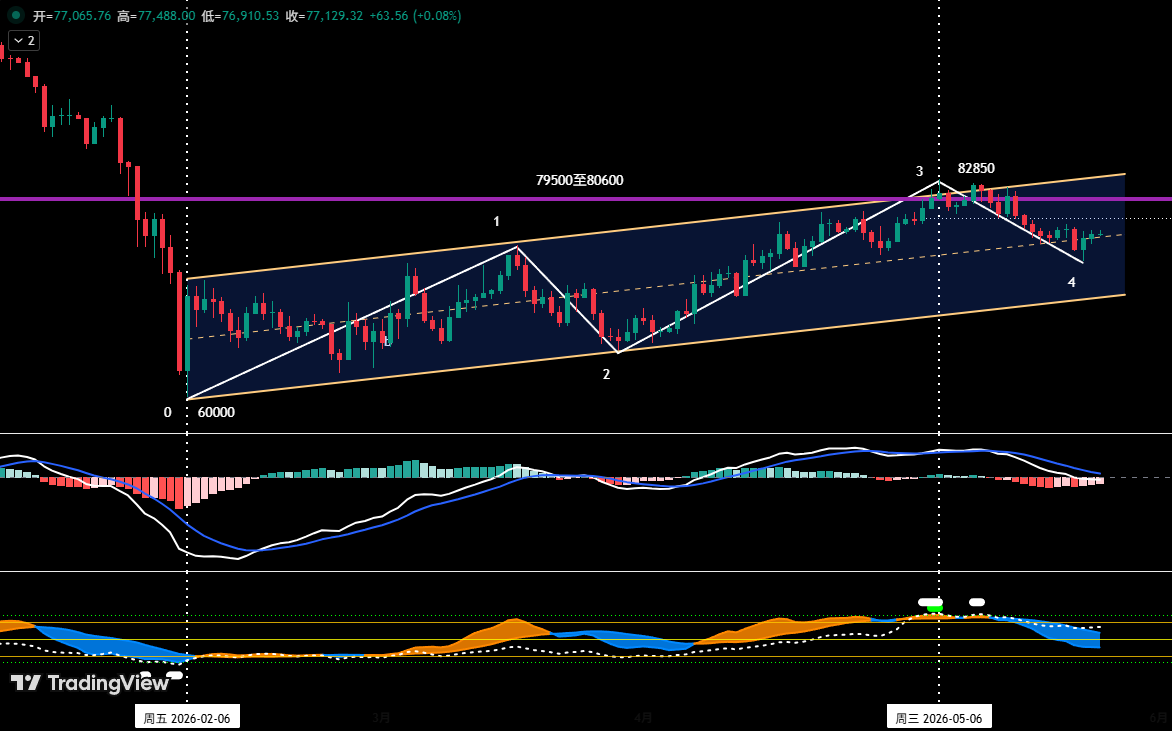
Figure 1

• As shown in (Figure 1), since establishing a stage low near $60,000 on February 6, 2026, Bitcoin's daily chart has constructed and maintained a clearly structured ascending channel: its lower boundary is formed by connecting the lows of February 6 and March 29, while the upper boundary is drawn parallel to the lower boundary through the high of March 17.

• In our April 27th weekly review, we pointed out: "The current price is facing dual pressure from the channel's upper boundary and the $79,500 to $80,600 resistance zone, making a breakthrough likely difficult". Subsequent market action confirmed this assessment. After nearly 20 days of tug-of-war between bulls and bears, although a new rebound high of $82,850 was reached on May 6, it failed to effectively break through this zone's resistance, and the price subsequently began to fluctuate downward.

From the current structure, the price has retraced from near the channel's upper boundary to the mid-channel area. If the price fails to find effective support near the mid-channel and resume its uptrend, the probability of subsequently seeking support at the channel's lower boundary is increasing.

2. In-Depth Analysis of BTC's Hourly Chart Structure

Bitcoin _ 4-Hour Chart
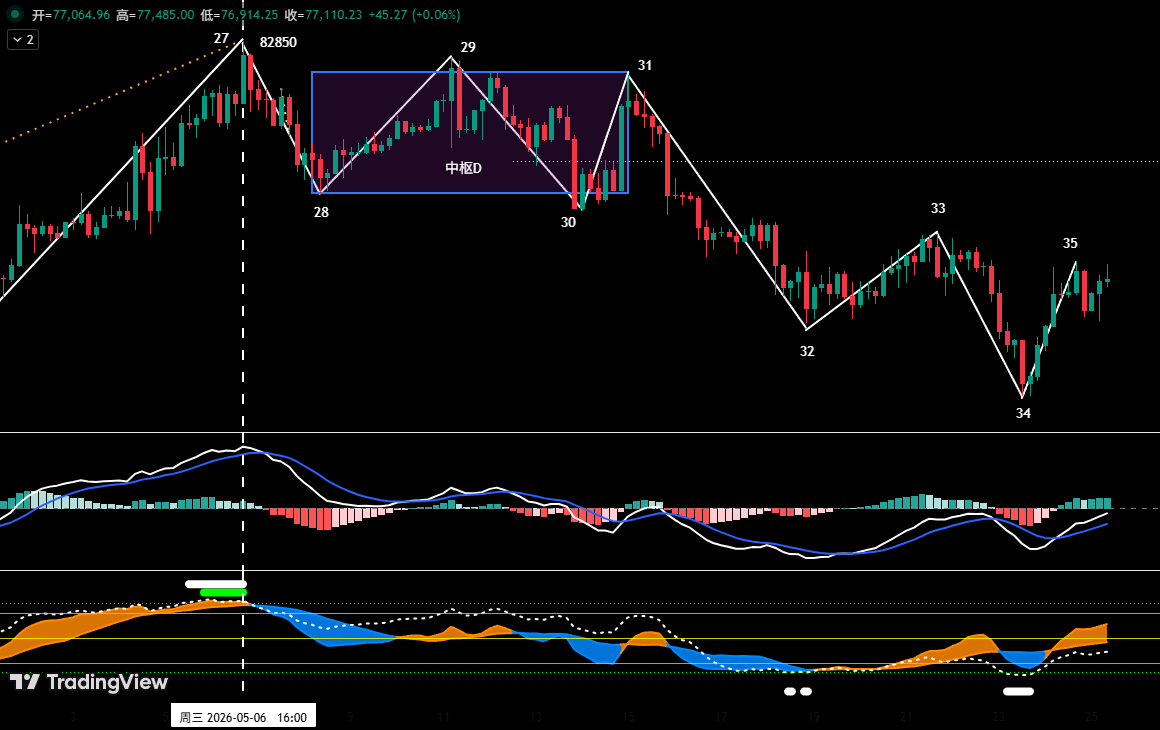
Figure 2

As shown in (Figure 2), from the May 6 high of $82,850 to the ongoing adjustment;

• On the 4-hour chart, it can be subdivided into an 8-segment adjustment structure: from "Segment 27-28" to "Segment 34-35"; Central D: Due to the overlapping of segments 28-29, 29-30, and 30-31, they constitute Central D.

• From the 4-hour chart structure, segment 34-35 is about to rebound to the $78,500–$79,500 zone. If the price faces resistance and falls back after rebounding to this zone, failing to form an effective breakthrough, the market is likely to continue the current fluctuating adjustment pattern and test the core support band of $73,500–$75,000 again.

II. Bitcoin Price Forecast and Operational Strategy for This Week

1. BTC Price Forecast for This Week:

Core View This Week: Focus on the outcome of the battle between bulls and bears for the $78,500–$79,500 resistance zone and the $73,500–$75,000 support zone.

2. Core Resistance Levels:

• First Resistance Zone: $78,500–$79,500 (near the boundaries of two central zones)

• Second Resistance Zone: $83,500–$84,500 (previous dense trading area)

3. Core Support Levels:

• First Support Zone: $73,500–$75,000 (previous key support area)

• Second Support Zone: $69,500–$70,500 (previous key support area)

4. Operational Strategy for This Week (Excluding Impact of Sudden News)

1. Mid-term Strategy:

Bitcoin _ Daily Chart: (Position Monitoring Model)
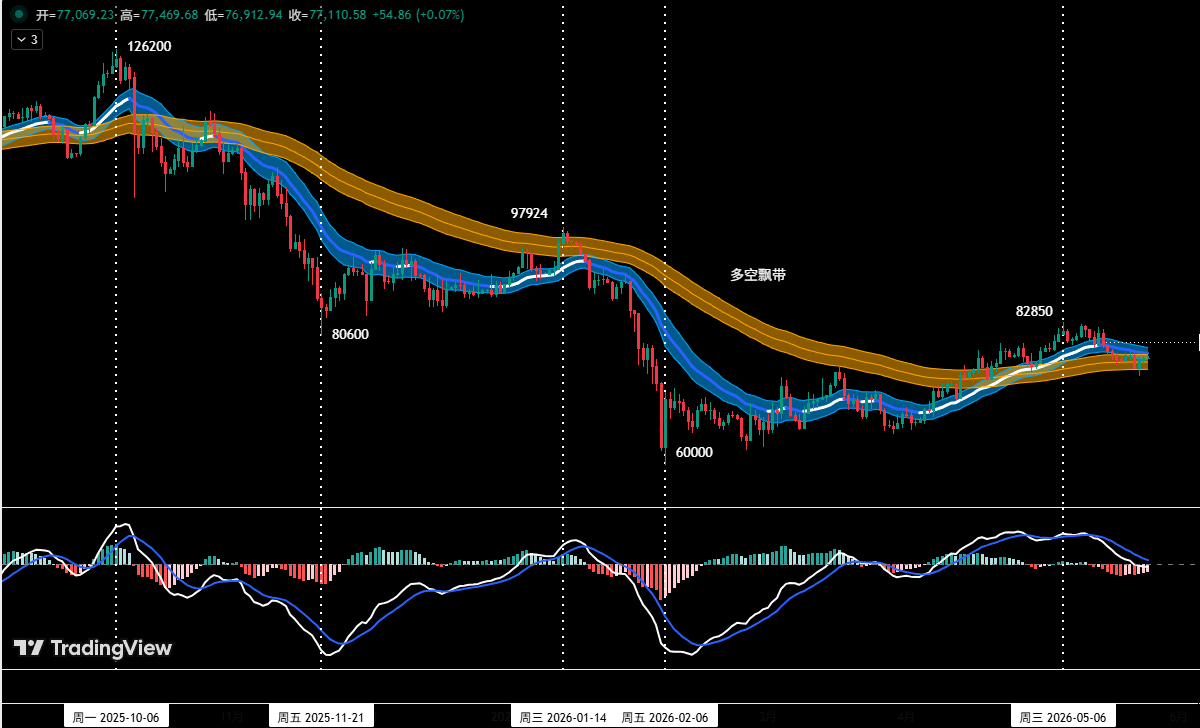
Figure 3

Position Monitoring Model: As shown in (Figure 3), based on trading rules, the market's mid-term direction is not yet clear. This week's mid-term strategy is to maintain a no-position, wait-and-see approach.

2. Short-term Strategy: Utilize 30% of capital, set stop-loss points, and look for "spread" opportunities based on support and resistance levels. (Using 30-minute/60-minute as the operational cycle).

3. In short-term operations, to dynamically respond to complex market developments, we have prepared two specific operational plans in advance: Plan A/B.

Plan A: Rebound Meets Resistance, Sell High.

• Entry: When the price rebounds to the $78,500–$79,500 zone and encounters resistance, combined with a top signal from the quantitative model, a short position below 30% can be established.

• Risk Control: Initial stop-loss set above $80,600.

• Exit: When the price adjusts near important support levels combined with model signals, gradually close the position to take profits.

Plan B: Effectively Breaks Support, Follow the Trend Short.

• Entry: When the price effectively breaks below the $73,500–$75,000 support zone combined with a model top signal, a short position below 30% can be established.

• Risk Control: Initial stop-loss set above $76,500.

• Exit: When the price falls to important support levels combined with model signals, gradually close the position to take profits.

III. HYPE Price Structure Analysis

HYPE_4-Hour Chart
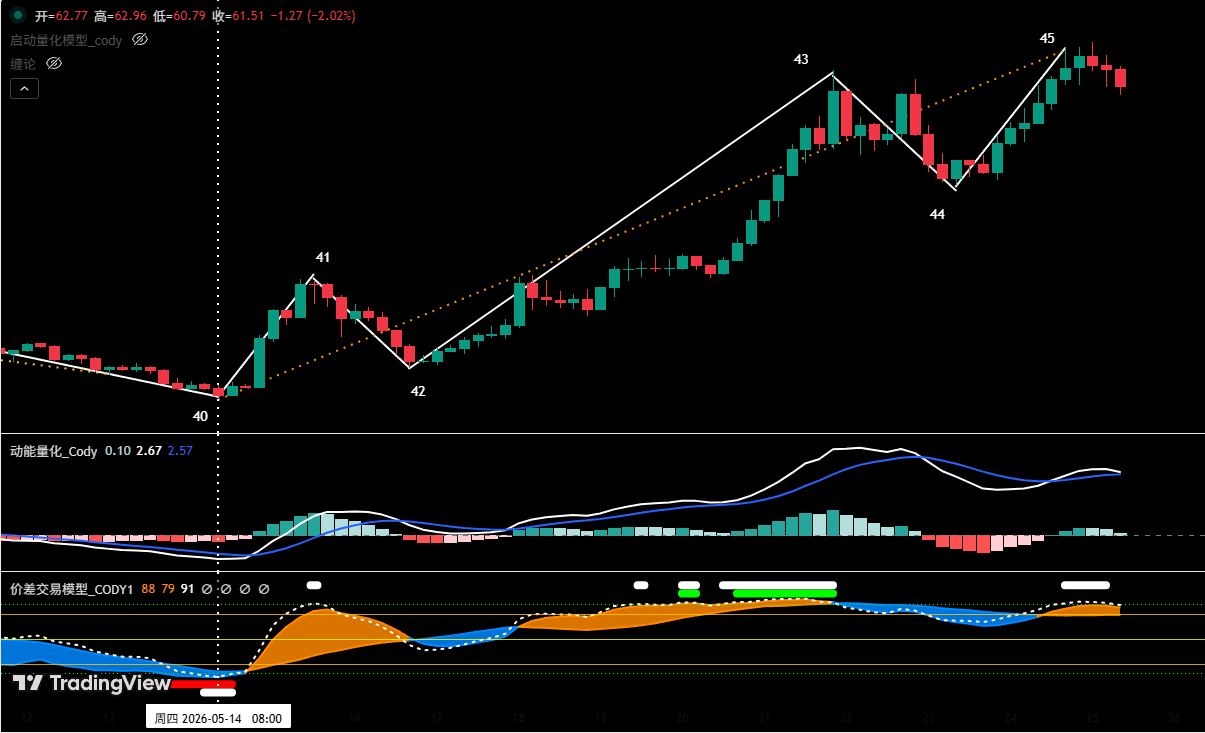
Figure 4

1. As shown in (Figure 4), the uptrend in HYPE starting from the May 14 low of $38.14 can be divided into a five-segment structure on the 4-hour chart: segments 40-41, 41-42, 42-43, 43-44, 44-45.

2. Our proprietary "Spread Trading Model" indicates that near endpoint 45, a top warning signal (white dot) has been triggered.

3. From the "Momentum Quantification Model" perspective, the rising segment (44-45) near $65 has shown signs of weakening upward momentum.

4. If the price forms a momentum bearish divergence state at "endpoint 45" and resonates with the top warning signal from the "Spread Trading Model", the probability of the price forming a short-term high here increases significantly.

IV. HYPE Price Forecast and Short-Term Operational Strategy for This Week

1. HYPE Price Forecast for This Week:

Core View on HYPE This Week:

• Observe whether "endpoint 45" can form a short-term high since the rise began on May 14.

• If a short-term high is formed, subsequently, look for short-term long opportunities when the price retraces to key support areas (e.g., $47.5 to $50) and shows clear signs of stabilization.

2. HYPE Short-Term Operational Strategy for This Week: (Buy on Support)

Currently, the strategy of "avoid blind chasing of highs, buy on dips" should be followed. If the price retraces to the $47.5 to $50 zone, finds support, and shows stabilization signals, combined with bottom signals triggered by both models, consider a light long position. Position size must be controlled below 30%, and strict stop-loss discipline must be maintained.

V. Operational Review

1. Short-Term Operation Review:(See Table I)

We strictly followed the operational plan. Based on trading signals from our proprietary "Spread Trading Model" and "Momentum Quantification Model", we completed one short-term (short) operation last week, achieving a trading profit of 2.78%.

1. Bitcoin Short-Term Trading Details Summary: (Leverage*1x)
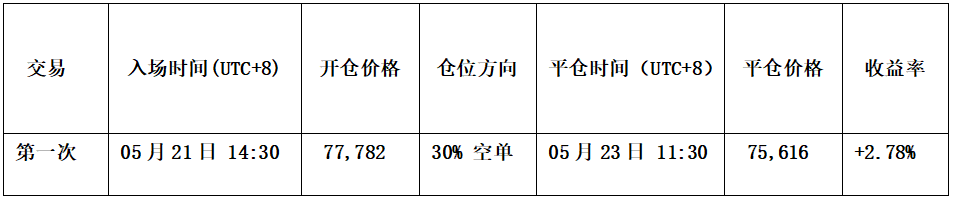
Table I

2. Short-Term Trading Review: (See Figure VI)

• Entry Strategy:

a. When the price rebounded near $78,500, encountered resistance, showed pressure signals, and the candlestick formed a "top reversal" bearish signal;

b. The "Spread Trading Model" triggered a top warning signal (white dot), and the "Momentum Quantification Model" formed a momentum bearish divergence signal.

Therefore, we established a 30% short position at $77,782.

• Exit Strategy:

a. When the price fell near $75,000 and found support, and the candlestick formed a "bottom reversal" signal;

b. The "Spread Trading Model" triggered a strong bottom warning signal (red dot + white dot), resonating with a bottom signal from the "Momentum Quantification Model".

Therefore, we closed all positions near $75,616.

• Summary: This trade successfully yielded a profit of approximately 2.78%.

BTC_30 Minute Chart: (Momentum Quantification Model + Spread Trading Model)
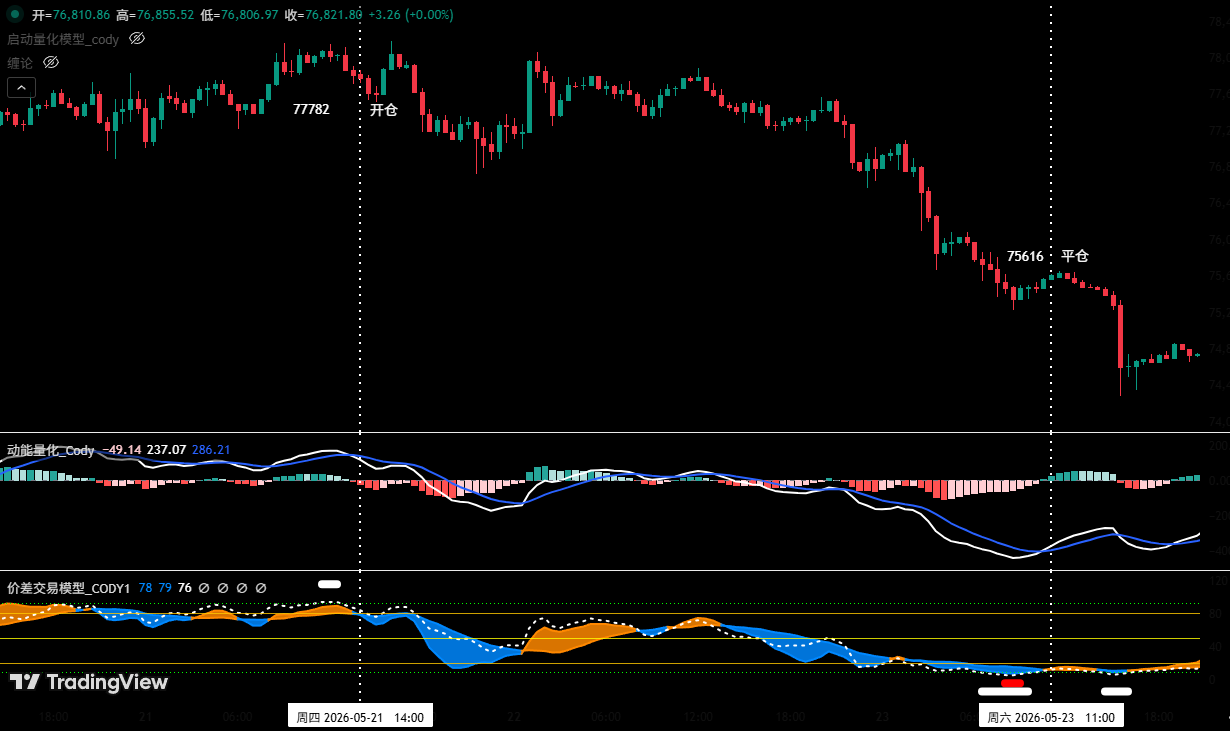
Figure V (Short-Term Trading Illustration)

VI. Special Note:

1. When opening a position: Immediately set the initial stop-loss point.

2. When profit reaches 1%: Move the stop-loss to the entry cost price (break-even point) to ensure capital safety.

3. When profit reaches 2%: Move the stop-loss to the 1% profit level.

4. Continuous Tracking: Thereafter, for every additional 1% profit, move the stop-loss up by 1%, dynamically protecting and locking in profits.

Financial markets are ever-changing; all market analysis and trading strategies require dynamic adjustment. All views, analytical models, and operational strategies mentioned in this article are derived from personal technical analysis, intended solely for personal trading log purposes, and do not constitute any investment advice or operational basis. The market carries risks; investment requires caution. Please do not make decisions based on this.


Questions liées

QAccording to the article's analysis, what are the two main resistance and support zones for Bitcoin this week?

AThe core resistance zone is 78,500-79,500 USD, and the core support zone is 73,500-75,000 USD.

QWhat was the primary technical reason for the author's successful short trade on Bitcoin the previous week?

AThe trade was executed based on a confluence of signals: the price encountered resistance near 78,500 USD forming a top reversal candlestick pattern, and both the author's 'Price Difference Trading Model' and 'Dynamic Energy Quantification Model' triggered top warning signals, including momentum divergence.

QBased on the analysis, what is the key condition for HYPE to present a potential short-term buying opportunity?

AA short-term buying opportunity for HYPE may arise if the price pulls back to the 47.5 to 50 USD support zone, shows clear signs of stabilization, and is confirmed by bottom signals from the author's trading models.

QWhat is the author's current medium-term (midline) strategy for Bitcoin, as indicated by their 'Position Monitoring Model'?

AAccording to the 'Position Monitoring Model', the medium-term market direction is not yet clear. Therefore, the author is maintaining a strategy of staying out of the market (holding no medium-term positions) and observing.

QIn the article's proposed short-term trading plans for Bitcoin, what are the two main scenarios (Plan A and Plan B)?

APlan A: Sell short on rallies if the price rebounds to the 78,500-79,500 USD resistance zone and encounters selling pressure. Plan B: Sell short on breakouts if the price effectively breaks below the 73,500-75,000 USD support zone.

Lectures associées

Trade.xyz refuse l'ajustement Rebase, le marché Pre-IPO en chaîne confronté à une épreuve majeure de valorisation

Auteur : Nancy, PANews Alors que les investisseurs crypto célèbrent l’introduction en bourse imminente de SpaceX sur les réseaux sociaux, Trade.xyz, plateforme de contrats perpétuels sur Hyperliquid, se retrouve sous le feu des critiques en raison de sa méthode de tarification du contrat pré-IPO SPCX (SpaceX). Le 10 juin, Trade.xyz a publié une clarification indiquant que son contrat « IPOP » est conçu pour refléter les anticipations de marché sur le prix unitaire d’une action, et non la valorisation globale de l’entreprise. Par conséquent, le nombre total d’actions ou la capitalisation boursière ne font pas partie de sa logique de prix. Cette position a été mise à l’épreuve après la publication du prospectus de SpaceX, révélant un nombre d’actions supérieur de 10 % aux estimations précédentes. Contrairement à plusieurs exchanges centralisés (CEX) qui ont suspendu les transactions et réajusté leurs prix, Trade.xyz a maintenu son cadre, provoquant un écart de prix, des opportunités d’arbitrage et des pertes importantes pour les traders en position longue, notamment ceux utilisant un effet de levier. Le débat soulève la question cruciale du « rebase » (réajustement de référence) pour les actifs pré-IPO sur la blockchain. Alors que les CEX peuvent ajuster centralisé les positions, les DEX (exchanges décentralisés) rencontrent des défis techniques pour modifier dynamiquement les contrats intelligents sans introduire de complexité ou de risques supplémentaires. Certains acteurs, comme Aster, ont déjà implémenté des mécanismes similaires, démontrant que c’est possible mais nécessite un effort délibéré de conception. L’incident met en lumière les défis plus larges auxquels font face les marchés décentralisés de contrats perpétuels lorsqu’ils cherchent à traiter des actifs du monde réel (RWA) comme les actions pré-IPO. La crédibilité de ces marchés pour la découverte de prix avant une introduction en bourse dépendra de leur capacité à gérer de manière transparente et équitable les événements corporatifs et les informations financières.

marsbitIl y a 2 mins

Trade.xyz refuse l'ajustement Rebase, le marché Pre-IPO en chaîne confronté à une épreuve majeure de valorisation

marsbitIl y a 2 mins

Associé d'a16z : Se positionner dans le flux de capitaux, c'est la véritable barrière concurrentielle

L'article soutient que la véritable pérennité d'une entreprise réside dans sa capacité à se positionner au cœur des flux de valeur, où elle peut prélever une partie des transactions qu'elle facilite. Historiquement, des sociétés comme les chemins de fer, Visa, Google, Meta ou AWS ont bâti leur puissance non pas en vendant un produit, mais en devenant des intermédiaires incontournables dans le transport, les paiements, la publicité ou la puissance de calcul. La crypto-monnaie rend ce modèle accessible aux startups. Grâce aux blockchains, aux stablecoins et aux tokens, elles peuvent créer des réseaux ouverts où la valeur circule à la vitesse d'Internet, et où les revenus sont partagés de manière programmable avec les contributeurs. Le secteur financier traditionnel, avec ses frais élevés et ses inefficacités (paiements, transferts internationaux, garde de titres...), constitue une cible prioritaire pour être "reconstruit" de cette manière. L'opportunité ne se limite pas à la finance. Des marchés émergents comme le calcul (GPU), les données d'IA, l'énergie ou les ressources spatiales verront aussi des flux de valeur massifs. Pour tout fondateur, les questions clés sont : mon produit est-il déjà dans un flux de valeur ? Mes revenus augmentent-ils proportionnellement à l'activité du réseau ? Où se trouvent les inefficacités les plus coûteuses à corriger ? L'avenir appartient à ceux qui compresseront les coûts des anciens systèmes pour se placer au centre des nouveaux flux.

marsbitIl y a 45 mins

Associé d'a16z : Se positionner dans le flux de capitaux, c'est la véritable barrière concurrentielle

marsbitIl y a 45 mins

Détection de 15 vulnérabilités zero-day de haut niveau : Le framework de débogage de protocoles de consensus par agents intelligents développé par 0G Lab en collaboration avec NUS, PKU et BUPT

Les protocoles de consensus, fondations critiques des systèmes distribués, sont notoirement difficiles à déboguer en raison de leur complexité. Une équipe de 0G Labs, de l'Université Nationale de Singapour, de l'Université de Pékin et de l'Université des Télécommunications de Pékin a présenté Agora, un cadre innovant d'agents IA multiples pour la détection automatisée de bugs. Agora s'éloigne de l'approche inefficace des modèles de langage monolithiques (comme GPT-5.2 ou Claude 4.5, qui ont échoué) en utilisant trois agents spécialisés : un Orchestrateur pour la coordination globale, un Stratège pour générer des scénarios d'attaque exploitant la connaissance du domaine, et un TestGen pour créer et exécuter des tests. Ce système, intégré à une architecture de test automatisé (Harness) avec une boucle de rétroaction, permet une analyse globale et un débogage en boucle fermée. Les résultats sont impressionnants : Agora a découvert 15 bugs logiques profonds et inconnus (zero-day) dans des protocoles comme Raft, EPaxos et dans des composants d'etcd et de Sui, avec un taux de faux positifs de seulement 26.1%. L'efficacité est remarquable, chaque bug majeur étant trouvé pour environ 40 dollars de coût en tokens. Ce cadre, conçu pour être économique et accessible, démontre la puissance de la collaboration multi-agents spécialisés pour les tâches complexes de vérification. Il est facilement adaptable à d'autres domaines critiques comme le contrôle de la concurrence dans les bases de données, les noyaux de systèmes d'exploitation ou l'audit de contrats intelligents Web3, ouvrant la voie à une nouvelle ère d'audit de sécurité automatisé pour l'infrastructure informatique fondamentale.

marsbitIl y a 47 mins

Détection de 15 vulnérabilités zero-day de haut niveau : Le framework de débogage de protocoles de consensus par agents intelligents développé par 0G Lab en collaboration avec NUS, PKU et BUPT

marsbitIl y a 47 mins

Le partenaire de a16z crypto : Le flux de capitaux est la véritable barrière d'entrée

Partout dans l'histoire du commerce, le succès durable des entreprises repose sur la circulation des capitaux : capter la création et le transfert de valeur au sein d'un écosystème et en prélever une partie. La cryptographie est la première technologie moderne adaptée à cette logique. Les blockchains fonctionnent comme des modèles commerciaux en réseau, bénéficiant d'effets de réseau natifs. Les jetons de réseau, lorsqu'ils sont bien conçus, alignent les intérêts de tous les participants (utilisateurs, développeurs, etc.) vers la croissance du réseau et redistribuent les revenus générés par le protocole. La logique fondamentale reste de trouver et de s'établir au cœur des flux de valeur. Les exemples historiques (chemins de fer, Visa, Jane Street) le démontrent : la combinaison du flux de capitaux et des effets de réseau constitue l'un des modèles commerciaux les plus solides. Aujourd'hui, les profits importants et les inefficacités du secteur financier traditionnel (frais de transaction élevés, règlement T+1) représentent des opportunités. Les entrepreneurs de la cryptographie peuvent construire la prochaine génération d'infrastructures : programmable, par règlement instantané, mondiale et native aux flux de capitaux. Cette opportunité s'étend bien au-delà de la finance : les marchés de la puissance de calcul (GPU), des données d'IA, de l'énergie, des métaux rares, etc., sont prêts pour des flux de valeur globaux massifs que les canaux traditionnels ne peuvent supporter. Ces nouveaux marchés sont des espaces vierges pour des modèles centrés sur la circulation des capitaux via une infrastructure programmable. La question clé pour les entrepreneurs est : votre activité est-elle au cœur d'un flux de valeur essentiel ? Pouvez-vous évoluer avec lui ? Où les marges sont-elles excessives par rapport à la valeur créée ? La réponse indique où se trouve l'opportunité : réduire les coûts, capturer de nouveaux flux et grandir grâce aux effets de réseau.

Foresight NewsIl y a 49 mins

Le partenaire de a16z crypto : Le flux de capitaux est la véritable barrière d'entrée

Foresight NewsIl y a 49 mins

Trading

Spot
Futures

Articles tendance

Comment acheter HYPE

Bienvenue sur HTX.com ! Nous vous permettons d'acheter Hyperliquid (HYPE) de manière simple et pratique. Suivez notre guide étape par étape pour commencer votre parcours crypto.Étape 1 : Création de votre compte HTXUtilisez votre adresse e-mail ou votre numéro de téléphone pour ouvrir un compte sur HTX gratuitement. L'inscription se fait en toute simplicité et débloque toutes les fonctionnalités.Créer mon compteÉtape 2 : Choix du mode de paiement (rubrique Acheter des cryptosCarte de crédit/débit : utilisez votre carte Visa ou Mastercard pour acheter instantanément Hyperliquid (HYPE).Solde :utilisez les fonds du solde de votre compte HTX pour trader en toute simplicité.Prestataire tiers :pour accroître la commodité d'utilisation, nous avons ajouté des modes de paiement populaires tels que Google Pay et Apple Pay.P2P :tradez directement avec d'autres utilisateurs sur HTX.OTC (de gré à gré) : nous offrons des services personnalisés et des taux de change compétitifs aux traders.Étape 3 : stockage de vos Hyperliquid (HYPE)Après avoir acheté vos Hyperliquid (HYPE), stockez-les sur votre compte HTX. Vous pouvez également les envoyer ailleurs via un transfert sur la blockchain ou les utiliser pour trader d'autres cryptos.Étape 4 : tradez des Hyperliquid (HYPE)Tradez facilement Hyperliquid (HYPE) sur le marché Spot de HTX. Il vous suffit d'accéder à votre compte, de sélectionner la paire de trading, d'exécuter vos trades et de les suivre en temps réel. Nous offrons une expérience conviviale aux débutants comme aux traders chevronnés.

665 vues totalesPublié le 2024.12.11Mis à jour le 2026.06.02

Comment acheter HYPE

Discussions

Bienvenue dans la Communauté HTX. Ici, vous pouvez vous tenir informé(e) des derniers développements de la plateforme et accéder à des analyses de marché professionnelles. Les opinions des utilisateurs sur le prix de HYPE (HYPE) sont présentées ci-dessous.

活动图片












