Before Buying the Dip, Understand the Two Types of Market Drawdowns

比推Publié le 2026-02-13Dernière mise à jour le 2026-02-13

Résumé

The article distinguishes between two types of stock drawdowns: systemic (market-driven) and idiosyncratic (company-specific). Systemic drawdowns, like the 2008 financial crisis, affect the entire market and can be navigated with behavioral advantages such as patience, as markets tend to recover. Idiosyncratic drawdowns, such as the recent AI-driven sell-off in software stocks, require analytical advantages—investors must accurately assess whether a company’s long-term prospects remain intact despite market pessimism. Using FactSet as an example, the author emphasizes that investors must differentiate between temporary panic and fundamental erosion of a company’s competitive moat. Relying solely on behavioral strategies for idiosyncratic risks is inadequate; deep analysis is essential to avoid mistaking arrogance for conviction.

Author: Todd Wenning

Compiled by: Deep Tide TechFlow

Original title: Before Buying the Dip, Understand the Two Types of Market Drawdowns


Deep Tide Introduction: Academic financial theory categorizes risk into systemic risk and idiosyncratic risk. Similarly, stock drawdowns can also be divided into two types: market-driven systemic drawdowns (such as the 2008 financial crisis) and company-specific idiosyncratic drawdowns (such as the current AI-induced software stock crash).

Todd Wenning uses FactSet as an example to point out: during systemic drawdowns, you can leverage behavioral advantages (patiently waiting for the market to recover); but during idiosyncratic drawdowns, you need analytical advantages—having a more accurate vision of the company's future a decade from now than the market does.

Amid the current AI impact on software stocks, investors must distinguish: is this a temporary market panic, or is the moat truly collapsing?

Do not use a blunt behavioral solution to solve a problem that requires nuanced analysis.

Full text below:

Academic financial theory posits two types of risk: systemic and idiosyncratic.

  • Systemic risk is unavoidable market risk. It cannot be eliminated through diversification, and it is the only type of risk for which you are compensated.

  • On the other hand, idiosyncratic risk is company-specific risk. Because you can cheaply purchase a diversified portfolio of uncorrelated businesses, you are not compensated for taking on this risk.

We can discuss Modern Portfolio Theory another day, but the systemic-idiosyncratic framework is very helpful for understanding different types of drawdowns (the percentage decline from peak to trough of an investment) and how we as investors should evaluate opportunities.

From the moment we picked up our first value investing book, we were taught to take advantage of a despondent Mr. Market when stocks are being sold off. If we remain calm while he loses his senses, we will prove ourselves to be stoic value investors.

But not all drawdowns are the same. Some are market-driven (systemic), while others are company-specific (idiosyncratic). Before you make a move, you need to know which type you are looking at.
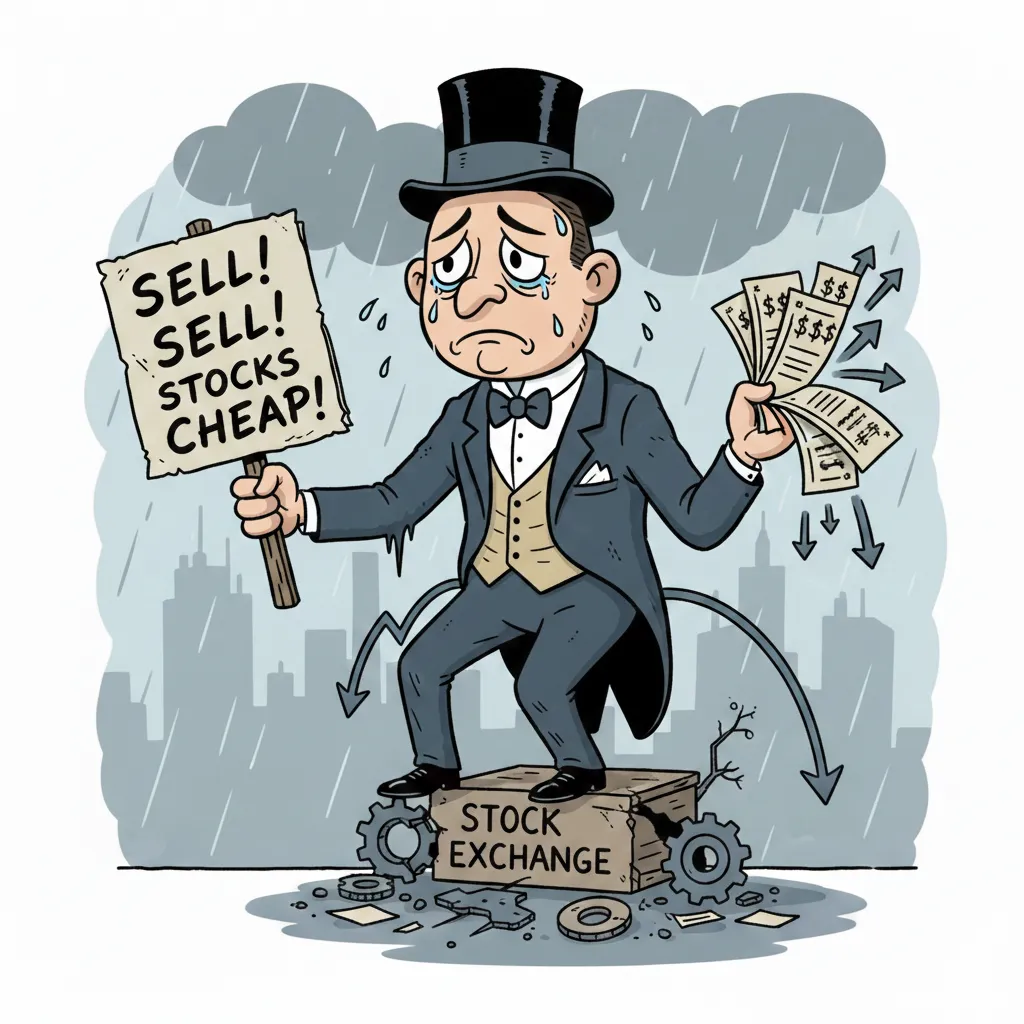
Generated by Gemini

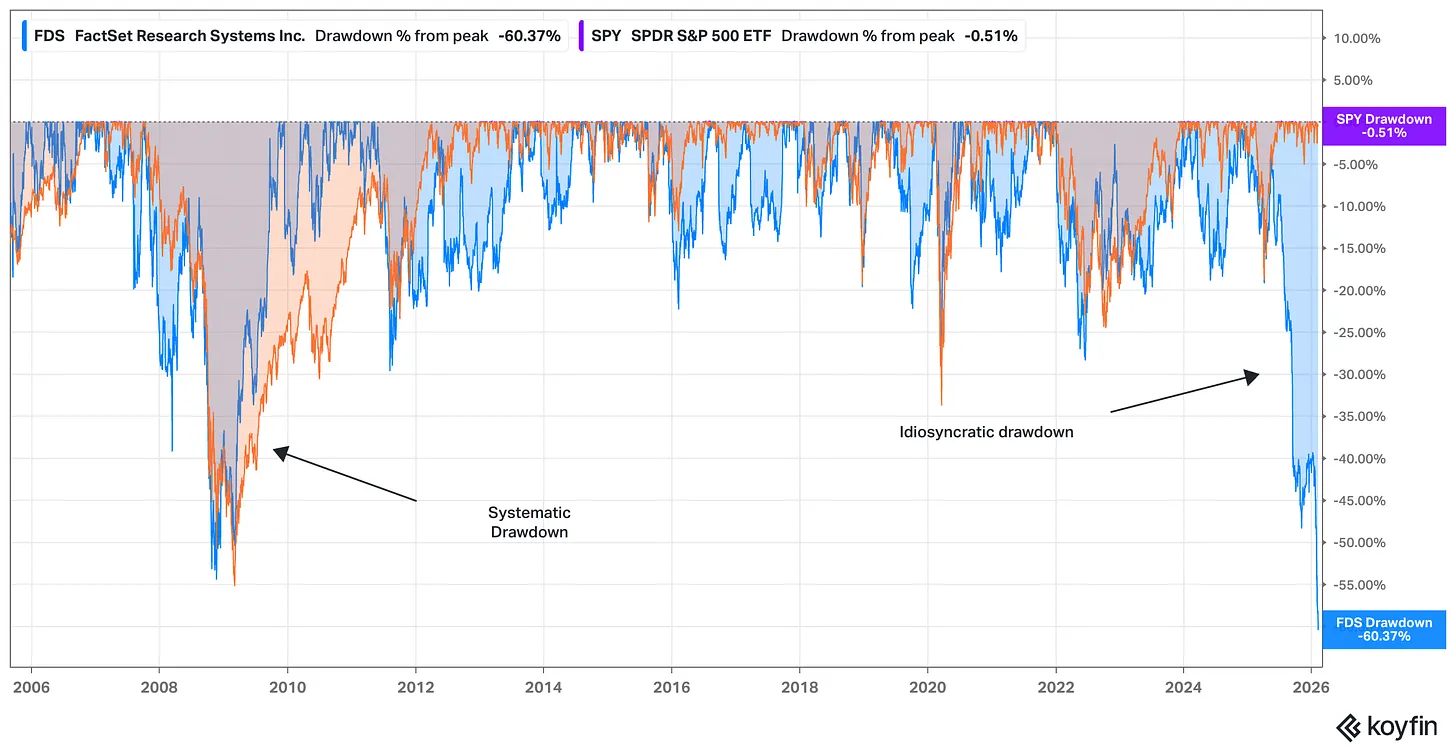
The recent sell-off in software stocks due to AI concerns illustrates this point. Let's look at the 20-year drawdown history between FactSet (FDS, blue) and the S&P 500 (measured via the SPY ETF, orange).
Source: Koyfin, as of February 12, 2026

FactSet's drawdown during the financial crisis was primarily systemic. In 2008/09, the entire market was worried about the durability of the financial system, and FactSet could not be immune to these concerns, especially since it sells products to financial professionals.

At that time, the stock's drawdown had less to do with FactSet's economic moat and more to do with whether that moat would matter if the financial system collapsed.

The 2025/26 FactSet drawdown is the opposite case. Here, the concerns are almost entirely focused on FactSet's moat and growth potential, along with widespread worries about accelerating AI capabilities disrupting pricing power in the software industry.

In systemic drawdowns, you can more reasonably make time arbitrage bets. History shows that markets tend to rebound, and companies with strong moats may emerge even stronger than before. So, if you are willing and able to remain patient while others panic, you can leverage a strong appetite to exploit behavioral advantages.

Photo by Walker Fenton on Unsplash

However, in idiosyncratic drawdowns, the market is telling you that something is wrong with the business itself. Specifically, it suggests increasing uncertainty about the business's terminal value.

Therefore, if you hope to take advantage of an idiosyncratic drawdown, you need analytical advantages in addition to behavioral ones.

To succeed, you need to have a more accurate vision of what the company will look like a decade from now than what the current market price implies.

Even if you know a company well, this is not easy to do. Stocks don't typically fall 50% relative to the market for no reason. Many once-stable holders—even some investors you respect for their deep research—had to capitulate for this to happen.

If you are going to step in as a buyer during an idiosyncratic drawdown, you need to have an answer for why these otherwise well-informed and thoughtful investors who sold were wrong, and why your vision is correct.

There is a fine line between conviction and arrogance.

Whether you are holding a stock in a drawdown or looking to initiate a new position in one, it's important that you understand what type of bet you are making.

Idiosyncratic drawdowns can tempt value investors to start looking for opportunities. Before you venture in, make sure you are not using a blunt behavioral solution to solve a problem that requires nuanced analysis.

Stay patient, stay focused.

Todd


Twitter:https://twitter.com/BitpushNewsCN

BitPush TG Discussion Group:https://t.me/BitPushCommunity

BitPush TG Subscription: https://t.me/bitpush

Original article link:https://www.bitpush.news/articles/7611840

Questions liées

QWhat are the two types of risk identified in academic financial theory, and how do they differ?

AThe two types of risk are systemic risk and idiosyncratic risk. Systemic risk is unavoidable market risk that cannot be eliminated through diversification and is the only type of risk for which investors are compensated. Idiosyncratic risk is company-specific risk that can be mitigated through a diversified portfolio of uncorrelated businesses, and investors are not compensated for taking on this risk.

QHow should an investor approach a systemic drawdown versus an idiosyncratic drawdown?

AIn a systemic drawdown, an investor can leverage a behavioral advantage by being patient and waiting for the market to recover, as history shows markets tend to rebound. In an idiosyncratic drawdown, an investor needs an analytical advantage—a more accurate vision of what the company will look like in ten years than what the market currently implies—because the issue is specific to the company's fundamentals.

QWhat example does Todd Wenning use to illustrate the difference between systemic and idiosyncratic drawdowns?

ATodd Wenning uses FactSet (FDS) as an example. The drawdown during the 2008/09 financial crisis was primarily systemic, driven by broad market fears about the financial system. The drawdown in 2025/26 was idiosyncratic, caused by specific concerns about FactSet's moat and growth potential due to AI disrupting the software industry.

QWhat is the author's warning about using behavioral solutions for idiosyncratic drawdowns?

AThe author warns against using a blunt behavioral solution, like simply buying during a sell-off, to address an idiosyncratic drawdown, which requires nuanced analysis. Investors must ensure they have a clear analytical edge and understand why informed sellers are wrong, rather than relying solely on patience or market recovery.

QAccording to the article, what must an investor have to successfully capitalize on an idiosyncratic drawdown?

ATo successfully capitalize on an idiosyncratic drawdown, an investor needs an analytical advantage—a well-reasoned vision of the company's future that is more accurate than the market's current assessment. They must also understand why other informed investors sold and be able to justify why their perspective is correct, balancing conviction without crossing into arrogance.

Lectures associées

La SEC américaine envisage d'abroger une vieille règle de 2005 : que signifie-t-elle pour les actions tokenisées ?

Le 11 juin, la SEC américaine a proposé de supprimer les Règles 611 et 610(e) du Règlement NMS, une réforme potentielle de la structure des marchés traditionnels. La Règle 611, dite « trade-through rule », empêche les transactions d'ignorer les meilleures cotations disponibles sur d'autres plateformes. La SEC estime qu'elle est devenue moins nécessaire dans un marché désormais hautement automatisé, et qu'elle génère des coûts de conformité et une fragmentation excessive. La Règle 610(e) restreint les « cotations verrouillées » (prix d'achat égal au prix de vente) et « croisées » (prix d'achat supérieur au prix de vente). Sa suppression pourrait permettre des écarts de prix plus serrés, tout en réduisant la complexité des systèmes. Cette proposition est pertinente pour le monde de la tokenisation, car la SEC évoque explicitement les technologies de registre distribué et les contrats intelligents. En assouplissant ces règles conçues en 2005, la SEC pourrait ouvrir un espace pour des mécanismes de négociation plus innovants et compatibles avec des actifs tokenisés fonctionnant 24h/24. Cependant, cette réforme ne résout pas les défis réglementaires fondamentaux liés à la tokenisation des titres. La SEC estime que cette suppression pourrait générer des économies annuelles de 54 à 77 millions de dollars pour les acteurs du marché en réduisant les complexités induites par la réglementation.

Foresight NewsIl y a 25 mins

La SEC américaine envisage d'abroger une vieille règle de 2005 : que signifie-t-elle pour les actions tokenisées ?

Foresight NewsIl y a 25 mins

La transformation d'Ethena et l'anxiété de Wall Street

En juin 2026, le protocole de stablecoin Ethena a annoncé un partenariat stratégique avec le géant de la gestion d'actifs Janus Henderson. Cette collaboration marque une évolution majeure pour Ethena, qui se transforme d'un protocole DeFi natif en une entité intégrant des actifs financiers traditionnels de haut niveau. À l'origine connu pour son stablecoin USDe basé sur une stratégie delta-neutre (en utilisant des positions perpétuelles courtes pour couvrir des dépôts en cryptomonnaies), Ethena a dû réviser son modèle après que sa dépendance aux taux de financement des contrats perpétuels ait montré ses limites lors des ralentissements de marché. La plateforme a ensuite diversifié ses réserves, réduisant fortement l'exposition aux produits dérivés pour y inclure des fonds monétaires tokenisés (comme BUIDL de BlackRock), des obligations d'entreprise et, désormais via le partenariat, des fonds de CLO (Certificate of Loan Obligation) de Janus Henderson. USDe est ainsi devenu un stablecoin hybride, adossé à un mélange d'actifs cryptographiques et traditionnels (RWA). La coopération avec Janus Henderson est multidimensionnelle : intégration d'un fonds CLO dans les réserves de l'USDe, investissement de Janus Henderson dans le jeton de gouvernance ENA, utilisation de l'sUSDe (la version stakée) comme outil de gestion de trésorerie par le géant de l'asset management, et projet commun de développer des produits cotés en bourse (ETP) pour distribuer USDe et ENA à une clientèle institutionnelle. Cet engagement d'un acteur traditionnel de cette envergure reflète une "anxiété" stratégique de Wall Street face à la montée en puissance des stablecoins, devenus une couche de règlement essentielle. Face à une régulation clarifiée (loi GENIUS aux États-Unis) et à la concurrence d'autres grands noms (PayPal, banques), les institutions financières craignent de perdre le contrôle de l'accès aux clients et cherchent à sécuriser leur rôle dans les futures infrastructures financières en s'associant avec des protocoles innovants comme Ethena. Cette fusion croissante entre la finance traditionnelle et la finance décentralisée a pour cœur de bataille le marché des stablecoins.

Foresight NewsIl y a 57 mins

La transformation d'Ethena et l'anxiété de Wall Street

Foresight NewsIl y a 57 mins

Toutes les blockchains ne peuvent pas accueillir les institutions : pourquoi Canton le peut

Pas toutes les blockchains sont capables d’accueillir les institutions financières, et Canton fait exception. Contrairement aux blockchains généralistes, Canton se positionne comme une couche de coordination pour les flux de travail institutionnels, permettant aux institutions de conserver leurs applications, leurs registres et leurs systèmes de gouvernance tout en utilisant une infrastructure commune pour les transactions, les garanties et les règlements. Fondée par une équipe issue de la finance traditionnelle (Citadel, DRW, JPMorgan) et experte en cryptographie, Canton a récemment levé 355 millions de dollars auprès d’un consortium rare d’acteurs clés : fonds souverains, banques globales, infrastructures de marché (CME, DTCC), teneurs de marché, et acteurs cryptos (Coinbase Ventures, Polychain). Cette alliance stratégique, matérialisée par des investissements en actions plutôt qu’en tokens, témoigne d’une adhésion forte à la vision de Canton. Techniquement, Canton se distingue par trois piliers : la confidentialité au niveau des sous-transactions (selective disclosure), les contrats intelligents Daml avec contrôle granulaire des droits, et des mécanismes de règlement atomique et synchronisé (Committed Settlement, Global Synchronizer). Cela permet de gérer précisément la visibilité des données, d’intégrer les règles métier et de garantir l’exécution simultanée des transactions, répondant ainsi aux exigences de risque de contrepartie et d’efficacité du capital. Le Canton Coin (CC) sert de fondement économique au réseau : il paie les coûts d’utilisation, récompense les validateurs et les applications, et suit un mécanisme burn-and-mint pour aligner émission et utilité réelle. Avec déjà 297 partenaires (dont DTCC, Goldman Sachs, Visa), plus de 760 validateurs actifs, et traitant mensuellement plus de 6 000 milliards de dollars d’actifs tokenisés et 350 milliards de dollars de repos sur Treasuries, Canton construit une base solide pour l’activité financière institutionnelle. Son impact sur la liquidité des marchés publics se fera indirectement, en élargissant le bassin d’actifs institutionnels tokenisés et en renforçant les infrastructures de connexion entre marchés. En résumé, Canton ne cherche pas à concurrencer les blockchains ouvertes, mais à fournir une couche de coordination fiable et ordonnée, essentielle pour la migration des activités financières sérieuses vers la blockchain.

Foresight NewsIl y a 1 h

Toutes les blockchains ne peuvent pas accueillir les institutions : pourquoi Canton le peut

Foresight NewsIl y a 1 h

MoneyGram : Pourquoi avons-nous lancé notre propre stablecoin ?

MoneyGram, leader mondial des transferts de fonds, lance sa propre stablecoin, MGUSD, dans le cadre d'une stratégie visant à élargir ses services financiers. Cette initiative permet aux millions d'utilisateurs, notamment ceux sous-bancarisés, de détenir un solde stable en dollars américains via l'application MoneyGram. Contrairement à de nombreuses stablecoins conçues pour le trading, MGUSD est intégrée dans l'écosystème existant de l'entreprise pour résoudre des problèmes concrets : stocker de la valeur, recevoir des transferts, convertir des devises et accéder à des services financiers via le vaste réseau physique et numérique de MoneyGram. La stablecoin, basée sur la blockchain Stellar et utilisant un portefeuille auto-détenu (self-custody), offre aux utilisateurs un plus grand contrôle sur leurs actifs tout en garantissant une expérience sécurisée et conforme aux réglementations. Elle s'intègre également aux infrastructures internes de MoneyGram, optimisant la gestion de trésorerie et les règlements, avec déjà 2 milliards de dollars de transactions annuelles traitées en stablecoins. Ce projet a été réalisé en environ un an grâce à une réorganisation interne adoptant des méthodes agiles, inspirées des startups, et en partenariat avec des acteurs spécialisés comme Stripe, Fireblocks et la Stellar Development Foundation. L'objectif n'est pas de concurrencer les grandes stablecoins, mais d'enrichir l'offre de MoneyGram, en améliorant les services directs aux clients tout en renforçant les partenariats avec son réseau mondial d'agents et d'institutions financières.

Foresight NewsIl y a 1 h

MoneyGram : Pourquoi avons-nous lancé notre propre stablecoin ?

Foresight NewsIl y a 1 h

Trading

Spot
Futures
活动图片





