ArkInvest Allocates $32.7M to Robinhood as Bitcoin Hyper Pumps

bitcoinistPublié le 2026-02-03Dernière mise à jour le 2026-02-03

Résumé

Ark Invest has acquired $32.7 million worth of Robinhood (HOOD) shares, signaling a strategic bet on increased retail market participation, which historically precedes crypto activity surges. This influx could cause Bitcoin network congestion, driving interest in scalability solutions. Bitcoin Hyper ($HYPER) is highlighted as a key infrastructure project merging Solana's speed with Bitcoin's security via the Solana Virtual Machine, enabling fast, low-cost transactions. With over $32 million raised in its presale and immediate staking options, it aims to attract developers and handle high-frequency BTC use cases, positioning itself as a solution to upcoming liquidity and scalability challenges.

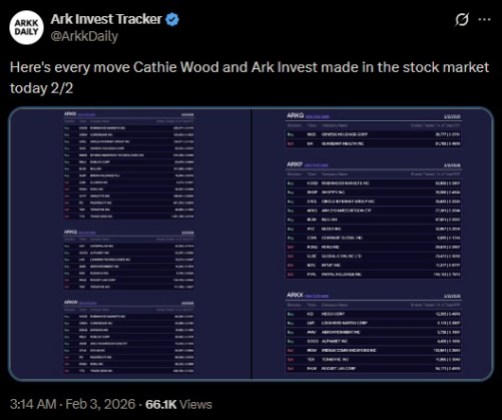
Ark Invest’s latest filing reveals a chunky $32.7M acquisition of Robinhood (HOOD) shares.

On the surface, it’s an equity play, but dig deeper, and it looks like a derivative bet on the resurgence of crypto market participation. Historically, Robinhood’s volume spikes act as a canary in the coal mine for retail capital, typically preceding major on-chain activity by 3-5 weeks.
The timing feels deliberate. As the Federal Reserve signals potential rate pauses, risk-on assets are re-pricing. But buying HOOD is just the surface trade. The inevitable second-order effect of a retail influx? Massive Bitcoin network congestion. When millions of new users try to move $BTC, fees don’t just rise; they skyrocket, making the base layer practically unusable for anyone moving less than six figures.

That bottleneck is exactly why institutional eyes are drifting toward infrastructure that can handle the coming liquidity shock. While Wall Street buys exchange stocks, on-chain capital is positioning into scalability protocols.

Specifically, smart money appears to be front-running the congestion narrative by accumulating Bitcoin Hyper ($HYPER), the first protocol to weld the Solana Virtual Machine (SVM) directly onto a Bitcoin Layer 2.

Buy $HYPER here.

Solving the Velocity Problem: Bitcoin Meets SVM Speed

The thesis here is simple mechanics. Bitcoin is secure but slow; Solana is fast but has faced centralization headaches. By fusing these architectures, Bitcoin Hyper ($HYPER) attempts a ‘best of both worlds’ environment to solve the trilemma plaguing current Layer 2s.

Most existing Bitcoin L2s still feel sluggish compared to modern DeFi standards. Bitcoin Hyper bypasses the lag by using the Solana Virtual Machine (SVM) for execution. The result? Sub-second transaction finality and costs that are fractions of a cent, all while anchoring state to the Bitcoin L1.
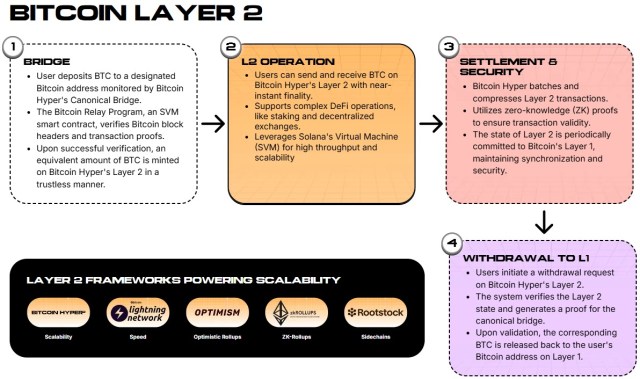
That matters because it finally unlocks high-frequency use cases for $BTC, think gaming, real-time payments, and complex DeFi swaps, that were previously impossible (or just too expensive) on the base layer.

Developers are eyeing the Rust-based environment too. The protocol offers a Developer SDK and API in Rust, meaning the massive pool of Solana devs can port their dApps to the Bitcoin ecosystem without rewriting their codebase. This isn’t just about building a chain; it’s about importing an entire developer economy.

You can buy $HYPER here.

Presale Data Signals Institutional Accumulation

The market’s appetite for high-performance infrastructure shows up in the hard numbers. According to the official presale page, Bitcoin Hyper ($HYPER) has raised over $32M, a figure that frankly outpaces most comparable infrastructure rounds this cycle. The token sits at $0.013675, a valuation that looks modest relative to the utility proposition.
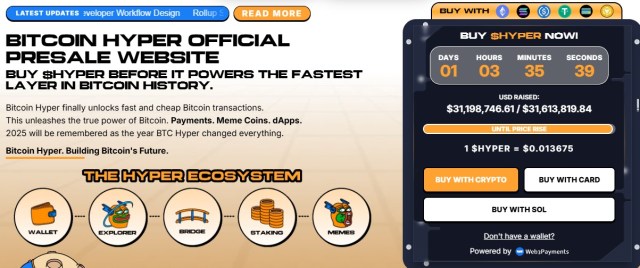
The incentives seem structured to keep that liquidity sticky. Staking opens immediately after the Token Generation Event (TGE), with a 7-day vesting period for presale participants. That lock-up mechanism helps prevent immediate sell-offs, aiming to create a stable floor at launch.

For investors watching Ark Invest buy the ‘shovels’ (Robinhood), Bitcoin Hyper represents the ‘ground’ where the actual digging happens.

Visit the official $HYPER presale here.

The content provided in this article is for informational purposes only and does not constitute financial advice. Cryptocurrency investments, including presales and stocks like Robinhood, carry high risks. Always conduct your own due diligence before investing.


Questions liées

QWhat is the significance of Ark Invest's $32.7M acquisition of Robinhood shares according to the article?

AThe article suggests that while it appears to be an equity play on the surface, it is actually a derivative bet on the resurgence of crypto market participation. Historically, Robinhood's trading volume spikes act as an early indicator (a 'canary in the coal mine') for retail capital entering the market, typically preceding major on-chain activity by 3-5 weeks.

QWhat problem does the Bitcoin Hyper ($HYPER) protocol aim to solve?

ABitcoin Hyper aims to solve the blockchain trilemma for Bitcoin Layer 2s by combining the security of Bitcoin with the speed of Solana. It welds the Solana Virtual Machine (SVM) directly onto a Bitcoin L2 to provide sub-second transaction finality and extremely low costs, thereby solving the 'velocity problem' and enabling high-frequency use cases like gaming and real-time payments on Bitcoin.

QHow does the article connect a potential influx of retail users to Bitcoin network congestion?

AThe article states that an influx of retail users, signaled by increased activity on platforms like Robinhood, leads to massive Bitcoin network congestion. When millions of new users try to move BTC, transaction fees don't just rise but 'skyrocket,' making the base layer practically unusable for transactions under six figures.

QWhat advantage does Bitcoin Hyper's Rust-based development environment provide?

ABy offering a Developer SDK and API in Rust, Bitcoin Hyper allows the massive existing pool of Solana developers to easily port their decentralized applications (dApps) to the Bitcoin ecosystem without having to rewrite their entire codebase, effectively importing an entire developer economy.

QWhat does the presale data for Bitcoin Hyper ($HYPER) indicate, as mentioned in the article?

AThe presale data indicates strong institutional accumulation, having raised over $32 million, which the article states outpaces most comparable infrastructure rounds in the current market cycle. The token's valuation is considered modest relative to its utility, and its staking and vesting mechanisms are designed to create liquidity stability post-launch.

Lectures associées

Dialogue avec Ray Dalio : Nous sommes actuellement dans une bulle de l'IA, 1% de mon portefeuille est en Bitcoin

Ray Dalio, fondateur de Bridgewater Associates, met en garde contre la bulle actuelle de l'IA, présentant des signes classiques similaires aux précédents krachs financiers. Il explique qu'une combinaison de spéculation excessive, d'endettement et de changements de taux d'intérêt pourrait provoquer son éclatement, entraînant une récession économique. Dalio décrit également un « grand cycle » mondial d'environ 80 ans, caractérisé par des inégalités croissantes, des déficits publics élevés et des tensions géopolitiques. Nous serions actuellement dans une phase de déclin de ce cycle, avec un ordre mondial en transition. Pour protéger leur patrimoine, il conseille aux investisseurs de diversifier leurs actifs (actions, obligations, or, immobilier) plutôt que de détenir uniquement des liquidités. Il mentionne détenir environ 1% de Bitcoin, mais préfère l'or physique pour sa stabilité. Concernant l'IA, Dalio souligne qu'elle remplacera progressivement le travail intellectuel humain, creusant les inégalités. L'avenir appartiendra à ceux qui sauront allier intelligence humaine et collaboration avec l'IA. Enfin, il évoque un monde de plus en plus régionalisé, avec un affaiblissement de la puissance américaine, visible dans des conflits comme celui avec l'Iran, et la montée en puissance d'autres pôles, notamment la Chine.

marsbitIl y a 4 h

Dialogue avec Ray Dalio : Nous sommes actuellement dans une bulle de l'IA, 1% de mon portefeuille est en Bitcoin

marsbitIl y a 4 h

7,2 billions de KRW en une journée, les achats nets des investisseurs étrangers atteignent un record historique ce vendredi ! Wall Street : Les vents contraires sur les flux de capitaux sud-coréens se sont dissipés

Les marchés boursiers sud-coréens montrent des signes tangibles d'amélioration des flux de capitaux. Le 31 juillet, les investisseurs étrangers ont réalisé un achat net record de 7 200 milliards de wons sur une seule journée dans le KOSPI, marquant un renversement de la tendance de sorties massives observée ces derniers mois. En juillet, leurs ventes nettes mensuelles se sont fortement réduites à 9 800 milliards de wons, contre 48 400 et 44 500 milliards en juin et mai respectivement. Parallèlement, les institutions domestiques comme les fonds de pension ont inversé leur tendance, passant à un achat net de 1 000 milliards de wons en juillet. La Commission des services financiers a également resserré l'accès aux ETF à effet de levier sur actions individuelles pour les investisseurs de détail, réduisant ainsi la volatilité du marché. Citigroup Research maintient son objectif pour le KOSPI à 10 000 points, estimant que les vents contraires liés aux flux de capitaux s'atténuent. Des facteurs tels que les fondamentaux solides du secteur des puces mémoire, les faibles valorisations du marché, une économie robuste et un environnement politique favorable devraient soutenir le marché. La possibilité d'interventions des autorités pour stabiliser le marché offre également un filet de sécurité.

marsbitIl y a 4 h

7,2 billions de KRW en une journée, les achats nets des investisseurs étrangers atteignent un record historique ce vendredi ! Wall Street : Les vents contraires sur les flux de capitaux sud-coréens se sont dissipés

marsbitIl y a 4 h

Choc ! La prochaine IA d'OpenAI résout 10 problèmes du calibre de la Médaille Fields

**OpenAI provoque un séisme mathématique avec son nouveau modèle Astra** OpenAI a dévoilé des avancées mathématiques majeures réalisées par son modèle interne Astra, présenté par Sam Altman. L'IA aurait résolu ou fait progresser dix problèmes complexes dans des domaines variés comme la géométrie haute dimension, la théorie des groupes et la complexité quantique. Le résultat le plus marquant est la construction du premier groupe "non sofic" infini et finiment présenté, réfutant une conjecture de Mikhail Gromov vieille de 27 ans. Cette seule découverte est qualifiée de niveau "Prix Fields". Astra a également amélioré une borne fondamentale sur le problème de l'empilement des sphères en haute dimension, stagnant depuis 1978, et a réfuté la conjecture de rigidité d'Alain Connes en construisant une infinité de groupes non isomorphes partageant la même algèbre de von Neumann. Ces résultats, compilés dans un document de 249 pages, sont accompagnés de preuves formelles vérifiées par l'assistant Lean 4. OpenAI précise que le coût total de génération de ces démonstrations aurait été inférieur à 2000 dollars. La communauté mathématique réagit avec stupeur, certains experts y voyant un tournant historique où l'IA démontre une intuition et une capacité de raisonnement pouvant surpasser les meilleurs mathématiciens humains.

marsbitIl y a 6 h

Choc ! La prochaine IA d'OpenAI résout 10 problèmes du calibre de la Médaille Fields

marsbitIl y a 6 h

Trading

Spot
活动图片




