Anthropic Just Released an "AI Job Disruption Report": The Higher the Education, the More "Disrupted"

marsbitPublié le 2026-01-16Dernière mise à jour le 2026-01-16

Résumé

Anthropic's latest "Economic Index Report" reveals a counterintuitive finding: AI accelerates work most dramatically in complex, high-skill tasks. While AI boosts speed by 9x for high-school-level tasks, this jumps to 12x for college-level work, indicating that knowledge-intensive roles are most impacted. The report highlights a critical shift towards "deskilling," where AI handles the analytical core of jobs, potentially leaving humans with diminished, routine tasks. However, effective human-AI collaboration extends AI's effective task horizon from 2 hours to 19 hours, showcasing a 10x improvement in handling complex projects. Globally, a divide exists: wealthier nations use AI for productivity enhancement, while poorer regions primarily use it for education. Anthropic forecasts AI could drive 1.0-1.2% annual US productivity growth, echoing 1990s tech boom levels. The key takeaway is that the future belongs not to those replaced by AI, but to those who master defining problems and collaborating with it.

Original Author: Xinzhiyuan

The "gold content" of your job is being hollowed out by AI. Anthropic's latest report reveals a counterintuitive truth: the more complex a task is as measured by years of education required, the more dramatically AI accelerates it. More frightening than direct replacement is "deskilling"—AI takes away the joy of thinking, leaving you with only mundane chores. But the data also points to the only way out: mastering human-AI collaboration can increase your odds of success tenfold. In this era of computational surplus, this is a survival guide you must understand.

Anthropic just released its "Economic Index Report" on its official website yesterday.

The report not only focuses on what people are using AI for but also on the extent to which AI is truly replacing human thinking.
This time, they introduced a new dimension called "Economic Primitives" to quantify task complexity, required education level, and the degree of AI autonomy.

The future of the workplace reflected in the data is far more complex than simple "unemployment" or "utopian" theories.

The Harder the Task, the Faster AI Does It

In our traditional understanding, machines are usually good at repetitive, simple labor but appear clumsy in areas involving profound knowledge.

But Anthropic's data presents a completely opposite conclusion: the more complex the task, the more惊人 (stunning) the "acceleration" brought by AI.

The report shows that for tasks understandable with just a high school education, Claude can increase work speed by 9 times;

once the task difficulty rises to a level requiring a college degree, this acceleration multiplier soars to 12 times.

This means that the white-collar elite work that originally required humans to ponder for hours is currently the area where AI "harvests" most efficiently.

Even when considering the failure rate of AI occasionally producing hallucinations, the conclusion remains unchanged: the efficiency surge AI brings to complex tasks is enough to offset the cost of fixing its errors.

This explains why programmers and financial analysts are now more reliant on Claude than data entry clerks—because in these high-intelligence-density fields, the leverage effect demonstrated by AI is the strongest.

19 Hours: The "New Moore's Law" of Human-AI Collaboration

The most shocking data in this report comes from the test of AI's "endurance" (task horizons, measured by 50% success rate).

Standard benchmark tests like METR (Model Evaluation & Threat Research) suggest that current top models (like Claude Sonnet 4.5) see their success rate drop below 50% when handling tasks that would take a human 2 hours.
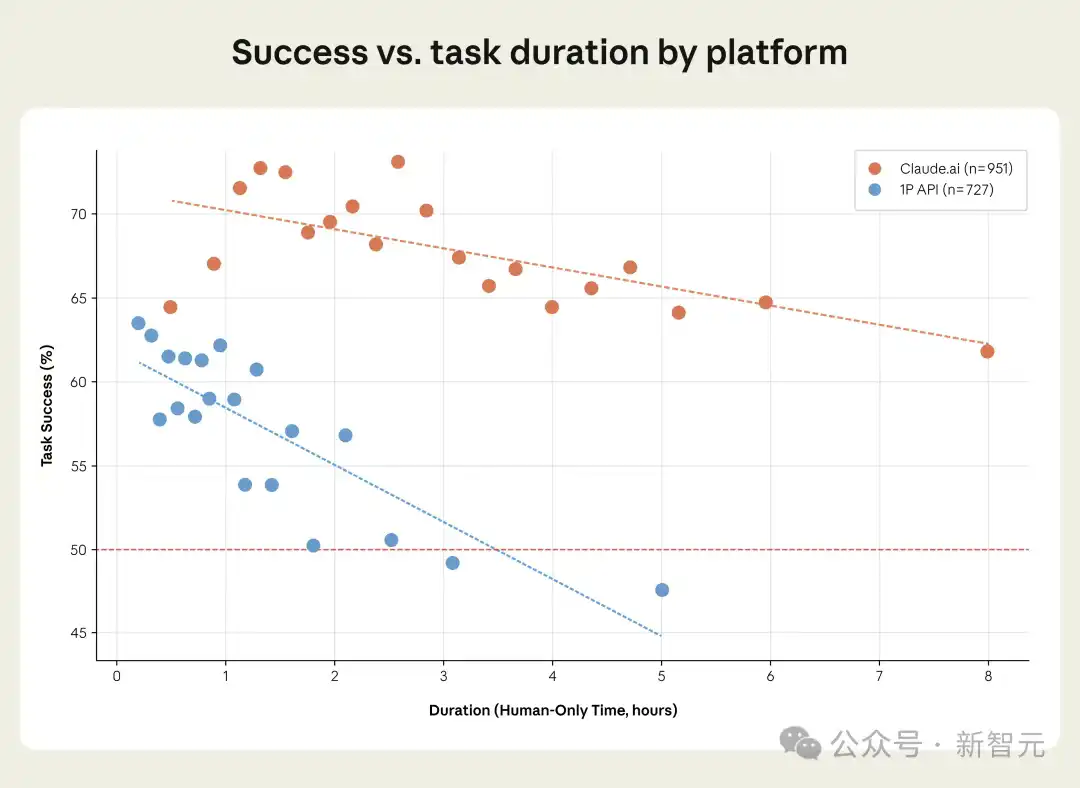
But in Anthropic's actual user data, this time limit is significantly extended.

In commercial scenarios using API calls, Claude can maintain a success rate of over 50% for tasks involving 3.5 hours of work.

And in the Claude.ai chat interface, this number is astonishingly pushed to 19 hours.

Why such a huge gap? The secret lies in human intervention.

Benchmark tests are AI facing the test alone, while real-world users break down a massive complex project into countless small steps, constantly correcting AI's course through feedback loops.

This human-AI collaborative workflow pushes the (50% success rate measured) task duration上限 (upper limit) from 2 hours to about 19 hours, nearly a 10-fold increase.

This might be the true shape of future work: not AI doing everything independently, but humans learning how to steer it through a marathon.

The Folded World Map: The Poor Learn Knowledge, the Rich Engage in Production

If we zoom out to a global perspective, we see a clear and slightly ironic "adoption curve".

In high per capita GDP developed countries, AI is already deeply embedded in productivity and personal life.

People use it to write code, create reports, and even plan travel itineraries.

But in countries with lower per capita GDP, Claude's primary role is "teacher," with大量 (a large number of) uses concentrated on coursework and educational tutoring.
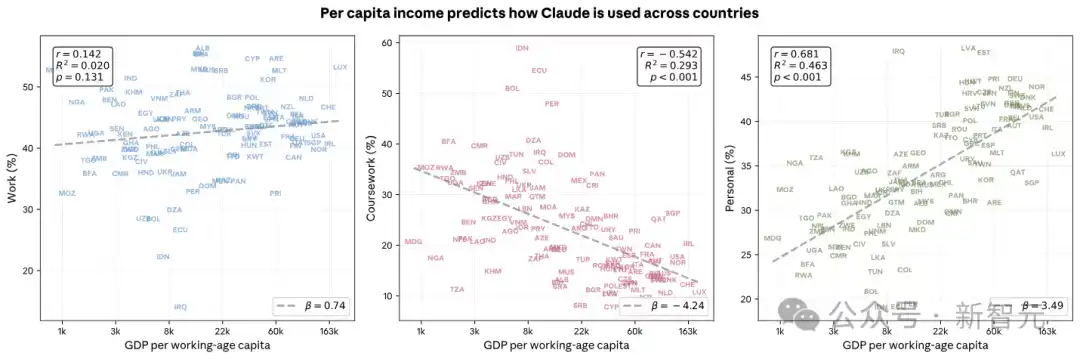
Beyond wealth disparity, this is also a manifestation of a technological gap.

Anthropic mentioned they are collaborating with the Rwandan government, trying to help people there leapfrog the mere "learning" phase and enter broader application layers.

Because without intervention, AI is likely to become a new barrier: people in wealthy regions use it to exponentially amplify output, while people in less developed regions are still using it to补习 (remedially learn) basic knowledge.

Workplace Concerns: The Specter of "Deskilling"

The most controversial and警惕 (warranting caution) part of the report is the discussion on "Deskilling".

Data indicates that the tasks currently covered by Claude require, on average, 14.4 years of educational background (equivalent to an associate degree), significantly higher than the 13.2 years required on average for overall economic activity.
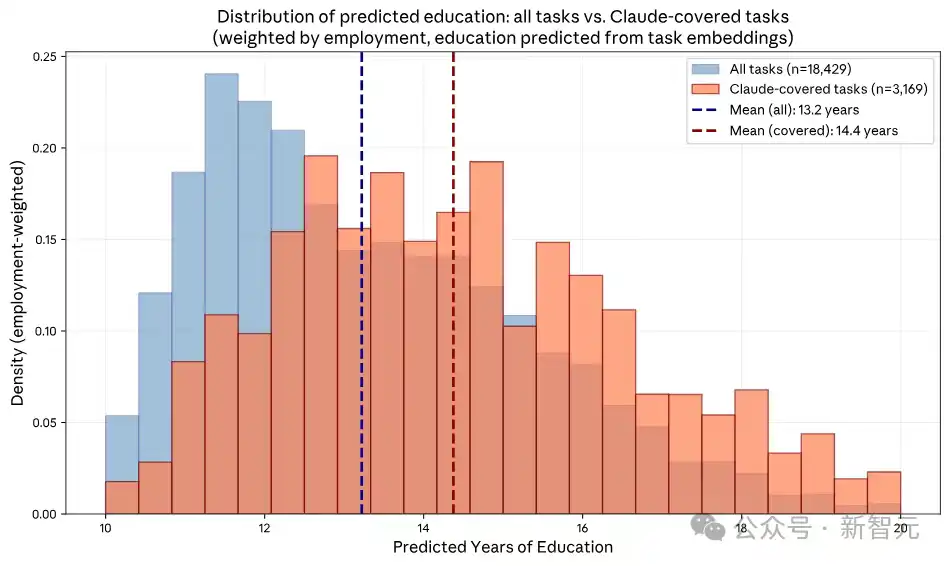
AI is systematically剔除 (removing) the "high-intelligence" parts of work.

For technical writers or travel agency agents, this could be disastrous.

AI takes over分析行业动态 (analyzing industry trends),规划复杂行程 (planning complex itineraries) — the tasks that require "brains" — leaving humans with only琐碎工作 (trivial tasks) like sketching or collecting invoices.

Your job remains, but the "gold content" of the job is hollowed out.

Of course, there are beneficiaries.

For example, real estate managers, when AI handles枯燥的行政工作 (tedious administrative work) like bookkeeping and contract comparison, can focus their energy on client negotiation and stakeholder management requiring high emotional intelligence—this is反而 (instead) a form of "Upskilling".

Anthropic cautiously states this is only an extrapolation based on the current situation, not an inevitable prophecy.

But the alarm it sounds is real.

If your core competitiveness is merely processing complex information, then you are at the eye of the storm.

A Return to the "Golden Age" of Productivity?

Finally, let's return to the macro perspective.

Anthropic revised its forecast for US labor productivity.

After剔除 (removing) possible AI errors and failures, they predict AI will drive productivity growth by 1.0% to 1.2% annually over the next decade.

This seems like a reduction of one-third compared to the previous optimistic estimate of 1.8%, but don't underestimate this 1 percentage point.

It is enough to bring US productivity growth back to the levels of the late 1990s internet boom.

Moreover, this is based solely on the model capabilities as of November 2025. With the entry of Claude Opus 4.5, and the gradual dominance of "augmented mode" (where people no longer try to dump all work on AI but collaborate with it more intelligently) in user behavior, this number has significant upside potential.

Conclusion

Reading through the entire report, what is most感慨 (striking) is not just how strong AI has become, but more how quickly humans are adapting.

We are undergoing a migration from "passive automation" to "active enhancement".

In this transformation, AI acts like a mirror; it takes over those tasks that require high education but can be completed through logical deduction, thereby forcing us to seek out value that cannot be quantified by algorithms.

In this era of computational surplus, humanity's scarcest ability is no longer finding answers, but defining problems.

References:

https://www.anthropic.com/research/economic-index-primitives

https://www.anthropic.com/research/anthropic-economic-index-january-2026-report

Questions liées

QAccording to Anthropic's report, which type of tasks does AI accelerate the most?

AAI accelerates complex tasks that require a higher level of education the most. Tasks requiring a college degree see a 12x speedup, compared to a 9x speedup for tasks requiring only a high school education.

QWhat is the key finding regarding human-AI collaboration in terms of task duration?

AThe key finding is that human-AI collaboration dramatically extends the viable task duration. While benchmarks suggest AI's 50% success rate drops at 2-hour tasks, real-world collaborative workflows push this limit to approximately 19 hours.

QHow does the primary use of AI differ between high-GDP and low-GDP countries, as per the report?

AIn high-GDP countries, AI is primarily used for productivity and personal life enhancement (e.g., coding, reports). In low-GDP countries, its main role is as an educational tool for coursework and tutoring.

QWhat is 'deskilling' and which professionals are most at risk from it?

A'Deskilling' is the process where AI systematically removes the high-intellect, analytical parts of a job, leaving humans with more mundane tasks. Professionals like technical writers and travel agents, whose core value is processing complex information, are most at risk.

QWhat is Anthropic's revised forecast for AI's annual impact on US productivity growth over the next decade?

AAnthropic's revised forecast estimates that AI will boost US labor productivity growth by 1.0% to 1.2% annually over the next decade, a figure comparable to the growth rates seen during the late 1990s internet boom.

Lectures associées

Dialogue avec Ray Dalio : Nous sommes actuellement dans une bulle de l'IA, 1% de mon portefeuille est en Bitcoin

Ray Dalio, fondateur de Bridgewater Associates, met en garde contre la bulle actuelle de l'IA, présentant des signes classiques similaires aux précédents krachs financiers. Il explique qu'une combinaison de spéculation excessive, d'endettement et de changements de taux d'intérêt pourrait provoquer son éclatement, entraînant une récession économique. Dalio décrit également un « grand cycle » mondial d'environ 80 ans, caractérisé par des inégalités croissantes, des déficits publics élevés et des tensions géopolitiques. Nous serions actuellement dans une phase de déclin de ce cycle, avec un ordre mondial en transition. Pour protéger leur patrimoine, il conseille aux investisseurs de diversifier leurs actifs (actions, obligations, or, immobilier) plutôt que de détenir uniquement des liquidités. Il mentionne détenir environ 1% de Bitcoin, mais préfère l'or physique pour sa stabilité. Concernant l'IA, Dalio souligne qu'elle remplacera progressivement le travail intellectuel humain, creusant les inégalités. L'avenir appartiendra à ceux qui sauront allier intelligence humaine et collaboration avec l'IA. Enfin, il évoque un monde de plus en plus régionalisé, avec un affaiblissement de la puissance américaine, visible dans des conflits comme celui avec l'Iran, et la montée en puissance d'autres pôles, notamment la Chine.

marsbitIl y a 2 h

Dialogue avec Ray Dalio : Nous sommes actuellement dans une bulle de l'IA, 1% de mon portefeuille est en Bitcoin

marsbitIl y a 2 h

7,2 billions de KRW en une journée, les achats nets des investisseurs étrangers atteignent un record historique ce vendredi ! Wall Street : Les vents contraires sur les flux de capitaux sud-coréens se sont dissipés

Les marchés boursiers sud-coréens montrent des signes tangibles d'amélioration des flux de capitaux. Le 31 juillet, les investisseurs étrangers ont réalisé un achat net record de 7 200 milliards de wons sur une seule journée dans le KOSPI, marquant un renversement de la tendance de sorties massives observée ces derniers mois. En juillet, leurs ventes nettes mensuelles se sont fortement réduites à 9 800 milliards de wons, contre 48 400 et 44 500 milliards en juin et mai respectivement. Parallèlement, les institutions domestiques comme les fonds de pension ont inversé leur tendance, passant à un achat net de 1 000 milliards de wons en juillet. La Commission des services financiers a également resserré l'accès aux ETF à effet de levier sur actions individuelles pour les investisseurs de détail, réduisant ainsi la volatilité du marché. Citigroup Research maintient son objectif pour le KOSPI à 10 000 points, estimant que les vents contraires liés aux flux de capitaux s'atténuent. Des facteurs tels que les fondamentaux solides du secteur des puces mémoire, les faibles valorisations du marché, une économie robuste et un environnement politique favorable devraient soutenir le marché. La possibilité d'interventions des autorités pour stabiliser le marché offre également un filet de sécurité.

marsbitIl y a 2 h

7,2 billions de KRW en une journée, les achats nets des investisseurs étrangers atteignent un record historique ce vendredi ! Wall Street : Les vents contraires sur les flux de capitaux sud-coréens se sont dissipés

marsbitIl y a 2 h

Choc ! La prochaine IA d'OpenAI résout 10 problèmes du calibre de la Médaille Fields

**OpenAI provoque un séisme mathématique avec son nouveau modèle Astra** OpenAI a dévoilé des avancées mathématiques majeures réalisées par son modèle interne Astra, présenté par Sam Altman. L'IA aurait résolu ou fait progresser dix problèmes complexes dans des domaines variés comme la géométrie haute dimension, la théorie des groupes et la complexité quantique. Le résultat le plus marquant est la construction du premier groupe "non sofic" infini et finiment présenté, réfutant une conjecture de Mikhail Gromov vieille de 27 ans. Cette seule découverte est qualifiée de niveau "Prix Fields". Astra a également amélioré une borne fondamentale sur le problème de l'empilement des sphères en haute dimension, stagnant depuis 1978, et a réfuté la conjecture de rigidité d'Alain Connes en construisant une infinité de groupes non isomorphes partageant la même algèbre de von Neumann. Ces résultats, compilés dans un document de 249 pages, sont accompagnés de preuves formelles vérifiées par l'assistant Lean 4. OpenAI précise que le coût total de génération de ces démonstrations aurait été inférieur à 2000 dollars. La communauté mathématique réagit avec stupeur, certains experts y voyant un tournant historique où l'IA démontre une intuition et une capacité de raisonnement pouvant surpasser les meilleurs mathématiciens humains.

marsbitIl y a 4 h

Choc ! La prochaine IA d'OpenAI résout 10 problèmes du calibre de la Médaille Fields

marsbitIl y a 4 h

Grâce aux lancers de dés, les clés Bitcoin sont stockées hors ligne, mais tout le monde ne s'y mettra pas

Le titre « Les clés Bitcoin protégées par des dés, mais la méthode reste marginale » introduit un article sur la génération manuelle de graines de portefeuille Bitcoin à l'aide de dés. L'article explique le concept d'entropie, illustré par Claude Shannon, où un dé à six faces génère environ 2,585 bits d'incertitude. Il aborde le scandale récent de Coldcard, où une vulnérabilité du générateur de nombres aléatoires matériel a compromis des fonds. Les utilisateurs ayant généré leur phrase de récupération avec des dés (environ 99 lancers pour une haute sécurité) n'étaient pas affectés pour leur seed principal. Cependant, l'analyse du chercheur Kevin Loaec montre que d'autres fonctions du portefeuille (clés de copie, portefeuilles papier, mots de passe, etc.) utilisaient ce générateur défectueux et restaient vulnérables. L'article souligne les défis pratiques de la méthode des dés : elle est longue, sujette aux erreurs de saisie, et peu adaptée aux nouveaux utilisateurs qui pourraient mal l'exécuter. Il conclut que si cette méthode manuelle est robuste pour les experts, l'objectif à long terme est d'avoir un matériel et des logiciels générant une entropie fiable de manière simple et sécurisée. Il conseille aux propriétaires de Coldcard de vérifier leur firmware et les fonctions utilisées, et rappelle l'intérêt des solutions multi-signatures avec différents fabricants pour limiter les risques.

cryptonews.ruIl y a 7 h

Grâce aux lancers de dés, les clés Bitcoin sont stockées hors ligne, mais tout le monde ne s'y mettra pas

cryptonews.ruIl y a 7 h

Trading

Spot
活动图片





