a16z Crypto: 9 Charts to Understand the Evolution of Stablecoins

marsbitPublié le 2026-04-25Dernière mise à jour le 2026-04-25

Résumé

Stablecoins are evolving from trading instruments to core financial infrastructure, driven by regulatory clarity and increased adoption. Key trends include accelerated growth following the U.S. GENIUS Act and the EU’s MiCA framework, which spurred non-USD stablecoin activity. Consumer-to-business transactions are growing fastest, doubling in 2025, while stablecoin card usage has surged. Velocity has nearly doubled since 2024, indicating active use rather than passive holding. Geographically, Asia dominates volume, led by Singapore, Hong Kong, and Japan. Notably, domestic transactions now account for nearly three-quarters of payments, highlighting stablecoins' role as local payment mediums on global infrastructure. Non-USD stablecoins, like Brazil’s BRLA, are also gaining traction. The data suggests stablecoins are becoming ubiquitous payment tools—global in design but increasingly local in practice.

Author: a16z crypto

Compiled by: Jiahuan, ChainCatcher

Stablecoins have been finding their footing for years.

Initially, they were just a trading tool, a means to transfer dollars across exchanges. Then they evolved into a savings instrument, held rather than spent. Today, the data points in a new direction: stablecoins are increasingly becoming core financial infrastructure.

The following nine charts reveal the factors driving this trend.

Regulation Accelerates Market Growth

For most of their history, regulatory uncertainty limited institutional participation. Later, the GENIUS Act brought regulatory clarity. It didn't create this trend, but it amplified and accelerated it.
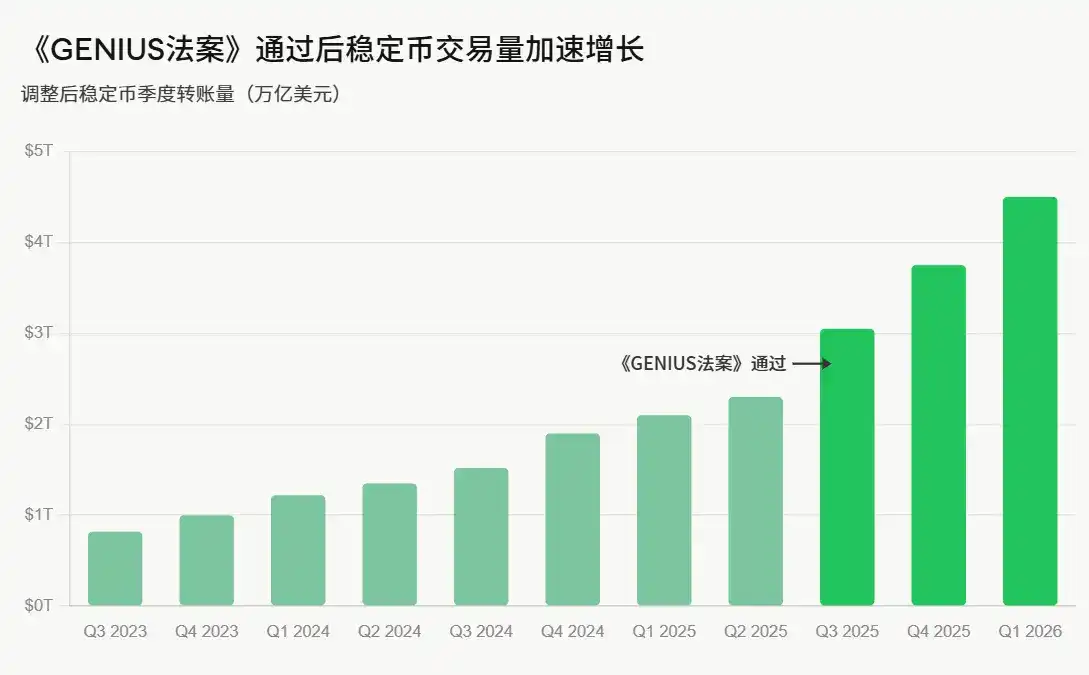
In the United States, the GENIUS Act established the first federal-level framework for stablecoin issuance. This shift is clearly visible in the data: adjusted trading volume had been rising for several quarters before the bill's passage, and growth accelerated further after its passage, reaching approximately $4.5 trillion in Q1 2026.

European regulation—the Markets in Crypto-Assets (MiCA) framework—tells a more complex story. When the法案 fully came into effect at the end of 2024, several major exchanges delisted USDT to comply, leading to a surge in activity for non-dollar stablecoins, which一度 exceeded $40 billion.
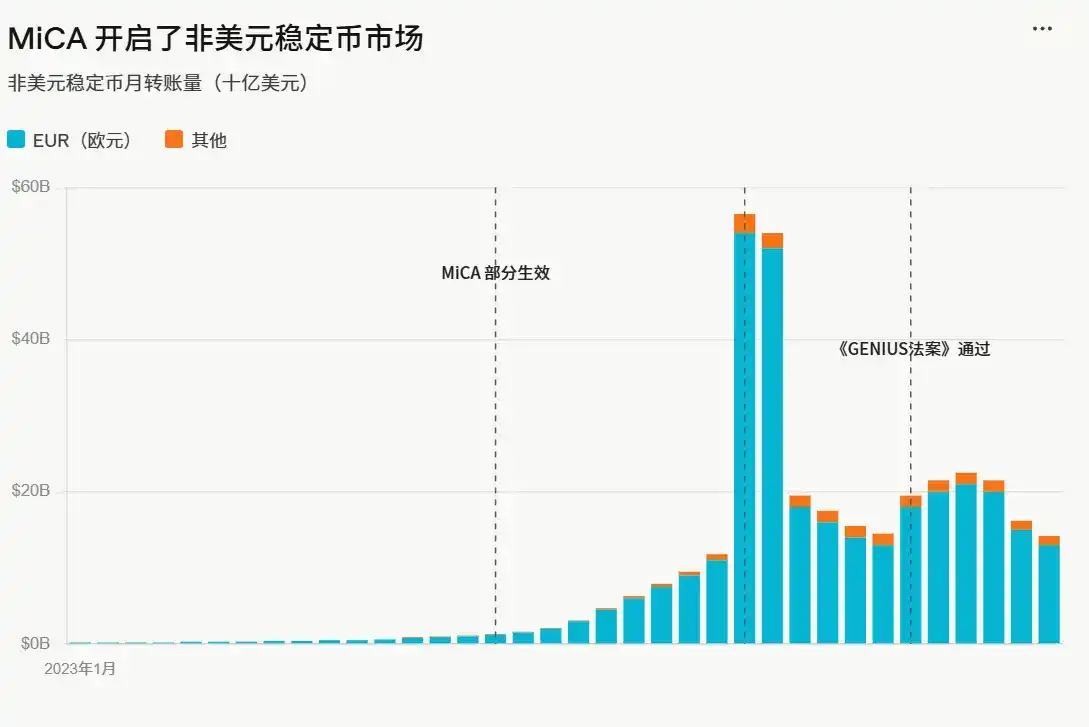
Since then, trading volume has stabilized at levels higher than the pre-MiCA baseline, around $15 billion to $25 billion per month. Regulation created a lasting market for non-dollar stablecoins that previously barely existed.

Stablecoin Commercial Activity is Growing

Perhaps the most noteworthy structural change lies in how people are actually using stablecoins.
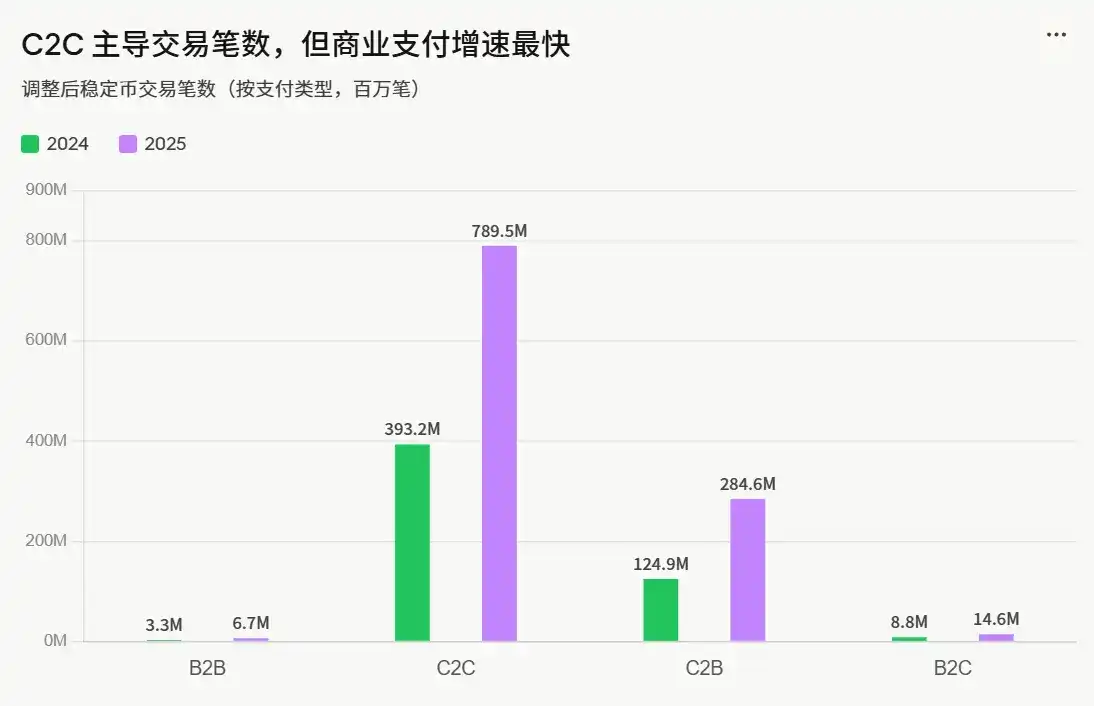
In terms of raw transaction count, the C2C category far surpasses all others: reaching 789.5 million in 2025. But Consumer-to-Business (C2B) stablecoin transactions grew the fastest, reaching 284.6 million in 2025 compared to 124.9 million in 2024, more than doubling year-over-year (+128%).

Data from stablecoin card infrastructure highlights this trend.
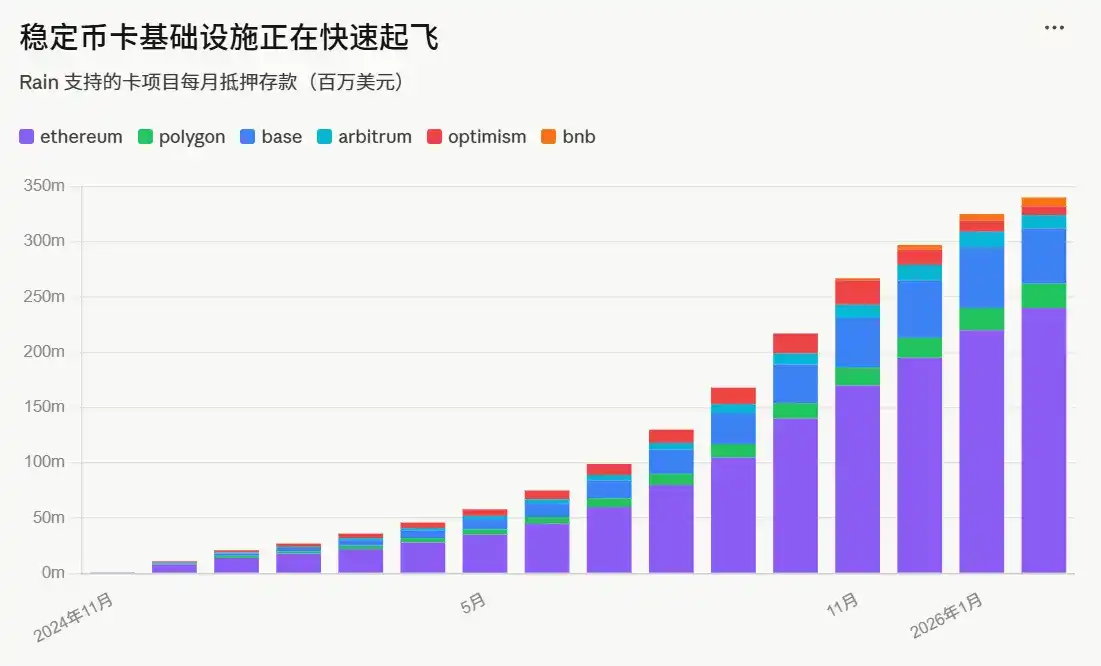
Monthly collateral deposits for stablecoin card programs supported by Rain (including Etherfi Cash, Kast, Wallbit, etc.) grew from nearly zero in November 2024 to over $300 million per month by early 2026. While this is collateral supporting spending, not direct spending of stablecoins, the trajectory is striking: stablecoin commercial activity is on the rise.

Stablecoin Velocity is Increasing

Every dollar of stablecoin supply is turning over more frequently.

Since early 2024, the velocity of stablecoins (the ratio of adjusted monthly transfer volume to circulating supply) has almost doubled, rising from 2.6x to 6x. An increase in velocity means demand for stablecoin transactions is outpacing new issuance, and the existing supply is working harder.
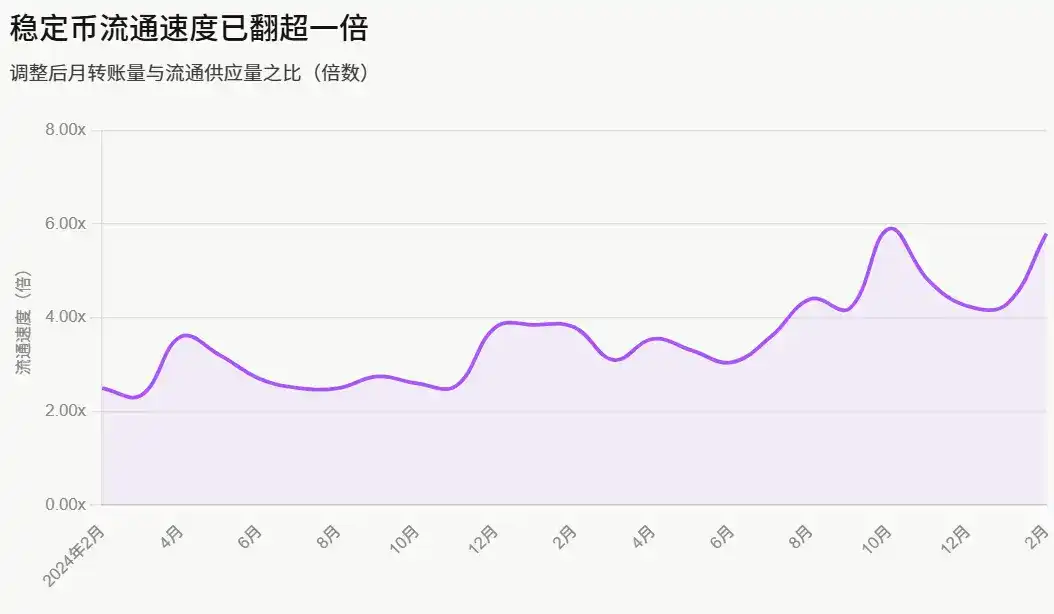
This is a hallmark of a true payment network—the base currency is being actively used, not just held.

Stablecoin Volume Reflects More Payments

If trading, fund flows, and exchange mechanisms—which make up the bulk of stablecoin transactions—are excluded, the estimated total for payments between different entities last year was still between $350 billion and $550 billion.

By volume, the Business-to-Business (B2B) sector dominates stablecoin payments (unsurprising given its scale). But other sectors, such as direct Consumer-to-Consumer (C2C) payments and interactions with merchants, are also expanding rapidly.

Stablecoin Payments are Currently Concentrated in Specific Regions

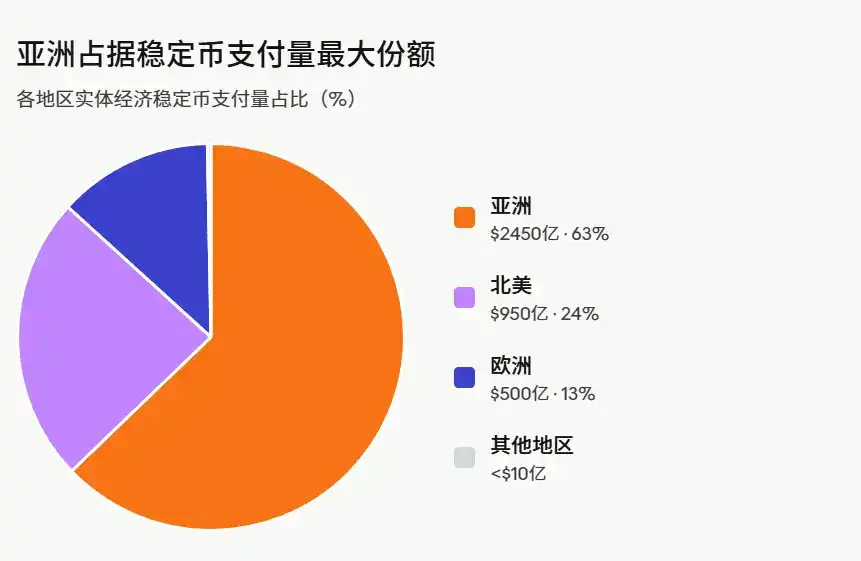
Geographically, stablecoin payment activity is not evenly distributed.

Nearly two-thirds of the transaction volume comes from Asia, primarily concentrated in Singapore, Hong Kong, and Japan.

North America accounts for about a quarter. Europe's share is around 13%. Latin America and Africa together make up only a very small portion, less than $1 billion.
Not Just Cross-Border Payments, But Local Currencies on Global Rails

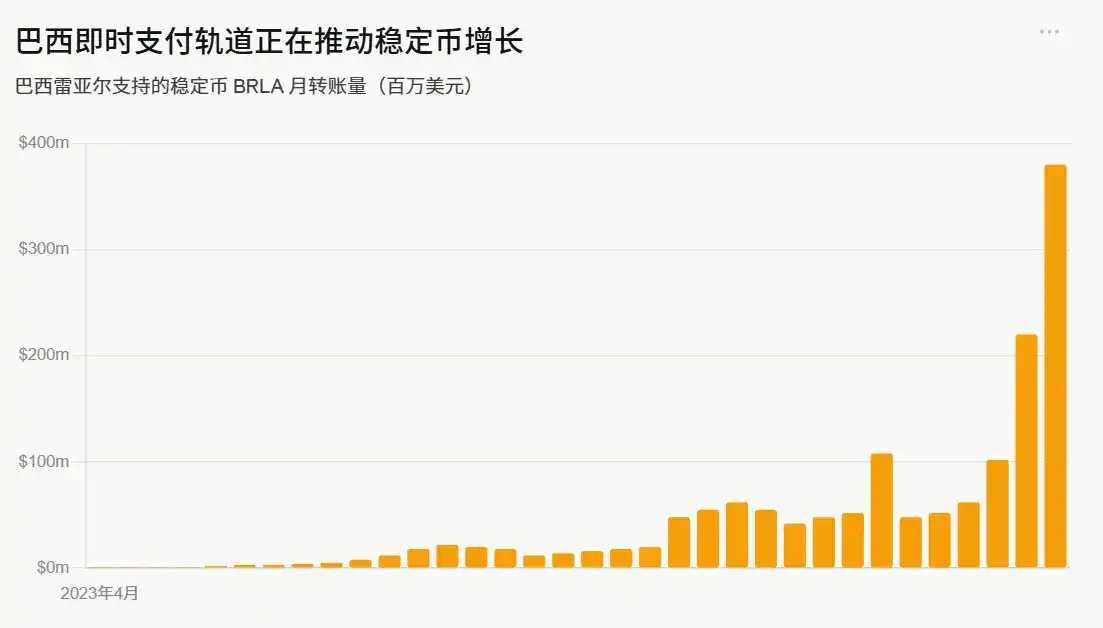
The development of non-dollar stablecoins is not limited to Europe; it is also evident in emerging markets, driven by various factors.

Brazil is a prime example. The monthly transfer volume of BRLA (a stablecoin backed by the Brazilian Real) has grown from nearly zero in early 2023 to about $400 million per month by early 2026. Access to the PIX instant payment network has driven its adoption.
Although stablecoins are often described as cross-border tools, the proportion of cross-border activity has actually been declining, not rising.

Domestic transactions (stablecoin transfers occurring within the same country/region) have grown from about half of the payment volume in early 2024 to nearly three-quarters by early 2026. What does this mean? Stablecoins are not only establishing themselves as remittance or forex tools but also becoming a local payment medium running on global infrastructure.
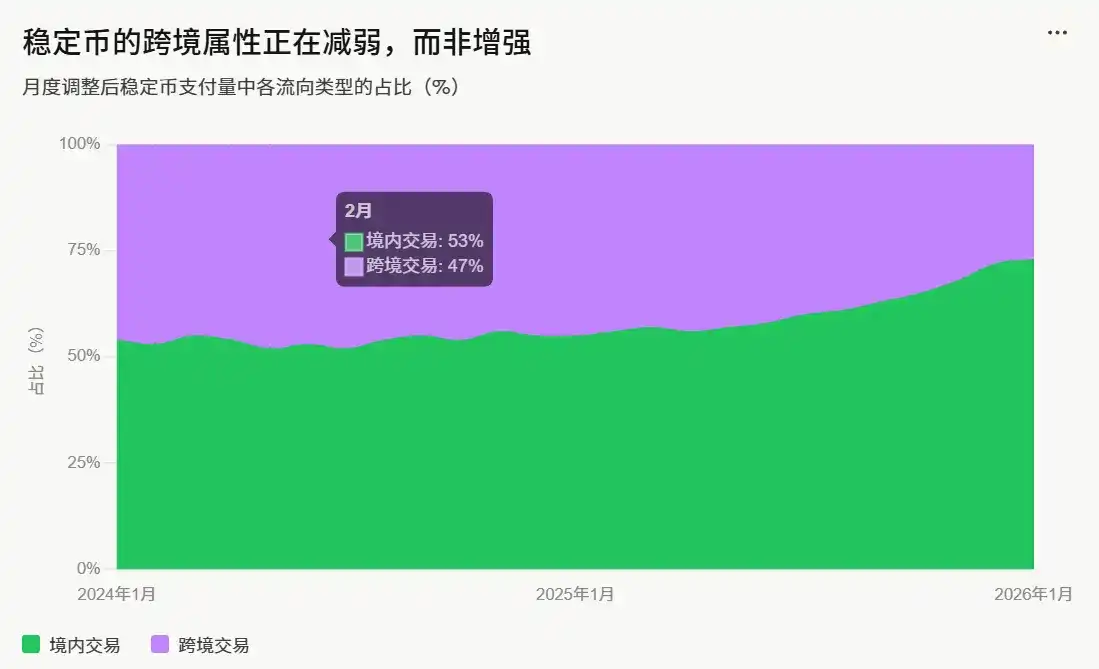
Putting all these factors together, a clear picture emerges, though it's not the one most people expected: many thought stablecoins would be purely focused on cross-border transactions. Instead, they are becoming increasingly localized.

While the US dollar remains the core f币锚定 for the vast majority of stablecoins, stablecoins are by no means simply an export of the dollar. Non-dollar variants, such as euro-backed and Brazilian real-backed local currency stablecoins, are gaining popularity.

Although peer-to-peer (C2C) stablecoin transfers far exceed other types of payment flows in quantity, increasingly usage is flowing towards everyday consumption (C2B).

Each quarter's data provides more evidence that stablecoins are developing into general-purpose payment infrastructure. They are global by design but increasingly local in practice.

It's still early days. But the shape of this system is becoming clearer.

Questions liées

QWhat was the impact of the GENIUS Act on stablecoin trading volume in the US?

AThe GENIUS Act established the first federal-level framework for stablecoin issuance in the US. Before its passage, adjusted trading volume had been increasing for several consecutive quarters. After its enactment, growth accelerated further, reaching approximately $4.5 trillion in Q1 2026.

QWhich region accounts for the largest share of stablecoin payment volume, and which specific areas are the main contributors?

AAsia accounts for nearly two-thirds of the stablecoin payment volume. The main contributors are Singapore, Hong Kong, and Japan.

QWhat is the most significant structural change in how people use stablecoins, as indicated by transaction growth?

AThe most significant structural change is the growth in Consumer-to-Business (C2B) stablecoin transactions. This category saw the fastest growth, more than doubling (+128%) from 124.9 million transactions in 2024 to 284.6 million in 2025.

QWhat does the increasing velocity of stablecoins indicate about their use?

AThe increasing velocity of stablecoins, which nearly doubled from 2.6x to 6x since early 2024, indicates that the demand for stablecoin transactions is outpacing new issuance. It means the existing supply is circulating more frequently, which is a hallmark of a genuine payment network where the base currency is being actively used, not just held.

QContrary to common belief, what trend is observed in the proportion of cross-border stablecoin activity?

AContrary to the common belief that stablecoins are primarily for cross-border transactions, the proportion of cross-border activity has actually been decreasing. Domestic transactions (stablecoin transfers within the same country/region) grew from about half of the payment volume in early 2024 to nearly three-quarters by early 2026.

Lectures associées

Casper Lance une Boîte à Outils IA pour Agents Autonomes et Constructeurs

La Casper Association a lancé la Casper AI Toolkit, l'offre IA la plus complète sur une blockchain de Layer 1. Cette boîte à outils permet aux agents IA d'effectuer deux tâches principales : réaliser des transactions autonomes en tant qu'acteurs économiques, et créer, tester et déployer de nouvelles applications sans assistance humaine. Pour les transactions, le protocole x402 intègre le paiement directement dans la requête, permettant des micropaiements HTTP instantanés sans comptes de facturation ni intervention humaine. Les agents peuvent également interagir directement avec la blockchain via le Model Context Protocol (MCP) pour interroger des soldes ou soumettre des transactions. En tant que développeurs, les agents IA peuvent utiliser le cadre de travail Odra pour concevoir et déployer des contrats intelligents de manière autonome, un processus soutenu par le package CSPR.build Agent Skills. Ces composants forment un système cohérent où les agents peuvent à la fois construire des services et payer pour les utiliser, formant ainsi les bases d'une "économie machine". La prochaine étape, l'abstraction de compte, vise à donner aux agents leurs propres identités on-chain. Pour encourager le développement, la Casper Association organise un "Buildathon" avec 150 000 $ de prix et une utilisation gratuite parrainée du facilitateur x402 pour les équipes participantes.

TheNewsCryptoIl y a 49 mins

Casper Lance une Boîte à Outils IA pour Agents Autonomes et Constructeurs

TheNewsCryptoIl y a 49 mins

SpaceX, OpenAI, Anthropic : Les trois géants de l'IA dans la dernière ligne droite vers l'introduction en Bourse. Sur lequel faut-il miser ?

Les plus grandes introductions en bourse de l'histoire, SpaceX, OpenAI et Anthropic, se préparent à lever jusqu'à 1800 milliards de dollars, dépassant le total de la bulle internet. Cette ruée soudaine vers le marché public s'explique par l'énorme appétit en dépenses d'infrastructure pour l'IA (centres de données, GPU, électricité), que les flux de trésorerie actuels ne peuvent plus financer. SpaceX, avec son modèle commercial non éprouvé de centres de données spatiaux, redéfinit les règles d'entrée dans les indices pour attirer massivement les fonds de retraite passifs. Anthropic se distingue par une croissance explosive de ses revenus récurrents (450 milliards de dollars annualisés) et une profitabilité imminente, tirée par son adoption dans les grandes entreprises. OpenAI, comme Google qui lève 800 milliards de dollars séparément, a un besoin urgent de capitaux pour construire son infrastructure. Malgré les montants vertigineux et les ajustements de règles, les animateurs restent globalement optimistes. Ils estiment que ces investissements construisent la base physique essentielle de la prochaine ère technologique. La demande réelle dépasse l'offre de capacités de calcul, et les contraintes physiques (production de puces, construction) limitent les risques de bulle purement financière. Les trois sociétés représentent des paris à long terme sur les fondations de l'avenir.

marsbitIl y a 2 h

SpaceX, OpenAI, Anthropic : Les trois géants de l'IA dans la dernière ligne droite vers l'introduction en Bourse. Sur lequel faut-il miser ?

marsbitIl y a 2 h

« Vieilles actions » devenues « nouvelles valeurs prisées » : de Dell à Nokia, comment l'IA réévalue les anciennes infrastructures ?

Il y a un an, des entreprises comme Dell, Nokia, Cisco, Corning ou Western Digital n'étaient pas considérées comme des acteurs clés de l'IA, souvent perçues comme des valeurs à croissance lente. Aujourd'hui, leur performance boursière relance le débat. Cette réévaluation s'explique par une transition cruciale : l'IA passe de la théorie à la construction d'infrastructures physiques. Le marché identifie désormais la valeur des actifs historiques de ces entreprises—leurs chaînes d'approvisionnement, leur expérience de livraison et leur base client—dans le déploiement à grande échelle des data centers IA. Il ne s'agit pas d'une simple mode, mais d'une réponse aux besoins concrets de l'ingénierie système de l'IA. Trois catégories d'entreprises sont principalement revalorisées : 1. **Serveurs et intégration système** (Dell, HPE) : Leur force réside dans l'intégration des GPU dans des systèmes complets (serveurs, refroidissement, alimentation) pour les clients. 2. **Réseau et connectivité** (Corning, Nokia, Cisco) : L'IA à grande échelle dépend d'interconnexions à haut débit dans et entre les data centers, ainsi que des réseaux télécoms pour l'IA en périphérie. 3. **Stockage** (Western Digital, Seagate) : L'explosion des données d'entraînement, des journaux et des archives froides de l'IA génère une demande robuste pour des disques durs haute capacité. Pour une réévaluation durable, trois critères sont essentiels : la concrétisation des commandes et revenus liés à l'IA, la révision à la hausse des prévisions financières, et une amélioration de la qualité des marges bénéficiaires. En résumé, l'IA ne rajeunit pas ces "villes valeurs", mais leur redonne de la pertinence en ayant à nouveau besoin des infrastructures qu'elles maîtrisent depuis des décennies. La réévaluation profitera surtout à celles qui transforment réellement la demande d'IA en revenus et profits durables.

marsbitIl y a 2 h

« Vieilles actions » devenues « nouvelles valeurs prisées » : de Dell à Nokia, comment l'IA réévalue les anciennes infrastructures ?

marsbitIl y a 2 h

Trading

Spot
Futures
活动图片





