Building the Bright Path While Secretly Crossing Chencang: Is Walsh Paving the Way for a September "Rate Cut"?

marsbitPublié le 2026-06-29Dernière mise à jour le 2026-06-29

Résumé

The title "Building the Plank Road Openly While Secretly Crossing at Chencang: Is Walsh Paving the Way for a September 'Rate Cut'?" suggests Federal Reserve Chair Kevin Walsh's hawkish stance may be a deliberate smokescreen. Academy Securities analyst Peter Tchir argues in a report that markets, currently pricing a 75% chance of a September hike, are missing a potential path to a September rate cut that Walsh himself might be quietly preparing. Tchir posits that Walsh's hawkish rhetoric aims to suppress long-term yield risks (with the 10-year Treasury yield falling recently) while creating room for a narrative shift based on upcoming data. The potential political endgame, according to this view, could be rate cuts in September and October, ahead of the midterm elections. This hinges on a political logic where the Trump administration's preference for lower rates remains unchanged. A core part of Tchir's argument involves redefining inflation metrics. He contends the Fed under Walsh may deprioritize the PCE index, criticizing its lagging components like Owners' Equivalent Rent (OER). Instead, he points to alternative, more real-time indicators like the New Tenant Repeat Rent Index (NTRR) and the Truflation daily index, which shows core inflation around 1.45%. He suggests the Fed could shift its data narrative to justify policy easing. Furthermore, Tchir downplays AI-driven inflation fears. He argues that consumer price sensitivity, evidenced by negative market reactions to ...

Original Author: Zhao Ying

Original Source: Wall Street News

Federal Reserve Chairman Kevin Walsh's hawkish posture might be nothing more than an elaborately designed smokescreen.

In a recent report, Academy Securities analyst Peter Tchir suggests that while the market has currently priced in a 75% probability of a September rate hike and expects a cumulative 1.25 hikes by year-end, it is missing the real path leading to a September rate cut—a path perhaps being quietly laid by Walsh himself.

Tchir points out that Walsh has sent a clear enough signal: suppressing tail-end risks in long-term interest rates through hawkish rhetoric (the 10-year Treasury yield has retreated from 4.46% to 4.37% this week), while reserving space for a subsequent narrative shift based on data. In his view, the end point of this series of maneuvers could be a rate cut in September, another in October, landing just in time before the midterm elections.

This judgment remains a personal opinion for now, and Tchir himself acknowledges its uncertainty. Yet his line of argument is tightly knit, covering the redefinition of inflation data, the battle for narrative control over the neutral rate, and the core premise that the White House's policy goals have never changed.

Hawkishness Just an Act? Political Logic Points to Rate Cuts

The starting point of Tchir's argument is a political-economic interpretation of Walsh's motivations.

He believes the policy objectives of the Trump administration have never fundamentally shifted. The President himself has repeatedly stated his deep understanding of real estate and the importance of low interest rates to the property market. Against this backdrop, it's difficult to imagine Trump being satisfied with his own appointed Fed chairman maintaining a persistently hawkish stance—unless this is itself a negotiated strategy.

Tchir paints a hypothetical scenario: Walsh convinces Trump that sending dovish signals now would be disastrous. Letting him appear hawkish can cap long-term yields, maintain the appearance of Fed independence, while simultaneously pushing Wall Street analysts and the media fully towards hike expectations. Then, as data gradually "cooperates," pivot to rate cuts under the "data-dependent" rationale, and conveniently blame the inflation problem on the previous Fed "using wrong data and acting too late."

He adds that Walsh's father-in-law is a major donor to Trump, a background perhaps not entirely irrelevant.

Taking Aim at Inflation Data: PCE Isn't This Fed's Yardstick

The most substantive part of Tchir's argument is his systemic questioning of the current inflation measurement framework.

He explicitly states, PCE is not the preferred inflation gauge for Walsh's Fed. He believes PCE was more of a Bernanke-era preference, and Walsh does not lose sleep over PCE data at night.

His criticism is particularly sharp regarding the measurement of housing inflation. The "Owners' Equivalent Rent" (OER) in CPI didn't peak until mid-2023, reaching about 8%; whereas Zillow's rental data hit a high near 16% as early as early 2022. He points out that the Cleveland Fed has already developed the "New Tenant Repeat Rent" (NTRR) index, whose trend closely aligns with Zillow's, yet this more realistic indicator has received almost no attention.

His conclusion: The Fed could entirely, without introducing external data, shift to using the indicators developed by the Cleveland Fed itself, thereby providing a data-based justification for rate cuts.

Truflation and "Two-Point-Something Is Good Enough"

Beyond PCE, Tchir also cites Truflation's real-time inflation data. According to his introduction, Truflation constructs a daily inflation index based on massive real-time datasets, with its core inflation rate currently around 1.45%, consistently below 1.8% since February this year.
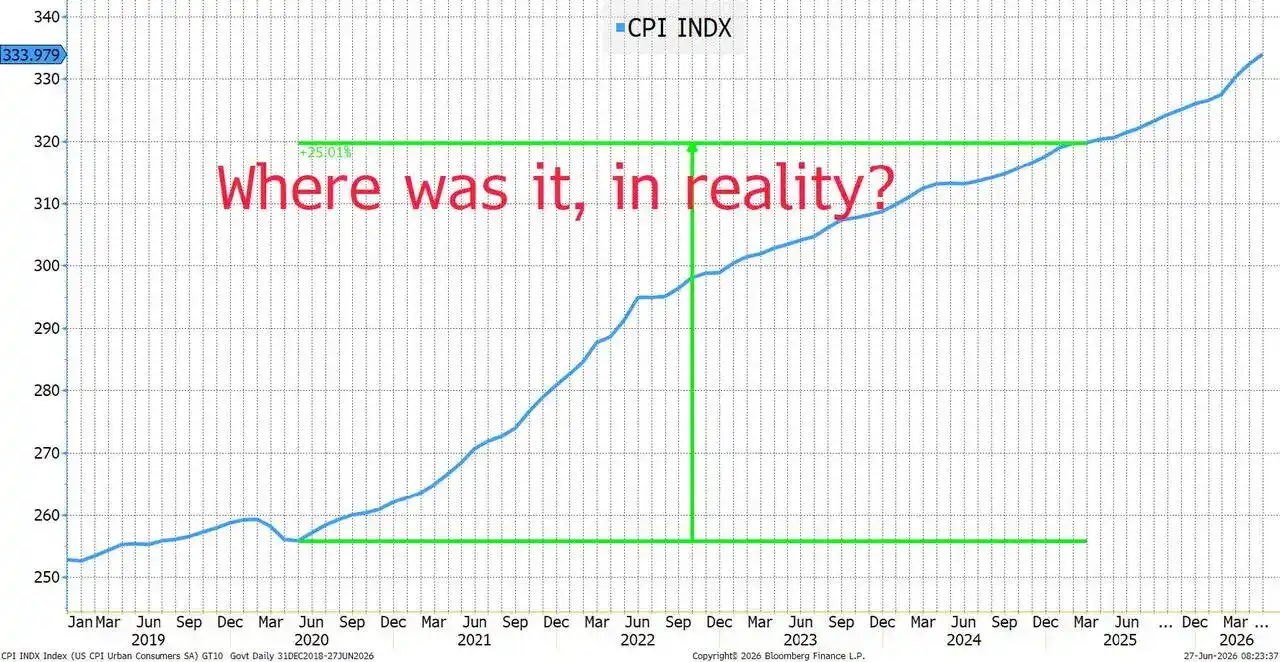
He also notes that Walsh's recent remarks hinted that the "big number" (the integer) of the inflation figure is more important than the precise value. Tchir infers from this that the market may be gradually being "conditioned"—to accept the cognitive framework that "two-point-something" is equivalent to approaching the 2% target. He marks the inflation target line on his chart as 2.9%, not the traditional 2%.

He believes that once the data narrative is switched, the technical barriers to rate cuts will significantly lower.

Tchir also mentions the work of former Fed insider Miran on the neutral rate issue. He believes that while no one in the market is discussing the neutral rate currently, this topic will resurface at an opportune moment.

His logic is: The neutral rate itself is difficult to measure precisely, with a substantial estimation range. If the new Fed leadership can argue that the previous judgment on the neutral rate was too high, then this alone could provide theoretical grounds for 50 to 100 basis points of rate cuts, while assigning blame to the "old Fed's error."

Apple Price Hikes and AI Inflation: Rate Hikes Are Aiming at the Wrong Target

Addressing market concerns about AI-driven inflation, Tchir offers a counter-interpretation.

He points out that Apple (AAPL)'s stock fell after announcing recent price hikes, a market reaction that precisely shows consumer tolerance for price increases is being questioned. If a top consumer brand like Apple struggles to have its price hikes digested by the market, the pricing power of ordinary consumer goods companies would only be weaker—contradicting the narrative of persistent inflation heating up.

He also cites feedback from a chip company: memory prices have not surged due to AI demand, with some products even cheaper than five years ago. He believes that AI and data center construction spending are indeed inflationary, but this is a completely different dimension from the affordability issues faced by ordinary consumers.

More critically, he argues that rate hikes have almost no dampening effect on AI/data center spending—those tech companies trading at 100x multiples are completely insensitive to a 50-basis-point rate move. Those truly hurt by rate hikes are ordinary borrowers with no connection to AI inflation.

Based on the above judgments, he believes the market will begin to reprice rate cut expectations, with the most certain opportunity lying in the short end of the yield curve—going long on short-term Treasuries, betting on lower front-end yields. For the long end, he maintains a neutral to slightly bullish stance, believing Treasury Secretary Bessent wants the 10-year yield back in the "3-handle," and Walsh has already removed tail-end risks for the long end through hawkish rhetoric.

In the equity space, he recommends a significant overweight in the energy sector, especially global nuclear power assets; within the Defense & Security (ProSec) theme, overweight biotech/pharmaceuticals and underweight chips. He is cautious on AI and data center valuations and warns that potential secondary issuance pressure from large tech companies could weigh on their stock prices.


Questions liées

QAccording to the article, what is the analyst Peter Tchir's main argument about Federal Reserve Chairman Kevin Walsh's hawkish stance?

APeter Tchir argues that Federal Reserve Chairman Kevin Walsh's hawkish stance might be a carefully designed smokescreen. He suggests that by making hawkish statements, Walsh aims to suppress the tail risk of long-term interest rates, while also reserving space to shift the data narrative later. Tchir believes the ultimate goal of this strategy could be to pave the way for a potential interest rate cut in September and again in October, coinciding with the timing of the midterm elections.

QWhat is Peter Tchir's key criticism regarding the current inflation measurement system used by the Fed?

APeter Tchir criticizes the Fed's reliance on the PCE index, stating that it is not the preferred inflation gauge for the current Fed leadership under Walsh. He argues that data lags, especially in housing inflation, make metrics like PCE outdated. He points to the Cleveland Fed's 'New Tenant Repeat Rent Index' (NTRR), which aligns more closely with real-time rental data from sources like Zillow, as a more accurate indicator that the Fed could switch to in order to justify rate cuts.

QWhat alternative inflation data does Peter Tchir cite to support the case for lower inflation, and what does it indicate?

APeter Tchir cites Truflation, a real-time inflation index built on massive datasets. According to his report, Truflation's core inflation rate is currently around 1.45% and has consistently stayed below 1.8% since February of this year. This data suggests that inflation is significantly lower than what the official, lagging indicators might imply.

QHow does Peter Tchir dismiss concerns about AI-driven inflation?

APeter Tchir dismisses concerns about AI-driven inflation by making two key points. First, he argues that the inflation from AI and data center construction is a different dimension from the affordability issues faced by general consumers. Second, he contends that interest rate hikes are ineffective at curbing AI/data center spending because the tech companies undertaking these investments are insensitive to small rate changes. Instead, he believes higher rates primarily hurt ordinary borrowers who are unrelated to the AI sector.

QWhat investment recommendations does Peter Tchir make based on his analysis in the report?

ABased on his analysis, Peter Tchir recommends investors re-price their expectations for rate cuts. He sees the most certain opportunity in the short end of the yield curve, suggesting going long on short-term Treasury bonds to bet on falling front-end yields. In equities, he advises a significant overweight in the energy sector (especially global nuclear power assets). Within the Defense & Security (ProSec) theme, he recommends an overweight in biotech/pharma and an underweight in semiconductors. He is cautious about the valuations of AI and data center stocks.

Lectures associées

L'informatique quantique approche du « jour Q » : comment la politique de chiffrement, la logique d'investissement et la gestion des risques se réorganisent

La technologie quantique influence de plus en plus les discussions sur les politiques cryptographiques, alors que le « Q-Day » – le point critique où les ordinateurs quantiques pourraient casser les algorithmes de chiffrement actuels – se rapproche. Alors que les marchés cryptos préparent un été animé, marqué par les débats législatifs comme le CLARITY Act et l’influence croissante des lobbies cryptos, une autre dimension émerge : la convergence entre les technologies quantiques, les cryptomonnaies et la cybersécurité. La prochaine phase de l’investissement crypto sera façonnée par la régulation et l’évolution de la cryptographie. Une régulation plus claire réduit les incertitudes, tandis que l’avancée du calcul quantique transforme une préoccupation théorique en un enjeu de planification concret. Les projets les plus résilients seront ceux qui allient préparation réglementaire et stratégie d’adaptation cryptographique à long terme. La préparation quantique devient un risque central pour les investisseurs. Les blockchains publiques reposent sur des systèmes cryptographiques que des ordinateurs quantiques avancés pourraient affaiblir. Il est désormais crucial que les projets identifient leurs dépendances cryptographiques, élaborent des plans de migration et testent des méthodes post-quantiques. Les gardiens et les bourses doivent évaluer leurs procédures de sécurité et de continuité. Les décideurs politiques doivent considérer l’intégrité cryptographique comme une infrastructure financière essentielle. À mesure que les stablecoins, les titres tokenisés et les paiements blockchain s’intègrent aux marchés financiers, la résilience cryptographique face aux menaces quantiques devient systémique. Une réponse politique raisonnable devrait encourager la divulgation des risques cryptographiques, exiger des plans de mise à niveau et favoriser la coordination entre les acteurs. La durabilité des cryptomonnaies dépendra de la capacité de leurs infrastructures de sécurité à s’adapter à cette pression technologique croissante.

Foresight NewsIl y a 28 mins

L'informatique quantique approche du « jour Q » : comment la politique de chiffrement, la logique d'investissement et la gestion des risques se réorganisent

Foresight NewsIl y a 28 mins

La phase de correction en cinq étapes du Bitcoin touche à sa fin, des opportunités apparaissent dans la zone de support HYPE | Analyse Invitée

**Analyse du Marché : Bitcoin (BTC) et HYPE - Fin de la Phase de Consolidation** Le BTC est actuellement dans la phase finale d'une correction en 5 segments. La formation du point « 44 » est cruciale pour la direction à court terme. S'il se forme au-dessus de 58 110 USD, une reprise technique est probable. Dans le cas contraire, un risque de baisse supplémentaire existe. Des scénarios opérationnels (A, B, C) sont prévus pour exploiter les mouvements de prix, avec une position vendeuse à moyen terme maintenue à 20% et 30% de capital dédié aux opportunités à court terme. Parallèlement, HYPE termine également une correction en 5 segments depuis son sommet. La formation du point « 56 » est déterminante. S'il est supérieur au précédent creux, formant un double creux, une reprise est probable. Une position acheteuse légère (moins de 30%) peut être envisagée en cas de stabilisation dans la zone de support identifiée. La semaine dernière, deux transactions vendeuses à court terme sur BTC, basées sur des signaux de modèles quantitatifs propriétaires, ont généré un bénéfice d'environ 6.21%. La discipline de gestion des risques, incluant des stops-loss dynamiques, est essentielle pour préserver le capital. **Avertissement :** Les marchés financiers sont volatils. Cette analyse technique et ces stratégies ne constituent en aucun cas un conseil en investissement. Investir comporte des risques.

marsbitIl y a 37 mins

La phase de correction en cinq étapes du Bitcoin touche à sa fin, des opportunités apparaissent dans la zone de support HYPE | Analyse Invitée

marsbitIl y a 37 mins

Loopring Met Fin à Son DEX Précurseur en zk-Rollup Après des Années d'Adoption Limitée

Loopring a officiellement fermé son échange décentralisé, mettant fin à l'une des premières plateformes de zk-rollup sur Ethereum. Toutes les fonctionnalités de trading ont été arrêtées immédiatement après l'annonce. Le projet, qui avait levé 45 millions de dollars en 2017, a démontré le potentiel des zk-rollups pour améliorer l'évolutivité d'Ethereum. Cependant, Loopring a reconnu une adoption utilisateur limitée. L'absence de machine virtuelle sur la plateforme a empêché les développeurs de créer des applications complexes, et le manque de cas d'usage pour les paiements a nui à la croissance de son écosystème. L'équipe a également admis des lacunes en compétences commerciales pour stimuler l'adoption, et le délistage du token LRC en 2026 a aggravé la situation. De plus, les nouveaux réseaux zkEVM comme zkSync, Scroll et StarkNet ont surpassé la technologie propriétaire de Loopring en permettant un déploiement plus facile de contrats intelligents et un écosystème d'applications décentralisées plus riche. Il n'était donc plus justifié de poursuivre le projet, qui avait déjà mis fin à ses services de portefeuille en juillet 2025. L'équipe de Loopring assure que tous les fonds utilisateurs sont sécurisés. Les soldes finaux seront calculés et, après une période de vérification de deux semaines, les actifs seront distribués directement aux portefeuilles des utilisateurs par lots, sans nécessiter de preuves Merkle.

TheNewsCryptoIl y a 37 mins

Loopring Met Fin à Son DEX Précurseur en zk-Rollup Après des Années d'Adoption Limitée

TheNewsCryptoIl y a 37 mins

La correction en cinq phases du Bitcoin touche à sa fin, une opportunité apparaît dans la zone de support HYPE | Analyse Invitée

Le Bitcoin (BTC) approche de la fin d'une correction en cinq vagues. La clé pour la direction à court terme est la formation du "point d'extrémité 44". S'il se forme au-dessus de 58 110 USD, un rebond technique est probable. Sinon, une poursuite de la baisse est à craindre. Des niveaux de support clés sont identifiés à 58 100 USD et 55 000 USD, avec des résistances à 60 900-62 300 USD, 65 500 USD et 67 300-69 500 USD. La stratégie maintient une position vendeuse à moyen terme de 20% et alloue 30% du capital à des opportunités de trading à court terme (scénarios A/B/C détaillés pour les positions longues et courtes). Concernant HYPE, l'actif est également dans une phase finale de correction en cinq vagues depuis le sommet de 76,94 USD. La formation du "point d'extrémité 56" est déterminante : s'il est supérieur au point 54 (double creux), un rebond est fortement attendu. Les supports sont situés autour de 58,5 USD et dans la zone 52-54 USD, avec des résistances à 65,5 USD et 71,5 USD. La stratégie pour HYPE privilégie des positions longues légères (moins de 30% du capital) sur les zones de support en cas de signaux de stabilisation. L'analyse inclut un retour sur deux transactions courtes sur BTC la semaine précédente, ayant généré un profit combiné d'environ 6,21%, en suivant des signaux de modèles quantitatifs propriétaires. Des procédures strictes de gestion des risques (placement et glissement des stop-loss) sont réitérées. Avertissement : Les analyses et stratégies présentées sont basées sur une interprétation technique personnelle et ne constituent pas un conseil en investissement. Les marchés sont volatils, une prudence est de mise.

Odaily星球日报Il y a 40 mins

La correction en cinq phases du Bitcoin touche à sa fin, une opportunité apparaît dans la zone de support HYPE | Analyse Invitée

Odaily星球日报Il y a 40 mins

L'IA balaie le monde, pourquoi la combinaison Crypto + IA est-elle si décevante ?

**Résumé : L'IA domine, mais pourquoi la combinaison Crypto + IA reste terne ?** Alors que l'IA connaît un essor mondial, le secteur blockchain peine à y trouver sa place. Une analyse par segments révèle un décalage structurel entre l'offre et la demande. * **Calcul et stockage décentralisés** : Bien que logiques pour la souveraineté des données ou les coûts, ces solutions ne présentent pas encore un avantage technique suffisant pour justifier le risque de migration des entreprises loin des géants du cloud. * **Validation des modèles et protection de la vie privée** : Des technologies comme le ZKML (Zero-Knowledge Machine Learning) résolvent des problèmes à long terme (audit, confidentialité), mais pas les priorités opérationnelles immédiates des entreprises. Leur adoption massive suivra probablement la réglementation, comme le montre l'Acte européen sur l'IA. * **Infrastructure pour agents IA** : Les projets blockchain développent une infrastructure pour une économie future d'agents autonomes interagissant entre eux. Cependant, le marché actuel se concentre sur l'automatisation des processus internes. La demande n'est pas encore mature. * **Paiement pour agents IA** : C'est le seul segment où la blockchain est sur un pied d'égalité avec la finance traditionnelle, car aucun des deux n'a encore résolu le défi des micropaiements fréquents et en temps réel entre machines. **Le problème fondamental n'est pas la logique de combinaison Crypto+IA, mais une grave inadéquation entre l'offre et la demande.** Les entreprises de l'IA traditionnelle recherchent des gains de performance immédiats et une stabilité à tout prix, tandis que la plupart des projets blockchain mettent l'accent sur des valeurs à plus long terme (décentralisation, transparence, propriété des données), souvent au déficit de la performance. L'absence de cas d'utilisation phare à grande échelle est le principal obstacle à l'adoption et au financement institutionnel. L'avenir du secteur dépendra de sa capacité à s'adapter aux besoins du marché actuel de l'IA tout en préparant l'infrastructure pour sa prochaine phase évolutive.

marsbitIl y a 52 mins

L'IA balaie le monde, pourquoi la combinaison Crypto + IA est-elle si décevante ?

marsbitIl y a 52 mins

Trading

Spot
活动图片