Source: a16z
Compiled by: Felix, PANews
a16z partner David Haber had a conversation with former Goldman Sachs CEO Lloyd Blankfein about leadership, risk, and how to navigate periods of extreme uncertainty. Drawing on his experience leading Goldman Sachs through the financial crisis, Lloyd Blankfein shared insights on how companies can build resilience, make decisions under pressure, and maintain corporate culture while scaling. PANews has compiled the highlights of the conversation.
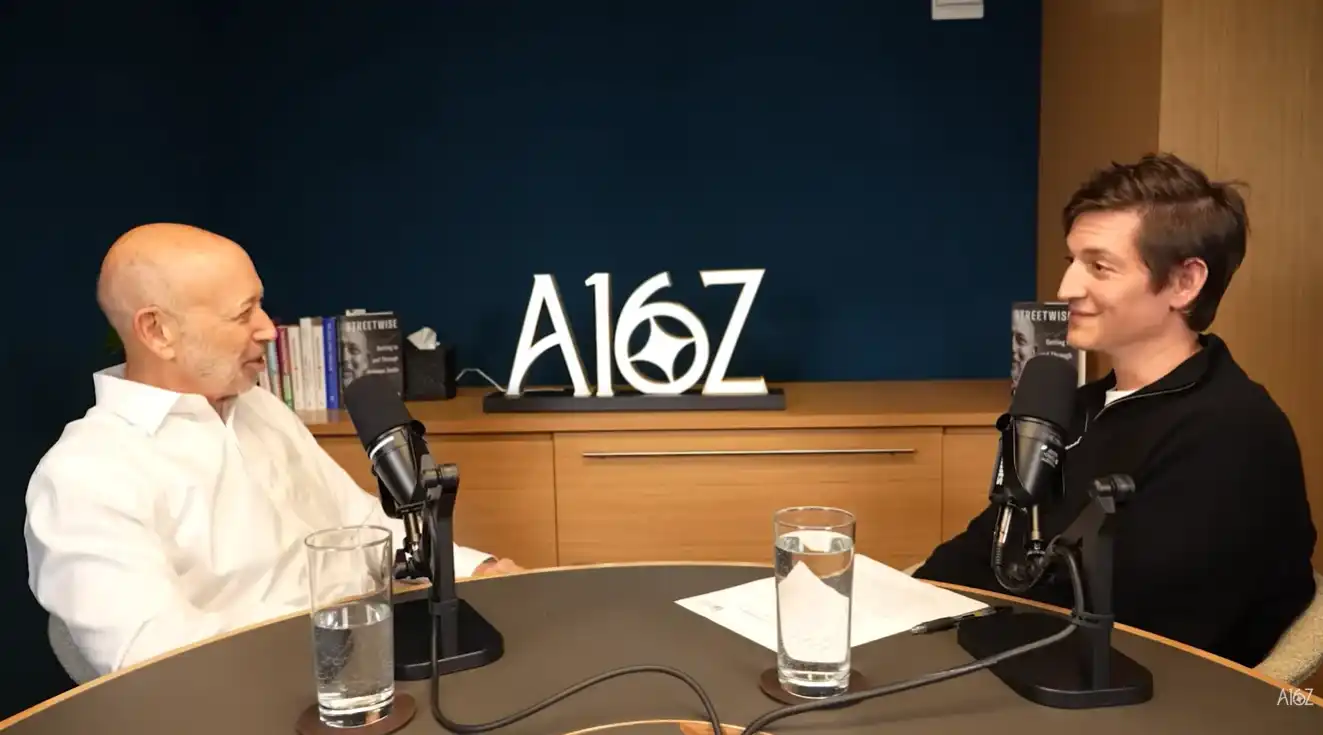
Host: Your tweet about the White House Correspondents' Dinner was fantastic. We need you to tweet more often. That tweet later got about 1.4 million views, which is really amazing.
(PANews note: During the shooting at the 2026 White House Correspondents' Association dinner, Lloyd Blankfein was present and remained very calm, even asking the person next to him if they were going to finish their salad. The next day he posted a summary on X platform:
"Attended the White House Correspondents' Dinner last night, a rare Washington trip for me without a subpoena. The pluses: lively atmosphere, nobody died, and it ended early. I noted a new status touchstone emerging among the government elite: were you whisked away by the Secret Service, or left to fend for yourself?" )
Lloyd: You know what's interesting? You might think, when you see something, you'd immediately want to tweet about it. But for me, it felt like: "Oh, I haven't tweeted in a while, let me find something to post." Also, being in the risk management business, I was always keenly aware that everyone is constantly expressing themselves, and eventually you get 'canceled' because you might unknowingly cross an invisible line that nobody knows about. So I realized, from a risk-reward perspective, aside from self-satisfaction, tweeting doesn't offer much real value. But then again, when you're retired, you're kind of grasping at straws, "Why not?" I remember saying when I retired that I had shed my old shackles; because I started using Twitter at Goldman Sachs, I realized I was playing a dangerous game back then, as I had been snarky towards the President, and there was a lot of back-and-forth between us. The interactions at the time were with Bernie Sanders and Elizabeth Warren.
Host: There was a report that during the shooting, you said to the person next to you, "Are you going to finish your salad?", is that true?
Lloyd: It's true, but not because I was hungry. In a crisis, I always try to defuse tension. By the way, hiding under the table is very smart. I wasn't being thoughtful; it just felt like watching a movie, with people in tuxedos suddenly holding guns, fully armed people running in pointing guns outside. Someone pulled my leg to get me down, I said, "You're absolutely right," and that was also a moment I was grateful to be short. I saw people weren't panicking much, and to break the ice, I looked down and asked, "Are you going to finish your salad?" It seemed funny at the time.
Host: Have you always been this calm since you were young?
Lloyd: Yes, at Goldman Sachs, people said I was very good in a crisis, so much so that I would even create crises to give myself a chance to perform. My normal resting state is not resting, always a bit tense. But in a crisis, things slow down for me, like in slow motion, and I become very sensitive to what people around me are thinking. The most important thing in a crisis is to get people to do their jobs, not freeze, not succumb to chaos.
Host: Is this innate or cultivated by childhood experiences?
Lloyd: I don't know, and I've never done that kind of prediction on myself. We have a once-in-a-century crisis about every four or five years, always. This doesn't mean I like crises, nor would I actively seek to get involved in one. It's just that when a crisis happens, I usually have confidence that I won't panic. If even I were to panic, everyone would have broken down before me. By the way, this also taught me how to identify the people you need to rely on, because you really can't judge by appearance. I went through the financial crisis, where we had a great athlete, a real man's man, who went to rodeos on weekends, but he performed terribly in the crisis. And I, as the firm's co-president, had to teach him how to breathe deeply. Conversely, some people who looked like they couldn't walk up a flight of stairs performed exceptionally well in the crisis. So that's why I recommend that when you pick board members, the best choice is to find people who have already been through a crisis.
Host: You have a very ordinary family background. I'm curious, what role did living near New York City or Manhattan play in fueling your ambition? Where did you grow up?
Lloyd: I grew up within distant sight of Manhattan. I probably only went there about three times before college (twice to Radio City Music Hall, once for a Harvard interview). It seemed like it was 5,000 miles away to me. I lived in public housing, needed to transfer buses to get into the city. Because I didn't know much then, I didn't have the burden of high expectations. Compared to the burden of high expectations I see on people now, I see that as an advantage. Going to Harvard was a culture shock for me because I went to a failing high school, hadn't read many books, my verbal scores were low, but my math was almost perfect, about 790. My only ambition back then was to go to an out-of-state university, to leave Brooklyn.
Host: Goldman Sachs has an extraordinary history, not built through mergers like JPMorgan Chase or Bank of America, but brick by brick by generations of entrepreneurial partners. The acquisition of J. Aron might be an exception. Did people at the time think this firm would have such a big impact on Goldman?
Lloyd: I was on the acquired side, so I don't know what they were thinking at the time, but I later found out it was a "disaster." Like Columbus looking for India and finding America, they accidentally got an entrepreneurial culture they didn't intend to buy. In the early 80s, inflation was high, gold had just been allowed for personal holding, and J. Aron exploded during the inflationary period, selling its highest-value self to Goldman. At the time, Wall Street firms needed commodity desks. Goldman was an upper-class firm, recruiting from the Ivy League; while J. Aron was street-smart, almost like the mafia, and the best entry-level job was being a driver for a trader. After college and law school, I worked at a law firm for a few years, felt it wasn't a fit, interviewed all over Wall Street (including Goldman) and was rejected. The only one that hired me was a commodity trading firm I hadn't heard of, J. Aron, putting me in precious metals sales. Later, when it was acquired by Goldman, I got in.
Host: Did you learn to be a risk manager there? The audience might not know what trading was like at J. Aron or Goldman in the 80s or 90s.
Lloyd: The nature of trading hasn't changed; the tools have changed, but judgment and perspective are the same. Anyone in investment is doing two things: trying to make money (taking risks) for themselves and their clients, and simultaneously trying to be a risk manager. You have to split yourself in two, asking both "Are we taking enough risk?" and "Are we overcommitted? If X, Y, or Z happens, what's our contingency plan?" Sometimes things aren't going well, and people don't want to take risks. But we're hired to take risks; you have to encourage people to take more risk. And at other times, you have to ask them: "What can you do today, at a very low cost, to mitigate a catastrophic outcome that might happen in the future?" When everyone needs insurance, when a hurricane is about to hit, insuring your beachfront property is very expensive. But in the dead of winter, it's much cheaper. My nature is always a bit fatalistic, a bit nervous, and always looking for what could go wrong, which gave me a good sense of direction in risk management. The biggest challenge for management is, about a third of the time, holding people back from risk, and most of the time, getting people to take more risk when they don't want to.
Host: Ashok (Goldman Sachs head of trading) mentioned that one cultural imprint J. Aron left on Goldman is "mark-to-market" (abbreviated as MTM). He also said you are a manager who isn't afraid of losses and are very good at gathering information from within the organization. You would even go over a manager's head to talk to the deputy head of a department.
Lloyd: I never wanted to undermine hierarchy, but I tried hard to make everyone feel comfortable talking to me. If a junior employee told me something, I never said, "I already know." I didn't want anyone to self-censor. Even if multiple people told me the same thing, I sat and listened. This not only gave me information but also helped me understand the person conveying it.
Regarding losses, people can lose money because they're foolish, or because they make mistakes. Smart people usually don't do foolish things, but they make mistakes, just like the best baseball hitters are out two-thirds of the time. When smart people make mistakes, you must never treat them like fools. The biggest mistake in risk management is letting "information learned after the fact" seep into judging the decision made at the time. No one can predict the future, or even see the present clearly, but after something happens, everyone becomes a genius. Most of what we do with risk is contingency planning. Through wargaming, when something happens, you have a plan to get off the blocks quickly, and people think you predicted it, but you just heard the starting gun earlier than others.
Host: How did you view technology during your time at Goldman?
Lloyd: Technology always changes everything, and in finance, it's often "winner-take-all." For example, trade execution systems, where a millisecond difference can win the order, leaving others in the dust. The finance sector is the best adopter of technology. As a regulated firm, we're not allowed to make mistakes (unlike Silicon Valley, where they can apologize; we can't). We have to run old and new systems in parallel, test 50 times, get 49 perfect, then dare to switch. So technology initially always increases costs, but over time improves efficiency. This also led to our early investment in risk systems like SecDB, whose core logic is still in use even after 25 to 30 years. It's like my HP 12C calculator that I've used for 40 years; it has stood the test of time.
Host: You spent half your time at the company before the IPO (the partnership era) and half after. How did you maintain that partnership culture?
Lloyd: Partnership culture and corporate culture are very different. The biggest concern when going public was losing the partnership culture. Partners are co-owners of the firm, their wealth depends on the entire enterprise, not just their little silo. They care about the whole, expect to have influence and a voice. Senior management needs to communicate with them when making decisions, listen to their opinions, give everyone a sense of ownership, thus forming a stable organization. People who leave still call themselves former Goldman people; we even have a dedicated alumni office to maintain connections. We went public because, after the repeal of the Glass-Steagall Act, we needed to expand our balance sheet to provide lending and financing services. To avoid destroying the culture, we spent 25 years, preserved something akin to partner elections, tied compensation to overall firm performance, making teams sacrifice short-term interests for the overall benefit, thereby leveraging the platform to grow. Private companies value earnings, while public companies value the price-to-earnings (P/E) ratio.
Host: Goldman performed well during the financial crisis but also faced unfair public backlash. What helped you get through it?
Lloyd: Risk management and the lack of a massive consumer business (though this also meant we lacked a public base after the crisis, suffering reputational damage). The partnership culture made us very focused when facing risks because partners even had their own houses at risk. We strictly enforced "mark-to-market" (abbreviated as MTM). We had independent bodies responsible for pricing; if a trader disputed a valuation, our approach was simple: go to the market and sell a little to test it. If there were no buyers, then we had to keep marking down the valuation. This mechanism was our early warning system for discovering crises.
Additionally, we required institutions like AIG to post collateral agreements; we were probably the only firm with the guts to do that at the time. During the crisis, we also kept our commitments to clients because we were a 150-year-old institution, and we had to be responsible for our reputation after getting through the crisis. This is also my advice to young people: Your peers will be running important institutions in 20 or 30 years; your actions now will determine how they judge you in the future. Don't just be a 'good buddy' to your subordinates; be an outstanding leader who makes them feel they've become better by following you.
Host: Today's tech companies (like those in AI) might face the kind of public scrutiny and criticism Goldman did back then. What advice do you have for OpenAI, Anthropic, or Musk?
Lloyd: Goldman used to be a wholesale institution, with no retail branches; we even had a dedicated PR department to ensure our name didn't appear in newspapers. But in the crisis, because we were too big, we became a prominent target; officials could easily turn their fire on us. My advice is: Go out there before the crisis erupts; let people know who you are and understand the value of your work. Don't wait until people have decided you screwed up to scramble and explain. Technology like AI is very important; the companies making huge bets on computing power at scale are founders investing with their own money, with deep conviction. There will be bubbles, but investing today due to a lack of information about the future isn't stupid.
Host: What risks in the market today do you think are underestimated?
Lloyd: The risks are in reliability and leverage. In the past, if someone on a trading floor misquoted a price, everyone would stop; you could spot the error with intuition. But now, large language models and other software can execute tens of thousands of trades silently in the background; you lose that intuitive check, and you lose the path to trace the thought process. If the tests themselves are flawed, the consequences could be devastating. However, we can't reverse the tide of the times; leverage allows us to create more wealth. Maybe in the future, we can achieve a three-day workweek, being a poet or going hunting in the afternoon. I'm for these technological advances.
Host: Finally, what advice do you have for young people just starting their careers?
Lloyd: Make yourself a whole person. Go study history, humanities, study for yourself. Opportunities exist at the intersection of specialized fields, beyond the horizon you can see. As your lifespan becomes longer, don't think only ages 18 to 24 are your productive years. You will have a more resilient, richer life and business career because you become an interesting and broadly knowledgeable person.
Related reading: Conversation with a16z co-founder: The physical laws of the old world are dead, crypto becomes key infrastructure for AI