Key lessons from Bitcoin in 2022 and what to expect in 2023

AmbcryptoPublié le 2023-01-02Dernière mise à jour le 2023-01-02

Résumé

Navigating the world of Bitcoin and cryptocurrencies, in general, has been a rough rollercoaster in 2022. That chapter is now closed and we have now entered into new unchartered territory. Every crypto enthusiast and their dog are now wondering whether 2023 will bring good tidings or whether it will turn out worse than 2022.

Navigating the world of Bitcoin and cryptocurrencies, in general, has been a rough rollercoaster in 2022. That chapter is now closed and we have now entered into new unchartered territory. Every crypto enthusiast and their dog are now wondering whether 2023 will bring good tidings or whether it will turn out worse than 2022.

“”

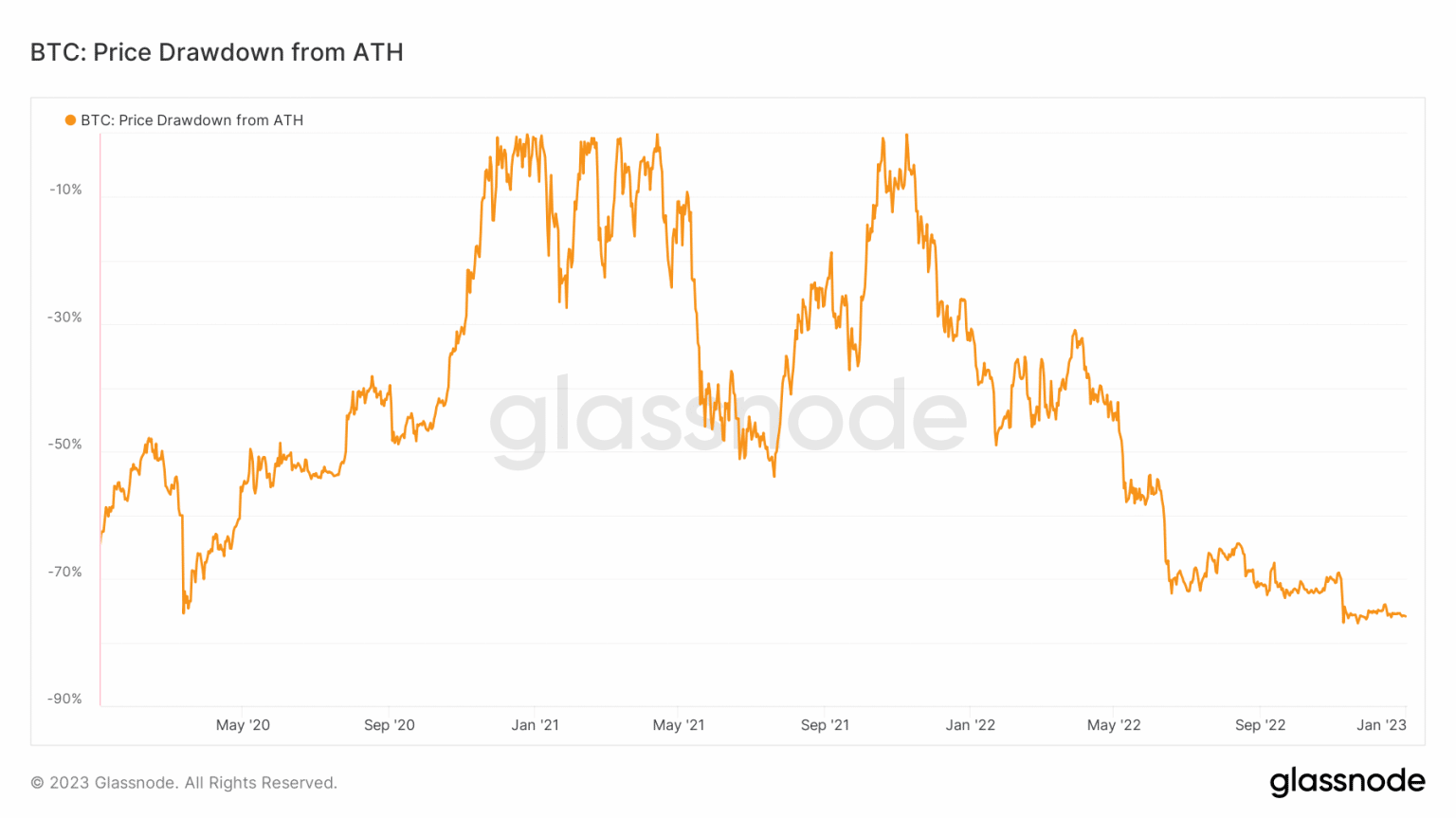
While short and long-term projections are common, Bitcoin’s performance in 2022 demonstrated a huge scope of unpredictability. Perhaps a recap of its performance may help put things into perspective. At its current price level, Bitcoin is drawn down by roughly 75.92% from its all-time high.
Source: Glassnode

“”

It is important to take note of where most of this drawdown has occurred. It’s from around November 2021 to the end of 2022. Why is this important? Well, mostly because of the time period in which it occurred.

“”

The economic perspective and Bitcoin’s correlation with risk-on assets

“”

If we cross-reference the start of the Bitcoin bear market and the U.S. Federal Reserve commenced quantitative tightening, we see a pattern. And this is where the inflation link comes in.

“”

Numerous factors and events in the last three years stressed the global economy and pushed major economies in the blink of a recession. The COVID pandemic affected global trade and placed a lot of stress on the global economy.

“”

The Russia-Ukraine war added salt to the proverbial wound as economic pressures mounted. The key denominator was inflation. Governments printed money heavily during the pandemic and this rapidly raised the level of inflation across the globe. The dollar particularly played a pivotal role in exporting inflation across the world as the global reserve currency.

“”

People had invested heavily in BTC using cheap funds available at low-interest rates. But the government’s plan to fight inflation involved raising interest rates as part of its strategy to mop up the excess liquidity.

“”

Bitcoin found itself in the economic crosshairs and as a result, many people started panic selling as quantitative tightening hammered down.

“”

The end of cheap money

“”

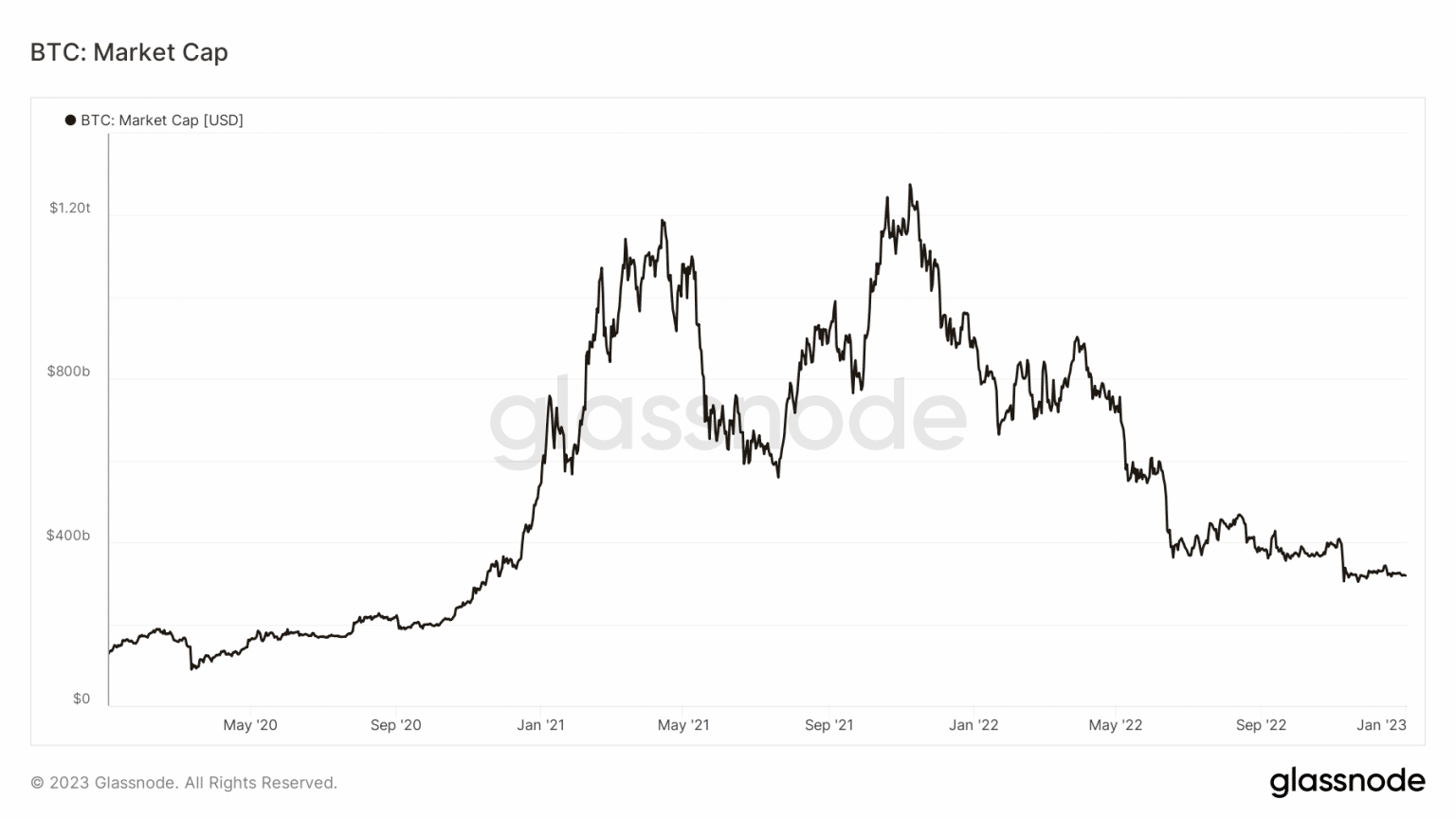
With cheap money quickly being sucked out of the markets, the economic pressure had a negative cascading effect on risk-on assets. Bitcoin happens to fall into this category despite it being considered an inflation hedge. The combined economic factors resulted in strong outflows reflected in Bitcoin’s market cap.
Source: Glassnode

“”

The outflows were sharp at the beginning but the pace slowed down towards the end of 2022. Now that we have a deeper perspective into what ailed BTC bulls in 2022, we can start looking into key factors to consider that may offer insights into 2023 expectations.

“”

The relationship between Bitcoin and the bonds market

“”

Bitcoin’s 2022 performance proved that there is, in fact, a link between BTC’s performance and the traditional finance market. Before we get into bonds, we have to look at what the FED is currently aiming at.

“”

As noted earlier, the FED has put up an aggressive fight against inflation by raising interest rates. However, this strategy might not be effective in the long run.

“”

An analysis by Sean Foo highlights the potential risks that the markets might experience in 2023. FED Chair Jerome Powell’s 2% target is quite ambitious and it underscores the potential for more quantitative tightening ahead.

“”

Such an outcome means we might see more uncertainty, as well as higher pressure on risk-on assets, and this, is where bonds come in.

“”

Bonds are preferable when the overall investment landscape is deemed too risky. As a result, investors have shifted their attention toward the bonds market, especially in the United States. This is because investors would rather have their funds in risk-free investments such as bonds.

“”

Under normal conditions, the demand for Bitcoin is expected to be low if there is a higher demand for bonds. However, the bonds yield curve is inverted and this means there is a high chance that the FED might cause an economic recession.

“”

More risks ahead but a potential hail Mary for Bitcoin

“”

The aforementioned scenario (inflation) may make bonds appealing but then that whole picture is starting to look like a house of cards. This is because the economic war between the United States, China, and Russia has intensified.

“”

In 2022 we saw a further push towards de-dollarization, especially from China. Meanwhile, Russia walks a similar path after being slapped with heavy sanctions.

“”

The European Union (EU) is pushing toward confiscating billions of wealth owned by Russia as part of the sanctions. This move may trigger fears across other nations, encouraging them to de-dollarize. Such an outcome may encourage many countries to offload their dollar bonds.

“”

If these events do come to fruition, the greenback might become weaker. Investors have been rushing toward gold and this will likely be the outcome for Russia if its assets are confiscated.

“”

It will likely use its dollar holdings to buy gold, placing more pressure on the U.S. dollar. Bitcoin might enjoy some demand too if this happens.

“”

Will Bitcoin see a resurgence of demand in 2023?

“”

Now that most of the borrowed liquidity that contributed to the 2022 Bitcoin crash has been wiped out, Bitcoin may finally make more sense as an inflation hedge. This is because like gold, Bitcoin does not have counterparty risk. This means the crypto companies liquidated in 2022 might be a blessing in disguise.

“”

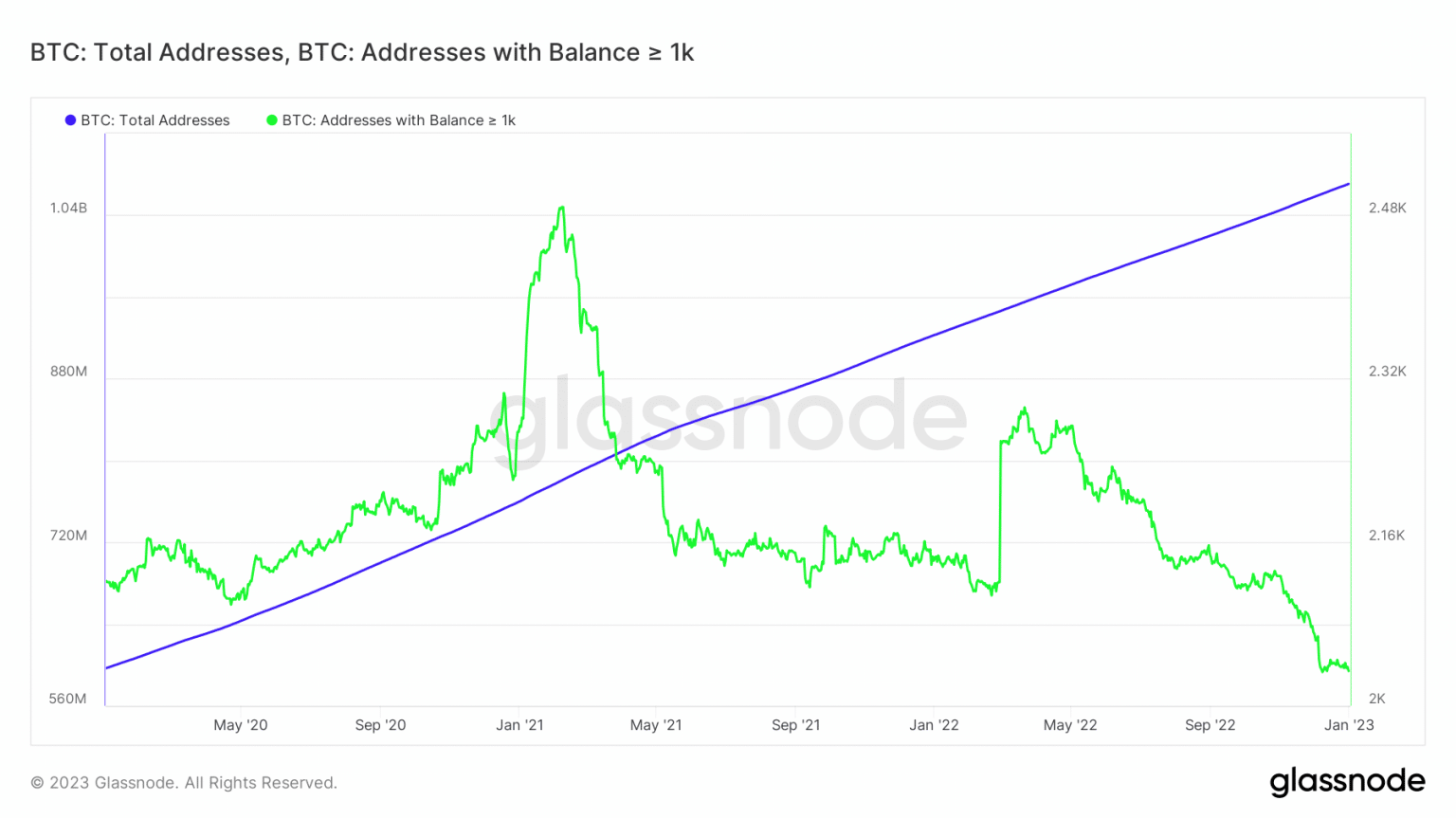
Bitcoin addresses have been steadily growing in the last three years, with over one billion addresses. On the other hand, the addresses holding over 1,000 BTC have dropped substantially in the last 12 months.
Source: Glassnode

“”

A resurgence of demand from addresses holding over 1,000 BTC might help the bulls to recover because it would indicate whale accumulation. These bullish expectations also align with a Bitcoin cycle analysis. 2023 may also mark the start of the next Bitcoin cycle.

“”

Conclusion

“”

We might see a resurgence of Bitcoin demand in 2023 if the stars align. However, there is still a lot of uncertainty, especially with the current economic conditions and the aforementioned risks.

Lectures associées

Le fondateur d'IOSG : L'Ethereum n'a pas besoin d'une nouvelle foi technologique, il a besoin d'un compromis à la Musk

Auteur : Jocy, Fondateur d'IOSG L'opinion centrale : Ethereum n'a pas besoin d'une nouvelle foi technologique, mais d'un compromis à la manière d'Elon Musk. L’annonce récente d’ETHLabs, financé par des entités majeures détentrices d’ETH comme BitMine et Lubin, révèle une perte de confiance du marché envers la gouvernance « petite et décentralisée » de l’Ethereum Foundation (EF). Ce n’est pas Vitalik Buterin qui initie ce changement, mais l’écosystème lui-même, signalant un besoin de réorientation. La différence clé entre Musk et Vitalik réside dans leur approche. Musk comprend d’abord les réalités commerciales et s’adapte, tandis que Vitalik part de principes techniques purs en espérant que les applications émergent d’elles-mêmes. Cette dernière méthode a fonctionné par le passé (ICO, DeFi, NFT), mais aujourd’hui, la concurrence est féroce et le temps presse. Ethereum manque cruellement d’une application phare, de type Starlink, et d’une orientation commerciale claire. Cela nécessite un engagement pratique dans le monde réel, pas simplement une feuille de route technique. Le vrai défi n’est pas stratégique, mais organisationnel, comme le souligne la fuite des talents de l’EF. Le nouveau modèle de gouvernance, avec des nœuds indépendants comme ETHLabs, tente de décentraliser la prise de décision. Cependant, distribuer les responsabilités est plus facile que de maintenir une cohésion et une direction communes. Cette cohésion ne peut venir que de la valeur partagée de l’ETH en tant qu’actif de référence, mais elle nécessite d’abord un récit réaliste et convaincant pour l’écosystème. Par ailleurs, l’indépendance déclarée de ces nouvelles structures reste à prouver dans la pratique, car les financeurs et les bénéficiaires sont souvent les mêmes acteurs. La confiance se construira sur des années de transparence. La menace ultime pour Ethereum n’est pas Solana, mais la migration de l’attention vers l’IA. La fenêtre pour réagir est étroite (12 à 18 mois). Seul un engagement concret, tourné vers des applications réelles et capable d’attirer les meilleurs talents, peut contrer cette tendance. En conclusion, l’idéal de Vitalik doit désormais s’ancrer dans la réalité par un engagement pratique et urgent. Le temps est l’adversaire le plus impitoyable.

marsbitIl y a 59 mins

Le fondateur d'IOSG : L'Ethereum n'a pas besoin d'une nouvelle foi technologique, il a besoin d'un compromis à la Musk

marsbitIl y a 59 mins

Jingdong et Mira Murati, ancienne CTO d'Open AI, misent sur la même piste de l'IA

Imaginez un scénario où un système d’IA perçoit et réagit en temps réel aux événements du monde physique sans attendre de demande explicite. C’est la promesse du modèle JoyAI-VL-Interaction, récemment rendu open source par JD.com. Il s’agit du premier modèle d’interaction visio-linguistique en temps réel entièrement open source, capable d’analyser un flux vidéo continu pour décider quand intervenir, quand rester silencieux ou quand déléguer une tâche complexe à un autre modèle. Contrairement aux assistants classiques fonctionnant en "tour par tour" (question-réponse), cette approche permet à l’IA d’être proactive dans des situations où l’utilisateur n’a pas le temps ou la capacité de formuler une requête : aide aux personnes âgées, assistance aux malvoyants, commentaire sportif automatique, surveillance industrielle ou robotique. JD.com n’est pas seul à explorer cette voie : Mira Murati, ancienne CTO d’OpenAI, et son laboratoire Thinking Machines Lab promeuvent une vision similaire des "modèles d’interaction". La particularité de JD.com est de placer la vision (plutôt que la voix) au cœur de la prise de décision, et de s’appuyer sur ses vastes données issues de scénarios réels (logistique, vente au détail, santé) pour entraîner le modèle. Le modèle, léger (8B paramètres) et conçu pour être déployé sur du matériel accessible (comme une carte graphique RTX 3090), est accompagné de son système d’inférence, de jeux de données et d’une documentation technique complets. JD.com ouvre ainsi la voie à une adoption large par les développeurs, visant à faire de l’IA proactive un élément central de l’intégration du numérique dans le monde physique.

marsbitIl y a 1 h

Jingdong et Mira Murati, ancienne CTO d'Open AI, misent sur la même piste de l'IA

marsbitIl y a 1 h

Google commence à vendre ses TPU, les géants cherchent à produire des "jetons à bas prix" avec des puces IA

Google commence désormais à vendre directement ses puces TPU (Tensor Processing Unit) et ses solutions matérielles de calcul IA aux centres de données tiers et aux clients. Ces puces, conçues spécifiquement pour les opérations mathématiques de tenseurs et de matrices, sont au cœur du fonctionnement des grands modèles d'IA. Auparavant, les TPU n'étaient accessibles que via la location dans les centres de données cloud de Google. Cette stratégie permet à Google de proposer une alternative à l'écosystème NVIDIA (GPU, CUDA), non pas en se positionnant sur la puissance brute, mais sur l'efficacité et la réduction des coûts, notamment pour l'inférence des modèles. L'objectif est de produire des "tokens" à moindre coût, un facteur clé pour démocratiser l'utilisation de l'IA à grande échelle. Google, à l'instar des grands fournisseurs de cloud comme Huawei Cloud et Alibaba Cloud, ne vend pas seulement du matériel. Il propose un écosystème complet intégrant puces, clusters, logiciels et services, transformant la puissance de calcul en une "productivité" directement utilisable. Cela reflète une évolution du marché : la compétition ne porte plus seulement sur la puissance des puces, mais sur la capacité à offrir une "meilleure puissance de calcul" – c'est-à-dire la solution la plus efficace et la plus économique pour des besoins variés. Ainsi, le marché de l'infrastructure IA évolue d'une "guerre des puces" vers une "guerre des systèmes". Si NVIDIA conserve sa position dominante pour l'entraînement des modèles et son écosystème mature, la montée en puissance de ces alternatives centrées sur le coût et l'efficacité opérationnelle redessine le paysage concurrentiel.

marsbitIl y a 1 h

Google commence à vendre ses TPU, les géants cherchent à produire des "jetons à bas prix" avec des puces IA

marsbitIl y a 1 h

Trading

Spot
Futures
活动图片