Kaito Revives 'Talk-to-Earn' Economy, But Many Are Hesitant to Install the New Plugin

marsbitPublié le 2026-08-21Dernière mise à jour le 2026-08-21

Résumé

Kaito AI has launched a new browser extension called Kaito Pulse, aiming to integrate users' discussions on X (formerly Twitter) with their on-chain activities and social influence to build a new "attention + behavior verification" scoring system. The plugin displays users' public trading positions from platforms like Polymarket directly on the X timeline, allowing others to assess if their statements align with their actual market behavior. This move is seen as reviving "influence-to-earn" incentives. However, the launch sparked significant privacy concerns. Critics, including an analysis by "Ultra," allege the extension collects extensive data, such as device fingerprints (via GPU, hardware info), X user behavior (browsing paths, clicks), and may access sensitive data from third-party accounts (e.g., ChatGPT, trading platforms). This raised debates about trading privacy for verified influence. In response, Kaito founder Yu Hu stated the design follows data minimization principles, aiming to generate verification proofs without collecting or storing raw user data, using technologies like zkTLS. He acknowledged some permission descriptions could be misleading and promised improvements. The controversy highlights a core dilemma for social finance (SocialFi) platforms: as fake engagement and AI content grow, more user data is needed to verify genuine influence, but this risks encroaching on user privacy and trust.

Author | Asher(@Asher_ 0210)

Your X feed might soon be flooded with 'talk-to-earn' projects again.

On August 18th, Kaito AI announced the launch of its browser plugin, Kaito Pulse, further tying users' discussion behavior on X, on-chain activity, and social influence together. Simultaneously, Kaito revealed its first post-relaunch partnership with Axis Robotics, restarting the incentive model centered around content creators and community contributors.

Unlike the simple content incentives previously centered around Yaps, what Kaito aims to do this time is not just 'reward posting,' but to establish a new scoring system based on 'attention + behavior verification.'

What is Kaito Pulse?

Kaito Pulse is a browser plugin launched by Kaito, designed to add more 'on-chain identity' information to the X timeline, allowing users to not only see the views expressed by an X account but also understand the real market behavior behind it.
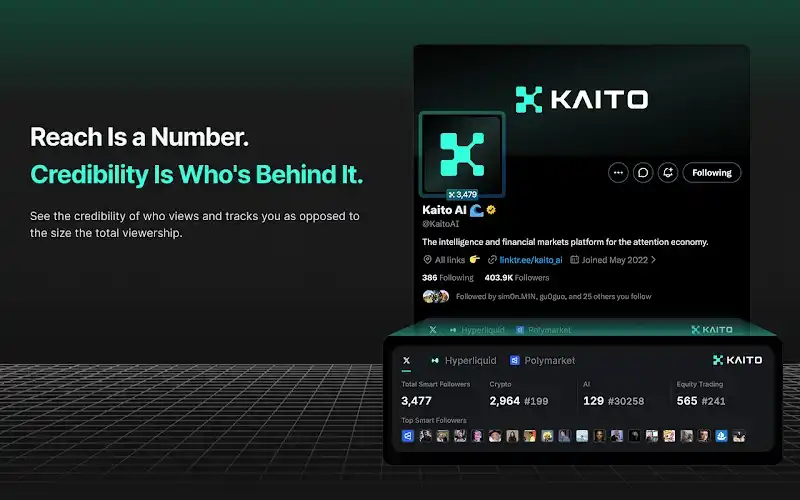
After installing the plugin, users can directly view other users' on-chain activity information within the X timeline, including public trading positions from platforms like Polymarket and Hyperliquid, thereby further assessing whether an account's views align with its actual actions.

By combining social influence with on-chain behavior, Kaito hopes to transform X from a mere information dissemination platform into a social layer that integrates 'views, identity, and trading behavior.'

This is also an evolution for Kaito from Yaps to Pulse.

Previously, Kaito primarily tracked the popularity of crypto discussions on X, creating content influence leaderboards, and incentivized user participation around KAITO. However, as many accounts began mass-producing content, the problem of measuring influence solely based on discussion volume became apparent. Therefore, Pulse further incorporates dimensions such as content influence, community interaction, and on-chain behavior verification, while introducing a new scoring system called Aura to measure user influence and verified on-chain behavior.

Previously, Kaito focused on who generated the most discussion; now, Kaito is more concerned with whose discussion is worth believing.

Plugin Requires Extensive Permissions, Sparking 'Data Collection' Controversy Post-Launch

The launch of Kaito Pulse sparked lively community discussion, with many feeling that as market conditions recover, a new wave of 'talk-to-earn' economy is imminent. However, Kaito Pulse quickly ignited a debate within the community regarding privacy permissions.

Kaito Pulse Plugin Accused of Multiple Deep Data Collection Practices

Ultra stated in an X post that by analyzing the Pulse plugin code, it was found that it may involve multiple data collection behaviors, including device fingerprinting, X platform behavior tracking, and third-party account verification.

Among these, the most concerning is the device identification issue. Ultra stated that Kaito Pulse might generate a device fingerprint using information such as GPU rendering results, hardware models, and hardware test audio, linking this information to X accounts, potentially compromising anonymity for multi-account users and community matrix accounts.

Beyond device information, Ultra also questioned the scope of user X behavior data collection by Kaito Pulse. The plugin may record certain user behaviors on the X platform, including browsing paths, content dwell time, click behavior, and follow status, and use periodic requests to determine if a user is active.

Furthermore, third-party account verification is another focal point of controversy. Ultra pointed out that Pulse involves verification processes for ChatGPT, Claude, and multiple trading platform accounts, suggesting these processes might access sensitive data such as user subscription status, usage quotas, and trading account information.

Community Divided: Verifying Authenticity or Sacrificing Privacy?

In the Yaps era, Kaito primarily relied on discussion popularity on X to measure influence. However, as mass content production by numerous accounts became prevalent, the community gradually began questioning: does high popularity equal real influence?

By incorporating more dimensions like on-chain behavior and external account verification, Kaito Pulse aims to reduce the room for gaining rankings solely through posting and interactions, making the influence score closer to a user's real contribution.

But more verification mechanisms also mean users need to grant more data permissions. Consequently, the community has formed two different views on Kaito Pulse:

  • Supporters believe that the biggest problem with InfoFi is farming and fake influence, and only by adding identity and behavior verification can a more credible incentive system be built;
  • Skeptics argue that platforms should not infinitely expand data collection scope just to improve scoring accuracy, and a new balance needs to be found between user privacy and incentive rewards.

Official Response to Privacy Controversy: Kaito Pulse Does Not Collect User Raw Data

Facing community skepticism, Kaito founder Yu Hu later responded.

Yu Hu stated that Kaito Pulse's design principle is data minimization. The product goal is not to collect user data, but, under active user authorization, to prove certain identities or behaviors through verification mechanisms.

Addressing community concerns about account information, Kaito Pulse does not obtain complete account content from users, nor does it store user raw data. The related processes are primarily used to generate verification results; the platform receives proof information, not the underlying user data.

Regarding the controversy sparked by external account verification, Kaito Pulse uses verification technologies, including zkTLS, hoping to allow users to prove they possess certain off-chain identities or behavior records without exposing the original data.

Simultaneously, Yu Hu acknowledged that the presentation scope of certain permissions might be prone to misunderstanding, and future versions will further optimize permission descriptions and user prompts.

The Next Step for the 'Talk-to-Earn' Economy: Verify Influence, or Surrender Privacy?

The discussion sparked by Kaito Pulse is essentially an unavoidable data dilemma in the InfoFi sector.

In the past, platforms judged an account's value primarily based on follower count, engagement data, and content popularity. However, as AI-generated content, batch accounts, and matrix operations become increasingly common, mere 'discussion volume' has become less and less representative of real influence.

Therefore, Kaito attempts to introduce more verification dimensions, and controversy follows—when a platform wants to further prove 'who you are' and 'whether your views are credible,' users need to surrender more and more information.

For users, installing the plugin to participate in the next wave of the 'talk-to-earn' economy also means they need to reconsider: for the sake of rankings, points, and potential rewards, how much data are they actually willing to open up? Platforms need more data to distinguish real influence from fake hype; but users also need assurance that this data is truly used only for verification and does not become a new digital profile.

Kaito Pulse wants to verify user influence, but as it masters more and more data on devices, behaviors, and accounts, Kaito itself becomes the subject of scrutiny.


Cryptos en tendance

Questions liées

QWhat is Kaito Pulse and what does it aim to achieve?

AKaito Pulse is a browser plugin launched by Kaito AI. It aims to enhance the X (Twitter) timeline by displaying users' on-chain activity information, such as public trading positions from platforms like Polymarket and Hyperliquid. The goal is to bind users' discussion behavior, on-chain activity, and social influence to help others assess if an account's opinions align with their actual actions, thereby transforming X into a social layer that integrates viewpoints, identity, and trading behavior.

QWhat were the main privacy concerns raised by the community regarding the Kaito Pulse plugin?

AThe community raised several privacy concerns, including potential device fingerprinting (collecting GPU rendering results, hardware models, and test audio), tracking user behavior on X (browsing paths, content dwell time, clicks, follow status), and accessing sensitive data from third-party account verification processes (like ChatGPT, Claude, and trading platforms). Critics feared this compromised user anonymity and privacy.

QHow did Kaito's founder, Yu Hu, respond to the privacy controversy?

AYu Hu responded that Kaito Pulse operates on a principle of data minimization and does not aim to collect user data. He stated that the plugin verifies identities or behaviors only with active user authorization, and it does not access or store users' complete account content or raw underlying data. He acknowledged that some permission descriptions could be misleading and promised optimizations in future versions.

QWhat is the core dilemma highlighted by the article regarding platforms like Kaito in the InfoFi (Information Finance) space?

AThe core dilemma is balancing the need for data verification against user privacy. Platforms need more data (like on-chain behavior and account verification) to distinguish real influence from fake hype generated by AI or bot accounts. However, requiring users to provide more personal data raises significant privacy concerns. Users must decide how much data they are willing to share for potential rewards and rankings.

QHow did Kaito's approach to measuring user influence change from its Yaps era to the Pulse era?

ADuring the Yaps era, Kaito primarily measured user influence based on the volume of crypto-related discussions on X. The shift to the Pulse era involves moving beyond simple discussion metrics. Kaito Pulse introduces a more comprehensive scoring system called Aura, which evaluates content influence, community interaction, and verified on-chain behavior. The focus has shifted from 'who creates the most discussion' to 'whose discussion is credible and backed by real actions.'

Lectures associées

MiCA s'apprête à cibler les coffres-forts DeFi, mais la réglementation sera difficile

Le règlement MiCA de l'UE, initialement exempté de prêt cryptographique, fait l'objet d'une consultation pour éventuellement inclure la finance décentralisée (DeFi), notamment les « vaults » de prêt. Ces structures, canalisant des milliards vers les marchés du crédit, posent un défi réglementaire car leurs fonctions économiques sont réparties entre contrats intelligents et multiples participants, sans entité centrale claire. L'exemple du protocole Morpho illustre la complexité : son architecture Vault V2 répartit les rôles (curateur, allocateur, sentinelle), rendant difficile l'identification d'un « fournisseur de service » unique. Les experts soulignent que réglementer le « prêt DeFi » comme une catégorie unique risque de regrouper des structures aux fonctions et contrôles très différents. Les débats portent sur les critères à utiliser : le degré de décentralisation, la structure de contrôle ou l'ajout explicite du prêt/emprunt à la liste des services réglementés. Des voix comme celle du fondateur de Curve Finance plaident pour un cadre dédié, adapté aux spécificités de la DeFi. La consultation de la Commission européenne se termine le 30 septembre 2026. Son issue déterminera si ces vaults restent hors du périmètre de MiCA ou deviennent soumis à une nouvelle régulation, le défi consistant à élaborer des règles distinguant les diverses formes de prêt sur chaîne et leurs mécanismes de contrôle.

cointelegraphIl y a 10 mins

MiCA s'apprête à cibler les coffres-forts DeFi, mais la réglementation sera difficile

cointelegraphIl y a 10 mins

Grayscale Research : Confidentialité financière à l'ère de l'IA, pourquoi Zcash ne doit pas être ignoré ?

La confidentialité est une composante essentielle de la monnaie, et non une fonctionnalité secondaire. Le rapport de Grayscale Research souligne que l'ère de l'IA et la généralisation des stablecoins suscitent une attention renouvelée pour la confidentialité financière. Zcash, une crypto-monnaie décentralisée, se distingue en offrant des transactions masquées facultatives grâce à des preuves à connaissance zéro, permettant de valider des paiements sans divulguer l'expéditeur, le destinataire ou le montant. Contrairement aux blockchains transparentes comme Bitcoin, Zcash permet aux utilisateurs de choisir la confidentialité. Ses mises à jour successives (Sapling, Orchard, Ironwood) ont considérablement amélioré son utilité. Actuellement, 90% de ses transactions sont masquées et 25% de l'offre en circulation est dans le pool protégé, démontrant une demande réelle. Malgré une capitalisation modeste (0,6% du segment des monnaies numériques), Zcash présente un potentiel de réévaluation si le marché reconnaît la valeur fondamentale de la confidentialité. Les risques incluent le cadre réglementaire, les défis techniques hérités et l'exécution future des mises à niveau. L'opportunité d'investissement réside dans le fait que le marché sous-évalue actuellement le potentiel d'une monnaie numérique privée.

marsbitIl y a 2 h

Grayscale Research : Confidentialité financière à l'ère de l'IA, pourquoi Zcash ne doit pas être ignoré ?

marsbitIl y a 2 h

Avec le passage des agents IA aux dépenses réelles, une nouvelle phase pourrait commencer pour le XRP

Un nouveau chapitre pourrait s'ouvrir pour XRP alors que les agents IA autonomes, après avoir acheté des ressources numériques, commencent à effectuer des transactions commerciales réelles. Chandler Fong, cofondateur de la startup t54 et ancien de Ripple, a décrit cette évolution vers une "économie des agents" avec divers besoins en paiements. Déjà, plus d'un million de transactions ont été effectuées sur le XRP Ledger (XRPL) sans intervention humaine via des agents. La première phase d'adoption commerciale, déjà soutenue par le kit XRPL AI Starter Kit de Ripple, permet aux agents de payer des API et des services en ligne en XRP ou RLUSD. La phase suivante, illustrée par le programme Mastercard "Agent Pay for Machines" auquel Ripple participe, leur donnera des pouvoirs de dépense limités pour des factures ou des ressources informatiques, selon des règles définies par les utilisateurs. L'utilisation du XRP dépendra des besoins de règlement : pour des micro-paiements fréquents, des canaux de paiement pourront être utilisés, tandis que le RLUSD offrira une stabilité en dollars. À long terme, l'adoption du XRPL pourrait devenir "invisible", les agents étant intégrés dans des plateformes existantes (trésorerie, logistique) et choisissant l'infrastructure blockchain en arrière-plan. La mesure du succès ne sera pas le volume de transactions seul, mais l'ampleur de l'activité économique utile générée via le ledger.

cryptonews.ruIl y a 2 h

Avec le passage des agents IA aux dépenses réelles, une nouvelle phase pourrait commencer pour le XRP

cryptonews.ruIl y a 2 h

Trading

Spot

Articles tendance

Comment acheter KAITO

Bienvenue sur HTX.com ! Nous vous permettons d'acheter Kaito (KAITO) de manière simple et pratique. Suivez notre guide étape par étape pour commencer votre parcours crypto.Étape 1 : Création de votre compte HTXUtilisez votre adresse e-mail ou votre numéro de téléphone pour ouvrir un compte sur HTX gratuitement. L'inscription se fait en toute simplicité et débloque toutes les fonctionnalités.Créer mon compteÉtape 2 : Choix du mode de paiement (rubrique Acheter des cryptosCarte de crédit/débit : utilisez votre carte Visa ou Mastercard pour acheter instantanément Kaito (KAITO).Solde :utilisez les fonds du solde de votre compte HTX pour trader en toute simplicité.Prestataire tiers :pour accroître la commodité d'utilisation, nous avons ajouté des modes de paiement populaires tels que Google Pay et Apple Pay.P2P :tradez directement avec d'autres utilisateurs sur HTX.OTC (de gré à gré) : nous offrons des services personnalisés et des taux de change compétitifs aux traders.Étape 3 : stockage de vos Kaito (KAITO)Après avoir acheté vos Kaito (KAITO), stockez-les sur votre compte HTX. Vous pouvez également les envoyer ailleurs via un transfert sur la blockchain ou les utiliser pour trader d'autres cryptos.Étape 4 : tradez des Kaito (KAITO)Tradez facilement Kaito (KAITO) sur le marché Spot de HTX. Il vous suffit d'accéder à votre compte, de sélectionner la paire de trading, d'exécuter vos trades et de les suivre en temps réel. Nous offrons une expérience conviviale aux débutants comme aux traders chevronnés.

398 vues totalesPublié le 2025.02.21Mis à jour le 2026.06.02

Comment acheter KAITO

Discussions

Bienvenue dans la Communauté HTX. Ici, vous pouvez vous tenir informé(e) des derniers développements de la plateforme et accéder à des analyses de marché professionnelles. Les opinions des utilisateurs sur le prix de KAITO (KAITO) sont présentées ci-dessous.

活动图片