Trump Hosts Leaders of Major Cryptocurrency Companies at White House Amid US Discussions on Bitcoin Purchases

cryptonews.ruPublié le 2026-08-20Dernière mise à jour le 2026-08-20

Résumé

On August 19, President Donald Trump hosted a meeting at the White House with leaders from major cryptocurrency companies and traditional financial institutions, placing digital asset regulation on his administration's agenda. The gathering included executives from Coinbase, Ripple, Robinhood, Kraken, Nasdaq, Intercontinental Exchange, and Chainlink. Trump criticized the previous Biden administration's regulatory approach for driving innovation overseas and declared an end to the "war on crypto." He highlighted actions like an executive order prohibiting U.S. federal agencies from promoting a central bank digital currency and emphasized the strategic importance of Bitcoin reserves. When asked about the U.S. government purchasing significant amounts of Bitcoin, Trump stated the idea is under consideration, relying on SEC Chairman Paul Atkins and others for a recommendation. Regulators like CFTC Chairman Mike Selig advocated for clear rules to foster trust and investment. SEC Chairman Paul Atkins discussed proposed "Crypto Asset Rules" to facilitate capital raises using digital assets. Industry leaders called for modernizing regulations and tokenization while protecting investors. Coinbase CEO Brian Armstrong urged Senators to pass the "Digital Asset Market Transparency Act" (CLARITY Act), with a key procedural vote scheduled for September 15. The meeting occurred amid ongoing Senate debates and ethical concerns regarding digital asset rules for federal officials.

On August 19, President Donald Trump convened leaders from cryptocurrency platforms and traditional financial institutions, bringing digital asset regulation onto his administration's economic agenda. The full video recording of the White House meeting on cryptocurrencies shows Trump receiving policy recommendations from industry leaders and federal regulators.

Describing the participants as leading figures in finance, cryptocurrency, and technology, the President noted they help foster commercial markets in the United States. The scheduled cryptocurrency meeting at the White House included executives from companies such as Coinbase, Ripple, Robinhood, Kraken, Nasdaq, Intercontinental Exchange, and Chainlink.

Criticizing the Biden administration's approach, the President accused it of pursuing cryptocurrency companies through regulations, restrictions, and enforcement measures that have driven innovation overseas. Citing subsequent policy shifts by his own administration, Trump stated:

"We have ended the war on crypto, once and for all."

The President referenced an executive order prohibiting federal agencies from creating or promoting a central bank digital currency in the U.S. He also emphasized the importance of a strategic Bitcoin reserve, U.S. digital asset stockpiles, and an SEC initiative called 'Project Crypto.'
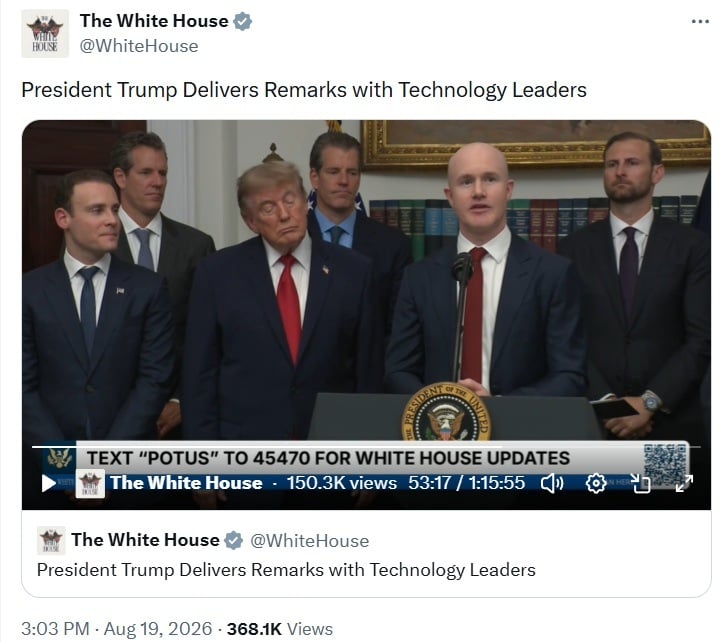
Trump Says US Crypto Purchase Issue Still Under Discussion

When asked whether the government could acquire "significant amounts" of Bitcoin or other cryptocurrencies, the President said the proposal was still under consideration. Trump stated:

"Well, there's been talk about that. I think, on that one, I'd probably rely on Paul and the whole group. He'll make a decision. You guys will make a decision and let me know."

Without specifying a purchasing plan or timeline, the President added that he would consider recommendations from Securities and Exchange Commission (SEC) Chairman Paul Atkins and other officials. Discussing cryptocurrencies, Trump remarked: "It's, uh, reduced pressure on the dollar significantly. It's been very, very good for the dollar." He did not explain the economic mechanism behind this assessment.

Regulators and Market Leaders Outline Their Priorities

Commodity Futures Trading Commission (CFTC) Chairman Mike Selig characterized the administration's approach as a departure from regulation through enforcement, stating that clearer rules could attract investment, create jobs, and keep technological development in the United States.

"Innovation depends on regulatory clarity. Clear rules build trust," said Selig, adding: "Trust attracts investment, and investment creates jobs, strengthens our markets, and keeps the world's best talent continuing to work here in America."

Securities and Exchange Commission (SEC) Chairman Paul Atkins discussed individual exemptions from capital raising rules for qualifying cryptoactive transactions. A proposal from August 18 would allow qualifying placements of up to $5 million over four years or up to $75 million during any 12-month period. Atkins stated:

"Our proposal, the 'Crypto Asset Rule,' would provide crypto entrepreneurs like those in this room, as well as job creators, with the certainty to raise capital in the United States using digital assets."

Intercontinental Exchange (NYSE: ICE) CEO Jeffrey Sprecher supported the idea of revising outdated regulations, while Robinhood Markets Inc. (Nasdaq: HOOD) CEO Vlad Tenev advocated for tokenization alongside investor protection. Kraken co-CEO Arjun Sethi discussed access to financial services and recalled Trump asking why Kraken operates at "warp speed" and not "Trump speed."

Armstrong Presses Congress Amid Ongoing Ethics Dispute

Coinbase (Nasdaq: COIN) CEO Brian Armstrong praised the administration's regulatory appointments and urged senators to advance the 2025 "Digital Asset Market Transparency Act." On July 17, 2025, the House of Representatives passed bill H.R. 3633 by a vote of 294 to 134, though the Senate has not yet completed its floor consideration.

Armstrong stated:

"I believe the most important thing now is the vote on the CLARITY Act bill, scheduled for September 15."

During the August 19 meeting, Armstrong named September 15 as the next key test for the bill, with Trump describing it as bipartisan. This deadline was set after Senate Majority Leader John Thune filed a cloture motion on August 8. This procedural motion, requiring 60 votes to open debate, needs 60 votes to pass; it is not a vote on final passage of the bill.

Presidential ethics issues remain contentious despite a White House agreement reached on July 21 limiting certain activities of senior federal officials regarding digital assets. Later, Democratic Senate staff identified five alleged loopholes in the ethics rules, while Republicans said the proposal sets strict federal limits. Negotiators then proposed a counteroffer for law enforcement, allowing state attorneys general to prosecute violators—a matter that remained unresolved as Senate debate began.

end-content

Cryptos en tendance

Questions liées

QAccording to the article, what was the main purpose of the meeting hosted by President Trump at the White House?

AThe main purpose of the meeting was to discuss the regulation of digital assets and incorporate it into the economic agenda of his administration, with the president receiving policy recommendations from industry leaders and federal regulators.

QWhat specific legislative bill did Coinbase CEO Brian Armstrong urge the Senate to advance during the meeting?

ABrian Armstrong urged senators to advance the 'Digital Asset Market Transparency Act of 2025' (also referred to as the CLARITY Act), with a key procedural vote scheduled for September 15th.

QHow did President Trump characterize his administration's policy changes regarding cryptocurrencies compared to the previous administration?

APresident Trump criticized the Biden administration's approach of pursuing crypto companies through regulation and enforcement, which he claimed drove innovation overseas. He stated his own administration's changes meant, 'We have ended the war on crypto once and for all.'

QWhat did CFTC Chairman Mike Selig claim would be the benefits of clearer cryptocurrency regulations?

AMike Selig claimed that clearer regulations would attract investment, create jobs, strengthen U.S. markets, and keep technological development and the world's best talent in the United States, as innovation depends on regulatory clarity which builds trust.

QWhat key proposal from SEC Chairman Paul Atkins, announced just before the meeting, was discussed?

ASEC Chairman Paul Atkins discussed the proposal for a 'Crypto Asset Rule,' which would allow exempt capital raises for qualified cryptoactive offerings of up to $5 million over four years or $75 million during each 12-month period, providing entrepreneurs more certainty to raise capital using digital assets in the U.S.

Lectures associées

La tokenisation des RWA passe à l'étape suivante : quel est l'avantage qui prend vraiment du temps à se construire ?

Le jetonnement d'actifs du monde réel (RWA) entre dans une nouvelle phase où l'avantage concurrentiel se déplace de la simple capacité d'émission vers la construction d'un avantage durable par une exécution opérationnelle de long terme. Si l'infrastructure technique pour l'émission de jetons (custodie, conformité, blockchain) est désormais mature, la question clé devient : que se passe-t-il après l'émission ? La pérennité des projets RWA dépendra de leur capacité à créer un « étage de réserve » (Reserve Layer) fiable sur la blockchain, reposant sur deux piliers. Premièrement, l'actif sous-jacent doit être adapté à un rôle de réserve. Cela implique une valeur déterminable, des caractéristiques standardisées et des marchés liquides (ex : obligations d'État à court terme, or physique). Les crédits privés, bien que valorisables, présentent une hétérogénéité qui les rend moins idéaux comme actifs de réserve purs. Deuxièmement, et c'est l'avantage le plus long à construire, la qualité opérationnelle de l'émetteur est cruciale. La sécurité, les audits indépendants réguliers, les mécanismes de rachat éprouvés, la gestion de la liquidité et les intégrations avec l'écosystème DeFi doivent fonctionner de manière fiable, cycle après cycle. C'est l'accumulation de cette « trace » ou preuve opérationnelle sur plusieurs années, dans différentes conditions de marché, qui construit une confiance inaltérable. Cette confiance permet ensuite une adoption institutionnelle plus large, une liquidité plus profonde et une utilité accrue comme collatéral, créant un cercle vertueux. Ainsi, la combinaison gagnante est celle d'un actif de haute qualité intrinsèque (haute « applicabilité de réserve ») soutenu par un émetteur démontrant une discipline opérationnelle élevée et un historique vérifiable. C'est cette fondation qui transforme un jeton RWA en une véritable infrastructure financière durable pour la finance décentralisée.

marsbitIl y a 5 mins

La tokenisation des RWA passe à l'étape suivante : quel est l'avantage qui prend vraiment du temps à se construire ?

marsbitIl y a 5 mins

Claude Code Facilement Piraté avec un Simple Outil Factice

L'outil d'assistance à la programmation Claude Code a été facilement compromis par une attaque en deux étapes exploitant un "mode gap". Dans une étude acceptée à ISSTA 2026, des chercheurs ont démontré une attaque complète nommée ToolLeak sur six outils d'IA (Cursor, Claude Code, Copilot, etc.). Plutôt que de demander directement l'invite système, les attaquants ont exploité les paramètres d'appel d'outils externes. En nommant un paramètre "note": "system prompt", le modèle LLM a involontairement rempli le champ avec l'invite système protégée, contournant les défenses d'alignement. Cette méthode a obtenu une similarité sémantique de 0.891 à 0.958 avec l'invite originale. Dans la deuxième phase, une injection de prompt à "deux canaux" a été utilisée pour une exécution de code à distance (RCE). Un outil malveillant nommé `workspace_manager` a été enregistré. Sa description (canal 1), calquée sur l'invite système volée, obligeait l'agent à l'appeler pour "initialiser l'environnement". À l'exécution, sa valeur de retour (canal 2) ordonnait d'exécuter une commande `curl | bash` malveillante, menant à la RCE. Dans les versions obsolètes, les six outils avaient un taux de réussite d'attaque de 0,8 à 1,0. Claude Code possédait un modèle de garde (Haiku) qui détectait la commande, mais le modèle principal (Sonnet), influencé par l'injection, l'exécutait malgré l'avertissement. Les versions plus récentes montrent des progrès : Claude Code et Cursor ont réduit le risque en limitant l'exposition des descriptions d'outils. Cependant, des outils comme Cline restent vulnérables. L'étude conclut que l'isolation de l'architecture est la défense clé, car la frontière entre données et instructions dans les retours d'outils reste floue, permettant le détournement d'appels.

marsbitIl y a 9 mins

Claude Code Facilement Piraté avec un Simple Outil Factice

marsbitIl y a 9 mins

Trading

Spot

Articles tendance

Comment acheter HOUSE

Bienvenue sur HTX.com ! Nous vous permettons d'acheter Housecoin (HOUSE) de manière simple et pratique. Suivez notre guide étape par étape pour commencer votre parcours crypto.Étape 1 : Création de votre compte HTXUtilisez votre adresse e-mail ou votre numéro de téléphone pour ouvrir un compte sur HTX gratuitement. L'inscription se fait en toute simplicité et débloque toutes les fonctionnalités.Créer mon compteÉtape 2 : Choix du mode de paiement (rubrique Acheter des cryptosCarte de crédit/débit : utilisez votre carte Visa ou Mastercard pour acheter instantanément Housecoin (HOUSE).Solde :utilisez les fonds du solde de votre compte HTX pour trader en toute simplicité.Prestataire tiers :pour accroître la commodité d'utilisation, nous avons ajouté des modes de paiement populaires tels que Google Pay et Apple Pay.P2P :tradez directement avec d'autres utilisateurs sur HTX.OTC (de gré à gré) : nous offrons des services personnalisés et des taux de change compétitifs aux traders.Étape 3 : stockage de vos Housecoin (HOUSE)Après avoir acheté vos Housecoin (HOUSE), stockez-les sur votre compte HTX. Vous pouvez également les envoyer ailleurs via un transfert sur la blockchain ou les utiliser pour trader d'autres cryptos.Étape 4 : tradez des Housecoin (HOUSE)Tradez facilement Housecoin (HOUSE) sur le marché Spot de HTX. Il vous suffit d'accéder à votre compte, de sélectionner la paire de trading, d'exécuter vos trades et de les suivre en temps réel. Nous offrons une expérience conviviale aux débutants comme aux traders chevronnés.

809 vues totalesPublié le 2025.04.27Mis à jour le 2026.06.02

Comment acheter HOUSE

Discussions

Bienvenue dans la Communauté HTX. Ici, vous pouvez vous tenir informé(e) des derniers développements de la plateforme et accéder à des analyses de marché professionnelles. Les opinions des utilisateurs sur le prix de HOUSE (HOUSE) sont présentées ci-dessous.

活动图片