A Critical Moment for Capital? The AI Narrative Shifts from Technology to Financing, Giants' Cash Flow Dries Up, Debt Markets Sound Alarm

marsbitPublié le 2026-08-17Dernière mise à jour le 2026-08-17

Résumé

The narrative of AI investment is shifting from a technology story to a capital expenditure story, and now to a financing story. This marks a "critical moment for capital," as noted by Bridgewater's Greg Jensen. Morgan Stanley forecasts that the total cost of AI infrastructure through 2028 will reach $3.2 trillion, with approximately $1.75 trillion expected to be raised from credit markets. However, free cash flow projections for major hyperscale cloud providers are declining sharply, with Oracle's 2027 forecast nearing -$40 billion. The bond market is already pricing in the rising risks. Apollo data shows AI-related bonds constitute 40% of long-duration supply. Credit spreads for hyperscalers have widened significantly this year—around 25 basis points for high-quality names—while the overall investment-grade market remained flat. Oracle's credit default swaps (CDS) have surged dramatically, indicating particular market concern. Renowned bond investor Jeff Gundlach sharply criticized financing plans using AI assets like GPUs as collateral, comparing them to "issuing 30-year ABS backed by bananas" due to the assets' rapid obsolescence. Although current balance sheets for hyperscalers appear strong, the future funding gap is widening. Morgan Stanley has nearly doubled its 2027 cloud capital expenditure growth forecast to 29%, amplifying the financing challenge. Purchasing commitments have exploded to $982 billion, with significant capital expenditures now existing off-balance...

The narrative around AI investment is shifting. It began as a technology story, evolved into a capital expenditure story, and is now becoming a financing story.

Recently, Bridgewater's Greg Jensen summarized the current situation in one sentence: "We are entering a critical moment for capital."

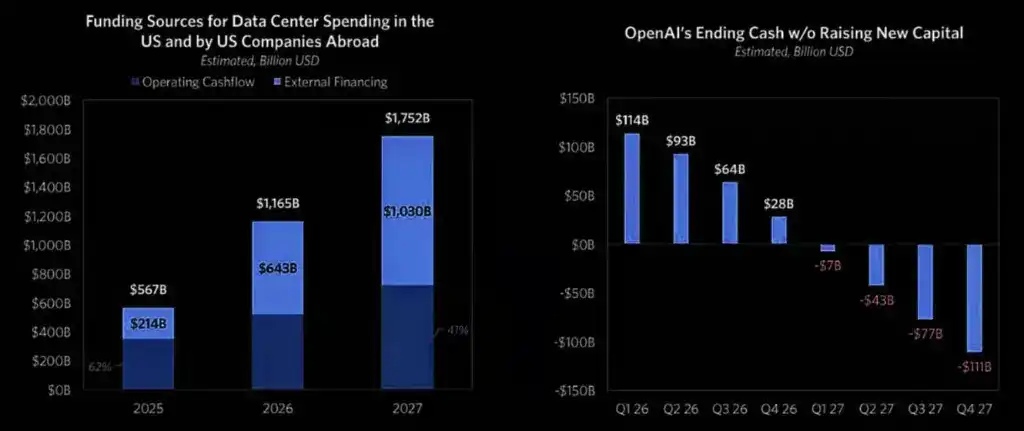
Morgan Stanley predicts that total spending on AI infrastructure construction will reach $3.2 trillion by 2028, with approximately $1.75 trillion needing to be raised through the credit markets. Funding sources have expanded from traditional investment-grade bonds to leveraged loans, private credit, and securitized products. Money is available, but it won't be cheap.

The bond market has already started to react. Apollo data shows that AI-related bond issuance now accounts for 40% of long-duration supply. Credit spreads for hyperscale cloud providers (Hyperscalers) have widened significantly this year, while the overall investment-grade market has remained virtually unchanged.

The "new bond king" Gundlach was even more direct, stating that issuing long-term bonds backed by GPUs is akin to "making a 30-year ABS out of bananas."
Cash Flow is Moving in the Wrong Direction

Capital expenditure forecasts are repeatedly revised upwards, while free cash flow forecasts continue to slide.

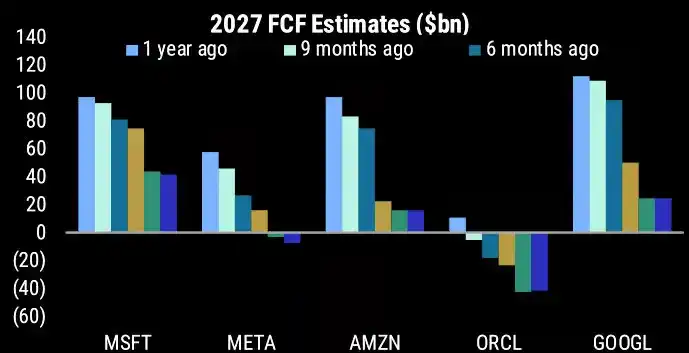
Morgan Stanley has significantly lowered its free cash flow forecasts for major hyperscale cloud providers for 2027. Oracle's situation is the most prominent, with its 2027 free cash flow forecast now approaching -$40 billion.
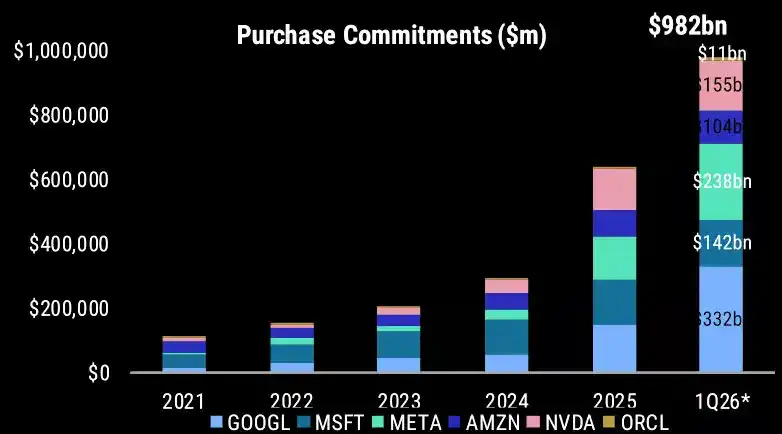
The scale of spending commitments is equally staggering. Purchase commitments from hyperscalers have exploded to $982 billion. Morgan Stanley points out that a significant portion of the real capital expenditure now exists off-balance-sheet. This means that looking only at the balance sheet severely underestimates the actual funding pressure.
Credit Markets Have Begun Pricing Risk

Investors are demanding higher compensation for risk.

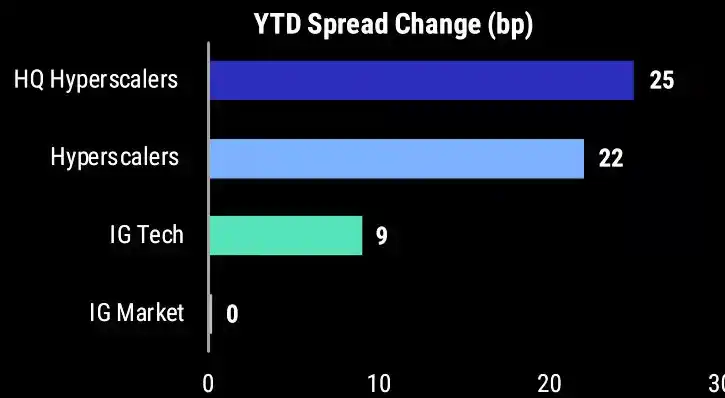
Morgan Stanley data shows that credit spreads for hyperscale cloud providers have "widened significantly this year, far exceeding the overall investment-grade market"—spreads for high-quality hyperscalers (HQ Hyperscalers) widened by about 25 basis points, regular hyperscalers widened by about 22 basis points, while the overall investment-grade market spread changed by 0.
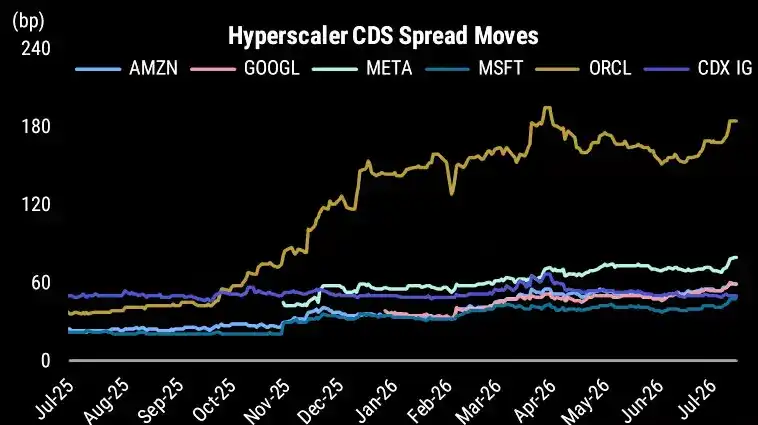
Oracle is the most watched case among them. While other hyperscalers' credit default swaps (CDS) generally trade in the 30 to 80 basis points range, Oracle's CDS surged from around 40 basis points in mid-2025 to a peak near 190 basis points in April 2026, and currently hovers around 180 basis points. Meta's CDS has risen more modestly to about 75 basis points. The credit market has clearly singled out the company it is most concerned about.
Balance Sheets are Strong, But the Problem Lies Ahead

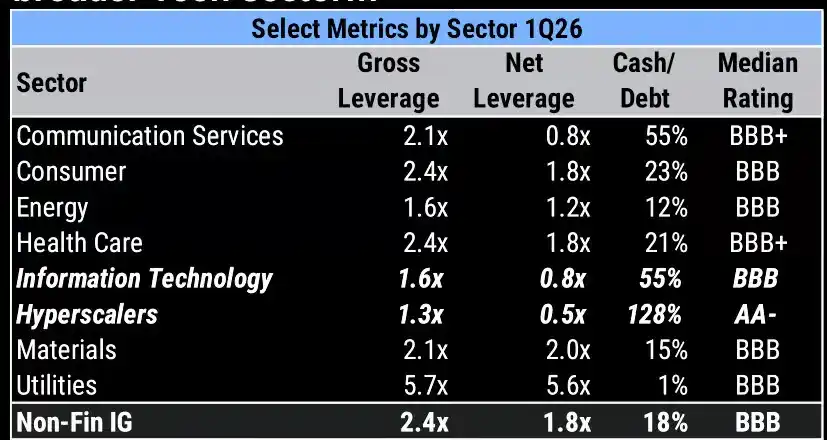
Morgan Stanley's Q1 2026 data shows that hyperscalers' total leverage ratio is only 1.3x, net leverage is 0.5x, the cash-to-debt ratio is as high as 128%, and the median credit rating is AA-. In contrast, the overall non-financial investment-grade universe has a total leverage ratio of 2.4x and a rating of BBB.

But the problem lies ahead. Morgan Stanley has sharply raised its forecast for cloud computing capital expenditure growth in 2027 from 14% to 29%, while hyperscalers are "reaffirming confidence in investment returns." As spending forecasts double, the financing gap widens accordingly.
"New Bond King" Gundlach: Using GPUs as Collateral is Like Using Bananas for ABS

Regarding financing schemes emerging in the market that use AI assets as collateral, renowned bond market investor Jeff Gundlach offered sharp criticism.

He warned about a planned $50 billion fund consortium, stating the plan is "likely not to stand the test of time." He asked on social media: "Using assets with unknown life spans as collateral for long-term debt? Why not do a 30-year ABS trade backed by bananas in a warehouse?" He added, these are "brand new engineered bananas with unknown life spans."

Gundlach's analogy gets to the core issue: GPUs depreciate extremely quickly, with technology refresh cycles far shorter than the tenure of the debt. When using such assets as collateral for long-term financing, the actual value of the collateral is highly uncertain.


Cryptos en tendance

Questions liées

QWhat is the main shift in the narrative of AI investment according to the article?

AThe narrative is shifting from being a technology story to a capital expenditure story, and is now becoming a financing story.

QWhat is the significant warning that Jeff Gundlach gives about using AI assets as collateral?

AJeff Gundlach warns that using assets like GPUs as collateral for long-term debt is akin to using bananas for a 30-year ABS, highlighting the risk due to their fast depreciation and short technological lifecycle compared to the debt tenure.

QWhat do the widening credit spreads for Hyperscalers indicate, according to the article?

AThe widening credit spreads for Hyperscalers indicate that investors are demanding higher risk compensation, signaling growing market concern about their future financial health amidst heavy AI infrastructure spending.

QWhich company's financial situation is highlighted as particularly concerning in the credit markets?

AOracle's financial situation is highlighted as particularly concerning. Its Credit Default Swap (CDS) spreads surged dramatically to around 190 basis points, far exceeding those of other Hyperscalers, and its 2027 free cash flow forecast is deep in negative territory.

QAccording to Morgan Stanley, what is the estimated total spending on AI infrastructure by 2028 and the financing need?

AMorgan Stanley predicts total AI infrastructure spending will reach $3.2 trillion by 2028, with approximately $1.75 trillion of that needing to be raised through credit markets.

Lectures associées

L'impact des rachats de bons du Trésor ne dure-t-il que 24 heures ? Bessent : Nous avons beaucoup d'outils, on verra

Le secrétaire au Trésor américain, Besant, a répondu aux fluctuations du marché obligataire après l'annonce du doublement des rachats de bons du Trésor à long terme. Il a qualifié la volatilité de 24 heures de « simple bruit » et souligné que le Trésor disposait d'une « vaste boîte à outils » pour intervenir davantage si nécessaire, laissant entendre que les opérations de rachat pourraient dépasser 40 milliards de dollars par opération. Il a estimé que les rendements actuels ne reflètent pas les fondamentaux de l'économie américaine, pointant particulièrement la faible liquidité des obligations à 30 ans. Besant a également annoncé un nouveau plan d'assainissement budgétaire, qui devrait être dévoilé fin de semaine ou début de semaine prochaine, visant à réduire les coûts d'emprunt à long terme. Il a réaffirmé la politique de dollar fort, notant que la devise revenait à ses niveaux d'il y a deux mois. Concernant l'Iran, Besant a déclaré qu'une conférence de presse se tiendrait lundi pour détailler les actions américaines, privilégiant une pression économique « maximale » pour éviter un conflit militaire majeur. Il s'est dit surpris par la hausse des prix du pétrole jeudi, anticipant que les mesures américaines les feraient baisser. Enfin, il a évoqué l'impact des investissements en IA, rendant les entreprises moins sensibles aux coûts d'emprunt, et a exprimé son optimisme quant à une future croissance de la productivité.

marsbitIl y a 29 mins

L'impact des rachats de bons du Trésor ne dure-t-il que 24 heures ? Bessent : Nous avons beaucoup d'outils, on verra

marsbitIl y a 29 mins

Introduction d'Hyperliquid, appel à l'adoption d'un projet de loi : synthèse du discours clé de Trump

Le président américain Donald Trump a récemment organisé une table ronde à la Maison Blanche, rassemblant des dirigeants de la finance, de la cryptomonnaie, de la technologie et des régulateurs. L'objectif était de renforcer la compétitivité américaine dans la finance et l'IA, en mettant particulièrement l'accent sur l'industrie des cryptomonnaies. Lors de son intervention, Trump a évoqué deux projets de loi clés : le « GENIUS Act », déjà signé, qui favorise l'adoption des stablecoins adossés au dollar, et le « Clarity Act », en cours d'examen au Congrès, qui vise à clarifier la distinction juridique entre les « titres numériques » et les « matières premières numériques ». Il a appelé à une adoption rapide de ce dernier. Les régulateurs ont également présenté des avancées majeures. La CFTC a confirmé le lancement du premier contrat perpétuel bitcoin conforme aux États-Unis et travaille à l'introduction du protocole décentralisé Hyperliquid dans un cadre réglementaire. La SEC a proposé de nouvelles règles pour permettre aux startups de lever des fonds via des actifs numériques de manière légale. Interrogé sur les réserves de bitcoin du gouvernement, Trump s'est dit ouvert à leur expansion. La réunion a également abordé brièvement les politiques énergétiques pour soutenir le développement de l'IA. Ces annonces sont perçues comme très positives pour le secteur des cryptomonnaies.

marsbitIl y a 1 h

Introduction d'Hyperliquid, appel à l'adoption d'un projet de loi : synthèse du discours clé de Trump

marsbitIl y a 1 h

Le président de la CFTC : l'agence continuera à travailler sur la régulation des cryptomonnaies si la loi CLARITY n'est pas adoptée

Le président de la CFTC, Michael Selig, a annoncé que l'agence poursuivra ses travaux sur la régulation des cryptomonnaies, même si le projet de loi CLARITY n'est pas adopté par le Congrès. Lors d'un discours, il a déclaré que la CFTC donnerait du temps au Congrès pour voter, mais si un compromis bipartisan n'est pas trouvé, il ordonnerait à ses équipes de commencer rapidement à élaborer de nouvelles règles. Cela vise, selon lui, à aider le président Trump à tenir ses promesses dans ce domaine. Le processus législatif du CLARITY est actuellement en pause jusqu'en septembre, nécessitant 60 voix au Sénat pour adoption. Selig a déjà demandé à son personnel d'autoriser les entités à proposer des transactions sur crypto-actifs avec effet de levier et d'étudier des protections pour les développeurs. Ces déclarations font suite à une réunion à la Maison Blanche avec Trump, qui a appelé à l'adoption d'une version "juste" du CLARITY pour devancer la Chine. Cependant, certains démocrates cherchent à renforcer les clauses éthiques du projet de loi, notamment concernant les investissements cryptos de la famille Trump. Parallèlement, la SEC a également publié des propositions de règles pour les actifs numériques. Selig agit actuellement en tant que seul commissaire confirmé de la CFTC, lui donnant un rôle central dans l'établissement de l'agenda de l'agence. Le comité consultatif a également discuté de l'IA et des marchés de prédiction, sur lesquels la CFTC affirme avoir une juridiction exclusive.

cryptonews.ruIl y a 3 h

Le président de la CFTC : l'agence continuera à travailler sur la régulation des cryptomonnaies si la loi CLARITY n'est pas adoptée

cryptonews.ruIl y a 3 h

Trading

Spot

Articles tendance

Comment acheter FLOW

Bienvenue sur HTX.com ! Nous vous permettons d'acheter Flow (FLOW) de manière simple et pratique. Suivez notre guide étape par étape pour commencer votre parcours crypto.Étape 1 : Création de votre compte HTXUtilisez votre adresse e-mail ou votre numéro de téléphone pour ouvrir un compte sur HTX gratuitement. L'inscription se fait en toute simplicité et débloque toutes les fonctionnalités.Créer mon compteÉtape 2 : Choix du mode de paiement (rubrique Acheter des cryptosCarte de crédit/débit : utilisez votre carte Visa ou Mastercard pour acheter instantanément Flow (FLOW).Solde :utilisez les fonds du solde de votre compte HTX pour trader en toute simplicité.Prestataire tiers :pour accroître la commodité d'utilisation, nous avons ajouté des modes de paiement populaires tels que Google Pay et Apple Pay.P2P :tradez directement avec d'autres utilisateurs sur HTX.OTC (de gré à gré) : nous offrons des services personnalisés et des taux de change compétitifs aux traders.Étape 3 : stockage de vos Flow (FLOW)Après avoir acheté vos Flow (FLOW), stockez-les sur votre compte HTX. Vous pouvez également les envoyer ailleurs via un transfert sur la blockchain ou les utiliser pour trader d'autres cryptos.Étape 4 : tradez des Flow (FLOW)Tradez facilement Flow (FLOW) sur le marché Spot de HTX. Il vous suffit d'accéder à votre compte, de sélectionner la paire de trading, d'exécuter vos trades et de les suivre en temps réel. Nous offrons une expérience conviviale aux débutants comme aux traders chevronnés.

427 vues totalesPublié le 2024.12.10Mis à jour le 2026.06.02

Comment acheter FLOW

Discussions

Bienvenue dans la Communauté HTX. Ici, vous pouvez vous tenir informé(e) des derniers développements de la plateforme et accéder à des analyses de marché professionnelles. Les opinions des utilisateurs sur le prix de FLOW (FLOW) sont présentées ci-dessous.

活动图片